



9-PAHSA-13C4

Based on 1 Customer Validation
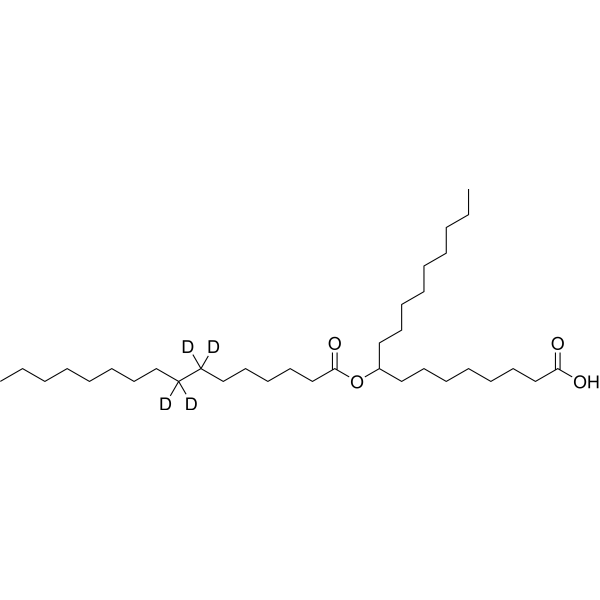
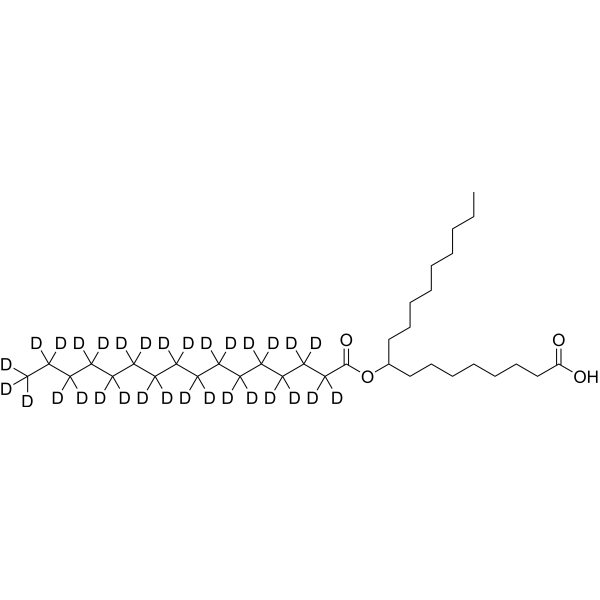
9-PAHSA-13C4 is 13C-labeled 9-PAHSA. 9-PAHSAis an orally active endogenous GPR120 agonist (EC50=18 μM). 9-PAHSAsignificantly inhibits LPS-induced inflammatory responses by blocking the NF-κB pathway. 9-PAHSAinduces adipocyte browning, enhances glucose uptake and reduces lipid accumulation, while improving mitochondrial function and the survival rate of steatotic hepatocytes. In terms of neuroprotection, 9-PAHSAregulates the expression of REST and BDNF in the prefrontal cortex of diabetic mice, and effectively prevents spatial working memory deficits and abnormal social behaviors. 9-PAHSAdoes not directly regulate insulin secretion or improve systemic insulin sensitivity, and possesses specific anti-inflammatory, metabolic regulatory and neuroprotective properties. 9-PAHSAcan be used in the research of diabetes-related cognitive impairment, obesity and non-alcoholic fatty liver disease.
The product specifications provided below refer solely to the active content of 9-PAHSA-13C4.
For research use only. We do not sell to patients.
- Purity : 99.9%
- CAS No.: 2748638-71-1
- Formula: C3013C4H66O4
- Molecular Weight:542.86
-
Storage:
Solution, -20°C, 2 years


To place orders, for customer services and technical support, please contact: MedChemExpress USA
Tel: 609-228-6898 E-mail: [email protected] [email protected]


-
 Biological Activity
-
Chemical Information
- Protocols
- Purity & Documentation
- References
-
 Help & FAQs




Biological Activity
Description
The product specifications provided below refer solely to the active content of 9-PAHSA-13C4.
In Vitro
Stable heavy isotopes of hydrogen, carbon, and other elements have been incorporated into drug molecules, largely as tracers for quantitation during the drug development process. Deuteration has gained attention because of its potential to affect the pharmacokinetic and metabolic profiles of drugs.
MedChemExpress (MCE) has not independently confirmed the accuracy of these methods. They are for reference only.
- 3T3-L1 preadipocyte-to-adipocyte differentiation
- RNA extraction experimental
- Mitochondrial membrane-potential fluorescent assay
- Large-size fat particle sorting
- Research Protocol for Endocrine Diseases
- Mitochondrial membrane-potential and mitochondrial mass staining
- Human Islet Cell Culture
- Research Protocol for Inflammation-related Diseases
- Research Protocol for Metabolic Diseases
- Lipid Droplets: Oil Red O/Sudan Dye Lipid Staining
- Alzheimer’s Disease Modeling
Application
1. This compound can be used as a tracer
2. This compound can be used as an internal standard for quantitative analysis by NMR, GC-MS, or LC-MS.


Chemical Information
-
CAS No. 2748638-71-1
-
Unlabeled CAS 1481636-31-0
-
Appearance Liquid
-
Molecular Weight 542.86
-
Formula C3013C4H66O4
-
Color Colorless to light yellow
-
SMILES
CCCCCCCCCCCC[13CH2][13CH2][13CH2][13C](OC(CCCCCCCCC)CCCCCCCC(O)=O)=O
-
Shipping
Room temperature in continental US; may vary elsewhere.
-
Storage
Solution, -20°C, 2 years


Purity & Documentation
-
Data Sheet (273 KB)
-
SDS (546 KB)
- English - EN (546 KB)
- Français - FR (546 KB)
- Deutsch - DE (546 KB)
- Norwegian - NO (546 KB)
- Español - ES (546 KB)
- Swedish - SV (546 KB)
- Italian - IT (546 KB)
- Korean - KR (546 KB)
- Portuguese - PT (546 KB)
-
Handling Instructions (2659 KB)
References
[1]. Russak EM, et al. Impact of Deuterium Substitution on the Pharmacokinetics of Pharmaceuticals. Ann Pharmacother. 2019 Feb;53(2):211-216. [Content Brief]
[2]. Pflimlin E, et al. Acute and Repeated Treatment with 5-PAHSA or 9-PAHSA Isomers Does Not Improve Glucose Control in Mice. Cell Metab. 2018;28(2):217-227.e13. [Content Brief]
[3]. Wen XH, et al. Effect of 9 - PAHSA on cognitive dysfunction in diabetic mice and its possible mechanism. Biochem Biophys Res Commun. 2020;524(3):525-532. [Content Brief]
[5]. Schultz Moreira AR, et al. 9-PAHSA Prevents Mitochondrial Dysfunction and Increases the Viability of Steatotic Hepatocytes. Int J Mol Sci. 2020;21(21):8279. Published 2020 Nov 5. [Content Brief]

Calculators
Concentration (start) × Volume (start) = Concentration (final) × Volume (final)


9-PAHSA-13C4 Related Classifications
HY-W770410 Related Classifications
 Powered by Bioz