



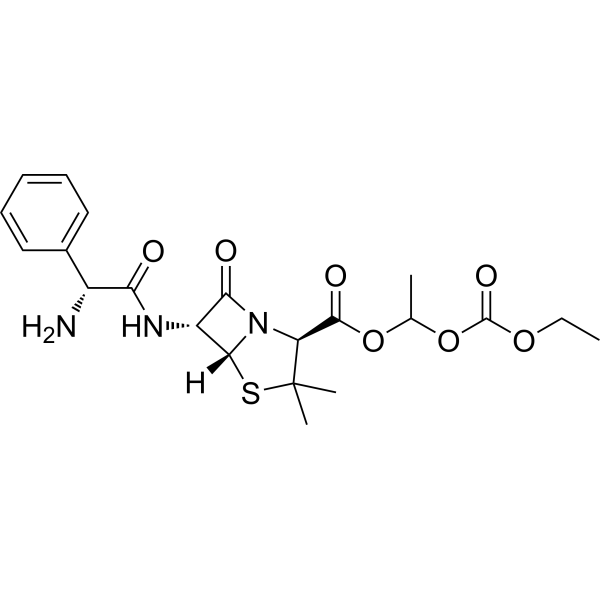
Bacampicillin
Bacampicillin is an orally active semi-synthetic aminopenicillin derivative, prodrug and bactericide that is readily inactivated by β-lactamases. Bacampicillin is hydrolyzed by carboxylester hydrolases and non-specific esterases in the gastrointestinal wall and plasma to form Ampicillin (HY-B0522), and produces higher levels of Ampicillin in rodents in vivo. Bacampicillin exhibits bactericidal activity against Gram-positive and Gram-negative bacteria. Bacampicillin can be used in studies related to bacterial infections.
For research use only. We do not sell to patients.
- CAS No.: 50972-17-3
- Formula: C21H27N3O7S
- Molecular Weight:465.52
-
Storage:
Please store the product under the recommended conditions in the Certificate of Analysis.

To place orders, for customer services and technical support, please contact: MedChemExpress USA
Tel: 609-228-6898 E-mail: [email protected] [email protected]


-
 Biological Activity
-
Chemical Information
- Protocols
- Purity & Documentation
- References
-
 Help & FAQs


All Antibiotic Isoforms
More

Biological Activity
Description
In Vitro
Bacampicillin (10-20 μg/mL; 30 min) is stable in synthetic gastric juice (pH 1.2) and phosphate buffer (pH 7.4), but undergoes extensive hydrolysis to Ampicillin (HY-B0522) in the presence of 10% human or rat serum after 30 min incubation at 37°C, with rat serum driving more complete hydrolysis than human serum[1].
Bacampicillin (100 μg/mL; up to 30 min) undergoes rapid first-order hydrolysis to Ampicillin in heparinized human blood, human plasma, and canine plasma at 37°C, with the fastest hydrolysis observed in human blood[1].
MedChemExpress (MCE) has not independently confirmed the accuracy of these methods. They are for reference only. Further protocols information, click here.
In Vivo
Bacampicillin (135 mg/kg; p.o.; single dose) produces significantly higher and longer-lasting interstitial fluid Ampicillin levels in female SPF-grade Sprague-Dawley rats with subcutaneous tissue cages compared to equimolar doses of Ampicillin[1].
Bacampicillin (135 mg/kg; p.o.; single dose) produces ampicillin concentrations in the kidney and liver tissues of female SPF-grade Sprague-Dawley rats that are 3 to 4 times those of equimolar ampicillin[1].
Bacampicillin (20 mg/kg; p.o.; single dose) exhibits 3-fold higher bioavailability than equimolar ampicillin in female beagle dogs[1].
Bacampicillin (p.o.; single dose) exhibits potent activity against a variety of bacterial infections in female NMRI mice, with better efficacy than Ampicillin[1].
MedChemExpress (MCE) has not independently confirmed the accuracy of these methods. They are for reference only.


Chemical Information
-
CAS No. 50972-17-3
-
Molecular Weight 465.52
-
Formula C21H27N3O7S
-
SMILES
O=C([C@@H](C(C)(C)S[C@]1([H])[C@@H]2NC([C@H](N)C3=CC=CC=C3)=O)N1C2=O)OC(OC(OCC)=O)C
-
Shipping
Room temperature in continental US; may vary elsewhere.
-
Storage
Please store the product under the recommended conditions in the Certificate of Analysis.

Protocols
-
Gram Staining of Tissue Sections
Gram staining of tissue sections is a histochemical technique used to differentiate Gram-positive and Gram-negative bacteria within histological specimens based on differences in bacterial cell wall structure and dye retention, adapted from classical bacteriological Gram staining into tissue-compatible “histological Gram stain” variants. In tissue applications, modifications of the Brown-Hopps and Brown-Brenn methods are commonly used to improve differentiation of microorganisms embedded within host connective tissue and to reduce overstaining or loss of Gram-negative signal, which are known limitations of earlier approaches. The principle relies on crystal violet-iodine complex retention in Gram-positive organisms and subsequent decolorization and counterstaining steps that allow contrast visualization of Gram-negative organisms against tissue background.
-
Bacterial live/dead nucleic-acid viability staining
The LIVE/DEAD bacterial viability staining method is based on differential permeability of nucleic-acid-binding fluorescent dyes, most commonly SYTO 9 and propidium iodide (PI), which enables discrimination of bacterial populations with intact versus compromised cytoplasmic membranes. SYTO 9 penetrates both intact and damaged bacterial membranes and binds nucleic acids to produce green fluorescence, whereas propidium iodide penetrates only cells with compromised membranes and fluoresces red while also reducing SYTO 9 signal through competitive binding and fluorescence interactions. The resulting fluorescence pattern is interpreted as a proxy for membrane integrity, which is widely used as an indicator of bacterial viability in microscopy, flow cytometry, and spectroscopic platforms. However, mechanistic studies show that SYTO 9 and PI interactions involve displacement and fluorescence resonance energy transfer effects, which can influence signal interpretation depending on dye ratios a


Purity & Documentation
References

Calculators
Concentration (start) × Volume (start) = Concentration (final) × Volume (final)


Bacampicillin Related Classifications
HY-B1149 Related Classifications
 Powered by Bioz
Keywords
- Bacampicillin
- 50972-17-3
- Drug Derivative
- Bacterial
- Antibiotic
- gram-negative bacteria
- upper respiratory tract infections
- urinary tract infections
- uncomplicated gonorrhea
- carboxylester hydrolase
- skin and soft tissue infections
- bacterial infections
- gram-positive bacteria
- lower respiratory tract infections
- beta-lactamase
- Inhibitor
- inhibitor
- inhibit