



GR148672X

Based on 1 Customer Validation
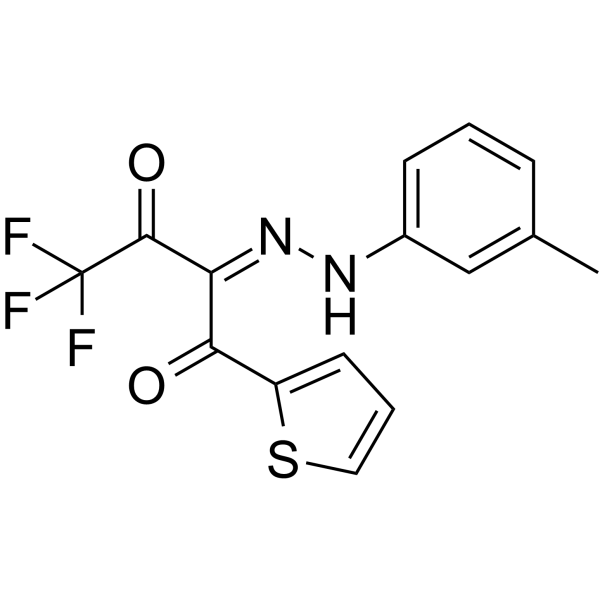
GR148672X is an inhibitor of carboxylesterase 1 (CES1) and hepatic microsomal triglyceride hydrolase (TGH). GR148672X blocks the catalytic activity of CES1, impairs the functions of triglyceride and cholesteryl ester lipase, reduces triglyceride mobilization and secretion, and decreases apolipoprotein B-100 secretion in primary rat hepatocytes. Under low-glucose conditions, GR148672X inhibits the survival of colorectal cancer cells by reducing free fatty acid availability, inducing toxic triglyceride accumulation, ROS production, mitochondrial damage, ferroptosis and apoptosis. GR148672X can be used in studies related to colorectal cancer and atherosclerosis.
연구목적의 판매만을 진행합니다. 환자를 대상으로 한 판매는 하지 않습니다.
- Purity : 99.58%
- CAS No.: 263890-70-6
- 화학식: C15H11F3N2O2S
- 분자량:340.32
-
보관:Powder -20°C, 3 years , 4°C, 2 years
* The compound is unstable in solutions, freshly prepared is recommended.

To place orders, for customer services and technical support, please contact: MedChemExpress USA
Tel: 609-228-6898 E-mail: [email protected] [email protected]


-
 Biological Activity
-
Chemical Information
-
용액&용해도
- Protocol
- 순도&문서
- References
-
 Help & FAQs




Biological Activity
제품 설명
IC50 & Target
IC50: 4 nM (TGH)[1]
In Vitro
GR148672X (10 μM; 4 days) potently reduces the viability of CT-26 colorectal cancer cells under glucose-restricted conditions, with no significant toxicity observed under normal glucose conditions[1].
GR148672X (10 μM; 4 days) potently reduces the viability of human colorectal cancer cell lines HCT-116, RKO, HT-29, CaCo-2, LS1034, and LS174T under glucose-restricted conditions, while showing no significant toxicity under normal glucose conditions[1].
GR148672X (10 µM; 5 h) reduces the secretion of stored triacylglycerol by 46% in primary rat hepatocytes[2].
GR148672X (10 µM; 4 h) reduces apoB-100 secretion by 42% and apoB-48 secretion by 20% in primary rat hepatocytes, without altering apoB synthesis, total protein secretion, or cell viability[2].
MedChemExpress (MCE) has not independently confirmed the accuracy of these methods. They are for reference only.
-
Cell Line:murine CT-26 colorectal carcinoma (CRC) cells
-
Concentration:10 μM
-
Incubation Time:4 days
-
Result:Showed no overt toxicity under normal glucose conditions.
Significantly increased glucose limitation-induced cell death, reducing cell survival to less than 10% of vehicle-treated control cells under glucose limitation.
-
Cell Line:HCT-116, RKO, HT-29, CaCo-2, LS1034, LS174T human CRC cell lines
-
Concentration:10 μM
-
Incubation Time:4 days
-
Result:Significantly increased glucose limitation-induced cell death in all six human CRC cell lines tested, reducing cell survival to 5% or less of vehicle-treated control cells under glucose limitation.
Showed no overt toxicity under normal culture conditions.
In Vivo
MedChemExpress (MCE) has not independently confirmed the accuracy of these methods. They are for reference only.
-
Animal Model:CT-26 and CHT-116 CRC allograft mice[1]
-
Dosage:50 mg/kg
-
Administration:i.p.; once daily for 10 (CT-26) or 27 (HCT-116) days
-
Result:Showed a significant effect in inhibiting tumor growth, and there was no obvious toxic reactions.


Chemical Information
-
CAS No. 263890-70-6
-
Appearance Solid
-
분자량 340.32
-
화학식 C15H11F3N2O2S
-
Color Light yellow to yellow
-
SMILES
O=C(C1=CC=CS1)/C(C(C(F)(F)F)=O)=N\NC2=CC=CC(C)=C2
-
선적
Room temperature in continental US; may vary elsewhere.
-
보관
Powder -20°C 3 years 4°C 2 years * The compound is unstable in solutions, freshly prepared is recommended.


용액&용해도
In Vitro:
DMSO : 41.67 mg/mL (122.44 mM; Need ultrasonic; Hygroscopic DMSO has a significant impact on the solubility of product, please use newly opened DMSO)
Please refer to the solubility information to select the appropriate solvent. The compound is unstable in solutions, freshly prepared is recommended.
Please refer to the solubility information to select the appropriate solvent. The compound is unstable in solutions, freshly prepared is recommended.
Concentration (start) × Volume (start) = Concentration (final) × Volume (final)
In Vivo:
Select the appropriate dissolution method based on your experimental animal and administration route.
- For the following dissolution methods, please ensure to first prepare a clear stock solution using an In Vitro approach and then sequentially add co-solvents:
- To ensure reliable experimental results, the clarified stock solution can be appropriately stored based on storage conditions. As for the working solution for In Vivo experiments, it is recommended to prepare freshly and use it on the same day.
- The percentages shown for the solvents indicate their volumetric ratio in the final prepared solution. If precipitation or phase separation occurs during preparation, heat and/or sonication can be used to aid dissolution.
Add each solvent one by one: 10% DMSO 40% PEG300 5% Tween-80 45% Saline
Solubility: ≥ 2.08 mg/mL (6.11 mM); Clear solution
This protocol yields a clear solution of ≥ 2.08 mg/mL (saturation unknown).
Taking 1 mL working solution as an example, add 100 μL DMSO stock solution (20.8 mg/mL) to 400 μL PEG300, and mix evenly; then add 50 μL Tween-80 and mix evenly; then add 450 μL Saline to adjust the volume to 1 mL.
Preparation of Saline: Dissolve 0.9 g sodium chloride in ddH₂O and dilute to 100 mL to obtain a clear Saline solution.
Add each solvent one by one: 10% DMSO 90% (20% SBE-β-CD in Saline)
Solubility: 2.08 mg/mL (6.11 mM); Suspended solution; Need ultrasonic
This protocol yields a suspended solution of 2.08 mg/mL. Suspended solution can be used for oral and intraperitoneal injection.
Taking 1 mL working solution as an example, add 100 μL DMSO stock solution (20.8 mg/mL) to 900 μL 20% SBE-β-CD in Saline, and mix evenly.
Preparation of 20% SBE-β-CD in Saline (4°C, storage for one week): 2 g SBE-β-CD powder is dissolved in 10 mL Saline, completely dissolve until clear.
In Vivo Dissolution Calculator
Please enter the basic information of animal experiments:
-
-
-
-
Recommended: Prepare an additional quantity of animals to account for potential losses during experiments.
Please enter your animal formula composition:
-
%DMSO +
Recommended: Keep the proportion of DMSO in working solution below 2% if your animal is weak.
-
%+
-
+%Tween-80 + +
-
%Saline +
The co-solvents required include: DMSO, . All of co-solvents are available by MedChemExpress (MCE). , Tween 80. All of co-solvents are available by MedChemExpress (MCE).
Working solution concentration: 0.22 mg/mL
Method for preparing stock solution: mg drug dissolved in μL DMSO. Stock solution concentration: mg/mL. * The compound is unstable in solutions, freshly prepared is recommended.
1. Take μL DMSO stock solution;
2. Add μL .
μL , mix evenly;
3. Then add μL Tween 80, mix evenly;
4. Then add μL
Please ensure that the stock solution in the first step is dissolved to a clear state, and add co-solvents in sequence. You can use ultrasonic heating (ultrasonic cleaner, recommended frequency 20-40 kHz), vortexing, etc. to assist dissolution.


순도&문서
-
Data Sheet (281 KB)
-
SDS (396 KB)
- English - EN (396 KB)
- Français - FR (396 KB)
- Deutsch - DE (396 KB)
- Norwegian - NO (396 KB)
- Español - ES (396 KB)
- Swedish - SV (396 KB)
- Italian - IT (396 KB)
- Korean - KR (396 KB)
- Portuguese - PT (396 KB)
-
Handling Instructions (2659 KB)
References
[1]. Capece D, et al. Enhanced triacylglycerol catabolism by carboxylesterase 1 promotes aggressive colorectal carcinoma. J Clin Invest. 2021;131(11):e137845. [Content Brief]
[2]. Gilham D, et al. Inhibitors of hepatic microsomal triacylglycerol hydrolase decrease very low density lipoprotein secretion. FASEB J. 2003;17(12):1685-1687. [Content Brief]


Complete Stock Solution Preparation Table
Please refer to the solubility information to select the appropriate solvent. The compound is unstable in solutions, freshly prepared is recommended.
| Optional Solvent | Concentration Solvent Mass | 1 mg | 5 mg | 10 mg | 25 mg |
|---|---|---|---|---|---|
| DMSO | 1 mM | 2.9384 mL | 14.6921 mL | 29.3841 mL | 73.4603 mL |
| 5 mM | 0.5877 mL | 2.9384 mL | 5.8768 mL | 14.6921 mL | |
| 10 mM | 0.2938 mL | 1.4692 mL | 2.9384 mL | 7.3460 mL | |
| 15 mM | 0.1959 mL | 0.9795 mL | 1.9589 mL | 4.8974 mL | |
| 20 mM | 0.1469 mL | 0.7346 mL | 1.4692 mL | 3.6730 mL | |
| 25 mM | 0.1175 mL | 0.5877 mL | 1.1754 mL | 2.9384 mL | |
| 30 mM | 0.0979 mL | 0.4897 mL | 0.9795 mL | 2.4487 mL | |
| 40 mM | 0.0735 mL | 0.3673 mL | 0.7346 mL | 1.8365 mL | |
| 50 mM | 0.0588 mL | 0.2938 mL | 0.5877 mL | 1.4692 mL | |
| 60 mM | 0.0490 mL | 0.2449 mL | 0.4897 mL | 1.2243 mL | |
| 80 mM | 0.0367 mL | 0.1837 mL | 0.3673 mL | 0.9183 mL | |
| 100 mM | 0.0294 mL | 0.1469 mL | 0.2938 mL | 0.7346 mL |


GR148672X Related Classifications
HY-110390 Related Classifications
 Powered by Bioz
Keywords
- GR148672X
- 263890-70-6
- Carboxylesterase (CES)
- Free Fatty Acid Receptor
- Reactive Oxygen Species (ROS)
- Mitochondrial Metabolism
- Ferroptosis
- Apoptosis
- carboxylesterase 1
- pancreatic lipase
- colorectal cancer cell
- CT-26 CRC cell
- hepatic microsomal triacylglycerol hydrolase
- lipoprotein lipase
- hormone-sensitive lipase
- primary rat hepatocytes
- acetylcholine esterase
- mouse colorectal carcinoma models
- Inhibitor
- inhibitor
- inhibit