



Insecticide
Insecticide
Insecticides refer to any toxic substances used to kill insects, which exert toxic effects on pests through different mechanisms, thereby achieving the purpose of controlling pest populations and protecting crops and human health. Insecticides have both chemical and biological origins and can be classified into organochlorine insecticides, organophosphorus insecticides, carbamate insecticides, and mineral insecticides based on their chemical properties. Insecticides interact with different target and non-target sites, including receptors, enzymes, and many other known and unknown molecules. Most insecticides are neurotoxicants that target the nervous system, but they can also affect other organs and body systems. Insecticides are metabolized through different metabolic pathways and often serve as biomarkers of exposure in the form of their parent compounds or metabolites. The toxicity of insecticides can be acute, subacute, or chronic, depending on the duration of exposure and the dose involved. Therefore, selecting sensitive, accurate, and validated biomarkers of exposure, effects, and susceptibility appears to be a challenging task.
Insecticides are widely used in agriculture, horticulture, forestry, gardening, homes, offices, and other fields[1][2].
All Product Categories
-
Insecticide Related Products (523)
Related Products (523)

-
D-Tetramethrin
 0 ImagesCat. No.: HY-W685358CAS No.: 1166-46-7D-Tetramethrin is a type I synthetic pyrethroid insecticide and hepatotoxicity inducer. D-Tetramethrin induces oxidative stress in the liver of zebrafish. D-Tetramethrin induces Apoptosis and inflammatory responses. D-Tetramethrin causes severe liver damage in zebrafish. D-Tetramethrin can be used in studies related to hepatotoxicity.
-
Bassianolide
 0 ImagesCat. No.: HY-P2087CAS No.: 64763-82-2Bassianolide is a cyclooligomer depsipeptide secondary metabolite. Bassianolide is an insecticidal virulence factor of Beauveria bassiana. Bassianolide inhibits acetylcholine-induced smooth muscle contraction, and shows moderate antiplasmodial and anti-mycobacterial activities.
-
Tralomethrin
 0 ImagesCat. No.: HY-126772CAS No.: 66841-25-6Tralomethrin is a pyrethroid insecticide used to control a wide range of pests in agriculture and public health.
-
Spinosyn K
 0 ImagesCat. No.: HY-N18035CAS No.: 159195-00-3Spinosyn K is an insecticide found in the actinomycete Saccharopolyspora spinosa. Spinosyn K shows strong insecticidal activity.
-
Allatostatin IV
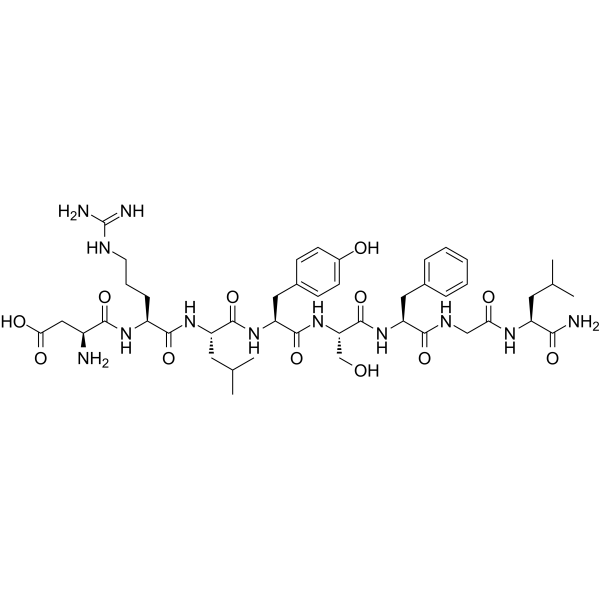 0 ImagesCat. No.: HY-P1760CAS No.: 123338-13-6Allatostatin IV is an octapeptide. Allatostatins are pleiotropic neuropeptides for inhibition of juvenile hormone synthesis in insects.
-
Tetramethylfluthrin
 0 ImagesCat. No.: HY-141456CAS No.: 84937-88-2Tetramethylfluthrin is an insecticide with potent activity against Aedes albopictus. Tetramethylfluthrin contributes to rapid Aedes albopictus population reduction when deployed via unmanned aerial vehicle cold mist spray. Tetramethylfluthrin exerts a knock-down effect and exhibits high toxicity to target insects. Tetramethylfluthrin can be used for the research of dengue fever and dengue hemorrhagic fever.
-
Furathiocarb
 0 ImagesFurathiocarb is a carbamate pro-insecticide and a contact allergen. Furathiocarb is commonly used in studies related to contact allergy. Furathiocarb induces significant proliferation of MHC II-positive B cells in auricular lymph node cells and induces the production of Th1 cytokines (such as IL-2, TNF-γ and IFN-γ). However, Furathiocarb does not induce respiratory allergy in mice. After absorption through the abdominal skin of isolated rats, Furathiocarb is completely metabolized into carbofuran, and its permeation amount increases with time and dosage. The skin permeation rates of both emulsifiable concentrate (EC) and wettable powder (WP) formulations of Furathiocarb are higher than that of Furathiocarb itself, with no significant difference between the two formulations.
-
Etofenprox (Standard)
 0 ImagesEtofenprox (Standard) is the analytical standard of Etofenprox. This product is intended for research and analytical applications. Etofenprox is an orally active non-ester pyrethroid insecticide. Etofenprox induces toxicity against many pest insects, including Diptera rather than mammalian and fish. Etofenprox has a liver tumor-promoting activity in rats accompanied with microsomal ROS production increase. Etofenprox can be used in agricultural pest control and malaria research.

-
TBZ-15
 0 ImagesCat. No.: HY-184009CAS No.: 892237-40-0TBZ-15 is an orally active competitive Chitinase inhibitor and Insecticide, with an IC50 of 1.00 μM against Ostrinia furnacalis Chitinase-h and an IC50 of 1.01 μM against Ostrinia furnacalis Chitinase-I. TBZ-15 exhibits insecticidal activity against the Asian corn borer (O. furnacalis) and the diamondback moth (P. xylostella).
-
Destruxin D2
 0 ImagesCat. No.: HY-P11809CAS No.: 79385-97-0Destruxin D2 is a cyclic hexadepsipeptide secondary metabolite and insecticide-phytotoxin produced by Metarhizium species fungus. Destruxin D2 can be found in the entomopathogenic fungus Metarhizium robertsii (isolate MT008).
-
γ-Thujaplicin
 0 Imagesγ-Thujaplicin is a Hinokitiol (HY-B2230)-related compound that can be isolated from the wood of Thujopsis dolabrata. γ-Thujaplicin shows strong cytotoxic activities against human stomach cancer cell lines KATO-III and Ehrlich’s ascites carcinoma. γ-Thujaplicin exhibits potent and broad-spectrum antifungal activity on wood-rotting fungi, and insecticidal activity on the noxious insects. γ-Thujaplicin can be used for cancer and infection research and pest management.
-
4-Nitro-3-(trifluoromethyl)phenol (Standard)
 0 ImagesSynonyms: 3-(Trifluoromethyl)-4-Nitrophenol (Standard); TFM (Standard)Moxifloxacin (hydrochloride monohydrate) (Standard) is the analytical standard of Moxifloxacin (hydrochloride monohydrate). This product is intended for research and analytical applications. Moxifloxacin (BAY 12-8039) hydrochloride monohydrate is an orally active bacterial inhibitor that is effective against Streptococcus pneumoniae. Moxifloxacin hydrochloride monohydrate can be used in tuberculosis research.
-
Bayer 30468
 0 ImagesBayer 30468 is an insecticide that is toxic to adult boll weevils.
-
Epiafzelechin
 0 ImagesCat. No.: HY-N21927CAS No.: 36801-69-1Epiafzelechin is a natural flavane compound that can be isolated from the seeds of Musa balbisiana. Epiafzelechin inhibits the growth of Cryptolestes pusillus and induces its death through toxic effects, rather than via antifeedant activity. Epiafzelechin can be used in studies related to growth inhibition of stored-product pests.
-
AChE-IN-117
 0 ImagesCat. No.: HY-184140AChE-IN-117 is an AChE/nAChR inhibitor with larvicidal activity against Culex pipiens third-instar larvae. AChE-IN-117 forms stable catalytic site interactions to disrupt cholinergic signaling. AChE-IN-117 binds to its receptor via hydrogen bonding and π-cation interactions to interfere with cholinergic synaptic transmission. AChE-IN-117 induces neurotoxic symptoms including hyperactivity, erratic movement, tremors, paralysis, and larval mortality. AChE-IN-117 can be used for the research of mosquito-borne infectious diseases.
-
Azadirachtin D
 0 ImagesCat. No.: HY-W750355CAS No.: 99399-65-2Azadirachtin D is an insect growth regulator targeting ecdysone receptor (EcR) in insects. Azadirachtin D blocks the 20-hydroxyecdysone signaling pathway, leading to developmental arrest or death in insects. Azadirachtin D is promising for research of agricultural pests.
-
1-Undecanol (Standard)
 0 ImagesSynonyms: Undecyl alcohol (Standard)1-Undecanol (Standard) (Undecyl alcohol (Standard)) is an analytical reference standard for 1-Undecanol (HY-W004292). This product is used for research and analytical applications. 1-Undecanol (Undecyl alcohol) is the main product generated from the degradation of 2-tridecanone by Pseudomonas bacteria isolated from the soil. 1-Undecanol can enhance the attraction of Grapholita molesta to sex pheromone traps.
-
Insecticidal agent 33
 0 ImagesCat. No.: HY-183949Insecticidal agent 33 is an AChE inhibitor with nematicidal activity. Insecticidal agent 33 impairs locomotor activity of Caenorhabditis elegans, and induces oxidative damage in Caenorhabditis elegans, including elevated reactive oxygen species (ROS) levels, lipofuscin accumulation, lipid deposition, and disrupted cellular homeostasis. Insecticidal agent 33 can be used for the research of plant-parasitic nematode infection.
-
7U85 hydrochloride
 0 ImagesCat. No.: HY-19148ACAS No.: 120097-92-97U85 hydrochloride exhibits biocidal activity, and can be utilized as an antitumor agent.



