



Insecticide
Insecticide
Insecticides refer to any toxic substances used to kill insects, which exert toxic effects on pests through different mechanisms, thereby achieving the purpose of controlling pest populations and protecting crops and human health. Insecticides have both chemical and biological origins and can be classified into organochlorine insecticides, organophosphorus insecticides, carbamate insecticides, and mineral insecticides based on their chemical properties. Insecticides interact with different target and non-target sites, including receptors, enzymes, and many other known and unknown molecules. Most insecticides are neurotoxicants that target the nervous system, but they can also affect other organs and body systems. Insecticides are metabolized through different metabolic pathways and often serve as biomarkers of exposure in the form of their parent compounds or metabolites. The toxicity of insecticides can be acute, subacute, or chronic, depending on the duration of exposure and the dose involved. Therefore, selecting sensitive, accurate, and validated biomarkers of exposure, effects, and susceptibility appears to be a challenging task.
Insecticides are widely used in agriculture, horticulture, forestry, gardening, homes, offices, and other fields[1][2].
All Product Categories
-
Insecticide Related Products (517)
Related Products (517)

-
1-Undecanol-d4
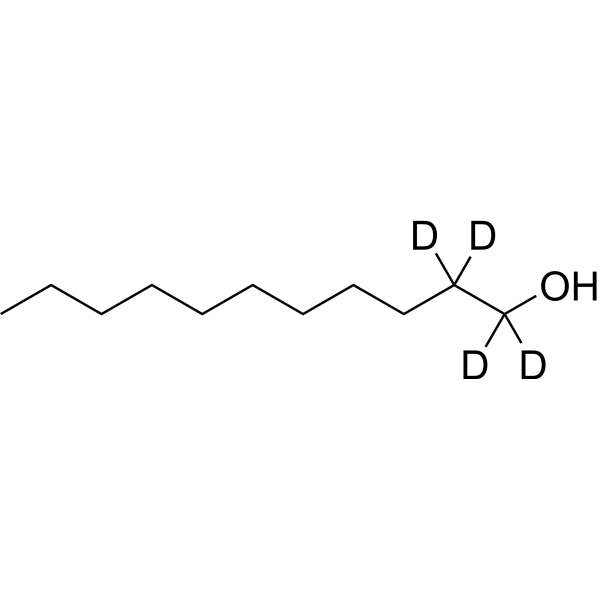 0 ImagesCat. No.: HY-W004292S1CAS No.: 1219803-47-0Synonyms: Undecyl alcohol-d41-Undecanol-d4 (Undecyl alcohol-d4) is the deuterium labeled 1-Undecanol (HY-W004292). 1-Undecanol (Undecyl alcohol) is the main product generated from the degradation of 2-tridecanone by Pseudomonas bacteria isolated from the soil. 1-Undecanol can enhance the attraction of Grapholita molesta to sex pheromone traps.
-
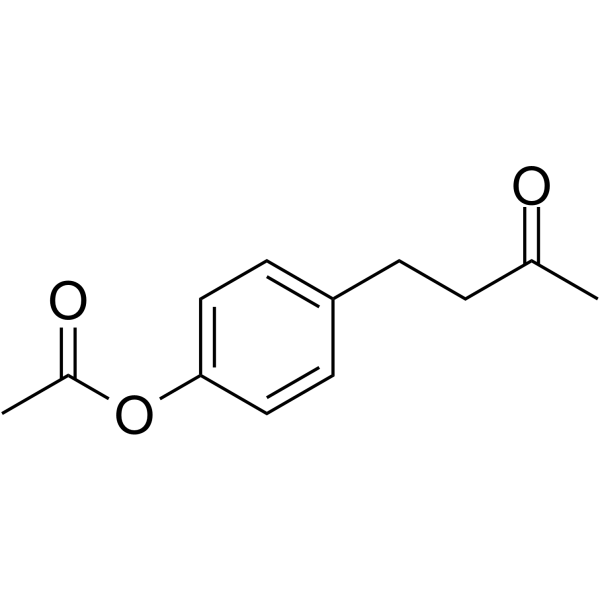
Leporin A
 0 ImagesCat. No.: HY-N16421CAS No.: 140381-54-0Leporin A is an insecticide. Leporin A binds to GABA receptors or sodium channels to disrupt neurotransmission.
-
Dihydromelilotoside
 0 ImagesCat. No.: HY-N21521CAS No.: 24696-05-7Dihydromelilotoside is an insecticide present in the stems of Dendrobium aurantiacum var. denneanum, sugarcane juice, and the aerial parts of Ajuga lupulina. Dihydromelilotoside can be used in studies related to Chagas disease (American trypanosomiasis).
-
Kaempferol-3-O-[2″,6″-di-O-E-p-coumaroyl]-β-D-glucopyranoside
![Kaempferol-3-O-[2″,6″-di-O-E-p-coumaroyl]-β-D-glucopyranoside](https://file.medchemexpress.com/product_pic/hy-n10784.gif "Click to View Kaempferol-3-O-[2″,6″-di-O-E-p-coumaroyl]-β-D-glucopyranoside Product Detail") 0 ImagesCat. No.: HY-N10784CAS No.: 121651-61-4Kaempferol-3-O-[2″,6″-di-O-E-p-coumaroyl]-β-D-glucopyranoside is a acylated keampferol glucoside. Kaempferol-3-O-[2″,6″-di-O-E-p-coumaroyl]-β-D-glucopyranoside can be isolated from the leaves of O. dentata, acts as a repellent against a fouling organism, the blue mussel M. edulis.
0 ImagesCat. No.: HY-N10784CAS No.: 121651-61-4Kaempferol-3-O-[2″,6″-di-O-E-p-coumaroyl]-β-D-glucopyranoside is a acylated keampferol glucoside. Kaempferol-3-O-[2″,6″-di-O-E-p-coumaroyl]-β-D-glucopyranoside can be isolated from the leaves of O. dentata, acts as a repellent against a fouling organism, the blue mussel M. edulis.
-
Metaldehyde-d16
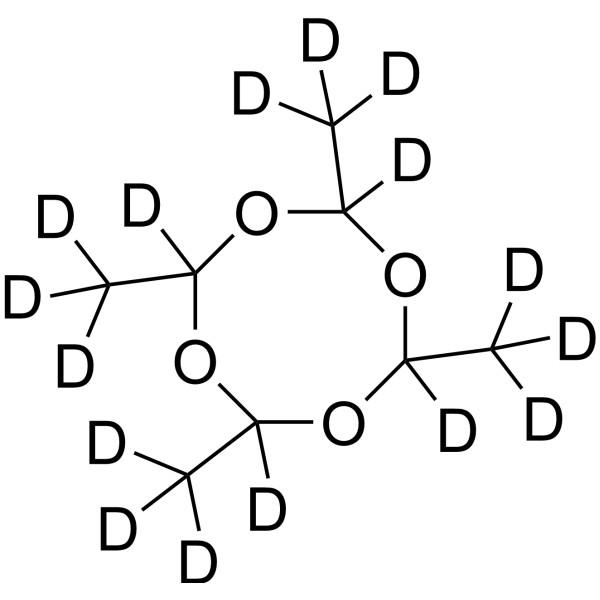 0 ImagesCat. No.: HY-B1870SCAS No.: 1219805-73-8
-
Iodofenphos
 0 ImagesCat. No.: HY-119381CAS No.: 18181-70-9Synonyms: JodfenphosIodofenphos (Jodfenphos) is an insecticide, that can be used as a protectant for stored grains. Iodofenphos is effective against grain pests, such as Sitophilus oryzae, Tribolium castaneum, and larvae of Trogoderma granarium, and has a significant residual toxicity, which could provide good insect control for several months.
-
Aldox-d6
 0 ImagesCat. No.: HY-W716702CAS No.: 2469039-16-3Synonyms: Lexamine M-13-d6; MAPD-d6Aldox-d6 (Lexamine M-13-d6; MAPD-d6) is the deuterium labeled Myristamidopropyl dimethylamine (HY-W099582). Myristamidopropyl dimethylamine (MAPD) is an antimicrobial agent (including against bacteria and fungi) and an insecticide, exhibiting inhibitory activity against Pseudomonas aeruginosa, Staphylococcus aureus, Candida albicans, Fusarium solani, and Acanthamoeba polyphaga. Myristamidopropyl dimethylamine can be used in research on microbial-induced keratitis .
-
Cryptopine
 0 ImagesCryptopine is a non-narcotic isoquinoline alkaloid. Cryptopine can reduce the activities of glutathione S-transferase (GST) and glutathione reductase (GR), depletes intracellular glutathione levels, stimulates lipid peroxidation, and induces cytotoxicity by disrupting the cellular defense system. Cryptopine binds stably to key targets of liver cancer and also exhibits anthelmintic activity against Dactylogyrus intermedius. Cryptopine can be used in studies related to liver cancer and Dactylogyrus intermedius infection.
-
RG-102240
 0 ImagesRG-102240 is a ligand for insect ecdysone receptor (EcR), with IC50 of 85 and 13 nM, in wildtype G:CfE(DEF) and its A110P mutant. RG-102240 induces the reporter gene activity of wild-type CfEcR and A110P mutant.
-
PROTAC ACC degrader-1
 0 ImagesCat. No.: HY-169008PROTAC ACC degrader-1 is an Acetyl-CoA Carboxylase PROTAC degrader with insecticidal activity, which induces ACC protein degradation via the ubiquitin-proteasome system. PROTAC ACC degrader-1 exhibits significant dose-dependent insecticidal activity against Aphis craccivora nymphs. PROTAC ACC degrader-1 can be used in studies related to Aphis craccivora infestation.
-
Ethyl chrysanthemate-d6
 0 ImagesCat. No.: HY-W753976Ethyl chrysanthemate-d6 is the deuterium labeled Ethyl chrysanthemate (HY-N7100). Ethyl chrysanthemate is an allelochemical compound used as an attractant.
-
Neoazedarachin B
 0 ImagesCat. No.: HY-N18061CAS No.: 207447-74-3Neoazedarachin B is an insect antifeedant present in the root bark of Melia toosendan. Neoazedarachin B reduces the feeding behavior of third-instar larvae of Spodoptera littoralis.
-
Etofenprox-phenol-d5
 0 ImagesCat. No.: HY-W718786CAS No.: 2733270-19-2Etofenprox-phenol-d5 is the deuterium labeled Etofenprox (HY-B0816). Etofenprox is an orally active non-ester pyrethroid insecticide. Etofenprox induces toxicity against many pest insects, including Diptera rather than mammalian and fish. Etofenprox has a liver tumor-promoting activity in rats accompanied with microsomal ROS production increase. Etofenprox can be used in agricultural pest control and malaria research.
-
Resmethrin-d6
 0 ImagesCat. No.: HY-114558S1Synonyms: Benzofuroline-d6; Isathrine-d6; Resmethrin-d6 (mixture of isomers)Resmethrin-d6 (Benzofuroline-d6) is the deuterium labeled Resmethrin (HY-114558). Pemafibrate racemate (K13675 racemate) is the racemate of pemafibrate, and activates PPARα activity, with EC50s of 1 nM, >10 μM and 1.7 μM for h-PPARα, h-PPARγ and h-PPARδ, respectively.
-
Cyanofenphos
 0 ImagesCat. No.: HY-120131CAS No.: 13067-93-1Cyanofenphos is an orally active organophosphate insecticide and brain AChE inhibitor with neurotoxicity. Cyanofenphos induces delayed neurotoxicity such as ataxia and paralysis. Cyanofenphos also causes symptoms including somnolence, reduced feed intake and weight loss in hens. Cyanofenphos has a unique self-antagonistic effect: repeated low-dose pre-treatment not only reduces subsequent acute toxicity, but also exacerbates delayed neurotoxicity and attenuates enzyme inhibition, with the protective effect peaking at 24 h after the last pre-treatment. Cyanofenphos is commonly used in studies related to delayed neurotoxicity.
-
D-Tetramethrin
 0 ImagesCat. No.: HY-W685358CAS No.: 1166-46-7D-Tetramethrin is a type I synthetic pyrethroid insecticide and hepatotoxicity inducer. D-Tetramethrin induces oxidative stress in the liver of zebrafish. D-Tetramethrin induces Apoptosis and inflammatory responses. D-Tetramethrin causes severe liver damage in zebrafish. D-Tetramethrin can be used in studies related to hepatotoxicity.
-
Bassianolide
 0 ImagesCat. No.: HY-P2087CAS No.: 64763-82-2Bassianolide is a cyclooligomer depsipeptide secondary metabolite. Bassianolide is an insecticidal virulence factor of Beauveria bassiana. Bassianolide inhibits acetylcholine-induced smooth muscle contraction, and shows moderate antiplasmodial and anti-mycobacterial activities.
-
Tralomethrin
 0 ImagesCat. No.: HY-126772CAS No.: 66841-25-6Tralomethrin is a pyrethroid insecticide used to control a wide range of pests in agriculture and public health.
-
Spinosyn K
 0 ImagesCat. No.: HY-N18035CAS No.: 159195-00-3Spinosyn K is an insecticide found in the actinomycete Saccharopolyspora spinosa. Spinosyn K shows strong insecticidal activity.



