



Liposome
Liposomes (NPs typically 100–500 nm in diameter) are fabricated from the self-assembly of phospholipids, which consist of a polar phosphate head group and hydrophobic lipid tails. In aqueous environments, the hydrophobic tails self-orient, resulting in a spherical structure comprised of an aqueous core surrounded by a lipophilic bilayer membrane. Liposomes are both biocompatible and biodegradable (e.g., at certain pH and temperature), which can be controlled by modifying the lipid composition. Furthermore, liposomes are amenable to various modifications that improve their efficacy as drug delivery carriers.
All Product Categories
-
Liposome Related Products (1261)
Related Products (1261)

-
16:0-23:2 Diyne PC
 0 ImagesCat. No.: HY-W800785CAS No.: 84271-00-1Synonyms: 1-palMitoyl-2-(10,12-tricosadiynoyl)-sn-glycero-3-phosphocholine16:0-23:2 Diyne PC is a phospholipase-mediated hydrolyzed phosphocoline with palmitic acid (16:0) and Pentacosa-10,12-diynoic acid for tails.
-
Dimethyldioctadecylammonium-d3 bromide
 0 ImagesCat. No.: HY-W724291Synonyms: Dioctadecyldimethylammonium-d3 bromide; DODAB-d3Dimethyldioctadecylammonium-d3 bromide (Dioctadecyldimethylammonium-d3 bromide) is the deuterium labeled Dimethyldioctadecylammonium bromide (HY-131119). Dimethyldioctadecylammonium bromide is a synthetic cationic lipid commonly used in gene delivery and vaccine development. Also known as DODAB or DDAB, it consists of a positively charged ammonium head group and two long hydrophobic tails. These properties make it useful for forming liposomes and other lipid-based nanoparticles that can efficiently deliver genetic material into cells. In addition to its applications in biotechnology, DDAB is also used in surfactants, emulsifiers and fabric softeners. However, due to its potential toxicity and irritation, extreme care should be taken when handling DDAB.
-
DMG-PEG2000-Mannose
 0 ImagesCat. No.: HY-182903ADMG-PEG2000-Mannose is a conjugate composed of dimyristoylglycerol (DMG), a PEG chain, and terminal mannose. DMG-PEG2000-Mannose combines the membrane compatibility of phospholipids with the targeted recognition capabilities of mannose, making it suitable for research in biomaterial construction and drug delivery.

-
DSPE-PEG2000-KTP
 0 ImagesCat. No.: HY-182094ADSPE-PEG2000-KTP is a PEG compound which composed of DSPE and a Kidney-targeting peptide KTP (HY-P11069). KTP can interact with specific proteins on the surface of renal tubular epithelial cells or exhibit higher affinity in the specific renal microenvironment, tending to aggregate or be internalized within the renal tubular epithelium. DSPE-PEG2000-KTP can actively guide carriers such as nanomedicines, liposomes, and microspheres to the kidney.
-
DSPE-PEG3400-R9
 0 ImagesCat. No.: HY-172277CDSPE-PEG3400-R9 is a PEG compound which composed of DSPE and a poly-arginine-9 peptide (R9). DSPE-PEG3400-R9 can be used for drug delivery.


-
Lipid ND-O1
 0 ImagesCat. No.: HY-W1130450CAS No.: 3096665-79-8Lipid ND-O1 is an ether-containing ionizable cationic lipid pKa of 6.6. Lipid ND-O1 can be used to generate lipid nanoparticles (LNPs) for siRNA delivery in vitro and in vivo. Lipid ND-O1 LNPs can be studied in research on hepatic fibrosis.
-
G0-C14 analog
 0 ImagesCat. No.: HY-159869CAS No.: 2935435-86-0G0-C14 analog is a G0-C14 derivative. G0-C14 is an ionizable cationic lipid that can be used to synthesize lipid nanoparticles (LNP).
-
1,2-Dilinoleoyl-sn-glycero-3-PC
 0 ImagesCat. No.: HY-W800732CAS No.: 6542-05-8Synonyms: Dilinoleoyllecithin1,2-Dilinoleoyl-sn-glycero-3-PC (Dilinoleoyllecithin) is a phospholipid. 1,2-Dilinoleoyl-sn-glycero-3-PC can be used in the manufacture of artificial membranes.
-
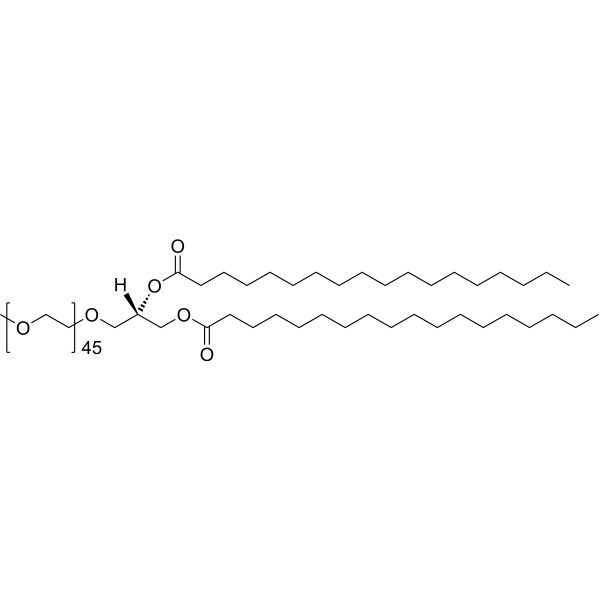
DSPE-PEG5000-APRPG
 0 ImagesCat. No.: HY-172274BDSPE-PEG5000-APRPG is a PEG compound which composed of DSPE and a APRPG peptide. DSPE-PEG5000-APRPG can be used for drug delivery.

-
DOPE-mPEG20000
 0 ImagesCat. No.: HY-W440988HDOPE-mPEG20000 is a PEGylated phospholipid containing DOPE. DOPE-mPEG20000 combines the membrane fusion capabilities of DOPE with the stealth properties of PEG, playing a crucial role in mRNA vaccines, long-circulating liposomes, and drug delivery systems.
-
DSG-PEG2000-COOH
 0 ImagesCat. No.: HY-183173ADSG-PEG2000-COOH is a conjugate composed of DSG, a PEG chain, and a terminal carboxyl group (-COOH). The carboxyl group in DSG-PEG2000-COOH can form an amide bond with a primary amine via EDC/NHS activation, enabling targeted modification of liposomes/nanoparticles.
-
Lipid 114
 0 ImagesCat. No.: HY-171900Lipid 114 is an ionizable cationic lipid with a pKa of approximately 6.8. Lipid 114 can be used to generate lipid nanoparticles (LNP) to deliver siRNA in vitro as well as in vivo. Lipid 114 LNPs encapsulating siRNA that targets IL-1β can reduce IL-1β expression in macrophages. Lipid 114 LNPs encapsulating siRNA that targets IL-1β also reduces hepatic and renal expression of IL-1β, as well as decreasing hepatic inflammation in mouse model with LPS-induced acute liver failure.
-
C8 PEG-Ceramide
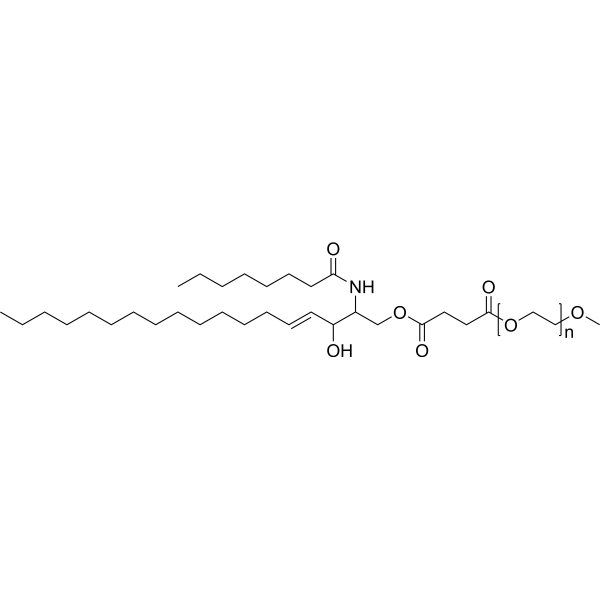 0 ImagesCat. No.: HY-144008CAS No.: 212116-76-2C8 PEG-Ceramide is a lipid product. C8 PEG-Ceramide can synthesize lipid bilayer carrier and can be used for drug delivery.
-
CP-LC-1254
 0 ImagesCat. No.: HY-172017CAS No.: 3040859-52-4CP-LC-1254 is an ionizable cationic amino lipid efficient delivery of different kinds of RNA (mRNA, cRNA and saRNA).
-
DSPE-PEG5000-R8
 0 ImagesCat. No.: HY-172276BDSPE-PEG5000-R8 is a PEG compound which composed of DSPE and a cell-penetrating peptide (R8). pDSPE-PEG5000-R8 can be used for drug delivery.



