



ACP-5862
Based on 1 publication(s) in Google Scholar
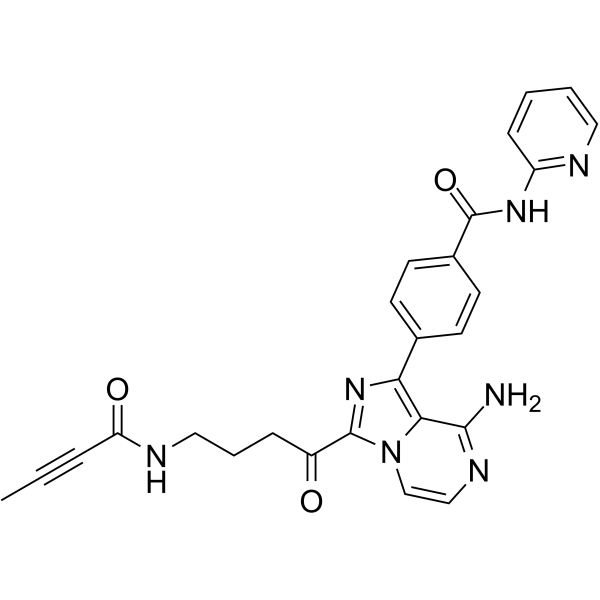
ACP-5862 is a major active, circulating, pyrrolidine ring-opened metabolite of Acalabrutinib with an IC50 of 5.0 nM for Bruton tyrosine kinase (BTK). ACP‐5862 is a weak time‐dependent inactivator of CYP3A4 and CYP2C8. Acalabrutinib is an orally active, irreversible, and highly selective BTK inhibitor, with an IC50 of 3 nM and EC50 of 8 nM.
Nos produits utilisent uniquement pour la recherche. Nous ne vendons pas aux patients.
- Pureté : 98.32%
- CAS No.: 2230757-47-6
- Formule: C26H23N7O3
- Masse moléculaire:481.51
-
Stockage:Powder -20°C, 3 years , 4°C, 2 years ; In solvent -80°C, 2 years , -20°C, 1 year

To place orders, for customer services and technical support, please contact: MedChemExpress USA
Tel: 609-228-6898 E-mail: [email protected] [email protected]


-
 Activité biologique
-
Chemical Information
-
Solvant et solubilité
- Pureté et documentation
- Références
-
 Help & FAQs


Publications Citing Use of MedChemExpress (MCE) ACP-5862
More

Activité biologique
Description
IC50 & Target
[2]|
CYP2C8 |
CYP3A4 |
In Vivo
ACP-5862 (M27) is the major single metabolite in the systemic circulation and accountes for 57.4% and 42.1% of the AUC0-t total radioactivity in male and female rat plasma, respectively. ACP-5862, the major human metabolite, is a relatively minor component in the systemic circulation and accountes for 6.1% and 8.1% of the AUC0-t total radioactivity in male and female dog plasma, respectively[1].
ACP-5862 (1 or 10 μM) has reversible protein binding of 98.6%, 99.8%, 94.3%, 98.6% in mouse, rat, dog, and human plasma[1].
MedChemExpress (MCE) has not independently confirmed the accuracy of these methods. They are for reference only.


Chemical Information
-
CAS No. 2230757-47-6
-
Appearance Solid
-
Masse moléculaire 481.51
-
Formule C26H23N7O3
-
Color White to off-white
-
SMILES
O=C(NC1=NC=CC=C1)C2=CC=C(C3=C4C(N)=NC=CN4C(C(CCCNC(C#CC)=O)=O)=N3)C=C2
-
Livraison
Room temperature in continental US; may vary elsewhere.
-
Stockage
Powder -20°C 3 years 4°C 2 years In solvent -80°C 2 years -20°C 1 year


Publications (1)
-
Journal Impact Factor
-
Most Recent
-
Biochem Biophys Res Commun
ACP-5862 suppresses esophageal squamous cell carcinoma growth through inducing apoptosis via activation of endoplasmic reticulum stress and ROS production. [Abstract]2021 Jan 1:534:995-1002. PMID: 33168189


Solvant et solubilité
In Vitro:
DMSO : 250 mg/mL (519.20 mM; Need ultrasonic; Hygroscopic DMSO has a significant impact on the solubility of product, please use newly opened DMSO)
Please refer to the solubility information to select the appropriate solvent. Once prepared, please aliquot and store the solution to prevent product inactivation from repeated freeze-thaw cycles.
Storage method and period of stock solution: -80°C, 2 years; -20°C, 1 year. When stored at -80°C, please use it within 2 years. When stored at -20°C, please use it within 1 year.
Please refer to the solubility information to select the appropriate solvent. Once prepared, please aliquot and store the solution to prevent product inactivation from repeated freeze-thaw cycles.
Storage method and period of stock solution: -80°C, 2 years; -20°C, 1 year. When stored at -80°C, please use it within 2 years. When stored at -20°C, please use it within 1 year.
Concentration (start) × Volume (start) = Concentration (final) × Volume (final)
In Vivo:
Select the appropriate dissolution method based on your experimental animal and administration route.
- For the following dissolution methods, please ensure to first prepare a clear stock solution using an In Vitro approach and then sequentially add co-solvents:
- To ensure reliable experimental results, the clarified stock solution can be appropriately stored based on storage conditions. As for the working solution for In Vivo experiments, it is recommended to prepare freshly and use it on the same day.
- The percentages shown for the solvents indicate their volumetric ratio in the final prepared solution. If precipitation or phase separation occurs during preparation, heat and/or sonication can be used to aid dissolution.
Add each solvent one by one: 10% DMSO 40% PEG300 5% Tween-80 45% Saline
Solubility: ≥ 2.08 mg/mL (4.32 mM); Clear solution
This protocol yields a clear solution of ≥ 2.08 mg/mL (saturation unknown).
Taking 1 mL working solution as an example, add 100 μL DMSO stock solution (20.8 mg/mL) to 400 μL PEG300, and mix evenly; then add 50 μL Tween-80 and mix evenly; then add 450 μL Saline to adjust the volume to 1 mL.
Preparation of Saline: Dissolve 0.9 g sodium chloride in ddH₂O and dilute to 100 mL to obtain a clear Saline solution.
In Vivo Dissolution Calculator
Please enter the basic information of animal experiments:
-
-
-
-
Recommended: Prepare an additional quantity of animals to account for potential losses during experiments.
Please enter your animal formula composition:
-
%DMSO +
Recommended: Keep the proportion of DMSO in working solution below 2% if your animal is weak.
-
%+
-
+%Tween-80 + +
-
%Saline +
The co-solvents required include: DMSO, . All of co-solvents are available by MedChemExpress (MCE). , Tween 80. All of co-solvents are available by MedChemExpress (MCE).
Working solution concentration: 0.22 mg/mL
Method for preparing stock solution: mg drug dissolved in μL DMSO. Stock solution concentration: mg/mL.
1. Take μL DMSO stock solution;
2. Add μL .
μL , mix evenly;
3. Then add μL Tween 80, mix evenly;
4. Then add μL
Please ensure that the stock solution in the first step is dissolved to a clear state, and add co-solvents in sequence. You can use ultrasonic heating (ultrasonic cleaner, recommended frequency 20-40 kHz), vortexing, etc. to assist dissolution.


Pureté et documentation
-
Fiche technique (277 KB)
-
SDS (251 KB)
- English - EN (251 KB)
- Français - FR (251 KB)
- Deutsch - DE (251 KB)
- Norwegian - NO (251 KB)
- Español - ES (251 KB)
- Swedish - SV (251 KB)
- Italian - IT (251 KB)
- Korean - KR (251 KB)
- Portuguese - PT (251 KB)
-
Instruction de manipulation (2659 KB)
Références
[1]. Herman SE, et al. The Bruton's tyrosine kinase (BTK) inhibitor acalabrutinib demonstrates potent on-target effects and efficacy in two mouse models of chronic lymphocytic leukemia. Clin Cancer Res. 2016 Nov 30 [Content Brief]
[2]. Diansong Zhou, et al. Evaluation of the Drug-Drug Interaction Potential of Acalabrutinib and Its Active Metabolite, ACP-5862, Using a Physiologically-Based Pharmacokinetic Modeling Approach. CPT Pharmacometrics Syst Pharmacol. 2019 Jul;8(7):489-499. [Content Brief]


Complete Stock Solution Preparation Table
Please refer to the solubility information to select the appropriate solvent. Once prepared, please aliquot and store the solution to prevent product inactivation from repeated freeze-thaw cycles.
Storage method and period of stock solution: -80°C, 2 years; -20°C, 1 year. When stored at -80°C, please use it within 2 years. When stored at -20°C, please use it within 1 year.
| Optional Solvent | Concentration Solvent Mass | 1 mg | 5 mg | 10 mg | 25 mg |
|---|---|---|---|---|---|
| DMSO | 1 mM | 2.0768 mL | 10.3840 mL | 20.7680 mL | 51.9200 mL |
| 5 mM | 0.4154 mL | 2.0768 mL | 4.1536 mL | 10.3840 mL | |
| 10 mM | 0.2077 mL | 1.0384 mL | 2.0768 mL | 5.1920 mL | |
| 15 mM | 0.1385 mL | 0.6923 mL | 1.3845 mL | 3.4613 mL | |
| 20 mM | 0.1038 mL | 0.5192 mL | 1.0384 mL | 2.5960 mL | |
| 25 mM | 0.0831 mL | 0.4154 mL | 0.8307 mL | 2.0768 mL | |
| 30 mM | 0.0692 mL | 0.3461 mL | 0.6923 mL | 1.7307 mL | |
| 40 mM | 0.0519 mL | 0.2596 mL | 0.5192 mL | 1.2980 mL | |
| 50 mM | 0.0415 mL | 0.2077 mL | 0.4154 mL | 1.0384 mL | |
| 60 mM | 0.0346 mL | 0.1731 mL | 0.3461 mL | 0.8653 mL | |
| 80 mM | 0.0260 mL | 0.1298 mL | 0.2596 mL | 0.6490 mL | |
| 100 mM | 0.0208 mL | 0.1038 mL | 0.2077 mL | 0.5192 mL |


ACP-5862 Related Classifications
HY-135334 Related Classifications
 Powered by Bioz