



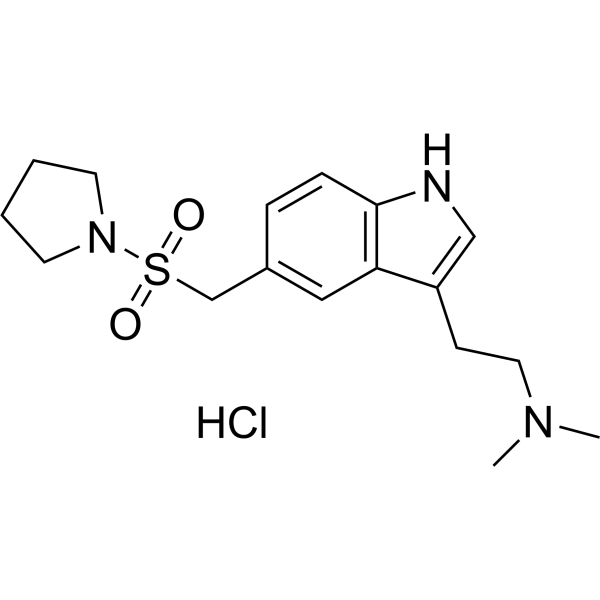
Almotriptan hydrochloride
Almotriptan (PNU180638) hydrochloride is an orally active, highly selective agonist of the 5-HT1B/1D receptor (5-HT1B/1D receptor), with EC50 values of 1.6 nM and 3.1 nM, respectively. Almotriptan hydrochloride shows moderate affinity for the 5-HT1F receptor, and weak affinity for the 5-HT1A, 5-HT6 and 5-HT7 receptors. Almotriptan hydrochloride induces intracranial vasoconstriction, inhibits nociceptive neurotransmission in the trigeminocervical complex, and suppresses the release of vasoactive peptides from trigeminal nerve endings. Almotriptan hydrochloride can be used in research related to migraine.
For research use only. We do not sell to patients.
- CAS No.: 154323-46-3
- Formula: C17H26ClN3O2S
- Molecular Weight:371.93
-
Storage:
Please store the product under the recommended conditions in the Certificate of Analysis.

To place orders, for customer services and technical support, please contact: MedChemExpress USA
Tel: 609-228-6898 E-mail: [email protected] [email protected]


-
 Biological Activity
-
Chemical Information
- Purity & Documentation
- References
-
 Help & FAQs


All 5-HT Receptor Isoforms
More

Biological Activity
Description
IC50 & Target
|
5-HT1B Receptor |
In Vitro
Almotriptan hydrochloride acts as a full agonist to induce potent concentration-dependent contractions in canine isolated saphenous veins, with an EC50 of 394 nM, via 5-HT1B/1D receptors[2].
Almotriptan hydrochloride induces vasoconstriction in human isolated meningeal, superficial temporal, and basilar arteries, with EC50 values of 0.7 μM (superficial temporal) and 3.7 μM (basilar), and greater potency than Sumatriptan (HY-B0121B) in meningeal arteries[2].
Almotriptan hydrochloride is metabolized by multiple human liver microsomal enzymes, including MAO-A, FMO, aldehyde dehydrogenase, CYP2D6, and CYP3A4, and only weakly inhibits CYP2D6 with no significant inhibition of MAO-A or MAO-B[2].
MedChemExpress (MCE) has not independently confirmed the accuracy of these methods. They are for reference only. .
In Vivo
Almotriptan (0-1 mg/kg; intravenous injection; single dose; maximum 0.3 mg/kg; intravenous injection; single dose; 30 μg/min; intracoronary infusion; 1 h) hydrochloride increases carotid vascular resistance in beagle dogs, and exhibits better carotid-femoral artery selectivity than Sumatriptan. At the tested doses, this agent has favorable cardiovascular safety, with no cardiac inhibitory effect or QTc interval change[2].
Almotriptan (10 mg/kg; subcutaneous injection; single dose) hydrochloride inhibits trigeminal ganglion-induced meningeal vascular extravasation in anesthetized guinea pigs, and at a subcutaneous dose of 10 mg/kg, it causes no hypothermia or bronchospasm in conscious guinea pigs[2].
Almotriptan (oral administration; single dose) hydrochloride does not alter cardiovascular parameters or diuretic effects in normotensive Wistar rats at the tested oral doses[2].
Almotriptan (1-3 mg/kg; subcutaneous injection; single administration) hydrochloride exerts no cardiovascular effects at the dose of 1 mg/kg s.c. in conscious cynomolgus monkeys, while the 3 mg/kg s.c. dose only induces mild, transient effects without electrocardiogram changes[2].
Almotriptan (up to 300 mg/kg; p.o.; single administration) hydrochloride shows no central nervous system-related behavioral or motor function effects in mice at oral doses up to 300 mg/kg[2].
Almotriptan hydrochloride slightly alleviates apomorphine (HY-12723)-induced vomiting responses in dogs[2].
MedChemExpress (MCE) has not independently confirmed the accuracy of these methods. They are for reference only.


Chemical Information
-
CAS No. 154323-46-3
-
Molecular Weight 371.93
-
Formula C17H26ClN3O2S
-
SMILES
CN(CCC1=CNC2=C1C=C(CS(=O)(N3CCCC3)=O)C=C2)C.Cl
-
Shipping
Room temperature in continental US; may vary elsewhere.
-
Storage
Please store the product under the recommended conditions in the Certificate of Analysis.


Purity & Documentation
References

Calculators
Concentration (start) × Volume (start) = Concentration (final) × Volume (final)


Almotriptan hydrochloride Related Classifications
HY-W335976 Related Classifications
 Powered by Bioz