



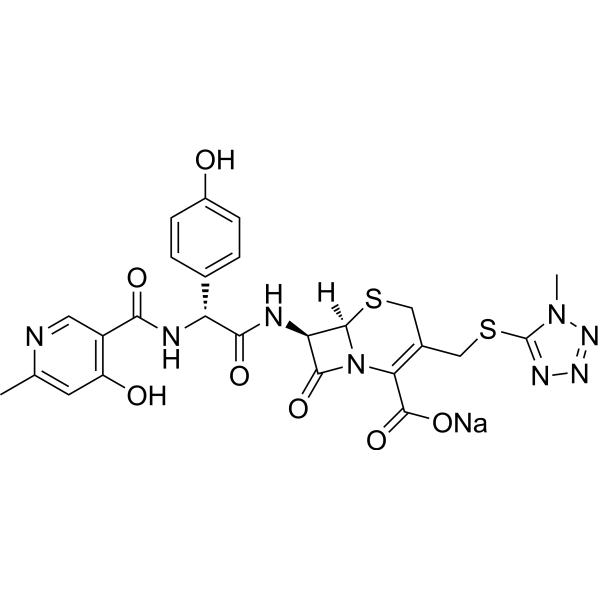
Cefpiramide sodium

Based on 1 Customer Validation
Cefpiramide sodium (SM-1652; Wy-44635) is a new Pseudomonas-active cephalosporin with a broad spectrum of antibacterial activity.
Nur für Forschungszwecke. Wir verkaufen nicht an Patienten.
- Reinheit: 98.82%
- CAS. Nr.: 74849-93-7
- Formel: C25H23N8NaO7S2
- Molecular Weight:634.62
-
Speicherung:
-20°C, sealed storage, away from moisture and light
* The compound is unstable in solutions, freshly prepared is recommended.

To place orders, for customer services and technical support, please contact: MedChemExpress USA
Tel: 609-228-6898 E-mail: [email protected] [email protected]


-
 Biologische Aktivität
-
Chemical Information
-
Lösungsmittel & Löslichkeit
- Reinheit & Dokumentation
- Verweise
-
 Help & FAQs



Alle Antibiotic Isoform-spezifische Produkte anzeigen
More

Biologische Aktivität
|
β-lactam |


Chemical Information
-
CAS. Nr. 74849-93-7
-
Appearance Solid
-
Molecular Weight 634.62
-
Formel C25H23N8NaO7S2
-
Color White to off-white
-
SMILES
O=C(C(N12)=C(CSC3=NN=NN3C)CS[C@]2([H])[C@H](NC([C@H](NC(C4=C(O)C=C(C)N=C4)=O)C5=CC=C(O)C=C5)=O)C1=O)O[Na]
-
Synonyms
SM-1652; Wy-44635
-
Versand
Room temperature in continental US; may vary elsewhere.
-
Speicherung
-20°C, sealed storage, away from moisture and light
* The compound is unstable in solutions, freshly prepared is recommended.


Lösungsmittel & Löslichkeit
DMSO : 58.33 mg/mL (91.91 mM; Need ultrasonic; Hygroscopic DMSO has a significant impact on the solubility of product, please use newly opened DMSO)
Please refer to the solubility information to select the appropriate solvent. The compound is unstable in solutions, freshly prepared is recommended.
Please refer to the solubility information to select the appropriate solvent. The compound is unstable in solutions, freshly prepared is recommended.
Konzentration (Stammlösung) × Volumen (Stammlösung) = Konzentration (Ziellösung) × Volumen (Ziellösung)
Select the appropriate dissolution method based on your experimental animal and administration route.
- For the following dissolution methods, please ensure to first prepare a clear stock solution using an In Vitro approach and then sequentially add co-solvents:
- To ensure reliable experimental results, the clarified stock solution can be appropriately stored based on storage conditions. As for the working solution for In Vivo experiments, it is recommended to prepare freshly and use it on the same day.
- The percentages shown for the solvents indicate their volumetric ratio in the final prepared solution. If precipitation or phase separation occurs during preparation, heat and/or sonication can be used to aid dissolution.
Add each solvent one by one: 10% DMSO 40% PEG300 5% Tween-80 45% Saline
Solubility: ≥ 2.08 mg/mL (3.28 mM); Clear solution
This protocol yields a clear solution of ≥ 2.08 mg/mL (saturation unknown).
Taking 1 mL working solution as an example, add 100 μL DMSO stock solution (20.8 mg/mL) to 400 μL PEG300, and mix evenly; then add 50 μL Tween-80 and mix evenly; then add 450 μL Saline to adjust the volume to 1 mL.
Preparation of Saline: Dissolve 0.9 g sodium chloride in ddH₂O and dilute to 100 mL to obtain a clear Saline solution.
Add each solvent one by one: 10% DMSO 90% (20% SBE-β-CD in Saline)
Solubility: ≥ 2.08 mg/mL (3.28 mM); Clear solution
This protocol yields a clear solution of ≥ 2.08 mg/mL (saturation unknown).
Taking 1 mL working solution as an example, add 100 μL DMSO stock solution (20.8 mg/mL) to 900 μL 20% SBE-β-CD in Saline, and mix evenly.
Preparation of 20% SBE-β-CD in Saline (4°C, storage for one week): 2 g SBE-β-CD powder is dissolved in 10 mL Saline, completely dissolve until clear.
Please enter the basic information of animal experiments:
-
-
-
-
Recommended: Prepare an additional quantity of animals to account for potential losses during experiments.
Please enter your animal formula composition:
-
%DMSO +
Recommended: Keep the proportion of DMSO in working solution below 2% if your animal is weak.
-
%+
-
+%Tween-80 + +
-
%Saline +
The co-solvents required include: DMSO, . All of co-solvents are available by MedChemExpress (MCE). , Tween 80. All of co-solvents are available by MedChemExpress (MCE).
Working solution concentration: 0.22 mg/mL
Method for preparing stock solution: mg drug dissolved in μL DMSO. Stock solution concentration: mg/mL. * The compound is unstable in solutions, freshly prepared is recommended.
1. Take μL DMSO stock solution;
2. Add μL .
μL , mix evenly;
3. Then add μL Tween 80, mix evenly;
4. Then add μL
Please ensure that the stock solution in the first step is dissolved to a clear state, and add co-solvents in sequence. You can use ultrasonic heating (ultrasonic cleaner, recommended frequency 20-40 kHz), vortexing, etc. to assist dissolution.


Reinheit & Dokumentation
-
Data Sheet (275 KB)
-
SDS (252 KB)
- English - EN (252 KB)
- Français - FR (252 KB)
- Deutsch - DE (252 KB)
- Norwegian - NO (252 KB)
- Español - ES (252 KB)
- Swedish - SV (252 KB)
- Italian - IT (252 KB)
- Korean - KR (252 KB)
- Portuguese - PT (252 KB)
-
Handling Instructions (2659 KB)
Verweise
[1]. Barry AL, et al. Cefpiramide: comparative in-vitro activity and beta-lactamase stability. J Antimicrob Chemother. 1985 Sep;16(3):315-25. [Content Brief]
[2]. Fu KP, et al. Therapeutic efficacy of cefpiramide and cefoperazone alone and in combination with gentamicin against pseudomonal infections in neutropenic mice. Chemotherapy. 1986;32(2):166-72. [Content Brief]
[3]. Neu HC, et al. The in vitro activity and beta-lactamase stability of cefpiramide compared with other beta-lactam antibiotics. Diagn Microbiol Infect Dis. 1985 Nov;3(6):479-88. [Content Brief]


Complete Stock Solution Preparation Table
Please refer to the solubility information to select the appropriate solvent. The compound is unstable in solutions, freshly prepared is recommended.
| Optional Solvent | Concentration Solvent Mass | 1 mg | 5 mg | 10 mg | 25 mg |
|---|---|---|---|---|---|
| DMSO | 1 mM | 1.5757 mL | 7.8787 mL | 15.7575 mL | 39.3937 mL |
| 5 mM | 0.3151 mL | 1.5757 mL | 3.1515 mL | 7.8787 mL | |
| 10 mM | 0.1576 mL | 0.7879 mL | 1.5757 mL | 3.9394 mL | |
| 15 mM | 0.1050 mL | 0.5252 mL | 1.0505 mL | 2.6262 mL | |
| 20 mM | 0.0788 mL | 0.3939 mL | 0.7879 mL | 1.9697 mL | |
| 25 mM | 0.0630 mL | 0.3151 mL | 0.6303 mL | 1.5757 mL | |
| 30 mM | 0.0525 mL | 0.2626 mL | 0.5252 mL | 1.3131 mL | |
| 40 mM | 0.0394 mL | 0.1970 mL | 0.3939 mL | 0.9848 mL | |
| 50 mM | 0.0315 mL | 0.1576 mL | 0.3151 mL | 0.7879 mL | |
| 60 mM | 0.0263 mL | 0.1313 mL | 0.2626 mL | 0.6566 mL | |
| 80 mM | 0.0197 mL | 0.0985 mL | 0.1970 mL | 0.4924 mL |


Cefpiramide sodium Related Classifications
HY-B0798 Related Classifications
 Powered by Bioz