



BRD9500

Based on 1 Customer Validation
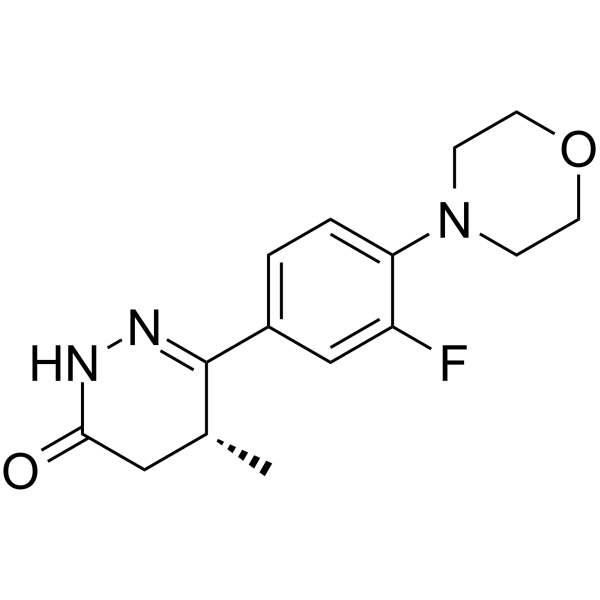
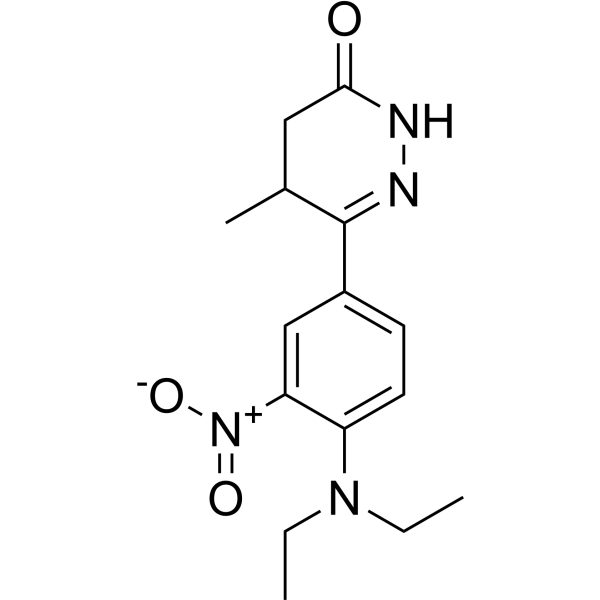
BRD9500 is an orally active phosphodiesterases 3 (PDE3) inhibitor with IC50s of 10 and 27 nM for PDE3A and PDE3B, respectively. Antitumor activity.
Nur für Forschungszwecke. Wir verkaufen nicht an Patienten.
- Reinheit : 98.41%
- CAS. Nr.: 1630760-75-6
- Formel: C15H18FN3O2
- Molecular Weight:291.32
-
Speicherung:Powder -20°C, 3 years , 4°C, 2 years ; In solvent -80°C, 6 months , -20°C, 1 month

To place orders, for customer services and technical support, please contact: MedChemExpress USA
Tel: 609-228-6898 E-mail: [email protected] [email protected]


-
 Biologische Aktivität
-
Chemical Information
-
Lösungsmittel & Löslichkeit
- Protokoll
- Reinheit & Dokumentation
- Verweise
-
 Help & FAQs




Biologische Aktivität
Beschreibung
IC50 & Target
[1]|
PDE3A 10 nM (IC50) |
PDE3B 27 nM (IC50) |
Cellular Effect
|
Cell Line

|
Type | Value | Description | References |
|---|---|---|---|---|
| HeLa | EC50 |
1.6 nM
Compound: (R)-30; BRD9500
|
Cytotoxicity against human HeLa cells assessed as cell growth inhibition measured after 48 hrs by Caspase-Glo reagent based assay
Cytotoxicity against human HeLa cells assessed as cell growth inhibition measured after 48 hrs by Caspase-Glo reagent based assay
|
[PMID: 31749907] |
| SK-MEL3 | EC50 |
1.3 nM
Compound: (R)-30; BRD9500
|
Cytotoxicity against human SK-MEL3 cells assessed as cell growth inhibition upto 10 uM measured after 48 hrs by Caspase-Glo reagent based assay
Cytotoxicity against human SK-MEL3 cells assessed as cell growth inhibition upto 10 uM measured after 48 hrs by Caspase-Glo reagent based assay
|
[PMID: 31749907] |
In Vitro
BRD9500 is a DNMDP analog. DNMDP potently and selectively inhibits PDE3A and PDE3B and kills cancer cells by inducing PDE3A/B interactions with SFLN12[1].
BRD9500 exhibits an EC50 of 1 nM for SK-MEL-3 melanoma cell line viability[1].
BRD9500 exhibits an EC50 of 1.6 nM for HeLa viability[1].
BRD9500 (10 μM; 8 hours) stabilizes the PDE3A-SLFN12 interaction in HeLa cells[1].
MedChemExpress (MCE) has not independently confirmed the accuracy of these methods. They are for reference only.
-
Cell Line:HeLa cells
-
Concentration:10 μM
-
Incubation Time:8 hours
-
Result:SLFN12 coimmunoprecipitation was analyzed by immunoblotting with an anti-V5 antibody to detect the SLFN12-V5 fusion protein. The SLFN12-V5 was clearly detected with the anti-V5 antibody.
In Vivo
BRD9500 shows high plasma levels in mice after iv (1 mg/kg) as well as po (2 mg/kg) dosing over eight hours making it a valuable candidate for in vivo xenograft testing[1].
MedChemExpress (MCE) has not independently confirmed the accuracy of these methods. They are for reference only.
-
Animal Model:Female NMRI nude mice bearing SK-MEL-3 melanoma cells tumor xenografts[1]
-
Dosage:10, 20, and 50 mg/kg
-
Administration:Orally at 10 and 20 mg/kg twice daily (2QD) and at 50 mg/kg once per day (QD).
-
Result:Achieved the strongest antitumor activity at 50 mg/kg. All treatments were well tolerated without critical body weight loss or toxicities.


Chemical Information
-
CAS. Nr. 1630760-75-6
-
Appearance Solid
-
Molecular Weight 291.32
-
Formel C15H18FN3O2
-
Color Off-white to light yellow
-
SMILES
O=C1C[C@@H](C)C(C2=CC=C(N3CCOCC3)C(F)=C2)=NN1
-
Versand
Room temperature in continental US; may vary elsewhere.
-
Speicherung
Powder -20°C 3 years 4°C 2 years In solvent -80°C 6 months -20°C 1 month


Lösungsmittel & Löslichkeit
In Vitro:
DMSO : 50 mg/mL (171.63 mM; Need ultrasonic; Hygroscopic DMSO has a significant impact on the solubility of product, please use newly opened DMSO)
Please refer to the solubility information to select the appropriate solvent. Once prepared, please aliquot and store the solution to prevent product inactivation from repeated freeze-thaw cycles.
Storage method and period of stock solution: -80°C, 6 months; -20°C, 1 month. When stored at -80°C, please use it within 6 months. When stored at -20°C, please use it within 1 month.
Please refer to the solubility information to select the appropriate solvent. Once prepared, please aliquot and store the solution to prevent product inactivation from repeated freeze-thaw cycles.
Storage method and period of stock solution: -80°C, 6 months; -20°C, 1 month. When stored at -80°C, please use it within 6 months. When stored at -20°C, please use it within 1 month.
Konzentration (Stammlösung) × Volumen (Stammlösung) = Konzentration (Ziellösung) × Volumen (Ziellösung)
In Vivo:
Select the appropriate dissolution method based on your experimental animal and administration route.
- For the following dissolution methods, please ensure to first prepare a clear stock solution using an In Vitro approach and then sequentially add co-solvents:
- To ensure reliable experimental results, the clarified stock solution can be appropriately stored based on storage conditions. As for the working solution for In Vivo experiments, it is recommended to prepare freshly and use it on the same day.
- The percentages shown for the solvents indicate their volumetric ratio in the final prepared solution. If precipitation or phase separation occurs during preparation, heat and/or sonication can be used to aid dissolution.
Add each solvent one by one: 10% DMSO 40% PEG300 5% Tween-80 45% Saline
Solubility: ≥ 2.5 mg/mL (8.58 mM); Clear solution
This protocol yields a clear solution of ≥ 2.5 mg/mL (saturation unknown).
Taking 1 mL working solution as an example, add 100 μL DMSO stock solution (25.0 mg/mL) to 400 μL PEG300, and mix evenly; then add 50 μL Tween-80 and mix evenly; then add 450 μL Saline to adjust the volume to 1 mL.
Preparation of Saline: Dissolve 0.9 g sodium chloride in ddH₂O and dilute to 100 mL to obtain a clear Saline solution.
Add each solvent one by one: 10% DMSO 90% (20% SBE-β-CD in Saline)
Solubility: ≥ 2.5 mg/mL (8.58 mM); Clear solution
This protocol yields a clear solution of ≥ 2.5 mg/mL (saturation unknown).
Taking 1 mL working solution as an example, add 100 μL DMSO stock solution (25.0 mg/mL) to 900 μL 20% SBE-β-CD in Saline, and mix evenly.
Preparation of 20% SBE-β-CD in Saline (4°C, storage for one week): 2 g SBE-β-CD powder is dissolved in 10 mL Saline, completely dissolve until clear.
In Vivo Dissolution Calculator
Please enter the basic information of animal experiments:
-
-
-
-
Recommended: Prepare an additional quantity of animals to account for potential losses during experiments.
Please enter your animal formula composition:
-
%DMSO +
Recommended: Keep the proportion of DMSO in working solution below 2% if your animal is weak.
-
%+
-
+%Tween-80 + +
-
%Saline +
The co-solvents required include: DMSO, . All of co-solvents are available by MedChemExpress (MCE). , Tween 80. All of co-solvents are available by MedChemExpress (MCE).
Working solution concentration: 0.22 mg/mL
Method for preparing stock solution: mg drug dissolved in μL DMSO. Stock solution concentration: mg/mL.
1. Take μL DMSO stock solution;
2. Add μL .
μL , mix evenly;
3. Then add μL Tween 80, mix evenly;
4. Then add μL
Please ensure that the stock solution in the first step is dissolved to a clear state, and add co-solvents in sequence. You can use ultrasonic heating (ultrasonic cleaner, recommended frequency 20-40 kHz), vortexing, etc. to assist dissolution.


Reinheit & Dokumentation
-
Data Sheet (274 KB)
-
SDS (251 KB)
- English - EN (251 KB)
- Français - FR (251 KB)
- Deutsch - DE (251 KB)
- Norwegian - NO (251 KB)
- Español - ES (251 KB)
- Swedish - SV (251 KB)
- Italian - IT (251 KB)
- Korean - KR (251 KB)
- Portuguese - PT (251 KB)
-
Handling Instructions (2659 KB)
Verweise


Complete Stock Solution Preparation Table
Please refer to the solubility information to select the appropriate solvent. Once prepared, please aliquot and store the solution to prevent product inactivation from repeated freeze-thaw cycles.
Storage method and period of stock solution: -80°C, 6 months; -20°C, 1 month. When stored at -80°C, please use it within 6 months. When stored at -20°C, please use it within 1 month.
| Optional Solvent | Concentration Solvent Mass | 1 mg | 5 mg | 10 mg | 25 mg |
|---|---|---|---|---|---|
| DMSO | 1 mM | 3.4327 mL | 17.1633 mL | 34.3265 mL | 85.8163 mL |
| 5 mM | 0.6865 mL | 3.4327 mL | 6.8653 mL | 17.1633 mL | |
| 10 mM | 0.3433 mL | 1.7163 mL | 3.4327 mL | 8.5816 mL | |
| 15 mM | 0.2288 mL | 1.1442 mL | 2.2884 mL | 5.7211 mL | |
| 20 mM | 0.1716 mL | 0.8582 mL | 1.7163 mL | 4.2908 mL | |
| 25 mM | 0.1373 mL | 0.6865 mL | 1.3731 mL | 3.4327 mL | |
| 30 mM | 0.1144 mL | 0.5721 mL | 1.1442 mL | 2.8605 mL | |
| 40 mM | 0.0858 mL | 0.4291 mL | 0.8582 mL | 2.1454 mL | |
| 50 mM | 0.0687 mL | 0.3433 mL | 0.6865 mL | 1.7163 mL | |
| 60 mM | 0.0572 mL | 0.2861 mL | 0.5721 mL | 1.4303 mL | |
| 80 mM | 0.0429 mL | 0.2145 mL | 0.4291 mL | 1.0727 mL | |
| 100 mM | 0.0343 mL | 0.1716 mL | 0.3433 mL | 0.8582 mL |


BRD9500 Related Classifications
HY-136350 Related Classifications
 Powered by Bioz