



Benoxaprofen

Based on 1 Customer Validation
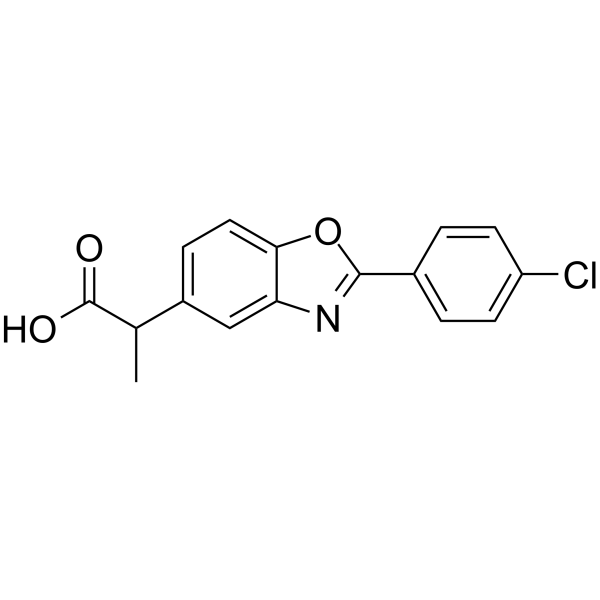
Benoxaprofen (LRCL 3794) is a nonsteroidal anti-inflammatory agent that blocks the biosynthesis of inflammatory mediators such as leukotrienes and prostaglandins by inhibiting 5-LOX, PGH2 synthase and cytochrome P-450. Benoxaprofen exhibits significant toxicity: it not only alters cellular redox status, uncouples oxidative phosphorylation and disrupts calcium ion homeostasis, but also causes liver injury through the formation of covalent adducts between its active metabolites and hepatic proteins. Benoxaprofen shows strong phototoxicity under ultraviolet irradiation, and induces erythrocyte lysis, mast cell degranulation and histamine release. Benoxaprofen is widely used in studies of urticaria and related phototoxic mechanisms.
Nos produits utilisent uniquement pour la recherche. Nous ne vendons pas aux patients.
- Pureté : 99.03%
- CAS No.: 51234-28-7
- Formule: C16H12ClNO3
- Masse moléculaire:301.72
-
Stockage:Powder -20°C, 3 years ; In solvent -80°C, 6 months , -20°C, 1 month

To place orders, for customer services and technical support, please contact: MedChemExpress USA
Tel: 609-228-6898 E-mail: [email protected] [email protected]


-
 Activité biologique
-
Chemical Information
- Protocole
- Pureté et documentation
- Références
-
 Help & FAQs


-
HY-B0330
LevofloxacinDNA Gyrase/Topoisomerase Inhibitor -
HY-50935
TroglitazonePPARγ Agonist -
HY-A0062
TelithromycinKetolide Antibiotic -
HY-121383
Labetalolα1/β-adrenergic Receptors Antagonist -
HY-B0141
EstradiolHuman Endogenous Metabolite -
HY-17502
SimvastatinHMGCR Inhibitor -
HY-11103
Sitaxsentan sodiumEndothelin A Receptor Antagonist -
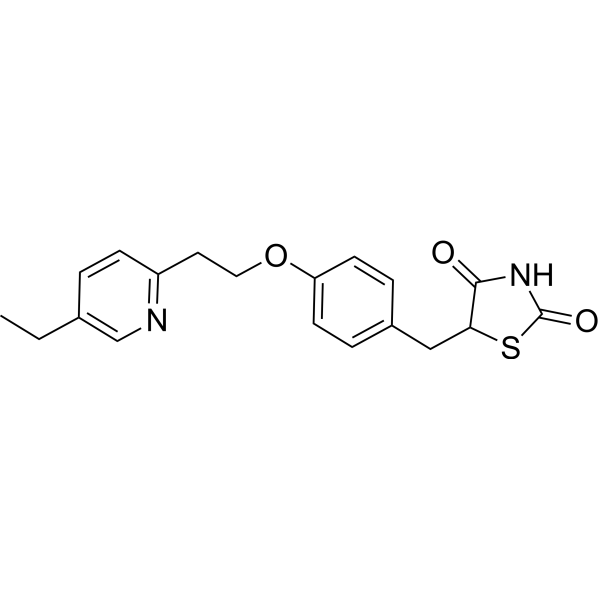
HY-13956
PioglitazonePPARγ Agonist -
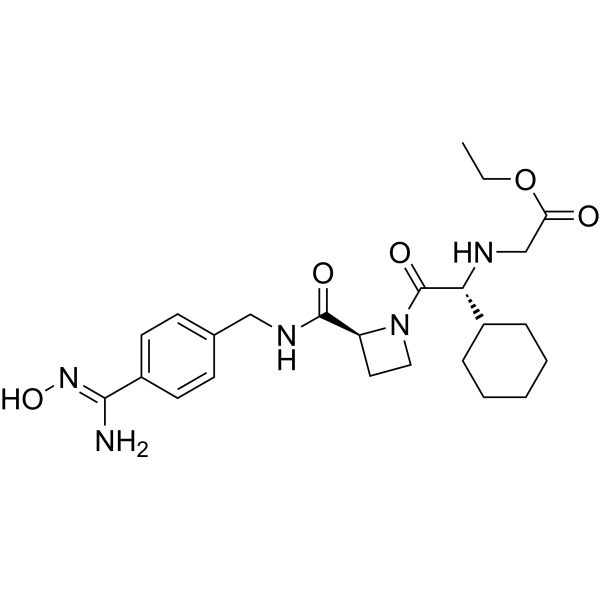
HY-10787
XimelagatranThrombin Inhibitor -
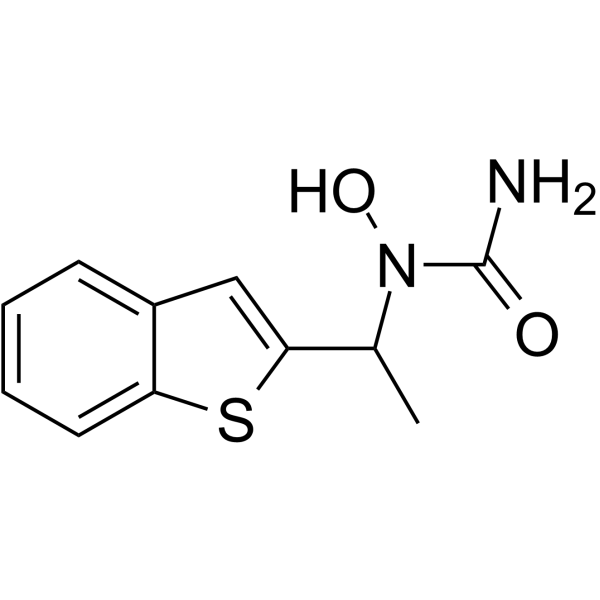
HY-14164
Zileuton5-Lipoxygenase Inhibitor -
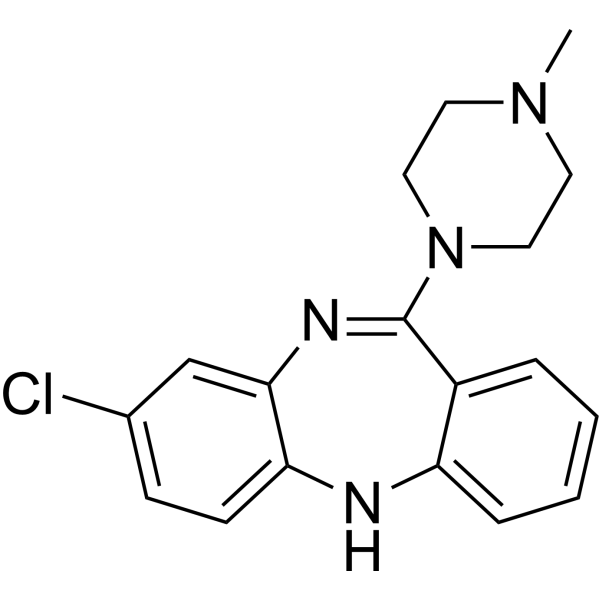
HY-14539
ClozapineAntipsychotic Agent -
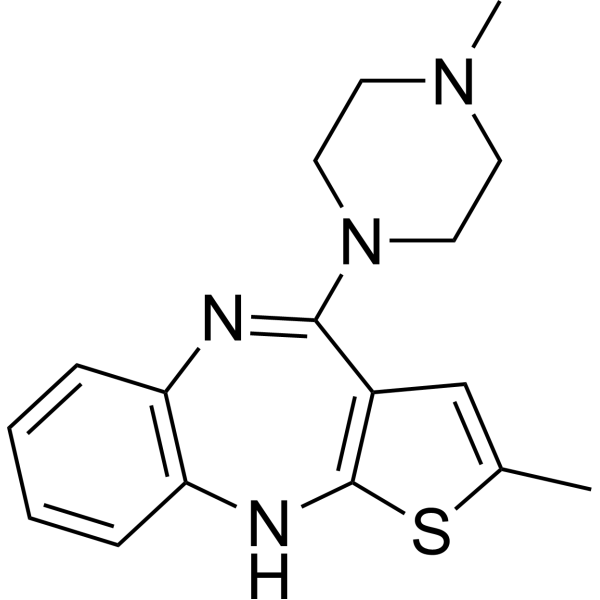
HY-14541
Olanzapine5-HT2/D1/D2 Antagonist


Activité biologique
Description
IC50 & Target
|
5-LOX |
Cellular Effect
|
Cell Line

|
Type | Value | Description | References |
|---|---|---|---|---|
| Sf21 | IC50 |
175 μM
Compound: Benoxaprofen
|
Inhibition of human BSEP expressed in plasma membrane vesicles of Sf21 cells assessed as inhibition of ATP-dependent [3H]taurocholate uptake
Inhibition of human BSEP expressed in plasma membrane vesicles of Sf21 cells assessed as inhibition of ATP-dependent [3H]taurocholate uptake
|
[PMID: 21965623] |
| Sf21 | IC50 |
99.1 μM
Compound: Benoxaprofen
|
Inhibition of Sprague-Dawley rat Bsep expressed in plasma membrane vesicles of Sf21 cells assessed as inhibition of ATP-dependent [3H]taurocholate uptake
Inhibition of Sprague-Dawley rat Bsep expressed in plasma membrane vesicles of Sf21 cells assessed as inhibition of ATP-dependent [3H]taurocholate uptake
|
[PMID: 21965623] |
In Vitro
Benoxaprofen (0.25-2.5 mM; 10-15 min) binds to cytochrome P-450 in rat liver microsomes to form a type I spectral complex, and competitively inhibits aminopyrine demethylation with a Ki value of 0.38 mM[1].
Benoxaprofen (0.75-1.25 mM; 2-4 h) does not alter the increased L/P ratio or ALT release it induces in uninduced isolated rat hepatocytes[1].
Benoxaprofen inhibits the production of iSRS, i12-HETE and PGE2 stimulated by A-23187 in RBL-1 cells, with IC50 values of 0.4 μM, 0.45 μM, and 1.3 μM, respectively[2].
Benoxaprofen (50 μg/mL; 24 h) does not form detectable irreversible adducts with human serum albumin at pH 7.4 and 37 °C[3].
Benoxaprofen (8 μM; 10 min, irradiated) induces photolysis of human erythrocytes; hemolysis occurs faster and earlier under aerobic conditions compared with anaerobic conditions, whereas no hemolysis takes place in dark environments[4].
MedChemExpress (MCE) has not independently confirmed the accuracy of these methods. They are for reference only.
-
Cell Line:human erythrocytes
-
Concentration:8 μM
-
Incubation Time:10 min; irradiated
-
Result:Induced photohemolysis of human erythrocytes in a concentration-dependent manner, with faster and earlier onset of lysis under oxygenated conditions compared to anaerobic conditions; no lysis occurs in the dark.
In Vivo
Benoxaprofen (20-200 mg/kg; i.p.; single dose) administered intraperitoneally to male Sprague-Dawley rats results in dose-proportional liver protein adduct formation and dose-dependent covalent modification of ~70 kDa and ~110 kDa hepatic proteins at 8 h post-administration[3].
Benoxaprofen (100 mg/kg; i.p.; single dose) administered intraperitoneally to male Sprague-Dawley rats results in time-dependent covalent modification of ~70 kDa and ~110 kDa hepatic proteins detectable from 4 to 24 h post-administration[3].
MedChemExpress (MCE) has not independently confirmed the accuracy of these methods. They are for reference only.
-
Animal Model:Sprague-Dawley rat (male, 200-300 g)[3]
-
Dosage:20 mg/kg
-
Administration:i.v.; single bolus dose
-
Result:Detectable plasma protein adducts at 1, 4, and 8 h post-administration.
Had liver protein adducts below the detection limit (~1 pmol/mg protein).
Achieved a systemic exposure (AUC0→8ₕ) of benoxaprofen glucuronide (BNX-G) of 1.98 ± 0.59 μg h/mL.
Reached a hepatobiliary exposure (Aₑ,ᵦᵢₗₑ,0→8ₕ) of BNX-G of 10.8 ± 1.4% of the dose.
-
Animal Model:Sprague-Dawley rat (male, 200-300 g)[3]
-
Dosage:20 mg/kg; 50 mg/kg; 100 mg/kg; 200 mg/kg
-
Administration:i.p.; single dose
-
Result:Exhibited dose-proportional liver protein adduct formation, with ~1.5 pmol/mg protein at 50 mg/kg, ~2.8 pmol/mg protein at 100 mg/kg, and ~6.5 pmol/mg protein at 200 mg/kg.
Showed dose-dependent covalent modification of two major liver proteins with molecular masses of ~70 kDa and ~110 kDa, with signal intensity more prominent in benoxaprofen-treated livers compared to controls.
-
Animal Model:Sprague-Dawley rat (male, 200-300 g)[3]
-
Dosage:100 mg/kg
-
Administration:i.p.; single dose
-
Result:Showed time-dependent covalent modification of ~70 kDa and ~110 kDa hepatic proteins, with signal intensity more prominent in benoxaprofen-treated livers compared to controls, and signals persisting through 24 h post-administration.


Chemical Information
-
CAS No. 51234-28-7
-
Appearance Solid
-
Masse moléculaire 301.72
-
Formule C16H12ClNO3
-
Color White to light yellow
-
SMILES
O=C(O)C(C)C1=CC=C(OC(C2=CC=C(Cl)C=C2)=N3)C3=C1
-
Synonyms
LRCL 3794
-
Livraison
Room temperature in continental US; may vary elsewhere.
-
Stockage
Powder -20°C 3 years In solvent -80°C 6 months -20°C 1 month


Pureté et documentation
-
Fiche technique (275 KB)
-
SDS (480 KB)
- English - EN (480 KB)
- Français - FR (480 KB)
- Deutsch - DE (480 KB)
- Norwegian - NO (480 KB)
- Español - ES (480 KB)
- Swedish - SV (480 KB)
- Italian - IT (480 KB)
- Korean - KR (480 KB)
- Portuguese - PT (480 KB)
-
Instruction de manipulation (2659 KB)
Références
[1]. Knights KM, et al. Benoxaprofen induced toxicity in isolated rat hepatocytes. Toxicology. 1986;40(3):327-339. [Content Brief]
[2]. Levine L, et al. Inhibition of the A-23187-stimulated leukotriene and prostaglandin biosynthesis of rat basophil leukemia (RBL-1) cells by nonsteroidal anti-inflammatory drugs, antioxidants, and calcium channel blockers. Biochem Pharmacol. 1983;32(20):3023-3026. [Content Brief]
[3]. Dong JQ, et al. Role of benoxaprofen and flunoxaprofen acyl glucuronides in covalent binding to rat plasma and liver proteins in vivo. Biochem Pharmacol. 2005;70(6):937-948. [Content Brief]

Calculators
Concentration (start) × Volume (start) = Concentration (final) × Volume (final)


Benoxaprofen Related Classifications
HY-13568 Related Classifications
 Powered by Bioz