



20-SOLA
Based on 1 publication(s) in Google Scholar
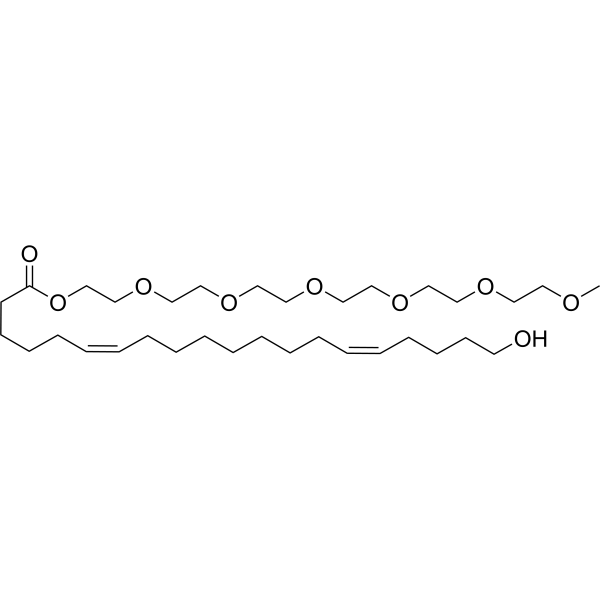
20-SOLA is an orally active 20-HETE antagonist. 20-SOLA greatly ameliorates changes in blood pressure and renal injury associated with a Streptozotocin (STZ) (HY-13753)-diabetic mouse model. 20-SOLA facilitates the restoration of coronary collateral growth (CCG) after ischemic injury. 20-SOLA can be studied for research in cardiovascular diseases and diabetes.
Nos produits utilisent uniquement pour la recherche. Nous ne vendons pas aux patients.
- Pureté: 99.55%
- CAS No.: 3084781-89-2
- Formule: C33H62O9
- Masse moléculaire:602.84
-
Stockage:Pure form -20°C, 3 years , 4°C, 2 years ; In solvent -80°C, 6 months , -20°C, 1 month

To place orders, for customer services and technical support, please contact: MedChemExpress USA
Tel: 609-228-6898 E-mail: [email protected] [email protected]


-
 Activité biologique
-
Chemical Information
-
Solvant et solubilité
- Pureté et documentation
- Références
-
 Help & FAQs
-

GPCR/G Protein Compound Library
HY-L006
-
Metabolism/Protease Compound Library
HY-L012
-
Anti-Aging Compound Library
HY-L034
-
Antioxidant Compound Library
HY-L037
-
Anti-diabetic Compound Library
HY-L040
-
Oxygen Sensing Compound Library
HY-L045
-
Anti-Cardiovascular Disease Compound Library
HY-L046
-
Mitochondria-Targeted Compound Library
HY-L089
-
Metabolic Enzyme Compound Library
HY-L146
-
Radioprotector Library
HY-L178
-
Bioactive Compound Library Max
HY-L181
-
MCE Bioactive Compound Library
HY-L001V
-
Bioactive Compound Library
HY-L001
-
High-Throughput Bioactive Compound Library
HY-L205
-
Lactylation Compound Library
HY-L249


Publications Citing Use of MedChemExpress (MCE) 20-SOLA
More

Activité biologique
20-SOLA reduces phenylephrine-induced contraction of rat renal interlobar arteries significantly[4].
MedChemExpress (MCE) has not independently confirmed the accuracy of these methods. They are for reference only.
20-SOLA (10 mg/kg/day, p.o./in drinking water, 15 w) attenuates high-fat diet-induced weight gain in Cyp4a14-/- male mice[3].
20-SOLA (10 mg/kg/day, p.o./in drinking water, 12 d) significantly reduces phenylephrine-mediated aortic ring contraction in male Cyp4a14KO mice but not in female mice[4].
20-SOLA (10 mg/kg/day, p.o./in drinking water, 4 w) lowers blood pressure in diabetic Cyp4a14KO mice and decreases albuminuria in wild-type and diabetic mice but does not affect body weight or blood glucose levels[4].
20-SOLA (10 mg/kg/day, p.o./in drinking water, 12 w) ameliorates mesangial expansion as well as matrix deposition in both groups[4].
MedChemExpress (MCE) has not independently confirmed the accuracy of these methods. They are for reference only.
-
Animal Model:DOX+HFD-fed Cyp4a12tg mice[2]
-
Dosage:10 mg/kg/day for 15 weeks
-
Administration:Oral gavage (p.o.)
-
Result:Prevented HFD-mediated decrease in oxygen consumption in mice.
Significantly reduced blood pressure of mice.
Had no effect on fasting glucose levels in mice fed HFD alone.
Had no effect on plasma insulin levels of HFD fed mice.
Significantly improved glucose tolerance in DOX+HFD-fed Cyp4a12tg mice after intraperitoneal glucose challenge of 2 g/kg body weight.
Prevented the diet-induced insulin resistance in transgenic mice overexpressing Cyp4a12-20-HETE synthase.
Significantly attenuated the HFD-mediated decrease in the level of P-IR-Tyr982 in skeletal muscle, adipose tissue and liver of Cyp4a12tg mice.
Prevented the HFD-induced increase in inhibitory Ser307 phosphorylation of IRS-1 in the skeletal muscle, adipose tissue and liver of DOX-treated Cyp4a12tg mice and HFD-induced decrease in IRS-1 levels indicative of reduction in degradation.
Affected insulin signaling directly and prevented impairment of insulin signaling in mice model.
-
Animal Model:HFD-fed Cyp4a14-/- male mice[3]
-
Dosage:10 mg/kg/day
-
Administration:Oral gavage (p.o.) in drinking water
-
Result:Resulted in reduced weight gain in mice compared with mice on a control diet.
Prevented the HFD-mediated increase and normalized blood pressure levels.
Prevented high-fat diet-induced insulin resistance in mice.
Did not significantly affect HFD-induced Cyp4a protein levels.
Greatly attenuated the decrease in the level or P-IR-Tyr-972 with early treatment whilst only prevented HFD-induced reduction in P-IR-Tyr-972 levels in skeletal muscle with late treatment.
Attenuated the HFD-induced increase in IRS-1 Ser-307 phosphorylation and decrease in its levels.


Chemical Information
-
CAS No. 3084781-89-2
-
Appearance Liquid
-
Masse moléculaire 602.84
-
Formule C33H62O9
-
Color Colorless to light yellow
-
SMILES
COCCOCCOCCOCCOCCOCCOC(CCCC/C=C\CCCCCCC/C=C\CCCCO)=O
-
Livraison
Room temperature in continental US; may vary elsewhere.
-
Stockage
Pure form -20°C 3 years 4°C 2 years In solvent -80°C 6 months -20°C 1 month


Publications (1)
-
Journal Impact Factor
-
Most Recent


Solvant et solubilité
DMSO : 100 mg/mL (165.88 mM; Need ultrasonic; Hygroscopic DMSO has a significant impact on the solubility of product, please use newly opened DMSO)
Please refer to the solubility information to select the appropriate solvent. Once prepared, please aliquot and store the solution to prevent product inactivation from repeated freeze-thaw cycles.
Storage method and period of stock solution: -80°C, 6 months; -20°C, 1 month. When stored at -80°C, please use it within 6 months. When stored at -20°C, please use it within 1 month.
Please refer to the solubility information to select the appropriate solvent. Once prepared, please aliquot and store the solution to prevent product inactivation from repeated freeze-thaw cycles.
Storage method and period of stock solution: -80°C, 6 months; -20°C, 1 month. When stored at -80°C, please use it within 6 months. When stored at -20°C, please use it within 1 month.
Concentration (start) × Volume (start) = Concentration (final) × Volume (final)
Select the appropriate dissolution method based on your experimental animal and administration route.
- For the following dissolution methods, please ensure to first prepare a clear stock solution using an In Vitro approach and then sequentially add co-solvents:
- To ensure reliable experimental results, the clarified stock solution can be appropriately stored based on storage conditions. As for the working solution for In Vivo experiments, it is recommended to prepare freshly and use it on the same day.
- The percentages shown for the solvents indicate their volumetric ratio in the final prepared solution. If precipitation or phase separation occurs during preparation, heat and/or sonication can be used to aid dissolution.
Add each solvent one by one: 10% DMSO 40% PEG300 5% Tween-80 45% Saline
Solubility: ≥ 2.5 mg/mL (4.15 mM); Clear solution
This protocol yields a clear solution of ≥ 2.5 mg/mL (saturation unknown).
Taking 1 mL working solution as an example, add 100 μL DMSO stock solution (25.0 mg/mL) to 400 μL PEG300, and mix evenly; then add 50 μL Tween-80 and mix evenly; then add 450 μL Saline to adjust the volume to 1 mL.
Preparation of Saline: Dissolve 0.9 g sodium chloride in ddH₂O and dilute to 100 mL to obtain a clear Saline solution.
Add each solvent one by one: 10% DMSO 90% (20% SBE-β-CD in Saline)
Solubility: ≥ 2.5 mg/mL (4.15 mM); Clear solution
This protocol yields a clear solution of ≥ 2.5 mg/mL (saturation unknown).
Taking 1 mL working solution as an example, add 100 μL DMSO stock solution (25.0 mg/mL) to 900 μL 20% SBE-β-CD in Saline, and mix evenly.
Preparation of 20% SBE-β-CD in Saline (4°C, storage for one week): 2 g SBE-β-CD powder is dissolved in 10 mL Saline, completely dissolve until clear.
Please enter the basic information of animal experiments:
-
-
-
-
Recommended: Prepare an additional quantity of animals to account for potential losses during experiments.
Please enter your animal formula composition:
-
%DMSO +
Recommended: Keep the proportion of DMSO in working solution below 2% if your animal is weak.
-
%+
-
+%Tween-80 + +
-
%Saline +
The co-solvents required include: DMSO, . All of co-solvents are available by MedChemExpress (MCE). , Tween 80. All of co-solvents are available by MedChemExpress (MCE).
Working solution concentration: 0.22 mg/mL
Method for preparing stock solution: mg drug dissolved in μL DMSO. Stock solution concentration: mg/mL.
1. Take μL DMSO stock solution;
2. Add μL .
μL , mix evenly;
3. Then add μL Tween 80, mix evenly;
4. Then add μL
Please ensure that the stock solution in the first step is dissolved to a clear state, and add co-solvents in sequence. You can use ultrasonic heating (ultrasonic cleaner, recommended frequency 20-40 kHz), vortexing, etc. to assist dissolution.


Pureté et documentation
-
Fiche technique (276 KB)
-
SDS (251 KB)
- English - EN (251 KB)
- Français - FR (251 KB)
- Deutsch - DE (251 KB)
- Norwegian - NO (251 KB)
- Español - ES (251 KB)
- Swedish - SV (251 KB)
- Italian - IT (251 KB)
- Korean - KR (251 KB)
- Portuguese - PT (251 KB)
-
Instruction de manipulation (2659 KB)
Références
[2]. Gilani, A., et al., (2021). 20-HETE interferes with insulin signaling and contributes to obesity-driven insulin resistance. Prostaglandins & other lipid mediators, 152, 106485. [Content Brief]
[3]. Gilani, A., et al., (2018). High-fat diet-induced obesity and insulin resistance in CYP4a14-/- mice is mediated by 20-HETE. American journal of physiology. Regulatory, integrative and comparative physiology, 315(5), R934–R944. [Content Brief]
[4]. Gangadhariah, M. H., et al., (2015). Hypertension is a major contributor to 20-hydroxyeicosatetraenoic acid-mediated kidney injury in diabetic nephropathy. Journal of the American Society of Nephrology: JASN, 26(3), 597–610. [Content Brief]


Complete Stock Solution Preparation Table
Please refer to the solubility information to select the appropriate solvent. Once prepared, please aliquot and store the solution to prevent product inactivation from repeated freeze-thaw cycles.
Storage method and period of stock solution: -80°C, 6 months; -20°C, 1 month. When stored at -80°C, please use it within 6 months. When stored at -20°C, please use it within 1 month.
| Optional Solvent | Concentration Solvent Mass | 1 mg | 5 mg | 10 mg | 25 mg |
|---|---|---|---|---|---|
| DMSO | 1 mM | 1.6588 mL | 8.2941 mL | 16.5881 mL | 41.4704 mL |
| 5 mM | 0.3318 mL | 1.6588 mL | 3.3176 mL | 8.2941 mL | |
| 10 mM | 0.1659 mL | 0.8294 mL | 1.6588 mL | 4.1470 mL | |
| 15 mM | 0.1106 mL | 0.5529 mL | 1.1059 mL | 2.7647 mL | |
| 20 mM | 0.0829 mL | 0.4147 mL | 0.8294 mL | 2.0735 mL | |
| 25 mM | 0.0664 mL | 0.3318 mL | 0.6635 mL | 1.6588 mL | |
| 30 mM | 0.0553 mL | 0.2765 mL | 0.5529 mL | 1.3823 mL | |
| 40 mM | 0.0415 mL | 0.2074 mL | 0.4147 mL | 1.0368 mL | |
| 50 mM | 0.0332 mL | 0.1659 mL | 0.3318 mL | 0.8294 mL | |
| 60 mM | 0.0276 mL | 0.1382 mL | 0.2765 mL | 0.6912 mL | |
| 80 mM | 0.0207 mL | 0.1037 mL | 0.2074 mL | 0.5184 mL | |
| 100 mM | 0.0166 mL | 0.0829 mL | 0.1659 mL | 0.4147 mL |


20-SOLA Related Classifications
HY-160186 Related Classifications
 Powered by Bioz