



Radezolid
Based on 11 publication(s) in Google Scholar
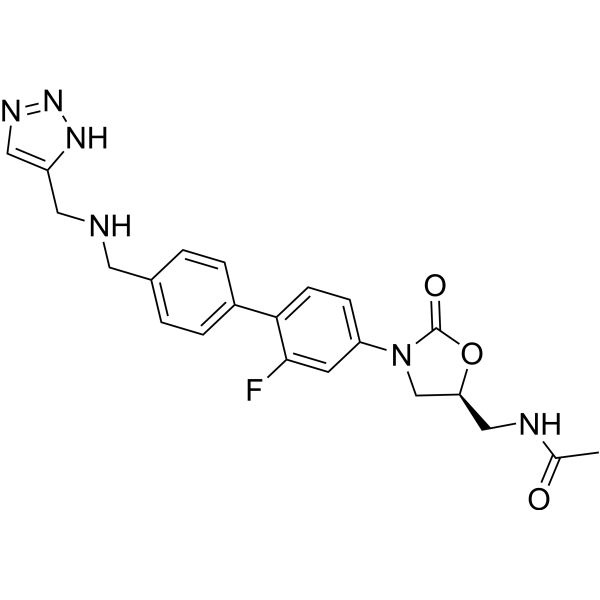
Radezolid (RX-1741) is a oxazolidinone antibiotic. Radezolid is active against Staphylococcus, Chlamydia, and Legionella species, and remains active against Linezolid-resistant strains.
Nos produits utilisent uniquement pour la recherche. Nous ne vendons pas aux patients.
- Pureté: 98.34%
- CAS No.: 869884-78-6
- Formule: C22H23FN6O3
- Masse moléculaire:438.45
-
Stockage:Powder -20°C, 3 years , 4°C, 2 years ; In solvent -80°C, 2 years , -20°C, 1 year

To place orders, for customer services and technical support, please contact: MedChemExpress USA
Tel: 609-228-6898 E-mail: [email protected] [email protected]


-
 Activité biologique
-
Chemical Information
-
Solvant et solubilité
- Protocole
- Pureté et documentation
- Références
-
 Help & FAQs
-

Antibacterial Compound Library
HY-L049
-
Anti-COVID-19 Compound Library
HY-L052
-
Antibiotics Library
HY-L067
-
Anti-Drug-Resistant Compound Library
HY-L169
-
Bioactive Compound Library Max
HY-L181
-
MCE Bioactive Compound Library
HY-L001V
-
Drug Repurposing Compound Library Plus
HY-L035P
-
Clinical Compound Library Plus
HY-L026P
-
Bioactive Compound Library
HY-L001
-
High-Throughput Bioactive Compound Library
HY-L205
-
Anti-Infection Compound Library
HY-L002
-
Clinical Compound Library
HY-L026
-
Drug Repurposing Compound Library
HY-L035


Publications Citing Use of MedChemExpress (MCE) Radezolid
More- Br J Cancer. 2021 Jun;124(12):2004-2016. [Abstract]
- Front Microbiol. 2023 Apr 26:14:1131178. [Abstract]
- Front Microbiol. 2020 Feb 14:11:196. [Abstract]
- FASEB J. 2025 Sep 15;39(17):e71037. [Abstract]
- Antimicrob Agents Chemother. 2023 Apr 18;67(4):e0165522. [Abstract]
- Microb Pathog. 2020 Feb:139:103866. [Abstract]
- J Antibiot (Tokyo). 2020 Dec;73(12):845-851. [Abstract]
- Patent. US20180085470A1.
- Patent. US9884126B2.
- Patent. US20160074529A1.
- Patent. US20150366985A1.
 Customer Validation & Images

-
WB
Voir tous les produits spécifiques à Isoform Antibiotic
More

Activité biologique
|
Oxazolidinone |
|
Cell Line

|
Type | Value | Description | References |
|---|---|---|---|---|
| THP-1 | EC50 |
0.02 mg/L
Compound: Radezolid
|
Antimicrobial activity against linezolid-susceptible Staphylococcus aureus SA238 infected in THP-1 cells at pH 5.5 after 24 hrs
Antimicrobial activity against linezolid-susceptible Staphylococcus aureus SA238 infected in THP-1 cells at pH 5.5 after 24 hrs
|
[PMID: 20385852] |
| THP-1 | EC50 |
0.04 mg/L
Compound: Radezolid
|
Antimicrobial activity against Listeria monocytogenes infected in THP1 cells after 24 hrs
Antimicrobial activity against Listeria monocytogenes infected in THP1 cells after 24 hrs
|
[PMID: 20385852] |
| THP-1 | EC50 |
0.07 mg/L
Compound: Radezolid
|
Antimicrobial activity against linezolid-susceptible Staphylococcus aureus NRS384 infected in THP1 cells after 24 hrs
Antimicrobial activity against linezolid-susceptible Staphylococcus aureus NRS384 infected in THP1 cells after 24 hrs
|
[PMID: 20385852] |
| THP-1 | EC50 |
0.09 mg/L
Compound: Radezolid
|
Antimicrobial activity against linezolid-susceptible Staphylococcus aureus NRS18 infected in THP1 cells after 24 hrs
Antimicrobial activity against linezolid-susceptible Staphylococcus aureus NRS18 infected in THP1 cells after 24 hrs
|
[PMID: 20385852] |
| THP-1 | EC50 |
0.09 mg/L
Compound: Radezolid
|
Antimicrobial activity against linezolid-susceptible Staphylococcus aureus SA040 infected in THP1 cells after 24 hrs
Antimicrobial activity against linezolid-susceptible Staphylococcus aureus SA040 infected in THP1 cells after 24 hrs
|
[PMID: 20385852] |
| THP-1 | EC50 |
0.12 mg/L
Compound: Radezolid
|
Antimicrobial activity against linezolid-susceptible Staphylococcus aureus ATCC 33591 infected in THP1 cells after 24 hrs
Antimicrobial activity against linezolid-susceptible Staphylococcus aureus ATCC 33591 infected in THP1 cells after 24 hrs
|
[PMID: 20385852] |
| THP-1 | EC50 |
0.14 mg/L
Compound: Radezolid
|
Antimicrobial activity against linezolid-resistant Staphylococcus aureus SA040L infected in THP1 cells after 24 hrs
Antimicrobial activity against linezolid-resistant Staphylococcus aureus SA040L infected in THP1 cells after 24 hrs
|
[PMID: 20385852] |
| THP-1 | EC50 |
0.16 mg/L
Compound: Radezolid
|
Antimicrobial activity against linezolid-susceptible Staphylococcus aureus SA238 infected in THP1 cells after 24 hrs
Antimicrobial activity against linezolid-susceptible Staphylococcus aureus SA238 infected in THP1 cells after 24 hrs
|
[PMID: 20385852] |
| THP-1 | EC50 |
0.24 mg/L
Compound: Radezolid
|
Antimicrobial activity against linezolid-susceptible Staphylococcus aureus ATCC 25923 infected in THP1 cells after 24 hrs
Antimicrobial activity against linezolid-susceptible Staphylococcus aureus ATCC 25923 infected in THP1 cells after 24 hrs
|
[PMID: 20385852] |
| THP-1 | EC50 |
0.24 mg/L
Compound: Radezolid
|
Antimicrobial activity against Staphylococcus aureus infected in THP1 cells after 24 hrs
Antimicrobial activity against Staphylococcus aureus infected in THP1 cells after 24 hrs
|
[PMID: 20385852] |
| THP-1 | EC50 |
0.29 mg/L
Compound: Radezolid
|
Antimicrobial activity against linezolid-resistant Staphylococcus aureus SA238L infected in THP1 cells after 24 hrs
Antimicrobial activity against linezolid-resistant Staphylococcus aureus SA238L infected in THP1 cells after 24 hrs
|
[PMID: 20385852] |
| THP-1 | EC50 |
0.31 mg/L
Compound: Radezolid
|
Antimicrobial activity against linezolid-susceptible Staphylococcus aureus SA238 infected in THP1 cells at pH 7.4 after 24 hrs
Antimicrobial activity against linezolid-susceptible Staphylococcus aureus SA238 infected in THP1 cells at pH 7.4 after 24 hrs
|
[PMID: 20385852] |
| THP-1 | EC50 |
0.47 mg/L
Compound: Radezolid
|
Antimicrobial activity against Legionella pneumophila ATCC 33153 infected in THP1 cells after 48hrs
Antimicrobial activity against Legionella pneumophila ATCC 33153 infected in THP1 cells after 48hrs
|
[PMID: 20385852] |
| THP-1 | EC50 |
1.51 mg/L
Compound: Radezolid
|
Antimicrobial activity against Staphylococcus epidermidis infected in THP1 cells after 24 hrs
Antimicrobial activity against Staphylococcus epidermidis infected in THP1 cells after 24 hrs
|
[PMID: 20385852] |
Radezolid MICs are systematically equal to or lower (up to 3 log2 dilutions) than those of linezolid for all linezolid-susceptible strains, with an 8-fold difference for the linezolid-resistant strains. Radezolid shows a greater potency than linezolid, independent of the bacteria tested, when concentrations are expressed on a weight (mg/L) basis. Radezolid shows an improved potency compared to that of linezolid when concentrations are expressed on a weight (mg/L) basis[1]. Radezolid and TR-700 perform well against 3-copy G2447T, G2576T, and G2576T/T2571C mutants[2].
MedChemExpress (MCE) has not independently confirmed the accuracy of these methods. They are for reference only.
| NCT Number | Sponsor | Condition | Start Date |
Phase
|
|---|---|---|---|---|
| NCT01329991 | Plexxikon| | 2011-05 | PHASE1 |


Chemical Information
-
CAS No. 869884-78-6
-
Appearance Solid
-
Masse moléculaire 438.45
-
Formule C22H23FN6O3
-
Color White to off-white
-
SMILES
CC(NC[C@H]1CN(C2=CC=C(C3=CC=C(CNCC4=CN=NN4)C=C3)C(F)=C2)C(O1)=O)=O
-
Synonyms
RX-1741
-
Livraison
Room temperature in continental US; may vary elsewhere.
-
Stockage
Powder -20°C 3 years 4°C 2 years In solvent -80°C 2 years -20°C 1 year


Publications (11)
-
Journal Impact Factor
-
Most Recent
-
Br J Cancer
RRBP1 rewires cisplatin resistance in oral squamous cell carcinoma by regulating Hippo pathway. [Abstract]2021 Jun;124(12):2004-2016. PMID: 33762722
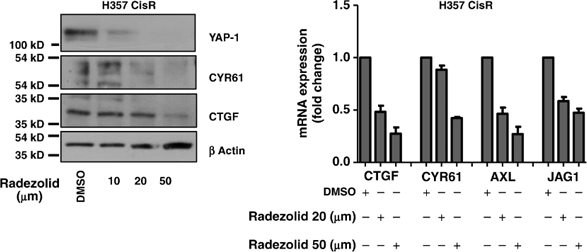
Radezolid purchased from MedChemExpress. Usage Cited in: Br J Cancer. 2021 Jun;124(12):2004-2016. [Abstract]
Radezolid (10-50μM; 48 hours) treatment significantly reduces the expression of YAP1 target genes (both at protein and mRNA level) in H357CisR and SCC-9 CisR cells.
-
Front Microbiol
Antibacterial and anti-biofilm activity of radezolid against Staphylococcus aureus clinical isolates from China. [Abstract]2023 Apr 26:14:1131178. PMID: 37180277 -
Front Microbiol
Radezolid Is More Effective Than Linezolid Against Planktonic Cells and Inhibits Enterococcus faecalis Biofilm Formation. [Abstract]2020 Feb 14:11:196. PMID: 32117185 -
FASEB J
Mitoribosome-Targeting Antibiotics Suppress Osteoclastogenesis and Periodontitis-Induced Bone Loss by Blocking Mitochondrial Protein Synthesis. [Abstract]2025 Sep 15;39(17):e71037. PMID: 40923938 -
Antimicrob Agents Chemother
Side-by-Side Profiling of Oxazolidinones to Estimate the Therapeutic Window against Mycobacterial Infections. [Abstract]2023 Apr 18;67(4):e0165522. PMID: 36920191 -
Microb Pathog
In vitro evaluation of the antibacterial activities of radezolid and linezolid for Streptococcus agalactiae. [Abstract]2020 Feb:139:103866. PMID: 31715321 -
J Antibiot (Tokyo)
2020 Dec;73(12):845-851. PMID: 32678335 -
-
-
-


Solvant et solubilité
DMSO : ≥ 25 mg/mL (57.02 mM; Hygroscopic DMSO has a significant impact on the solubility of product, please use newly opened DMSO)
* "≥" means soluble, but saturation unknown.
Please refer to the solubility information to select the appropriate solvent. Once prepared, please aliquot and store the solution to prevent product inactivation from repeated freeze-thaw cycles.
Storage method and period of stock solution: -80°C, 2 years; -20°C, 1 year. When stored at -80°C, please use it within 2 years. When stored at -20°C, please use it within 1 year.
Please refer to the solubility information to select the appropriate solvent. Once prepared, please aliquot and store the solution to prevent product inactivation from repeated freeze-thaw cycles.
Storage method and period of stock solution: -80°C, 2 years; -20°C, 1 year. When stored at -80°C, please use it within 2 years. When stored at -20°C, please use it within 1 year.
Concentration (start) × Volume (start) = Concentration (final) × Volume (final)
Select the appropriate dissolution method based on your experimental animal and administration route.
- For the following dissolution methods, please ensure to first prepare a clear stock solution using an In Vitro approach and then sequentially add co-solvents:
- To ensure reliable experimental results, the clarified stock solution can be appropriately stored based on storage conditions. As for the working solution for In Vivo experiments, it is recommended to prepare freshly and use it on the same day.
- The percentages shown for the solvents indicate their volumetric ratio in the final prepared solution. If precipitation or phase separation occurs during preparation, heat and/or sonication can be used to aid dissolution.
Add each solvent one by one: 10% DMSO 40% PEG300 5% Tween-80 45% Saline
Solubility: ≥ 2.5 mg/mL (5.70 mM); Clear solution
This protocol yields a clear solution of ≥ 2.5 mg/mL (saturation unknown).
Taking 1 mL working solution as an example, add 100 μL DMSO stock solution (25.0 mg/mL) to 400 μL PEG300, and mix evenly; then add 50 μL Tween-80 and mix evenly; then add 450 μL Saline to adjust the volume to 1 mL.
Preparation of Saline: Dissolve 0.9 g sodium chloride in ddH₂O and dilute to 100 mL to obtain a clear Saline solution.
Add each solvent one by one: 10% DMSO 90% (20% SBE-β-CD in Saline)
Solubility: ≥ 2.5 mg/mL (5.70 mM); Clear solution
This protocol yields a clear solution of ≥ 2.5 mg/mL (saturation unknown).
Taking 1 mL working solution as an example, add 100 μL DMSO stock solution (25.0 mg/mL) to 900 μL 20% SBE-β-CD in Saline, and mix evenly.
Preparation of 20% SBE-β-CD in Saline (4°C, storage for one week): 2 g SBE-β-CD powder is dissolved in 10 mL Saline, completely dissolve until clear.
Please enter the basic information of animal experiments:
-
-
-
-
Recommended: Prepare an additional quantity of animals to account for potential losses during experiments.
Please enter your animal formula composition:
-
%DMSO +
Recommended: Keep the proportion of DMSO in working solution below 2% if your animal is weak.
-
%+
-
+%Tween-80 + +
-
%Saline +
The co-solvents required include: DMSO, . All of co-solvents are available by MedChemExpress (MCE). , Tween 80. All of co-solvents are available by MedChemExpress (MCE).
Working solution concentration: 0.22 mg/mL
Method for preparing stock solution: mg drug dissolved in μL DMSO. Stock solution concentration: mg/mL.
1. Take μL DMSO stock solution;
2. Add μL .
μL , mix evenly;
3. Then add μL Tween 80, mix evenly;
4. Then add μL
Please ensure that the stock solution in the first step is dissolved to a clear state, and add co-solvents in sequence. You can use ultrasonic heating (ultrasonic cleaner, recommended frequency 20-40 kHz), vortexing, etc. to assist dissolution.

Protocole
Antibiotic accumulation is determined following the general procedure, and the cellular content of [14C]radezolid is assayed in cell lysates by liquid scintillation counting (lowest limit of detection, 0.003 mg/liter; linear response between 0.01 and 0.78 mg/liter; R2=0.999). All cell drug contents are expressed by reference to the total cell protein content and converted into apparent total cell concentrations using a conversion factor of 5 μL per mg of cell protein.
MedChemExpress (MCE) has not independently confirmed the accuracy of these methods. They are for reference only.


Pureté et documentation
-
Fiche technique (287 KB)
-
SDS (254 KB)
- English - EN (254 KB)
- Français - FR (254 KB)
- Deutsch - DE (254 KB)
- Norwegian - NO (254 KB)
- Español - ES (254 KB)
- Swedish - SV (254 KB)
- Italian - IT (254 KB)
- Korean - KR (254 KB)
- Portuguese - PT (254 KB)
-
Instruction de manipulation (2659 KB)
Références
[1]. Lemaire S, et al. Cellular pharmacodynamics of the novel biaryloxazolidinone radezolid: studies with infected phagocytic and nonphagocytic cells, using Staphylococcus aureus, Staphylococcus epidermidis, Listeria monocytogenes, and Legionella pneumophila. [Content Brief]
[2]. Locke JB, et al. Structure-activity relationships of diverse oxazolidinones for linezolid-resistant Staphylococcus aureus strains possessing the cfr methyltransferase gene or ribosomal mutations. Antimicrob Agents Chemother. 2010 Dec;54(12):5337-43. [Content Brief]


Complete Stock Solution Preparation Table
Please refer to the solubility information to select the appropriate solvent. Once prepared, please aliquot and store the solution to prevent product inactivation from repeated freeze-thaw cycles.
Storage method and period of stock solution: -80°C, 2 years; -20°C, 1 year. When stored at -80°C, please use it within 2 years. When stored at -20°C, please use it within 1 year.
| Optional Solvent | Concentration Solvent Mass | 1 mg | 5 mg | 10 mg | 25 mg |
|---|---|---|---|---|---|
| DMSO | 1 mM | 2.2808 mL | 11.4038 mL | 22.8076 mL | 57.0190 mL |
| 5 mM | 0.4562 mL | 2.2808 mL | 4.5615 mL | 11.4038 mL | |
| 10 mM | 0.2281 mL | 1.1404 mL | 2.2808 mL | 5.7019 mL | |
| 15 mM | 0.1521 mL | 0.7603 mL | 1.5205 mL | 3.8013 mL | |
| 20 mM | 0.1140 mL | 0.5702 mL | 1.1404 mL | 2.8510 mL | |
| 25 mM | 0.0912 mL | 0.4562 mL | 0.9123 mL | 2.2808 mL | |
| 30 mM | 0.0760 mL | 0.3801 mL | 0.7603 mL | 1.9006 mL | |
| 40 mM | 0.0570 mL | 0.2851 mL | 0.5702 mL | 1.4255 mL | |
| 50 mM | 0.0456 mL | 0.2281 mL | 0.4562 mL | 1.1404 mL |


Radezolid Related Classifications
HY-14800 Related Classifications
 Powered by Bioz