



Clomiphene
Based on 5 publication(s) in Google Scholar
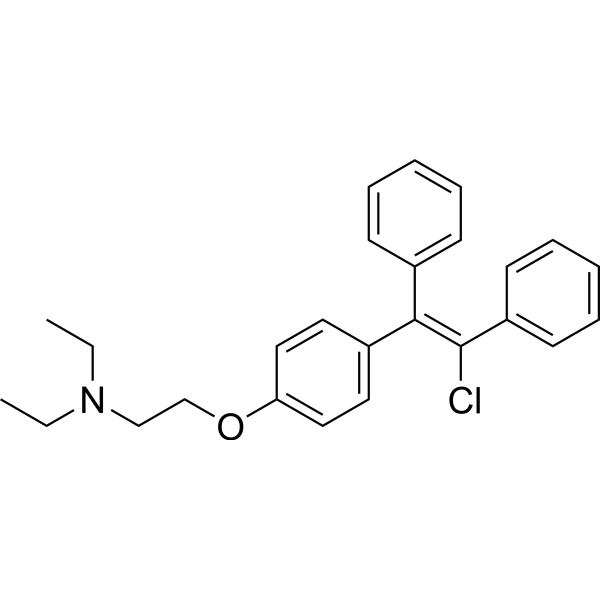
Clomiphene (Clomifene; (Z/E)-Enclomiphene; (Z/E)-Enclomifene) is an orally active ovulation-inducing agent. Clomiphene binds to hypothalamic estrogen receptors to elevate FSH levels, and exhibits antiestrogenic or estrogenic properties. Clomiphene can induce erturbations during meiotic maturation and cytogenetic abnormalities in mouse oocytes. Clomiphene ameliorates memory impairment in PCOS models. Clomiphene mobilizes cytosolic calcium and reduces viability in prostate cancer cells. Clomiphene can be used for the research of polycystic ovary syndrome (PCOS) and prostate cancer.
연구목적의 판매만을 진행합니다. 환자를 대상으로 한 판매는 하지 않습니다.
- Purity : 98.59%
- CAS No.: 911-45-5
- 화학식: C26H28ClNO
- 분자량:405.96
-
보관:Pure form -20°C, 3 years , 4°C, 2 years ; In solvent -80°C, 6 months , -20°C, 1 month

To place orders, for customer services and technical support, please contact: MedChemExpress USA
Tel: 609-228-6898 E-mail: [email protected] [email protected]


-
 Biological Activity
-
Chemical Information
-
용액&용해도
- Protocol
- 순도&문서
- References
-
 Help & FAQs


Publications Citing Use of MedChemExpress (MCE) Clomiphene
More

Biological Activity
제품 설명
Cellular Effect
|
Cell Line

|
Type | Value | Description | References |
|---|---|---|---|---|
| HT-1080 | IC50 |
37.86 μM
Compound: 76
|
Inhibition of IDH1 R132H mutant in human HT-1080 cells assessed as suppression of 2-HG production incubated for 48 hrs by LC-MS analysis
Inhibition of IDH1 R132H mutant in human HT-1080 cells assessed as suppression of 2-HG production incubated for 48 hrs by LC-MS analysis
|
[PMID: 29847930] |
In Vitro
Clomiphene (citrate) (1.0-5.0 μg/mL; 18 h) significantly increases hyperploidy and diploidy in cultured mouse germinal vesicle-stage oocytes, while reducing the proportion of metaphase I oocytes, indicating accelerated oocyte maturation[1].
Clomiphene (citrate) (10-50 μM) increases cytosolic free calcium levels in PC3 human prostate cancer cells with an EC50 of approximately 30 μM[4].
Clomiphene (citrate) (50 μM; 2-30 min) induces time-dependent mild cytotoxicity in PC3 human prostate cancer cells, reducing viability by 10-50% over 2-15 minutes of incubation with no further decrease after 15 minutes[4].
MedChemExpress (MCE) has not independently confirmed the accuracy of these methods. They are for reference only.
-
Cell Line:PC3 human prostate cancer cells
-
Concentration:50 μM
-
Incubation Time:2 min; 5 min; 10 min; 15 min; 20 min; 30 min
-
Result:Reduced cell viability in a time-dependent manner: 2 minutes of incubation reduced viability by 10%, 15 minutes of incubation reduced viability by 50%, and extending incubation to 30 minutes did not further reduce viability.
In Vivo
Clomiphene (citrate) (1 mg/kg; p.o.; daily; 15 days) improves spatial and non-spatial memory impairment, restores reproductive hormone levels, increases serum antioxidant enzyme concentrations, and downregulates prefrontal cortex AchE gene expression in Letrozole (HY-14248)-induced PCOS rats, but does not reduce anxiety-like behavior[2].
Clomiphene decreases serum gonadotropin levels and reduces testosterone secretion in rats[4].
MedChemExpress (MCE) has not independently confirmed the accuracy of these methods. They are for reference only.
-
Animal Model:ICR (female, 8-12 weeks, 25-34 g, ovarian stimulation with PMSG and hCG)[1]
-
Dosage:25, 50, 100 mg/kg
-
Administration:i.p.; 3 doses over 4 hours
-
Result:Increased hyperploidy to 1.5% (4 of 265 analyzed oocytes) and reduced average number of ovulated oocytes per mouse to 20.5 at 100 mg/kg.
Increased premature centromere separation to 5.0% (15 of 300 analyzed oocytes) and reduced average ovulated oocytes per mouse to 35.0 at 25 mg/kg.
Increased premature centromere separation to 3.6% (12 of 329 analyzed oocytes), increased single unpaired chromatids to 1.8% (6 of 329 analyzed oocytes), and reduced average ovulated oocytes per mouse to 37.7 at 50 mg/kg.
-
Animal Model:Wistar (female, 190-210 g, Letrozole-induced PCOS)[2]
-
Dosage:1 mg/kg
-
Administration:p.o.; daily; 15 days
-
Result:Significantly increased spontaneous alternation performance count and percentage in the Y maze compared to PCOS-only rats.
Increased serum superoxide dismutase (SOD) and catalase concentrations compared to PCOS-only rats.
Showed weak non-significant reduction in serum interleukin-1β (IL-1B) levels compared to PCOS-only rats.
Reversed upregulated acetylcholine esterase (AchE) gene expression in the prefrontal cortex compared to PCOS-only rats.
Reduced follicle-stimulating hormone (FSH) to 0.31 mIU/mL, reduced luteinizing hormone (LH) to 3.14 mIU/mL, increased estradiol to 27.68 ng/mL, and reduced testosterone to 0.28 ng/mL compared to PCOS-only rats.
Did not reduce anxiety-like behavior, as anxiety index values remained statistically high compared to control rats.
Clinical Trial
| NCT Number | Sponsor | Condition | Start Date |
Phase
|
|---|---|---|---|---|
| NCT01329991 | Plexxikon| | 2011-05 | PHASE1 |


Chemical Information
-
CAS No. 911-45-5
-
Appearance Oil
-
분자량 405.96
-
화학식 C26H28ClNO
-
Color Colorless to light yellow
-
SMILES
Cl/C(C1=CC=CC=C1)=C(C2=CC=C(C=C2)OCCN(CC)CC)/C3=CC=CC=C3
-
Synonyms
Clomifene; (Z/E)-Enclomiphene; (Z/E)-Enclomifene
-
선적
Room temperature in continental US; may vary elsewhere.
-
보관
Pure form -20°C 3 years 4°C 2 years In solvent -80°C 6 months -20°C 1 month


Publications (5)
-
Journal Impact Factor
-
Most Recent
-
J Cell Mol Med
2026 Apr;30(7):e71101. PMID: 41896195 -
J Pharm Biomed Anal
Screening method of mildronate and over 300 doping agents by reversed-phase liquid chromatography-high resolution mass spectrometry. [Abstract]2021 Feb 20:195:113870. PMID: 33453569 -
Biochem Biophys Res Commun
Combinatorial screening of a panel of FDA-approved drugs identifies several candidates with anti-Ebola activities. [Abstract]2020 Feb 19;522(4):862-868. PMID: 31806372 -
-


용액&용해도
In Vitro:
DMSO : 100 mg/mL (246.33 mM; Need ultrasonic; Hygroscopic DMSO has a significant impact on the solubility of product, please use newly opened DMSO)
Please refer to the solubility information to select the appropriate solvent. Once prepared, please aliquot and store the solution to prevent product inactivation from repeated freeze-thaw cycles.
Storage method and period of stock solution: -80°C, 6 months; -20°C, 1 month. When stored at -80°C, please use it within 6 months. When stored at -20°C, please use it within 1 month.
Please refer to the solubility information to select the appropriate solvent. Once prepared, please aliquot and store the solution to prevent product inactivation from repeated freeze-thaw cycles.
Storage method and period of stock solution: -80°C, 6 months; -20°C, 1 month. When stored at -80°C, please use it within 6 months. When stored at -20°C, please use it within 1 month.
Concentration (start) × Volume (start) = Concentration (final) × Volume (final)
In Vivo:
Select the appropriate dissolution method based on your experimental animal and administration route.
- For the following dissolution methods, please ensure to first prepare a clear stock solution using an In Vitro approach and then sequentially add co-solvents:
- To ensure reliable experimental results, the clarified stock solution can be appropriately stored based on storage conditions. As for the working solution for In Vivo experiments, it is recommended to prepare freshly and use it on the same day.
- The percentages shown for the solvents indicate their volumetric ratio in the final prepared solution. If precipitation or phase separation occurs during preparation, heat and/or sonication can be used to aid dissolution.
Add each solvent one by one: 10% DMSO 40% PEG300 5% Tween-80 45% Saline
Solubility: ≥ 5 mg/mL (12.32 mM); Clear solution
This protocol yields a clear solution of ≥ 5 mg/mL (saturation unknown).
Taking 1 mL working solution as an example, add 100 μL DMSO stock solution (50.0 mg/mL) to 400 μL PEG300, and mix evenly; then add 50 μL Tween-80 and mix evenly; then add 450 μL Saline to adjust the volume to 1 mL.
Preparation of Saline: Dissolve 0.9 g sodium chloride in ddH₂O and dilute to 100 mL to obtain a clear Saline solution.
In Vivo Dissolution Calculator
Please enter the basic information of animal experiments:
-
-
-
-
Recommended: Prepare an additional quantity of animals to account for potential losses during experiments.
Please enter your animal formula composition:
-
%DMSO +
Recommended: Keep the proportion of DMSO in working solution below 2% if your animal is weak.
-
%+
-
+%Tween-80 + +
-
%Saline +
The co-solvents required include: DMSO, . All of co-solvents are available by MedChemExpress (MCE). , Tween 80. All of co-solvents are available by MedChemExpress (MCE).
Working solution concentration: 0.22 mg/mL
Method for preparing stock solution: mg drug dissolved in μL DMSO. Stock solution concentration: mg/mL.
1. Take μL DMSO stock solution;
2. Add μL .
μL , mix evenly;
3. Then add μL Tween 80, mix evenly;
4. Then add μL
Please ensure that the stock solution in the first step is dissolved to a clear state, and add co-solvents in sequence. You can use ultrasonic heating (ultrasonic cleaner, recommended frequency 20-40 kHz), vortexing, etc. to assist dissolution.


순도&문서
-
Data Sheet (279 KB)
-
SDS (558 KB)
- English - EN (558 KB)
- Français - FR (558 KB)
- Deutsch - DE (558 KB)
- Norwegian - NO (558 KB)
- Español - ES (558 KB)
- Swedish - SV (558 KB)
- Italian - IT (558 KB)
- Korean - KR (558 KB)
- Portuguese - PT (558 KB)
-
Handling Instructions (2659 KB)
References
[1]. London SN, et al. Clomiphene citrate-induced perturbations during meiotic maturation and cytogenetic abnormalities in mouse oocytes in vivo and in vitro. Fertil Steril. 2000;73(3):620-626. [Content Brief]
[2]. Akintoye OO, et al. Synergistic action of carvedilol and clomiphene in mitigating the behavioral phenotypes of letrozole-model of PCOS rats by modulating the NRF2/NFKB pathway. Life Sci. 2023;324:121737. [Content Brief]
[3]. Legro R S, et al. Clomiphene, metformin, or both for infertility in the polycystic ovary syndrome[J]. New England Journal of Medicine, 2007, 356(6): 551-566. [Content Brief]
[4]. Jiann BP, et al. Effect of clomiphene on Ca(2+) movement in human prostate cancer cells. Life Sci. 2002;70(26):3167-3178. [Content Brief]


Complete Stock Solution Preparation Table
Please refer to the solubility information to select the appropriate solvent. Once prepared, please aliquot and store the solution to prevent product inactivation from repeated freeze-thaw cycles.
Storage method and period of stock solution: -80°C, 6 months; -20°C, 1 month. When stored at -80°C, please use it within 6 months. When stored at -20°C, please use it within 1 month.
| Optional Solvent | Concentration Solvent Mass | 1 mg | 5 mg | 10 mg | 25 mg |
|---|---|---|---|---|---|
| DMSO | 1 mM | 2.4633 mL | 12.3165 mL | 24.6330 mL | 61.5824 mL |
| 5 mM | 0.4927 mL | 2.4633 mL | 4.9266 mL | 12.3165 mL | |
| 10 mM | 0.2463 mL | 1.2316 mL | 2.4633 mL | 6.1582 mL | |
| 15 mM | 0.1642 mL | 0.8211 mL | 1.6422 mL | 4.1055 mL | |
| 20 mM | 0.1232 mL | 0.6158 mL | 1.2316 mL | 3.0791 mL | |
| 25 mM | 0.0985 mL | 0.4927 mL | 0.9853 mL | 2.4633 mL | |
| 30 mM | 0.0821 mL | 0.4105 mL | 0.8211 mL | 2.0527 mL | |
| 40 mM | 0.0616 mL | 0.3079 mL | 0.6158 mL | 1.5396 mL | |
| 50 mM | 0.0493 mL | 0.2463 mL | 0.4927 mL | 1.2316 mL | |
| 60 mM | 0.0411 mL | 0.2053 mL | 0.4105 mL | 1.0264 mL | |
| 80 mM | 0.0308 mL | 0.1540 mL | 0.3079 mL | 0.7698 mL | |
| 100 mM | 0.0246 mL | 0.1232 mL | 0.2463 mL | 0.6158 mL |


Clomiphene Related Classifications
HY-A0287 Related Classifications
 Powered by Bioz
Keywords
- Clomiphene
- 911-45-5
- Clomifene
- (Z/E)-Enclomiphene
- (Z/E)-Enclomifene
- Estrogen Receptor/ERR
- endoplasmic reticulum
- polycystic ovary syndrome
- PC3 human prostate cancer cells
- PCOS models
- hypothalamic estrogen receptors
- letrozole-induced PCOS rats
- mouse oocytes
- prostate cancer cells
- estrogen receptor
- musk shrews
- Inhibitor
- inhibitor
- inhibit