



Vinburnine
Based on 3 publication(s) in Google Scholar
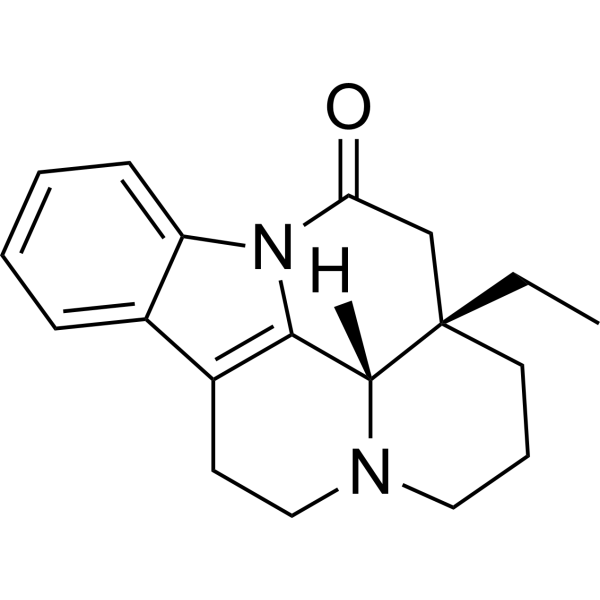
Vinburnine ((-)-Eburnamonine; (-)-Vincamone) is an orally active, blood-brain barrier permeable immunomodulator and apoptosis inducer. Vinburnine drives the secretion of IL-24 by activating the P38/MAPK/ATF3 signaling axis. Vinburnine induces reactive oxygen species production and DNA damage in cancer cells, thereby inhibiting cancer cell proliferation, activating the apoptotic cascade, and enhancing CD8+ T cell function to remodel the tumor immune microenvironment. Vinburnine can be used in the research of diseases such as melanoma.
For research use only. We do not sell to patients.
- Purity : 98.30%
- CAS No.: 4880-88-0
- Formula: C19H22N2O
- Molecular Weight:294.40
-
Storage:Powder -20°C, 3 years ; In solvent -80°C, 6 months , -20°C, 1 month

To place orders, for customer services and technical support, please contact: MedChemExpress USA
Tel: 609-228-6898 E-mail: [email protected] [email protected]


-
 Biological Activity
-
Chemical Information
-
Solvent & Solubility
- Protocols
- Purity & Documentation
- References
-
 Help & FAQs



Publications Citing Use of MedChemExpress (MCE) Vinburnine
More

Biological Activity
Description
Cellular Effect
|
Cell Line

|
Type | Value | Description | References |
|---|---|---|---|---|
| KMS-12-BM | IC50 |
>100 μM
Compound: 2
|
Cytotoxicity against human KMS-12-BM cells after 96 hrs by MTS assay
Cytotoxicity against human KMS-12-BM cells after 96 hrs by MTS assay
|
[PMID: 24055047] |
| LNCaP | IC50 |
>100 μM
Compound: 2
|
Cytotoxicity against human LNCAP cells after 96 hrs by MTS assay
Cytotoxicity against human LNCAP cells after 96 hrs by MTS assay
|
[PMID: 24055047] |
| MDA-MB-231 | IC50 |
41.8 μM
Compound: 2
|
Cytotoxicity against human MDA-MB-231 cells after 96 hrs by MTS assay
Cytotoxicity against human MDA-MB-231 cells after 96 hrs by MTS assay
|
[PMID: 24055047] |
| RPMI-8226 | IC50 |
>100 μM
Compound: 2
|
Cytotoxicity against human RPMI8226 cells after 96 hrs by MTS assay
Cytotoxicity against human RPMI8226 cells after 96 hrs by MTS assay
|
[PMID: 24055047] |
| U-266 | IC50 |
>100 μM
Compound: 2
|
Cytotoxicity against human U266 cells after 96 hrs by MTS assay
Cytotoxicity against human U266 cells after 96 hrs by MTS assay
|
[PMID: 24055047] |
In Vitro
Vinburnine (2.5-20 μM; 24-72 h) dose- and time-dependently reduces viability of SK-MEL-5, SK-MEL-28, A375, and B16F10 melanoma cells with IC50 values of ~5 μM (human lines) and ~7.5 μM (murine line), while sparing normal human melanocytes[1].
Vinburnine (2.5-10 μM; 48 h) dose-dependently suppresses colony formation in SK-MEL-5, SK-MEL-28, A375, and B16F10 melanoma cells, with near-complete inhibition at 5 μM in human lines and significant inhibition at 10 μM in the murine line[1].
Vinburnine inhibits migration of A375, SK-MEL-28, and SK-MEL-5 melanoma cells in a wound healing assay[1].
Vinburnine (2.5-5 μM; 12-24 h) inhibits migration and invasion of A375, SK-MEL-28, and SK-MEL-5 melanoma cells in Transwell assays[1].
Vinburnine induces ROS overproduction in A375, SK-MEL-28, and SK-MEL-5 melanoma cells, which mediates its growth-inhibitory effects[1].
Vinburnine induces DNA strand breaks in A375, SK-MEL-28, and SK-MEL-5 melanoma cells[1].
Vinburnine activates the DNA damage response pathway in A375, SK-MEL-28, SK-MEL-5, and B16F10 melanoma cells, as evidenced by upregulated p-ATM, p-ATR, and γH2AX detected via Western blot[1].
Vinburnine (2.5-5 μM; 24 h) induces G0/G1 phase cell cycle arrest in A375, SK-MEL-28, and SK-MEL-5 melanoma cells[1].
Vinburnine (2.5-5 μM; 24 h) induces apoptosis in A375, SK-MEL-28, and SK-MEL-5 melanoma cells as measured by flow cytometry[1].
Vinburnine (2.5-5 μM; 24 h) modulates apoptosis-related protein expression in A375, SK-MEL-28, and SK-MEL-5 melanoma cells via upregulation of pro-apoptotic proteins and downregulation of anti-apoptotic BCL-2[1].
Vinburnine activates the IL-24 promoter to enhance its transcriptional activity in melanoma cells[1].
Vinburnine (2.5-5 μM; 48 h) enhances the interaction between ATF3 protein and the IL-24 promoter in SK-MEL-28 melanoma cells[1].
Vinburnine enhances the in vitro cytotoxicity of PBMCs and CD8+ T cells against A375-luciferase and B16F10-luciferase melanoma cells[1].
MedChemExpress (MCE) has not independently confirmed the accuracy of these methods. They are for reference only.
-
Cell Line:SK-MEL-5, SK-MEL-28, A375, B16F10, PIG1
-
Concentration:2.5-20 μM
-
Incubation Time:24-72 h
-
Result:Significantly reduced cell viability in a dose- and time-dependent manner across all tested melanoma cell lines.
Exhibited IC50 values of approximately 5 μM for SK-MEL-5, SK-MEL-28, and A375 cells, and around 7.5 μM for B16F10 cells.
Showed no cytotoxic effect in normal human melanocytes (PIG1) even at 20 μM.
-
Cell Line:A375, SK-MEL-28, SK-MEL-5
-
Concentration:2.5-5 μM
-
Incubation Time:24 h
-
Result:Markedly arrested melanoma cells in the G0/G1 phase.
-
Cell Line:A375, SK-MEL-28, SK-MEL-5
-
Concentration:2.5-5 μM
-
Incubation Time:24 h
-
Result:Caused a significant rise in early apoptotic cell populations (Annexin V+PI−) and late apoptotic cell populations (Annexin V+PI+).
-
Cell Line:A375, SK-MEL-28, SK-MEL-5
-
Concentration:2.5-5 μM
-
Incubation Time:24 h
-
Result:Increased expression of pro-apoptotic proteins BAX, cleaved caspase-3, and cleaved caspase-9.
Downregulated anti-apoptotic factor BCL-2.
In Vivo
MedChemExpress (MCE) has not independently confirmed the accuracy of these methods. They are for reference only.
-
Animal Model:C57BL/6 (8-week-old female; subcutaneous injection of 5 × 10⁵ B16F10 melanoma cells)[1]
-
Dosage:10 mg/kg; 20 mg/kg
-
Administration:p.o.; daily; 10 days
-
Result:Significantly reduced tumor volume compared to vehicle control.
Increased tumor-infiltrating CD8+ T cells from 5.03% to 17.9% of CD3+ cells.
Increased CD4+ T cells from ~5% to ~10% of CD3+ cells.
Increased NK1.1+ cells from ~2% to ~4% of CD45+ cells.
Caused no significant changes in mouse body weight during treatment.
- Annexin V plus membrane-impermeant dye apoptosis staining
- ROS/oxidative-stress fluorescent staining
- BrdU Incorporation Assay
- Somatic Cell Culture
- CFSE Dye Dilution Proliferation Assay
- Dye-dilution cell tracking and proliferation staining
- CCK-8/WST-8 Cell Proliferation Assay
- Protocol for Cell Cycle
- Cell Counting-Based Growth Curve Assay
- Colony Formation (Clonogenic) Assay
- Research Protocol for Cancer Immunology
- Cell Viability Determination by MTT Colorimetric Assay
- EdU Incorporation Assay (Click Chemistry-Based DNA Synthesis Measurement)
- Detection of Apoptosis
- TUNEL staining for apoptotic DNA fragmentation
- Ki-67 Immunostaining Proliferation Assay
- PCNA Immunodetection Proliferation Assay
- Protocol for Cell Counting and Cell Density Analysis
- Apoptosis Solutions
- MTT Cell Proliferation Assay
- Genotoxicity/Mutagenicity Study


Chemical Information
-
CAS No. 4880-88-0
-
Appearance Solid
-
Molecular Weight 294.40
-
Formula C19H22N2O
-
Color White to off-white
-
SMILES
O=C1C[C@@]2(CC)[C@@]3([H])C(N1C4=CC=CC=C54)=C5CCN3CCC2
-
Synonyms
(-)-Eburnamonine; (-)-Vincamone
-
Structure Classification
-
Initial Source
-
Shipping
Room temperature in continental US; may vary elsewhere.
-
Storage
Powder -20°C 3 years In solvent -80°C 6 months -20°C 1 month


Publications (3)
-
Journal Impact Factor
-
Most Recent
-
J Exp Clin Cancer Res
Vinburnine potentiates anti-PD1 immunotherapy in melanoma through IL-24 secretion via P38/MAPK/ATF3 signaling. [Abstract]2025 Aug 27;44(1):255. PMID: 40866941 -
Adv Sci (Weinh)
Vinburnine Sensitizes Radiotherapy Efficacy in Nasopharyngeal Carcinoma by Triggering Pyroptosis and Immune Responses via Activation of EDAR-NFκB Pathway. [Abstract]2025 Sep 25:e06139. PMID: 40995667 -


Solvent & Solubility
In Vitro:
DMSO : 8.33 mg/mL (28.29 mM; Need ultrasonic; Hygroscopic DMSO has a significant impact on the solubility of product, please use newly opened DMSO)
Please refer to the solubility information to select the appropriate solvent. Once prepared, please aliquot and store the solution to prevent product inactivation from repeated freeze-thaw cycles.
Storage method and period of stock solution: -80°C, 6 months; -20°C, 1 month. When stored at -80°C, please use it within 6 months. When stored at -20°C, please use it within 1 month.
Please refer to the solubility information to select the appropriate solvent. Once prepared, please aliquot and store the solution to prevent product inactivation from repeated freeze-thaw cycles.
Storage method and period of stock solution: -80°C, 6 months; -20°C, 1 month. When stored at -80°C, please use it within 6 months. When stored at -20°C, please use it within 1 month.
Concentration (start) × Volume (start) = Concentration (final) × Volume (final)
In Vivo:
Select the appropriate dissolution method based on your experimental animal and administration route.
- For the following dissolution methods, please ensure to first prepare a clear stock solution using an In Vitro approach and then sequentially add co-solvents:
- To ensure reliable experimental results, the clarified stock solution can be appropriately stored based on storage conditions. As for the working solution for In Vivo experiments, it is recommended to prepare freshly and use it on the same day.
- The percentages shown for the solvents indicate their volumetric ratio in the final prepared solution. If precipitation or phase separation occurs during preparation, heat and/or sonication can be used to aid dissolution.
Add each solvent one by one: 10% DMSO 40% PEG300 5% Tween-80 45% Saline
Solubility: ≥ 0.83 mg/mL (2.82 mM); Clear solution
This protocol yields a clear solution of ≥ 0.83 mg/mL (saturation unknown).
Taking 1 mL working solution as an example, add 100 μL DMSO stock solution (8.3 mg/mL) to 400 μL PEG300, and mix evenly; then add 50 μL Tween-80 and mix evenly; then add 450 μL Saline to adjust the volume to 1 mL.
Preparation of Saline: Dissolve 0.9 g sodium chloride in ddH₂O and dilute to 100 mL to obtain a clear Saline solution.
Add each solvent one by one: 10% DMSO 90% (20% SBE-β-CD in Saline)
Solubility: ≥ 0.83 mg/mL (2.82 mM); Clear solution
This protocol yields a clear solution of ≥ 0.83 mg/mL (saturation unknown).
Taking 1 mL working solution as an example, add 100 μL DMSO stock solution (8.3 mg/mL) to 900 μL 20% SBE-β-CD in Saline, and mix evenly.
Preparation of 20% SBE-β-CD in Saline (4°C, storage for one week): 2 g SBE-β-CD powder is dissolved in 10 mL Saline, completely dissolve until clear.
In Vivo Dissolution Calculator
Please enter the basic information of animal experiments:
-
-
-
-
Recommended: Prepare an additional quantity of animals to account for potential losses during experiments.
Please enter your animal formula composition:
-
%DMSO +
Recommended: Keep the proportion of DMSO in working solution below 2% if your animal is weak.
-
%+
-
+%Tween-80 + +
-
%Saline +
The co-solvents required include: DMSO, . All of co-solvents are available by MedChemExpress (MCE). , Tween 80. All of co-solvents are available by MedChemExpress (MCE).
Working solution concentration: 0.22 mg/mL
Method for preparing stock solution: mg drug dissolved in μL DMSO. Stock solution concentration: mg/mL.
1. Take μL DMSO stock solution;
2. Add μL .
μL , mix evenly;
3. Then add μL Tween 80, mix evenly;
4. Then add μL
Please ensure that the stock solution in the first step is dissolved to a clear state, and add co-solvents in sequence. You can use ultrasonic heating (ultrasonic cleaner, recommended frequency 20-40 kHz), vortexing, etc. to assist dissolution.


Purity & Documentation
-
Data Sheet (302 KB)
-
SDS (419 KB)
- English - EN (419 KB)
- Français - FR (419 KB)
- Deutsch - DE (419 KB)
- Norwegian - NO (419 KB)
- Español - ES (419 KB)
- Swedish - SV (419 KB)
- Italian - IT (419 KB)
- Korean - KR (419 KB)
- Portuguese - PT (419 KB)
-
Handling Instructions (2659 KB)
References
[1]. Zhu S, et al. Vinburnine potentiates anti-PD1 immunotherapy in melanoma through IL-24 secretion via P38/MAPK/ATF3 signaling. Journal of experimental & clinical cancer research : CR. 2025 Aug 27;44(1):255. [Content Brief]
[2]. Fandy TE, et al. In vitro characterization of transport and metabolism of the alkaloids: vincamine, vinpocetine and eburnamonine. Cancer chemotherapy and pharmacology. 2016 Feb;77(2):259-67. [Content Brief]


Complete Stock Solution Preparation Table
Please refer to the solubility information to select the appropriate solvent. Once prepared, please aliquot and store the solution to prevent product inactivation from repeated freeze-thaw cycles.
Storage method and period of stock solution: -80°C, 6 months; -20°C, 1 month. When stored at -80°C, please use it within 6 months. When stored at -20°C, please use it within 1 month.
| Optional Solvent | Concentration Solvent Mass | 1 mg | 5 mg | 10 mg | 25 mg |
|---|---|---|---|---|---|
| DMSO | 1 mM | 3.3967 mL | 16.9837 mL | 33.9674 mL | 84.9185 mL |
| 5 mM | 0.6793 mL | 3.3967 mL | 6.7935 mL | 16.9837 mL | |
| 10 mM | 0.3397 mL | 1.6984 mL | 3.3967 mL | 8.4918 mL | |
| 15 mM | 0.2264 mL | 1.1322 mL | 2.2645 mL | 5.6612 mL | |
| 20 mM | 0.1698 mL | 0.8492 mL | 1.6984 mL | 4.2459 mL | |
| 25 mM | 0.1359 mL | 0.6793 mL | 1.3587 mL | 3.3967 mL |


Vinburnine Related Classifications
HY-B1180 Related Classifications
 Powered by Bioz