



DMPX

Based on 1 Customer Validation
DMPX (3,7-Dimethyl-1-propargylxanthine) is a selective A2A adenosine receptor (A2A AR) antagonist that crosses the blood-brain barrier, with a Ki of 11 μM for rat A2 adenosine receptor and a Ki of 45 μM for rat A1 adenosine receptor. By blocking A2A receptors in specific brain regions, DMPX protects dopaminergic and GABAergic neurons from mitochondrial dysfunction. DMPX is applicable to research related to depression, Parkinson's disease and Huntington's disease.
Para uso exclusivo en investigación. No vendemos a pacientes.
- Pureza : 99.66%
- No. CAS: 14114-46-6
- Fòrmula: C10H10N4O2
- Peso molecular:218.21
-
Almacenamiento:Powder -20°C, 3 years , 4°C, 2 years ; In solvent -80°C, 6 months , -20°C, 1 month


To place orders, for customer services and technical support, please contact: MedChemExpress USA
Tel: 609-228-6898 E-mail: [email protected] [email protected]


-
 Actividad biológica
-
Chemical Information
-
Solvente y solubilidad
- Protocolo
- Pureza y Documentación
- Referencias
-
 Help & FAQs


-
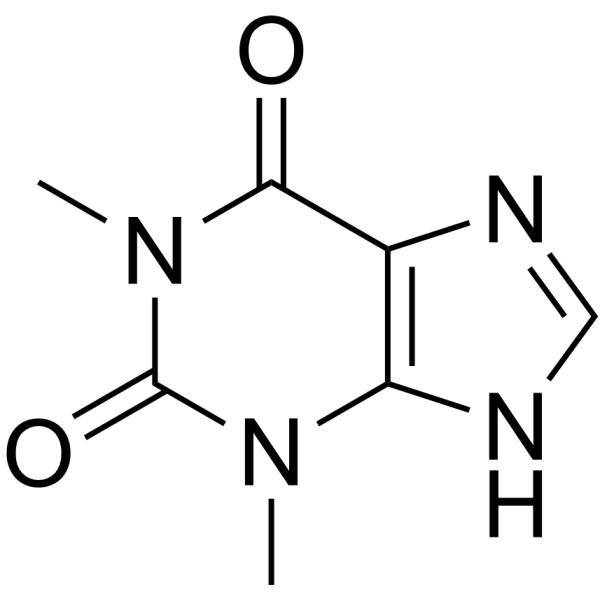
HY-B0809
TheophyllinePDE Inhibitor -
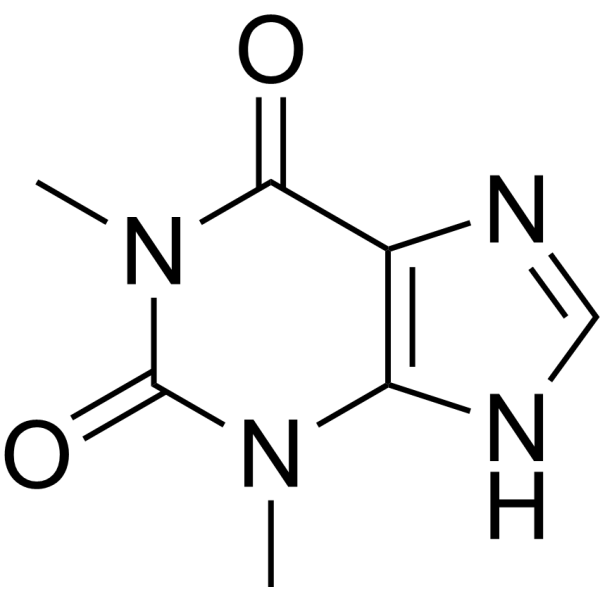
HY-B0809R
Theophylline (Standard) -
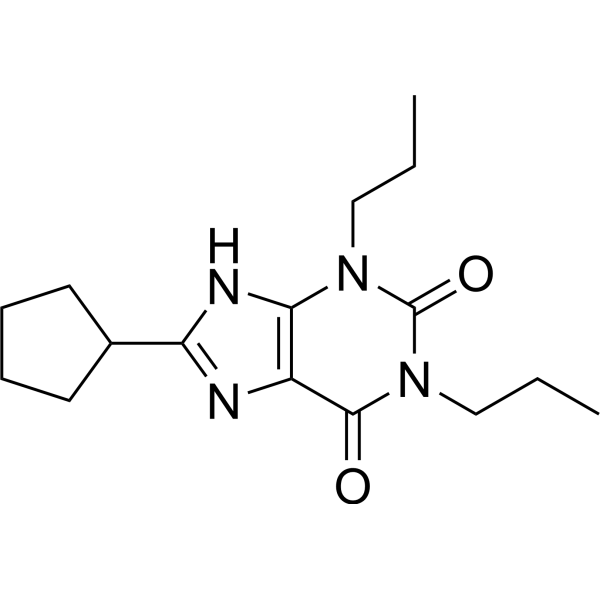
HY-100937
DPCPXA1 Receptor Antagonist -
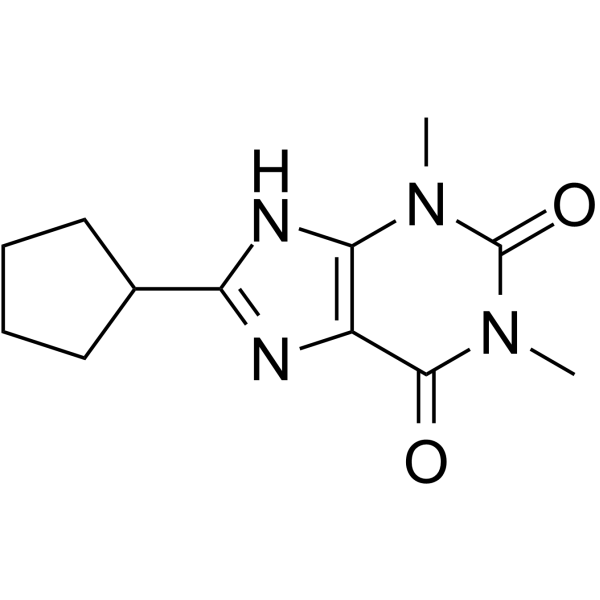
HY-W011955
8-Cyclopentyl-1,3-dimethylxanthineA1 Receptor Antagonist -

HY-100937R
DPCPX (Standard)A1 Receptor Antagonist -

HY-W011955R
8-Cyclopentyl-1,3-dimethylxanthine (Standard)A1 Receptor Antagonist
Ver todos los productos específicos de isoformas Adenosine Receptor
More

Actividad biológica
Descripciòn
IC50 & Target
[2]|
A2AR 11 μM (Ki) |
A1AR 45 μM (Ki) |
In Vivo
DMPX (0.032-10 mg/kg; 9.9 μmol/kg; i.p.; single administration) is a potent and selective in vivo A2 adenosine receptor antagonist. It is 57 times more potent at blocking NECA-induced hypothermia than CHA (HY-18939)-induced hypothermia, and 11 times more potent at blocking NECA (HY-103173)-induced motor inhibition than CHA-induced motor inhibition. In addition, its intrinsic motor stimulant potency (ED50 = 9.9 μmoL/kg) is slightly higher than that of caffeine[2].
DMPX (5 mg/kg; i.p.; single administration) significantly attenuates the malonate-induced depletion of striatal dopamine and tyrosine hydroxylase (TH). In rats, DMPX also completely blocks malonate-induced striatal GABA loss[3].
MedChemExpress (MCE) has not independently confirmed the accuracy of these methods. They are for reference only.
-
Animal Model:Albino Swiss (male, adult, 25-30 g)[1]
-
Dosage:3 mg/kg
-
Administration:i.p.; single dose (30 minutes prior to tests/decapitation)
-
Result:Significantly reduced the immobility time of mice in the forced swimming test and the tail suspension test, and produced an antidepressant-like synergistic effect.
-
Animal Model:DBA/2 (10-week-old, male, inbred)[2]
-
Dosage:0.032, 0.1, 0.32, 1.0, 3.2, 10 mg/kg (blockade of hypothermia/locomotor depression); 9.9 μmol/kg (intrinsic locomotor stimulation)
-
Administration:i.p.; single dose; 15 minutes prior to agonist administration (blockade assays); i.p.; single dose (intrinsic stimulation assay)
-
Result:Antagonized NECA-induced hypothermia and motor inhibition.
-
Animal Model:Swiss-Webster (male, 30-35 gm) and Sprague-Dawley (male, 300-375 gm, intrastriatal malonate infusion induced)[3]
-
Dosage:5 mg/kg
-
Administration:i.p.; single dose; 30 min prior to malonate infusion
-
Result:Significantly alleviated the depletion of dopamine and TH in the striatum caused by succinic acid.
Completely blocked the loss of GABA in the striatum caused by succinic acid in rats.


Chemical Information
-
No. CAS 14114-46-6
-
Appearance Solid
-
Peso molecular 218.21
-
Fòrmula C10H10N4O2
-
Color White to off-white
-
SMILES
O=C1C2=C(N(C)C(N1CC#C)=O)N=CN2C
-
Synonyms
3,7-Dimethyl-1-propargylxanthine
-
Envío
Room temperature in continental US; may vary elsewhere.
-
Almacenamiento
Powder -20°C 3 years 4°C 2 years In solvent -80°C 6 months -20°C 1 month


Solvente y solubilidad
In Vitro:
DMSO : 40 mg/mL (183.31 mM; Need ultrasonic; Hygroscopic DMSO has a significant impact on the solubility of product, please use newly opened DMSO)
Please refer to the solubility information to select the appropriate solvent. Once prepared, please aliquot and store the solution to prevent product inactivation from repeated freeze-thaw cycles.
Storage method and period of stock solution: -80°C, 6 months; -20°C, 1 month. When stored at -80°C, please use it within 6 months. When stored at -20°C, please use it within 1 month.
Please refer to the solubility information to select the appropriate solvent. Once prepared, please aliquot and store the solution to prevent product inactivation from repeated freeze-thaw cycles.
Storage method and period of stock solution: -80°C, 6 months; -20°C, 1 month. When stored at -80°C, please use it within 6 months. When stored at -20°C, please use it within 1 month.
Concentration (start) × Volume (start) = Concentration (final) × Volume (final)
In Vivo:
Select the appropriate dissolution method based on your experimental animal and administration route.
- For the following dissolution methods, please ensure to first prepare a clear stock solution using an In Vitro approach and then sequentially add co-solvents:
- To ensure reliable experimental results, the clarified stock solution can be appropriately stored based on storage conditions. As for the working solution for In Vivo experiments, it is recommended to prepare freshly and use it on the same day.
- The percentages shown for the solvents indicate their volumetric ratio in the final prepared solution. If precipitation or phase separation occurs during preparation, heat and/or sonication can be used to aid dissolution.
Add each solvent one by one: 10% DMSO 40% PEG300 5% Tween-80 45% Saline
Solubility: ≥ 4 mg/mL (18.33 mM); Clear solution
This protocol yields a clear solution of ≥ 4 mg/mL (saturation unknown).
Taking 1 mL working solution as an example, add 100 μL DMSO stock solution (40.0 mg/mL) to 400 μL PEG300, and mix evenly; then add 50 μL Tween-80 and mix evenly; then add 450 μL Saline to adjust the volume to 1 mL.
Preparation of Saline: Dissolve 0.9 g sodium chloride in ddH₂O and dilute to 100 mL to obtain a clear Saline solution.
In Vivo Dissolution Calculator
Please enter the basic information of animal experiments:
-
-
-
-
Recommended: Prepare an additional quantity of animals to account for potential losses during experiments.
Please enter your animal formula composition:
-
%DMSO +
Recommended: Keep the proportion of DMSO in working solution below 2% if your animal is weak.
-
%+
-
+%Tween-80 + +
-
%Saline +
The co-solvents required include: DMSO, . All of co-solvents are available by MedChemExpress (MCE). , Tween 80. All of co-solvents are available by MedChemExpress (MCE).
Working solution concentration: 0.22 mg/mL
Method for preparing stock solution: mg drug dissolved in μL DMSO. Stock solution concentration: mg/mL.
1. Take μL DMSO stock solution;
2. Add μL .
μL , mix evenly;
3. Then add μL Tween 80, mix evenly;
4. Then add μL
Please ensure that the stock solution in the first step is dissolved to a clear state, and add co-solvents in sequence. You can use ultrasonic heating (ultrasonic cleaner, recommended frequency 20-40 kHz), vortexing, etc. to assist dissolution.


Pureza y Documentación
-
Ficha de datos (280 KB)
-
SDS (393 KB)
- English - EN (393 KB)
- Français - FR (393 KB)
- Deutsch - DE (393 KB)
- Norwegian - NO (393 KB)
- Español - ES (393 KB)
- Swedish - SV (393 KB)
- Italian - IT (393 KB)
- Korean - KR (393 KB)
- Portuguese - PT (393 KB)
-
Instrucciones de manejo (2659 KB)
Referencias
[1]. Szopa A, et al. Agomelatine and tianeptine antidepressant activity in mice behavioral despair tests is enhanced by DMPX, a selective adenosine A2A receptor antagonist, but not DPCPX, a selective adenosine A1 receptor antagonist. Pharmacol Rep. 2019;71(4):676-681. [Content Brief]
[2]. Seale TW, et al. 3,7-Dimethyl-1-propargylxanthine: a potent and selective in vivo antagonist of adenosine analogs. Life Sci. 1988;43(21):1671-1684. [Content Brief]
[3]. Alfinito PD, et al. Adenosinergic protection of dopaminergic and GABAergic neurons against mitochondrial inhibition through receptors located in the substantia nigra and striatum, respectively. J Neurosci. 2003;23(34):10982-10987. [Content Brief]


Complete Stock Solution Preparation Table
Please refer to the solubility information to select the appropriate solvent. Once prepared, please aliquot and store the solution to prevent product inactivation from repeated freeze-thaw cycles.
Storage method and period of stock solution: -80°C, 6 months; -20°C, 1 month. When stored at -80°C, please use it within 6 months. When stored at -20°C, please use it within 1 month.
| Optional Solvent | Concentration Solvent Mass | 1 mg | 5 mg | 10 mg | 25 mg |
|---|---|---|---|---|---|
| DMSO | 1 mM | 4.5827 mL | 22.9137 mL | 45.8274 mL | 114.5685 mL |
| 5 mM | 0.9165 mL | 4.5827 mL | 9.1655 mL | 22.9137 mL | |
| 10 mM | 0.4583 mL | 2.2914 mL | 4.5827 mL | 11.4569 mL | |
| 15 mM | 0.3055 mL | 1.5276 mL | 3.0552 mL | 7.6379 mL | |
| 20 mM | 0.2291 mL | 1.1457 mL | 2.2914 mL | 5.7284 mL | |
| 25 mM | 0.1833 mL | 0.9165 mL | 1.8331 mL | 4.5827 mL | |
| 30 mM | 0.1528 mL | 0.7638 mL | 1.5276 mL | 3.8190 mL | |
| 40 mM | 0.1146 mL | 0.5728 mL | 1.1457 mL | 2.8642 mL | |
| 50 mM | 0.0917 mL | 0.4583 mL | 0.9165 mL | 2.2914 mL | |
| 60 mM | 0.0764 mL | 0.3819 mL | 0.7638 mL | 1.9095 mL | |
| 80 mM | 0.0573 mL | 0.2864 mL | 0.5728 mL | 1.4321 mL | |
| 100 mM | 0.0458 mL | 0.2291 mL | 0.4583 mL | 1.1457 mL |


DMPX Related Classifications
HY-W004425 Related Classifications
 Powered by Bioz