



Tianeptine
Based on 1 publication(s) in Google Scholar
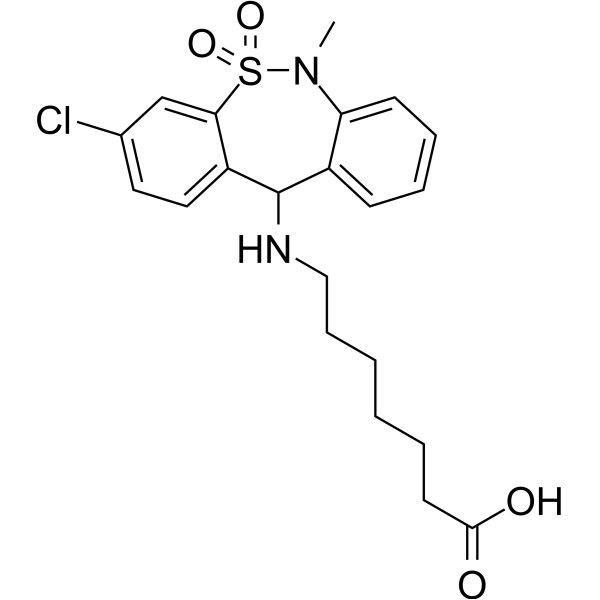
Tianeptine is an atypical antidepressant. Tianeptine is a moderate-intensity agonist of the μ-opioid receptor (MOR), and to a lesser extent, is an agonist of the δ-opioid receptor (DOR). Tianeptine is a glutamate modulator that can enhance AMPA receptor and antagonize NMDA receptor. tianeptine increases sensitivity of the α1 adrenergic receptor, which only manifests in chronic treatment. Tianeptine exerts neuroprotective effects under stress/inflammation-induced conditions, exhibiting anti-inflammatory and antioxidant properties. Tianeptine inhibits MMP-9 by suppressing the PI3K/Akt-mediated NF-κB pathway. Tianeptine can be used to alleviate symptoms of depression and anxiety, but does not cause sedative effects.
For research use only. We do not sell to patients.
- Purity: 99.21%
- CAS No.: 72797-41-2
- Formula: C21H25ClN2O4S
- Molecular Weight:436.95
-
Storage:Powder -20°C, 3 years , 4°C, 2 years ; In solvent -80°C, 6 months , -20°C, 1 month

To place orders, for customer services and technical support, please contact: MedChemExpress USA
Tel: 609-228-6898 E-mail: [email protected] [email protected]


-
 Biological Activity
-
Chemical Information
-
Solvent & Solubility
- Purity & Documentation
- References
-
 Help & FAQs




Publications Citing Use of MedChemExpress (MCE) Tianeptine
MoreAll Opioid Receptor Isoforms
MoreAll iGluR Isoforms
More

Biological Activity
|
μ Opioid Receptor/MOR |
δ Opioid Receptor/DOR |
MMP-9 |
Akt |
PI3K |
NF-κB |
Tianeptine inhibits the polarization of microglia/macrophages to a pro-inflammatory (M1) phenotype by stimulating MOR, and increases the activity of antioxidant enzymes such as superoxide dismutase (SOD) and catalase, thereby alleviating oxidative stress damage[2].
Tianeptine can increase BDNF and NGF levels in brain regions such as the hippocampus and amygdala, and promote neurogenesis in the dentate gyrus of the hippocampus[2].
Tianeptine (0.1-100 μM, 14 days) significantly reduces hypoxia-induced LDH release in rat embryonic cortical neurons[4].
Tianeptine (10 μM) does not reduce neuronal apoptosis induced directly by NMDA (HY-17551), but shows a slight but significant protective effect in the presence of IL-1β in mouse cortical neurons[4].
Tianeptine demonstrates low cardiotoxicity and minimal risk of CYP-mediated drug-drug interactions (DDIs)[1].
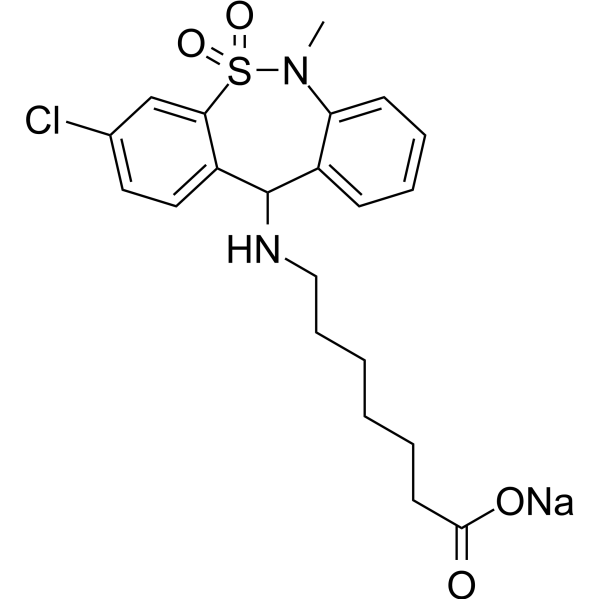
Tianeptine sodium salt (125-500 µM, 24 h) suppresses TNF-α-induced expression of MMP-9 in human carcinoma cells MDA-MB-231 via suppression of the PI3K/Akt-mediated NF-κB pathway[5].
MedChemExpress (MCE) has not independently confirmed the accuracy of these methods. They are for reference only.
-
Cell Line:LNCaP cells
-
Concentration:500 μM
-
Incubation Time:24 h
-
Result:Significantly attenuated TNF-α-stimulated cancer cell invasion.
-
Cell Line:LNCaP cells
-
Concentration:125, 250, 500 μM
-
Incubation Time:1, 6 h
-
Result:Dose-dependent inhibited MMP-9 expression.
Blocked TNF-α-induced IκBα degradation and p65/p50 nuclear translocation.
Inhibited TNF-α-induced phosphorylation of PI3K and Akt.
Tianeptine does not modify the rate of extracellular serotonin in rats, so it does not increase or decrease the reuptake of serotonin[2].
Tianeptine improves cognitive deficits and memory impairment caused by stress, and enhances learning ability and spatial memory[2].
Tianeptine (5-10 mg/kg, i.p., single dose) exhibits significant analgesic effects in both the hot-plate and tail-flick thermal pain models in mice without causing motor impairment[3].
Tianeptine (1-10 mg/kg, i.p., single dose or twice daily for 5 days) shows neuroprotective effect which is not achieved by directly antagonizing NMDA receptors, but is only fully stimulated in pathological conditions with inflammatory/cytokine provocation[4].
MedChemExpress (MCE) has not independently confirmed the accuracy of these methods. They are for reference only.
-
Animal Model:Corticosterone release assay established in male Wistar rats, weighing initially 260-280 g[1]
-
Dosage:10 mg/kg (without Benserazide (HY-121275)) and 50 mg/kg (with Benserazide)
-
Administration:Intraperitoneal injection (i.p.), single dose
-
Result:Did not antagonize 5-HTP-induced peripheral corticosterone release. Specifically antagonized the appetite suppression and weight loss effects caused by increased central 5-HT.
-
Animal Model:Hot-plate and tail-flick model established in adult male Swiss Webster mice (25-32 g)[3]
-
Dosage:5 and 10 mg/kg
-
Administration:Intraperitoneal injection (i.p.), single dose
-
Result:Significantly prolonged the latency of pain response in both the tail-flick and hot plate tests, demonstrating a strong analgesic effect at 10 mg/kg. Completely blocked the analgesic effect in both pain models pretreatment with pCPA (HY-B1368). Did not affect the performance of mice on the rotating rod.
-
Animal Model:Model of cerebral cortex and white matter area damage established in Newborn Swiss mice on postnatal day 5 (P5)[4]
-
Dosage:1, 3 and 10 mg/kg
-
Administration:Intraperitoneal injection (i.p.), single dose or twice daily for 5 days
-
Result:Failed to alleviate the underlying impairment caused by ibotenate with acute or chronic administration. Effectively reversed damage exacerbated by chronic IL-1β pretreatment.
| NCT Number | Sponsor | Condition | Start Date |
Phase

|
|---|---|---|---|---|
| NCT01329991 | Plexxikon| | 2011-05 | PHASE1 |


Chemical Information
-
CAS No. 72797-41-2
-
Appearance Solid
-
Molecular Weight 436.95
-
Formula C21H25ClN2O4S
-
Color White to off-white
-
SMILES
O=C(CCCCCCNC(C1=CC=CC=C1N2C)C3=CC=C(C=C3S2(=O)=O)Cl)O
-
Shipping
Room temperature in continental US; may vary elsewhere.
-
Storage
Powder -20°C 3 years 4°C 2 years In solvent -80°C 6 months -20°C 1 month


Publications (1)
-
Journal Impact Factor
-
Most Recent
-
Nat Commun
Modulation of AMPA receptor surface diffusion restores hippocampal plasticity and memory in Huntington's disease models. [Abstract]2018 Oct 15;9(1):4272. PMID: 30323233


Solvent & Solubility
DMSO : 10 mg/mL (22.89 mM; Need ultrasonic; Hygroscopic DMSO has a significant impact on the solubility of product, please use newly opened DMSO)
Please refer to the solubility information to select the appropriate solvent. Once prepared, please aliquot and store the solution to prevent product inactivation from repeated freeze-thaw cycles.
Storage method and period of stock solution: -80°C, 6 months; -20°C, 1 month. When stored at -80°C, please use it within 6 months. When stored at -20°C, please use it within 1 month.
Please refer to the solubility information to select the appropriate solvent. Once prepared, please aliquot and store the solution to prevent product inactivation from repeated freeze-thaw cycles.
Storage method and period of stock solution: -80°C, 6 months; -20°C, 1 month. When stored at -80°C, please use it within 6 months. When stored at -20°C, please use it within 1 month.
Concentration (start) × Volume (start) = Concentration (final) × Volume (final)
Select the appropriate dissolution method based on your experimental animal and administration route.
- For the following dissolution methods, please ensure to first prepare a clear stock solution using an In Vitro approach and then sequentially add co-solvents:
- To ensure reliable experimental results, the clarified stock solution can be appropriately stored based on storage conditions. As for the working solution for In Vivo experiments, it is recommended to prepare freshly and use it on the same day.
- The percentages shown for the solvents indicate their volumetric ratio in the final prepared solution. If precipitation or phase separation occurs during preparation, heat and/or sonication can be used to aid dissolution.
Add each solvent one by one: 10% DMSO 40% PEG300 5% Tween-80 45% Saline
Solubility: ≥ 1 mg/mL (2.29 mM); Clear solution
This protocol yields a clear solution of ≥ 1 mg/mL (saturation unknown).
Taking 1 mL working solution as an example, add 100 μL DMSO stock solution (10.0 mg/mL) to 400 μL PEG300, and mix evenly; then add 50 μL Tween-80 and mix evenly; then add 450 μL Saline to adjust the volume to 1 mL.
Preparation of Saline: Dissolve 0.9 g sodium chloride in ddH₂O and dilute to 100 mL to obtain a clear Saline solution.
Add each solvent one by one: 10% DMSO 90% (20% SBE-β-CD in Saline)
Solubility: ≥ 1 mg/mL (2.29 mM); Clear solution
This protocol yields a clear solution of ≥ 1 mg/mL (saturation unknown).
Taking 1 mL working solution as an example, add 100 μL DMSO stock solution (10.0 mg/mL) to 900 μL 20% SBE-β-CD in Saline, and mix evenly.
Preparation of 20% SBE-β-CD in Saline (4°C, storage for one week): 2 g SBE-β-CD powder is dissolved in 10 mL Saline, completely dissolve until clear.
Please enter the basic information of animal experiments:
-
-
-
-
Recommended: Prepare an additional quantity of animals to account for potential losses during experiments.
Please enter your animal formula composition:
-
%DMSO +
Recommended: Keep the proportion of DMSO in working solution below 2% if your animal is weak.
-
%+
-
+%Tween-80 + +
-
%Saline +
The co-solvents required include: DMSO, . All of co-solvents are available by MedChemExpress (MCE). , Tween 80. All of co-solvents are available by MedChemExpress (MCE).
Working solution concentration: 0.22 mg/mL
Method for preparing stock solution: mg drug dissolved in μL DMSO. Stock solution concentration: mg/mL.
1. Take μL DMSO stock solution;
2. Add μL .
μL , mix evenly;
3. Then add μL Tween 80, mix evenly;
4. Then add μL
Please ensure that the stock solution in the first step is dissolved to a clear state, and add co-solvents in sequence. You can use ultrasonic heating (ultrasonic cleaner, recommended frequency 20-40 kHz), vortexing, etc. to assist dissolution.


Purity & Documentation
-
Data Sheet (287 KB)
-
SDS (396 KB)
- English - EN (396 KB)
- Français - FR (396 KB)
- Deutsch - DE (396 KB)
- Norwegian - NO (396 KB)
- Español - ES (396 KB)
- Swedish - SV (396 KB)
- Italian - IT (396 KB)
- Korean - KR (396 KB)
- Portuguese - PT (396 KB)
-
Handling Instructions (2659 KB)
References
[1]. Broqua P; Baudrie V; Chaouloff F Differential effects of the novel antidepressant tianeptine on L-5-hydroxytryptophan (5-HTP)-elicited corticosterone release and body weight loss. Eur Neuropsychopharmacol. 1992 Jun;2(2):115-20. [Content Brief]
[2]. Alamo C, et, al. Tianeptine, an atypical pharmacological approach to depression. Rev Psiquiatr Salud Ment. Jul-Sep 2019;12(3):170-186. [Content Brief]
[3]. Uzbay IT, et, al. Analgesic effect of tianeptine in mice. Life Sci. 1999;64(15):1313-9. [Content Brief]
[4]. Plaisant F, et, al. Neuroprotective properties of tianeptine: interactions with cytokines. Neuropharmacology. 2003 May;44(6):801-9. [Content Brief]
[5]. Jayasooriya RG, et al. Tianeptine sodium salt suppresses TNF-α-induced expression of matrix metalloproteinase-9 in human carcinoma cells via suppression of the PI3K/Akt-mediated NF-κB pathway. Environ Toxicol Pharmacol. 2014 Sep;38(2):502-9. [Content Brief]


Complete Stock Solution Preparation Table
Please refer to the solubility information to select the appropriate solvent. Once prepared, please aliquot and store the solution to prevent product inactivation from repeated freeze-thaw cycles.
Storage method and period of stock solution: -80°C, 6 months; -20°C, 1 month. When stored at -80°C, please use it within 6 months. When stored at -20°C, please use it within 1 month.
| Optional Solvent | Concentration Solvent Mass | 1 mg | 5 mg | 10 mg | 25 mg |
|---|---|---|---|---|---|
| DMSO | 1 mM | 2.2886 mL | 11.4430 mL | 22.8859 mL | 57.2148 mL |
| 5 mM | 0.4577 mL | 2.2886 mL | 4.5772 mL | 11.4430 mL | |
| 10 mM | 0.2289 mL | 1.1443 mL | 2.2886 mL | 5.7215 mL | |
| 15 mM | 0.1526 mL | 0.7629 mL | 1.5257 mL | 3.8143 mL | |
| 20 mM | 0.1144 mL | 0.5721 mL | 1.1443 mL | 2.8607 mL |


Tianeptine Related Classifications
HY-90003 Related Classifications
 Powered by Bioz