



EDI048
Based on 1 publication(s) in Google Scholar
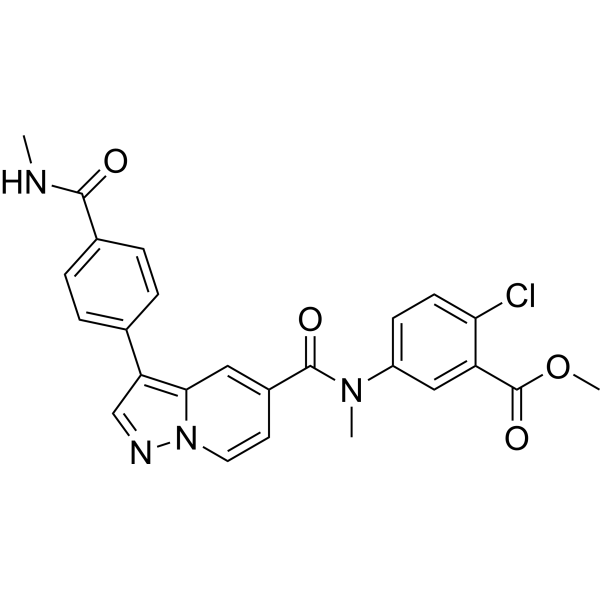
EDI048 is an orally active, gut-restricted parasiticidal agent. EDI048 specifically binds to the ATP-binding site of Cryptosporidium phosphatidylinositol 4-kinase (CpPI (4) K), blocks parasite membrane biogenesis, arrests the pathogen at the schizont stage, and thus irreversibly clears the infection. EDI048 is rapidly converted to an inactive carboxylic acid metabolite via hepatic first-pass metabolism, with extremely low systemic exposure, good safety profile, and no cardiotoxicity, genotoxicity or off-target effects. EDI048 is used in studies of intestinal cryptosporidiosis in children.
商品は「研究用試薬」です。人や動物の医療用・臨床診断用・食品用の製品ではありません。
研究用途以外に使用した場合、当社は一切の責任を負いかねます。
- 純度 : 99.86%
- CAS 番号: 2767264-57-1
- 分子式: C25H21ClN4O4
- 分子量:476.91
-
保管条件:Powder -20°C, 3 years , 4°C, 2 years ; In solvent -80°C, 6 months , -20°C, 1 month

To place orders, for customer services and technical support, please contact: MedChemExpress USA
Tel: 609-228-6898 E-mail: [email protected] [email protected]


-
 生物活性
生物活性
-
化学情報
-
溶剤 & 溶解度
- プロトコル
- 純度とドキュメンテーション
- 参考文献
-
 Help & FAQs


MedChemExpress(MCE)の使用を引用している文献 EDI048
MoreParasite アイソフォーム固有の製品をすべて表示
More

生物活性
製品説明
体外実験
EDI048 (1 nM-20 μM; 5 min preincubation + 50 min incubation) potently inhibits wild-type Cryptosporidium parvum PI(4)K with an IC50 of 0.004 μM, and its activity depends on the conserved tyrosine residues Y705 and Y907 in the ATP-binding pocket of this enzyme[1].
EDI048 potently inhibits the asexual life cycles of Cryptosporidium parvum (48 h EC50=0.052 μM) and Cryptosporidium hominis (48 h EC50=0.050 μM) in HCT-8 cell cultures[1].
EDI048 (27 nM-20 μM; 72 h) exhibits antiparasitic activity against Cryptosporidium parvum in HCT-8 cell cultures. EDI048 achieves maximal parasite clearance (clearance rate >99%) at concentrations ≥27 nM, with a clearance half-life of approximately 15 h[1].
EDI048 (3× EC50; 4 h) exerts irreversible parasiticidal activity against Cryptosporidium parvum at the merozoite maturation stage (8-12 h post-infection) in HCT-8 cell cultures, but has no effect on the growth of the early trophozoite stage[1].
MedChemExpress (MCE) has not independently confirmed the accuracy of these methods. They are for reference only.
-
Cell Line:HCT-8 human ileocaecal colorectal adenocarcinoma cells infected with Cryptosporidium parvum or Cryptosporidium hominis
-
Concentration:10-point 3-fold serial dilutions
-
Incubation Time:48 h (starting at 3 h post-infection)
-
Result:Inhibited Cryptosporidium parvum with an EC50 of 0.052 μM.
Inhibited Cryptosporidium hominis with an EC50 of 0.050 μM.
体内実験
EDI048 (10 mg/kg; p.o.; once every 12 hours; for 7 consecutive days) significantly reduces fecal oocyst excretion and rapidly alleviates diarrhea symptoms in neonatal calves infected with cryptosporidiosis, with no recurrence of infection after treatment[1].
MedChemExpress (MCE) has not independently confirmed the accuracy of these methods. They are for reference only.
-
Animal Model:B6.129S7-Ifngtm1Ts/J (female, 6-8 weeks old, IFN-γ-knockout)[1]
-
Dosage:1 mg/kg; 3 mg/kg; 10 mg/kg
-
Administration:p.o.; daily; 5 days
-
Result:Achieved a 0.3 log reduction in faecal oocyst shedding.
Achieved a 1.1 log reduction in faecal oocyst shedding.
Achieved a 3.1 log reduction in faecal oocyst shedding.
Resulted in undetectable systemic exposure at 1 mg/kg and 3 mg/kg.
Reached a maximum serum concentration (Cmax) of 8.4 nM and area under the curve (AUC) of 20.4 nM·h at 10 mg/kg.
-
Animal Model:Holstein-Friesian (neonatal bull and heifer, ≥30 kg birth weight)[1]
-
Dosage:10 mg/kg
-
Administration:p.o.; every 12 hours; 7 days
-
Result:Reduced faecal oocyst shedding significantly compared to untreated controls.
Improved faecal consistency scores compared to untreated controls.
Resolved diarrhoea by 48 hours post-treatment.
Reduced days of severe diarrhoea and moderate-to-severe diarrhoea compared to controls.
Prevented infection recrudescence for 7 days after treatment cessation.
臨床実験
| NCT Number | Sponsor | Condition | Start Date |
Phase

|
|---|---|---|---|---|
| NCT01329991 | 2011-05 | PHASE1 |


化学情報
-
CAS 番号 2767264-57-1
-
性状 Solid
-
分子量 476.91
-
分子式 C25H21ClN4O4
-
Color Light yellow to yellow
-
SMILES
O=C(C1=CC(N(C)C(C2=CC3=C(C4=CC=C(C(NC)=O)C=C4)C=NN3C=C2)=O)=CC=C1Cl)OC
-
輸送条件
Room temperature in continental US; may vary elsewhere.
-
保管条件
Powder -20°C 3 years 4°C 2 years In solvent -80°C 6 months -20°C 1 month


Publications (1)
-
Journal Impact Factor
-
Most Recent
-
Pharmaceuticals (Basel)
Development of a Luciferase-Based In Vitro Assay to Evaluate the Efficacy of Anti-Cryptosporidial Drugs Against Cryptosporidium parvum. [Abstract]2026 Apr 3;19(4):576. PMID: 42075832


溶剤 & 溶解度
体外:
DMSO : 100 mg/mL (209.68 mM; Need ultrasonic; Hygroscopic DMSO has a significant impact on the solubility of product, please use newly opened DMSO)
Please refer to the solubility information to select the appropriate solvent. Once prepared, please aliquot and store the solution to prevent product inactivation from repeated freeze-thaw cycles.
Storage method and period of stock solution: -80°C, 6 months; -20°C, 1 month. When stored at -80°C, please use it within 6 months. When stored at -20°C, please use it within 1 month.
Please refer to the solubility information to select the appropriate solvent. Once prepared, please aliquot and store the solution to prevent product inactivation from repeated freeze-thaw cycles.
Storage method and period of stock solution: -80°C, 6 months; -20°C, 1 month. When stored at -80°C, please use it within 6 months. When stored at -20°C, please use it within 1 month.
濃度 (開始) × 体積 (開始) = 濃度 (終了) × 体積 (終了)
体内:
Select the appropriate dissolution method based on your experimental animal and administration route.
- For the following dissolution methods, please ensure to first prepare a clear stock solution using an In Vitro approach and then sequentially add co-solvents:
- To ensure reliable experimental results, the clarified stock solution can be appropriately stored based on storage conditions. As for the working solution for In Vivo experiments, it is recommended to prepare freshly and use it on the same day.
- The percentages shown for the solvents indicate their volumetric ratio in the final prepared solution. If precipitation or phase separation occurs during preparation, heat and/or sonication can be used to aid dissolution.
Add each solvent one by one: 10% DMSO 40% PEG300 5% Tween-80 45% Saline
Solubility: ≥ 2.5 mg/mL (5.24 mM); Clear solution
This protocol yields a clear solution of ≥ 2.5 mg/mL (saturation unknown).
Taking 1 mL working solution as an example, add 100 μL DMSO stock solution (25.0 mg/mL) to 400 μL PEG300, and mix evenly; then add 50 μL Tween-80 and mix evenly; then add 450 μL Saline to adjust the volume to 1 mL.
Preparation of Saline: Dissolve 0.9 g sodium chloride in ddH₂O and dilute to 100 mL to obtain a clear Saline solution.
In Vivo Dissolution Calculator
Please enter the basic information of animal experiments:
-
-
-
-
Recommended: Prepare an additional quantity of animals to account for potential losses during experiments.
Please enter your animal formula composition:
-
%DMSO +
Recommended: Keep the proportion of DMSO in working solution below 2% if your animal is weak.
-
%+
-
+%Tween-80 + +
-
%Saline +
The co-solvents required include: DMSO, . All of co-solvents are available by MedChemExpress (MCE). , Tween 80. All of co-solvents are available by MedChemExpress (MCE).
Working solution concentration: 0.22 mg/mL
Method for preparing stock solution: mg drug dissolved in μL DMSO. Stock solution concentration: mg/mL.
1. Take μL DMSO stock solution;
2. Add μL .
μL , mix evenly;
3. Then add μL Tween 80, mix evenly;
4. Then add μL
Please ensure that the stock solution in the first step is dissolved to a clear state, and add co-solvents in sequence. You can use ultrasonic heating (ultrasonic cleaner, recommended frequency 20-40 kHz), vortexing, etc. to assist dissolution.


純度とドキュメンテーション
-
データシート (279 KB)
-
SDS (251 KB)
- English - EN (251 KB)
- Français - FR (251 KB)
- Deutsch - DE (251 KB)
- Norwegian - NO (251 KB)
- Español - ES (251 KB)
- Swedish - SV (251 KB)
- Italian - IT (251 KB)
- Korean - KR (251 KB)
- Portuguese - PT (251 KB)
-
取扱説明書 (2659 KB)
参考文献


Complete Stock Solution Preparation Table
Please refer to the solubility information to select the appropriate solvent. Once prepared, please aliquot and store the solution to prevent product inactivation from repeated freeze-thaw cycles.
Storage method and period of stock solution: -80°C, 6 months; -20°C, 1 month. When stored at -80°C, please use it within 6 months. When stored at -20°C, please use it within 1 month.
| Optional Solvent | Concentration Solvent Mass | 1 mg | 5 mg | 10 mg | 25 mg |
|---|---|---|---|---|---|
| DMSO | 1 mM | 2.0968 mL | 10.4842 mL | 20.9683 mL | 52.4208 mL |
| 5 mM | 0.4194 mL | 2.0968 mL | 4.1937 mL | 10.4842 mL | |
| 10 mM | 0.2097 mL | 1.0484 mL | 2.0968 mL | 5.2421 mL | |
| 15 mM | 0.1398 mL | 0.6989 mL | 1.3979 mL | 3.4947 mL | |
| 20 mM | 0.1048 mL | 0.5242 mL | 1.0484 mL | 2.6210 mL | |
| 25 mM | 0.0839 mL | 0.4194 mL | 0.8387 mL | 2.0968 mL | |
| 30 mM | 0.0699 mL | 0.3495 mL | 0.6989 mL | 1.7474 mL | |
| 40 mM | 0.0524 mL | 0.2621 mL | 0.5242 mL | 1.3105 mL | |
| 50 mM | 0.0419 mL | 0.2097 mL | 0.4194 mL | 1.0484 mL | |
| 60 mM | 0.0349 mL | 0.1747 mL | 0.3495 mL | 0.8737 mL | |
| 80 mM | 0.0262 mL | 0.1311 mL | 0.2621 mL | 0.6553 mL | |
| 100 mM | 0.0210 mL | 0.1048 mL | 0.2097 mL | 0.5242 mL |


EDI048 関連分類
HY-156685 関連分類
 Powered by Bioz