



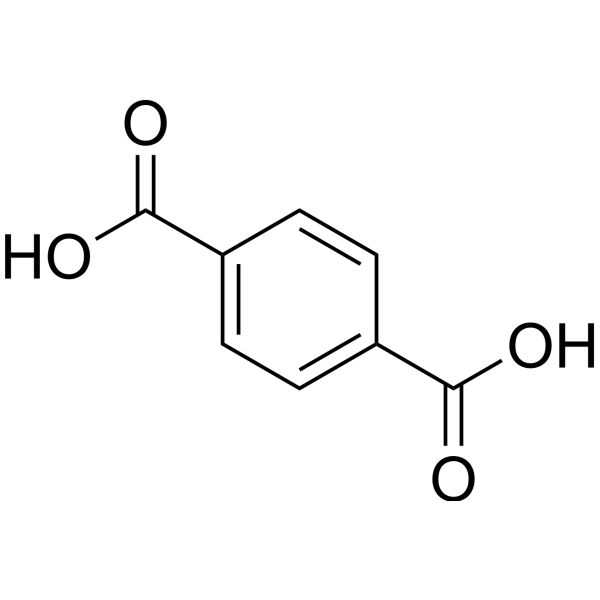
Terephthalic acid
Based on 1 publication(s) in Google Scholar
Terephthalic acid is an isomer and a precursor of polyester PET, which can be used to make clothing and plastics. Terephthalic acid can be used to build skin tumor models.
Para uso exclusivo en investigación. No vendemos a pacientes.
- Pureza: 99.85%
- No. CAS: 100-21-0
- Fòrmula: C8H6O4
- Peso molecular:166.13
-
Almacenamiento:
Store at room temperature 3 years.
In solvent -80°C, 2 years , -20°C, 1 year

To place orders, for customer services and technical support, please contact: MedChemExpress USA
Tel: 609-228-6898 E-mail: [email protected] [email protected]


-
 Actividad biológica
-
Chemical Information
-
Solvente y solubilidad
- Pureza y Documentación
- Referencias
-
 Help & FAQs


-
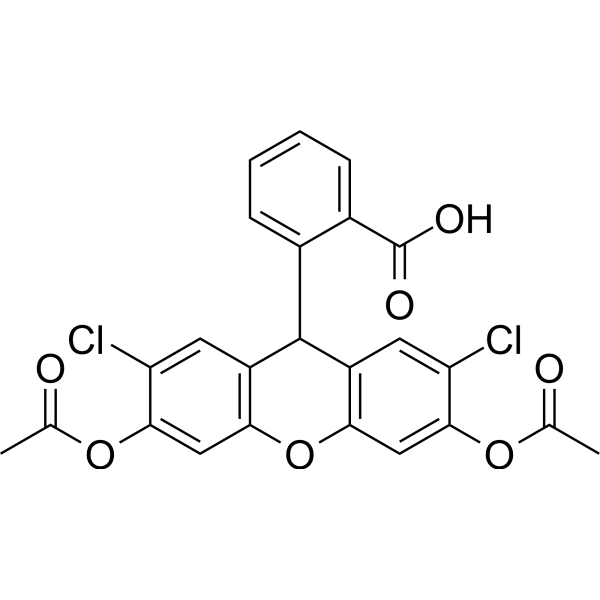
HY-D0940
H2DCFDA
-
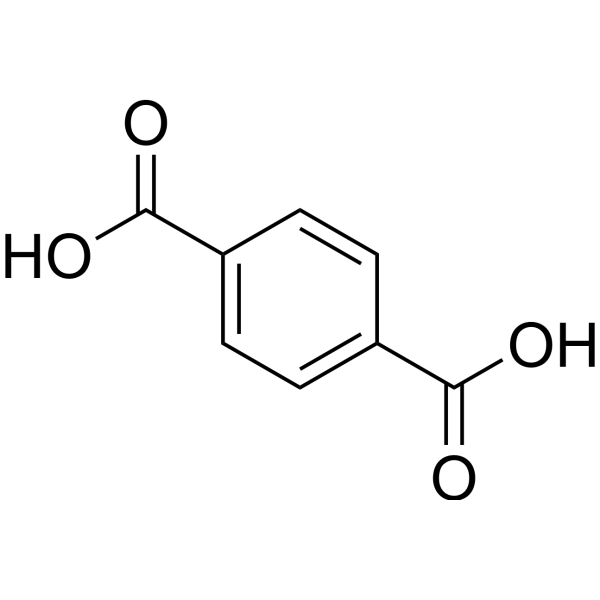
HY-W010098R
Terephthalic acid (Standard)
-

HY-Y1888
Corn oil
-
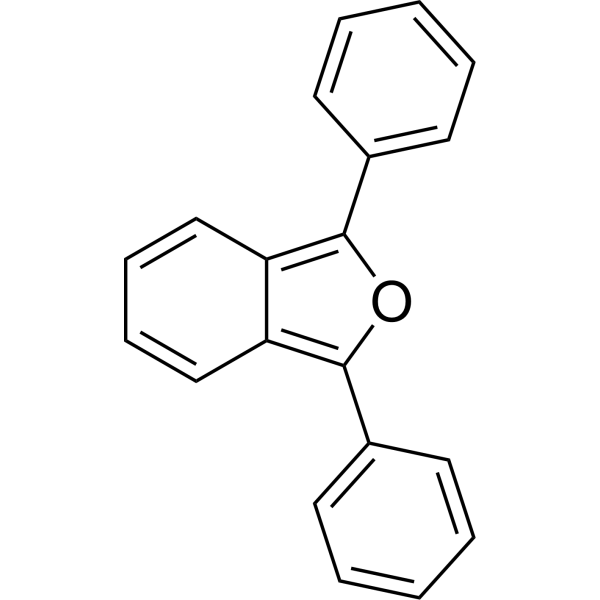
HY-W011664
1,3-Diphenylisobenzofuran
-
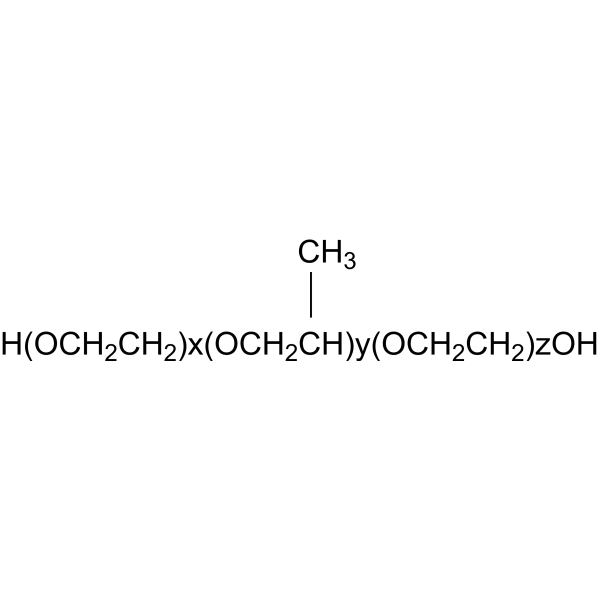
HY-D1005
Poloxamer 407 (F127)
-
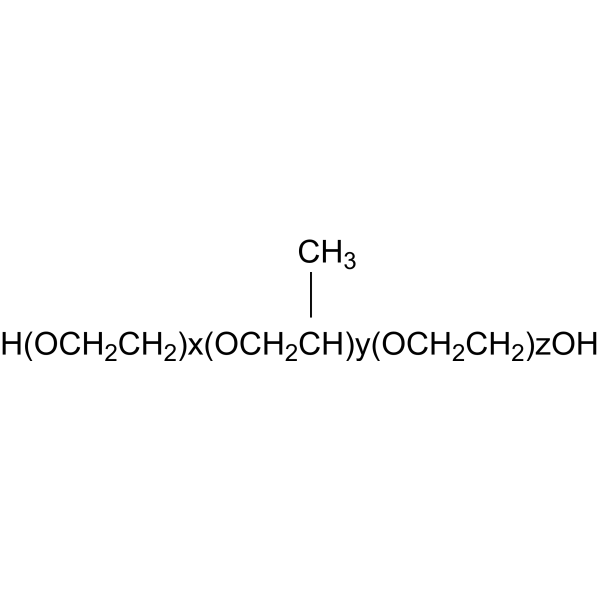
HY-D1005A
Poloxamer 188
-
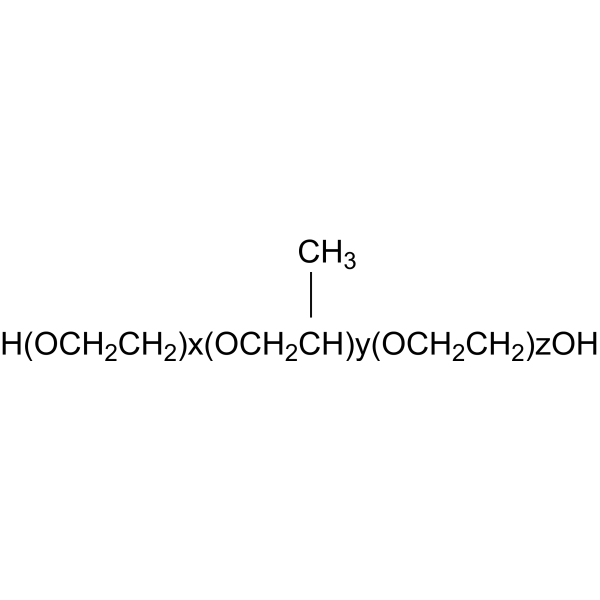
HY-D1005H
Poloxamer 188 (F68)
-

HY-D1005A6
Poloxamer 124 (L44)
-

HY-D1005A22
Poloxamer 338 (F108)
-

HY-D1005A25
Poloxamer 403 (P123)
-

HY-D1005A23
Poloxamer 401 (L121)
-

HY-D1005A10
Poloxamer 184 (L64)
Publications Citing Use of MedChemExpress (MCE) Terephthalic acid
More

Actividad biológica
Please do not refer to only one article to determine the experimental conditions. It is recommended to determine the optimal experimental conditions (animal strain, age, dosage, frequency and cycle, detection time and indicators, etc.) through preliminary experiments before the formal experiment.
Terephthalic acid can be used in animal modeling to create skin tumor models. In experiments, Terephthalic acid is administered orally to weanling and adult mice, exhibiting distinct pharmacokinetic features. Terephthalic acid is metabolized in the body to form calcium terephthalate or calcium hydrogen terephthalate, leading to oversaturation in the urine and promoting the formation of bladder stones. The lithogenic effect of Terephthalic acid is more pronounced in weanling mice than in adults, and its effect on bladder stone formation is more significant at higher doses (1000 mg/kg/day), with no noticeable effects observed at a dose of 142 mg/kg/day. The safe dosage range for Terephthalic acid in terms of inducing lithogenesis is: oral administration not exceeding 0.5 mg/kg/day, and a total concentration in drinking water not exceeding 3 mg/L.
Administration: 10 μg/mouse • topical application • refer to the note for details on the administration method
(2) DMBA and Terephthalic acid combined administration: Shave the backs of 8-10 week old mice, first apply DMBA (HY-W011845) (25 μg per mouse, dissolved in 200 μL of acetone) to the shaved dorsal skin, then apply Terephthalic acid (10 μg per mouse, dissolved in 200 μL of acetone) on the 3rd day after the first DMBA treatment.
(3) After 4 rounds of the above DMBA and Terephthalic acid combined treatment, mice receive Terephthalic acid (10 μg per mouse, dissolved in 200 μL of acetone) alone twice weekly for 20 weeks.
MedChemExpress (MCE) has not independently confirmed the accuracy of these methods. They are for reference only.


Chemical Information
-
No. CAS 100-21-0
-
Appearance Solid
-
Peso molecular 166.13
-
Fòrmula C8H6O4
-
Color White to off-white
-
SMILES
O=C(O)C1=CC=C(C(O)=O)C=C1
-
Structure Classification
-
Initial Source
-
Envío
Room temperature in continental US; may vary elsewhere.
-
Almacenamiento
Store at room temperature 3 years
In solvent -80°C 2 years -20°C 1 year


Publications (1)
-
Journal Impact Factor
-
Most Recent
-
Phytomedicine
Arnicolide C induces ROS-mediated modulation of PI3K/Akt and MAPK pathways to suppress MYC in hepatocellular carcinoma. [Abstract]2025 Nov 25:148:157423. PMID: 41138574


Solvente y solubilidad
DMSO : 20 mg/mL (120.39 mM; Need ultrasonic; Hygroscopic DMSO has a significant impact on the solubility of product, please use newly opened DMSO)
Please refer to the solubility information to select the appropriate solvent. Once prepared, please aliquot and store the solution to prevent product inactivation from repeated freeze-thaw cycles.
Storage method and period of stock solution: -80°C, 2 years; -20°C, 1 year. When stored at -80°C, please use it within 2 years. When stored at -20°C, please use it within 1 year.
Please refer to the solubility information to select the appropriate solvent. Once prepared, please aliquot and store the solution to prevent product inactivation from repeated freeze-thaw cycles.
Storage method and period of stock solution: -80°C, 2 years; -20°C, 1 year. When stored at -80°C, please use it within 2 years. When stored at -20°C, please use it within 1 year.
Concentration (start) × Volume (start) = Concentration (final) × Volume (final)
Select the appropriate dissolution method based on your experimental animal and administration route.
- For the following dissolution methods, please ensure to first prepare a clear stock solution using an In Vitro approach and then sequentially add co-solvents:
- To ensure reliable experimental results, the clarified stock solution can be appropriately stored based on storage conditions. As for the working solution for In Vivo experiments, it is recommended to prepare freshly and use it on the same day.
- The percentages shown for the solvents indicate their volumetric ratio in the final prepared solution. If precipitation or phase separation occurs during preparation, heat and/or sonication can be used to aid dissolution.
Add each solvent one by one: 10% DMSO 90% (20% SBE-β-CD in Saline)
Solubility: 2 mg/mL (12.04 mM); Suspended solution; Need ultrasonic
This protocol yields a suspended solution of 2 mg/mL. Suspended solution can be used for oral and intraperitoneal injection.
Taking 1 mL working solution as an example, add 100 μL DMSO stock solution (20.0 mg/mL) to 900 μL 20% SBE-β-CD in Saline, and mix evenly.
Preparation of 20% SBE-β-CD in Saline (4°C, storage for one week): 2 g SBE-β-CD powder is dissolved in 10 mL Saline, completely dissolve until clear.
Please enter the basic information of animal experiments:
-
-
-
-
Recommended: Prepare an additional quantity of animals to account for potential losses during experiments.
Please enter your animal formula composition:
-
%DMSO +
Recommended: Keep the proportion of DMSO in working solution below 2% if your animal is weak.
-
%+
-
+%Tween-80 + +
-
%Saline +
The co-solvents required include: DMSO, . All of co-solvents are available by MedChemExpress (MCE). , Tween 80. All of co-solvents are available by MedChemExpress (MCE).
Working solution concentration: 0.22 mg/mL
Method for preparing stock solution: mg drug dissolved in μL DMSO. Stock solution concentration: mg/mL.
1. Take μL DMSO stock solution;
2. Add μL .
μL , mix evenly;
3. Then add μL Tween 80, mix evenly;
4. Then add μL
Please ensure that the stock solution in the first step is dissolved to a clear state, and add co-solvents in sequence. You can use ultrasonic heating (ultrasonic cleaner, recommended frequency 20-40 kHz), vortexing, etc. to assist dissolution.


Pureza y Documentación
-
Ficha de datos (278 KB)
-
SDS (394 KB)
- English - EN (394 KB)
- Français - FR (394 KB)
- Deutsch - DE (394 KB)
- Norwegian - NO (394 KB)
- Español - ES (394 KB)
- Swedish - SV (394 KB)
- Italian - IT (394 KB)
- Korean - KR (394 KB)
- Portuguese - PT (394 KB)
-
Instrucciones de manejo (2659 KB)
Referencias
[1]. Heck HD, et al. The induction of bladder stones by terephthalic acid, dimethyl terephthalate, and melamine (2,4,6-triamino-s-triazine) and its relevance to risk assessment. Regul Toxicol Pharmacol. 1985 Sep;5(3):294-313. [Content Brief]
[2]. Saito M, et al. CENP-50 is required for papilloma development in the two-stage skin carcinogenesis model. Cancer Sci. 2020 Aug;111(8):2850-2860. [Content Brief]
[3]. Cui L, et al. Deregulation of the p16-cyclin D1/cyclin-dependent kinase 4-retinoblastoma pathway involved in the rat bladder carcinogenesis induced by terephthalic acid-calculi. Urol Res. 2006 Oct;34(5):321-8. [Content Brief]
[4]. Ball GL, et al. Toxicological review and oral risk assessment of terephthalic acid (TPA) and its esters: A category approach. Crit Rev Toxicol. 2012 Jan;42(1):28-67. [Content Brief]


Complete Stock Solution Preparation Table
Please refer to the solubility information to select the appropriate solvent. Once prepared, please aliquot and store the solution to prevent product inactivation from repeated freeze-thaw cycles.
Storage method and period of stock solution: -80°C, 2 years; -20°C, 1 year. When stored at -80°C, please use it within 2 years. When stored at -20°C, please use it within 1 year.
| Optional Solvent | Concentration Solvent Mass | 1 mg | 5 mg | 10 mg | 25 mg |
|---|---|---|---|---|---|
| DMSO | 1 mM | 6.0194 mL | 30.0969 mL | 60.1938 mL | 150.4846 mL |
| 5 mM | 1.2039 mL | 6.0194 mL | 12.0388 mL | 30.0969 mL | |
| 10 mM | 0.6019 mL | 3.0097 mL | 6.0194 mL | 15.0485 mL | |
| 15 mM | 0.4013 mL | 2.0065 mL | 4.0129 mL | 10.0323 mL | |
| 20 mM | 0.3010 mL | 1.5048 mL | 3.0097 mL | 7.5242 mL | |
| 25 mM | 0.2408 mL | 1.2039 mL | 2.4078 mL | 6.0194 mL | |
| 30 mM | 0.2006 mL | 1.0032 mL | 2.0065 mL | 5.0162 mL | |
| 40 mM | 0.1505 mL | 0.7524 mL | 1.5048 mL | 3.7621 mL | |
| 50 mM | 0.1204 mL | 0.6019 mL | 1.2039 mL | 3.0097 mL | |
| 60 mM | 0.1003 mL | 0.5016 mL | 1.0032 mL | 2.5081 mL | |
| 80 mM | 0.0752 mL | 0.3762 mL | 0.7524 mL | 1.8811 mL | |
| 100 mM | 0.0602 mL | 0.3010 mL | 0.6019 mL | 1.5048 mL |


Terephthalic acid Related Classifications
HY-W010098 Related Classifications
 Powered by Bioz