



FOSL1 degrader 1

Based on 1 Customer Validation
FOSL1 degrader 1 is a FOSL1 PROTAC degrader with a DC50 of 2.3 μM. FOSL1 degrader 1 induces proteasomal degradation of FOSL1. FOSL1 degrader 1 eliminates cancer stem cells in head and neck squamous cell carcinoma. FOSL1 degrader 1 suppresses head and neck squamous cell carcinoma tumorigenesis. FOSL1 degrader 1 can be used for the research of head and neck squamous cell carcinoma.
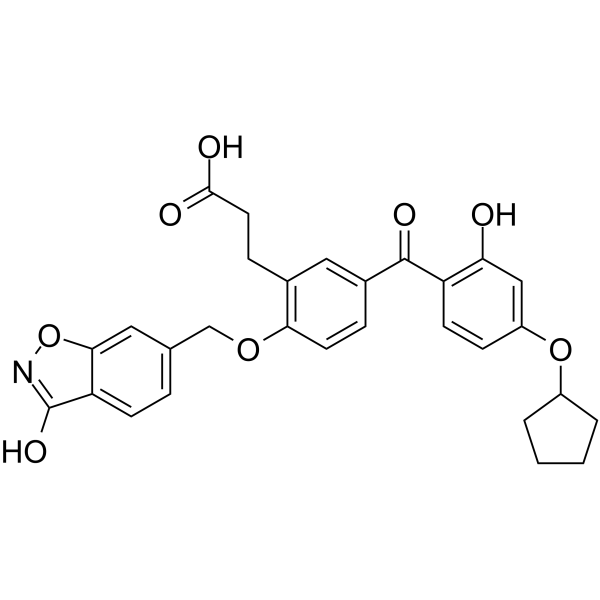
(Pink: FOSL1 ligand (HY-12270); Blue: Cereblon ligand (HY-10984); Black: linker (HY-130200)).
For research use only. We do not sell to patients.
- Purity : 99.66%
- Formula: C58H69N5O18
- Molecular Weight:1124.19
-
Storage:
-20°C, stored under nitrogen
* In solvent : -80°C, 6 months; -20°C, 1 month (stored under nitrogen)


To place orders, for customer services and technical support, please contact: MedChemExpress USA
Tel: 609-228-6898 E-mail: [email protected] [email protected]


-
 Biological Activity
-
Chemical Information
-
Solvent & Solubility
- Purity & Documentation
- References
-
 Help & FAQs




Biological Activity
Description
IC50 & Target
[1]|
FOSL1 2.3 μM (DC50) |
In Vitro
FOSL1 degrader 1 (compound 4) (range; 24 h) potently inhibits AP-1 luciferase activity in UM-SCC1-AP-1-luc cells with an IC50 of 26.4 μM[1].
FOSL1 degrader 1 (0.005-50 μM; 16 h) potently and selectively induces proteasome-dependent FOSL1 degradation in UM-SCC1 cells, with a DC50 of 2.3 μM, and reduces JUN expression as a downstream effect of FOSL1 degradation[1].
FOSL1 degrader 1 (15 μM; 16 h) significantly suppresses the expression of FOSL1 target genes (FOSL1, BMI1, SNAI2) in UM-SCC1 cells[1].
FOSL1 degrader 1 (48 h) has minimal toxicity to non-malignant TIGK cells, with an ED50 of 1087 μM[1].
FOSL1 degrader 1 (2 weeks) potently suppresses the self-renewal of ALDHhigh/CD44high UM-SCC1 cancer stem cells, with an ED50 of 0.18 μM[1].
MedChemExpress (MCE) has not independently confirmed the accuracy of these methods. They are for reference only. .
-
Cell Line:UM-SCC1 cells
-
Concentration:0.005 μM, 0.015 μM, 0.05 μM, 0.15 μM, 0.5 μM, 1.5 μM, 5 μM, 15 μM, 50 μM
-
Incubation Time:16
-
Result:Led to down-regulation of FOSL.
The expression of JUN, the major JUN family member in HNSCC, was also dramatically decreased after a 16h treatment.
-
Cell Line:UM-SCC1 cells
-
Concentration:15 μM
-
Incubation Time:16 h
-
Result:The expression of FOSL1 target genes, including SNAI2, FOSL1 itself, and the functional HNSCC CSC marker, BMI1, was significantly inhibited.
In Vivo
FOSL1 degrader 1 (compound 4) (21 mg/kg; i.p.; daily; 5 days) potently eliminates active FOSL1 and Bmi1+ CSCs in HNSCC tumors[1].
FOSL1 degrader 1 (compound 4) (21 mg/kg; i.p.; 3 doses on days 11, 13, 15 post-inoculation) significantly prolongs median overall survival by 43.8% in HNSCC orthotopic xenograft mice compared to vehicle control[1].
MedChemExpress (MCE) has not independently confirmed the accuracy of these methods. They are for reference only.
-
Animal Model:Bmi1CreER;RosatdTomato (6-week-old at study initiation; HNSCC induced via 4NQO)[1]
-
Dosage:2 mg/kg; 7 mg/kg; 21 mg/kg
-
Administration:i.p.; every other day; 30 days
-
Result:Significantly inhibited HNSCC tumor growth relative to vehicle control across all three doses.
Showed dose-dependent suppression of Tomato+ (Bmi1+ CSC-derived) cells and Fosl1 protein expression in tumor tissues.
Caused no significant impact on mouse body weight over the 30-day period.
-
Animal Model:Bmi1CreER;RosatdTomato (tumor-bearing; HNSCC induced via 4NQO)[1]
-
Dosage:21 mg/kg
-
Administration:i.p.; daily; 5 days
-
Result:Reduced Bmi1+ CSC numbers per mm2 of tumor tissue.
Achieved near-complete elimination of phospho-Fosl1 staining in tumor tissues, indicating effective degradation of active FOSL1.
-
Animal Model:NOD-scid-Gamma (NSG) (HNSCC orthotopic xenograft via UM-SCC1 cell inoculation)[1]
-
Dosage:7 mg/kg; 21 mg/kg
-
Administration:i.p.; 3 doses on days 11, 13, 15 post-inoculation
-
Result:Extended median overall survival to 23 days in the 21 mg/kg group, representing a 43.8% increase relative to vehicle control.
Showed no significant difference in median survival (16 days) between 7 mg/kg group and vehicle control.


Chemical Information
-
Appearance Solid
-
Molecular Weight 1124.19
-
Formula C58H69N5O18
-
Color White to yellow
-
SMILES
O=C1CCC(N2C(C(C(NCCOCCOCCOCCOCCOCCOCCOCCNC(CCC3=C(OCC4=CC(ON=C5O)=C5C=C4)C=CC(C(C6=C(O)C=C(OC7CCCC7)C=C6)=O)=C3)=O)=CC=C8)=C8C2=O)=O)C(N1)=O
-
Shipping
Room temperature in continental US; may vary elsewhere.
-
Storage
-20°C, stored under nitrogen
* In solvent : -80°C, 6 months; -20°C, 1 month (stored under nitrogen)


Solvent & Solubility
In Vitro:
DMSO : ≥ 100 mg/mL (88.95 mM; Hygroscopic DMSO has a significant impact on the solubility of product, please use newly opened DMSO)
* "≥" means soluble, but saturation unknown.
Please refer to the solubility information to select the appropriate solvent. Once prepared, please aliquot and store the solution to prevent product inactivation from repeated freeze-thaw cycles.
Storage method and period of stock solution: -80°C, 6 months; -20°C, 1 month (stored under nitrogen). When stored at -80°C, please use it within 6 months. When stored at -20°C, please use it within 1 month.
Please refer to the solubility information to select the appropriate solvent. Once prepared, please aliquot and store the solution to prevent product inactivation from repeated freeze-thaw cycles.
Storage method and period of stock solution: -80°C, 6 months; -20°C, 1 month (stored under nitrogen). When stored at -80°C, please use it within 6 months. When stored at -20°C, please use it within 1 month.
Concentration (start) × Volume (start) = Concentration (final) × Volume (final)
In Vivo:
Select the appropriate dissolution method based on your experimental animal and administration route.
- For the following dissolution methods, please ensure to first prepare a clear stock solution using an In Vitro approach and then sequentially add co-solvents:
- To ensure reliable experimental results, the clarified stock solution can be appropriately stored based on storage conditions. As for the working solution for In Vivo experiments, it is recommended to prepare freshly and use it on the same day.
- The percentages shown for the solvents indicate their volumetric ratio in the final prepared solution. If precipitation or phase separation occurs during preparation, heat and/or sonication can be used to aid dissolution.
For the following dissolution methods, please prepare the working solution directly:
It is recommended to prepare fresh solutions and use them promptly within a short period of time.
The percentages shown for the solvents indicate their volumetric ratio in the final prepared solution. If precipitation or phase separation occurs during preparation, heat and/or sonication can be used to aid dissolution.
Add each solvent one by one: 50% PEG300 50% Saline
Solubility: 2.5 mg/mL (2.22 mM); Suspended solution; Need ultrasonic
In Vivo Dissolution Calculator
Please enter the basic information of animal experiments:
-
-
-
-
Recommended: Prepare an additional quantity of animals to account for potential losses during experiments.
Please enter your animal formula composition:
-
%DMSO +
Recommended: Keep the proportion of DMSO in working solution below 2% if your animal is weak.
-
%+
-
+%Tween-80 + +
-
%Saline +
The co-solvents required include: DMSO, . All of co-solvents are available by MedChemExpress (MCE). , Tween 80. All of co-solvents are available by MedChemExpress (MCE).
Working solution concentration: 0.22 mg/mL
Method for preparing stock solution: mg drug dissolved in μL DMSO. Stock solution concentration: mg/mL. * In solvent : -80°C, 6 months; -20°C, 1 month (stored under nitrogen)
1. Take μL DMSO stock solution;
2. Add μL .
μL , mix evenly;
3. Then add μL Tween 80, mix evenly;
4. Then add μL
Please ensure that the stock solution in the first step is dissolved to a clear state, and add co-solvents in sequence. You can use ultrasonic heating (ultrasonic cleaner, recommended frequency 20-40 kHz), vortexing, etc. to assist dissolution.


Purity & Documentation
-
Data Sheet (274 KB)
-
SDS (252 KB)
- English - EN (252 KB)
- Français - FR (252 KB)
- Deutsch - DE (252 KB)
- Norwegian - NO (252 KB)
- Español - ES (252 KB)
- Swedish - SV (252 KB)
- Italian - IT (252 KB)
- Korean - KR (252 KB)
- Portuguese - PT (252 KB)
-
Handling Instructions (2659 KB)
References


Complete Stock Solution Preparation Table
Please refer to the solubility information to select the appropriate solvent. Once prepared, please aliquot and store the solution to prevent product inactivation from repeated freeze-thaw cycles.
Storage method and period of stock solution: -80°C, 6 months; -20°C, 1 month (stored under nitrogen). When stored at -80°C, please use it within 6 months. When stored at -20°C, please use it within 1 month.
| Optional Solvent | Concentration Solvent Mass | 1 mg | 5 mg | 10 mg | 25 mg |
|---|---|---|---|---|---|
| DMSO | 1 mM | 0.8895 mL | 4.4476 mL | 8.8953 mL | 22.2382 mL |
| 5 mM | 0.1779 mL | 0.8895 mL | 1.7791 mL | 4.4476 mL | |
| 10 mM | 0.0890 mL | 0.4448 mL | 0.8895 mL | 2.2238 mL | |
| 15 mM | 0.0593 mL | 0.2965 mL | 0.5930 mL | 1.4825 mL | |
| 20 mM | 0.0445 mL | 0.2224 mL | 0.4448 mL | 1.1119 mL | |
| 25 mM | 0.0356 mL | 0.1779 mL | 0.3558 mL | 0.8895 mL | |
| 30 mM | 0.0297 mL | 0.1483 mL | 0.2965 mL | 0.7413 mL | |
| 40 mM | 0.0222 mL | 0.1112 mL | 0.2224 mL | 0.5560 mL | |
| 50 mM | 0.0178 mL | 0.0890 mL | 0.1779 mL | 0.4448 mL | |
| 60 mM | 0.0148 mL | 0.0741 mL | 0.1483 mL | 0.3706 mL | |
| 80 mM | 0.0111 mL | 0.0556 mL | 0.1112 mL | 0.2780 mL |


FOSL1 degrader 1 Related Classifications
HY-162723 Related Classifications
 Powered by Bioz