



Fra1/FOSL1
Fra1/FOSL1 encodes FRA1, an inducible AP-1 transcription factor subunit that regulates gene expression in response to proliferative and environmental cues[1]. Mechanistically, FRA1-containing AP-1 dimers connect oncogenic pathways including RAS-ERK, IL-6/STAT3, AKT/mTOR, and TGFβ signaling to transcriptional programs controlling EMT, invasion, stem-like states, and cell plasticity[2][3][4][5]. In breast epithelial models, Fra-1/AP-1 induces EMT by increasing TGFβ1, Zeb1, Zeb2, and Slug, thereby promoting mesenchymal, invasive, and tumorigenic capacities[2]. In colorectal cancer, FRA1 directly controls EMT-related genes and mediates crosstalk between oncogenic RAS-ERK and TGFβ signaling during tumor progression[3]. In pancreatic models, FRA1 links KRAS signaling to acinar-to-ductal metaplasia and modulates response to RAF-MEK-ERK inhibition[4][6]. Compared with related FOS isoforms, FRA1 showed a unique inverse correlation with distant-metastasis-free survival among Fos genes in breast cancer datasets[2]. For experimental applications, FRA1 studies support perturbation strategies targeting expression, stability, post-translational regulation, or downstream effectors, including PARP7 inhibition, HDAC6 inhibition, MEK inhibitor combinations, and FRA1-associated target networks[6][7][8].
References:
- [1]. Al-Khayyat W, et al. FRA1 (FOSL1) suppresses neoplastic transformation and modulates radiation responses via transcriptional control of mitogenic and stress-responsive networks. Front Cell Dev Biol. 2025 Sep 22;13:1659986. [Content Brief]
- [2]. Bakiri L, et al. Fra-1/AP-1 induces EMT in mammary epithelial cells by modulating Zeb1/2 and TGFβ expression. Cell Death Differ. 2015 Feb;22(2):336-50. [Content Brief]
- [3]. Diesch J, et al. Widespread FRA1-dependent control of mesenchymal transdifferentiation programs in colorectal cancer cells. PLoS One. 2014 Mar 21;9(3):e88950. [Content Brief]
- [4]. Li AL, et al. FRA1 controls acinar cell plasticity during murine KrasG12D-induced pancreatic acinar to ductal metaplasia. Dev Cell. 2024 Nov 18;59(22):3025-3042.e7. [Content Brief]
- [5]. Xu X, et al. PTEN Lipid Phosphatase Activity Suppresses Melanoma Formation by Opposing an AKT/mTOR/FRA1 Signaling Axis. Cancer Res. 2024 Feb 1;84(3):388-404. [Content Brief]
- [6]. Schneeweis C, et al. AP1/Fra1 confers resistance to MAPK cascade inhibition in pancreatic cancer. Cell Mol Life Sci. 2022 Dec 19;80(1):12. [Content Brief]
- [7]. Manetsch P, et al. PARP7-mediated ADP-ribosylation of FRA1 promotes cancer cell growth by repressing IRF1- and IRF3-dependent apoptosis. Proc Natl Acad Sci U S A. 2023 Dec 5;120(49):e2309047120. [Content Brief]
- [8]. Wang T, et al. The inflammatory cytokine IL-6 induces FRA1 deacetylation promoting colorectal cancer stem-like properties. Oncogene. 2019 Jun;38(25):4932-4947. [Content Brief]
All Product Categories
-
Fra1/FOSL1 Related Products (2)
Related Products (2)

-
T-5224
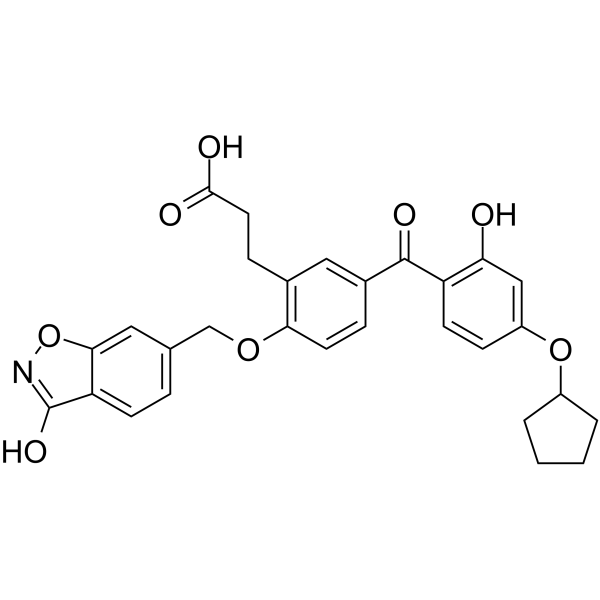 0 ImagesT-5224 is a transcription factor c-Fos/activator protein (AP)-1 inhibitor with anti-inflammatory effects, which specifically inhibits the DNA binding activity of c-Fos/c-Jun without affecting other transcription factors. T-5224 inhibits the IL-1β-induced up-regulation of Mmp-3, Mmp-13 and Adamts-5 transcription.
-
FOSL1 degrader 1
 0 ImagesCat. No.: HY-162723Purity: 99.66%FOSL1 degrader 1 is a FOSL1 PROTAC degrader with a DC50 of 2.3 μM. FOSL1 degrader 1 induces proteasomal degradation of FOSL1. FOSL1 degrader 1 eliminates cancer stem cells in head and neck squamous cell carcinoma. FOSL1 degrader 1 suppresses head and neck squamous cell carcinoma tumorigenesis. FOSL1 degrader 1 can be used for the research of head and neck squamous cell carcinoma.



