



dTAGV-1
Based on 6 publication(s) in Google Scholar
dTAGV-1 is a selective FKBP12F36V PORTAC degrader. dTAGV-1 induces rapid degradation of FKBP12F36V-tagged oncogenic fusion proteins, triggering collapse of downstream cellular signaling pathways, reduced proliferative capacity of cancer cells, and decreased levels of target proteins. dTAGV-1 is applicable to functional validation studies of cancer and undegradable oncoproteins.
(Pink: FKBP12 ligand (HY-114420); Blue: VHL ligand (HY-112078); Black: linker (HY-W012001)).
For research use only. We do not sell to patients.
- Purity: 99.43%
- CAS No.: 2451573-86-5
- Formula: C68H90N6O14S
- Molecular Weight:1247.54
-
Storage:Powder -20°C, 3 years , 4°C, 2 years ; In solvent -80°C, 6 months , -20°C, 1 month


To place orders, for customer services and technical support, please contact: MedChemExpress USA
Tel: 609-228-6898 E-mail: [email protected] [email protected]


-
 Biological Activity
-
Chemical Information
-
Solvent & Solubility
- Purity & Documentation
- References
-
 Help & FAQs
-


Apoptosis Compound Library
HY-L003
-
Cell Cycle/DNA Damage Compound Library
HY-L004
-
Immunology/Inflammation Compound Library
HY-L007
-
Anti-Cancer Compound Library
HY-L025
-
Autophagy Compound Library
HY-L029
-
Anti-Aging Compound Library
HY-L034
-
PROTAC Library
HY-L151
-
Bioactive Compound Library Max
HY-L181
-
Bioactive Compound Library
HY-L001
-
High-Throughput Bioactive Compound Library
HY-L205


Publications Citing Use of MedChemExpress (MCE) dTAGV-1
More Customer Validation & Images

-
WB
-
WB
-
WB
All PROTACs Isoforms
More

Biological Activity
|
FKBP12 |
VHL |
dTAGV-1 (500 nM; 1-24 h) rapidly degrades FKBP12F36V-KRASG12V and blocks downstream signaling in PATU-8902 FKBP12F36V-KRASG12V; KRAS-/- cells, with its activity dependent on the VHL and proteasome pathways[1].
dTAGV-1 (50-5000 nM; 24 h) potently degrades FKBP12F36V-EWS/FLI and reverses aberrant EWS/FLI-mediated signaling pathways in EWS502 FKBP12F36V-EWS/FLI; EWS/FLI-/- cells, with a hook effect observed at the concentration of 5000 nM[1].
dTAGV-1 (0.1-10 μM; 120 h) reduces the 3D sphere proliferation capacity of PATU-8902 FKBP12F36V-KRASG12V; KRAS-/- cells[1].
dTAGV-1 (1 μM; 0-6 days) inhibits the proliferation of EWS502 FKBP12F36V-EWS/FLI and EWS/FLI-/- cells[1].
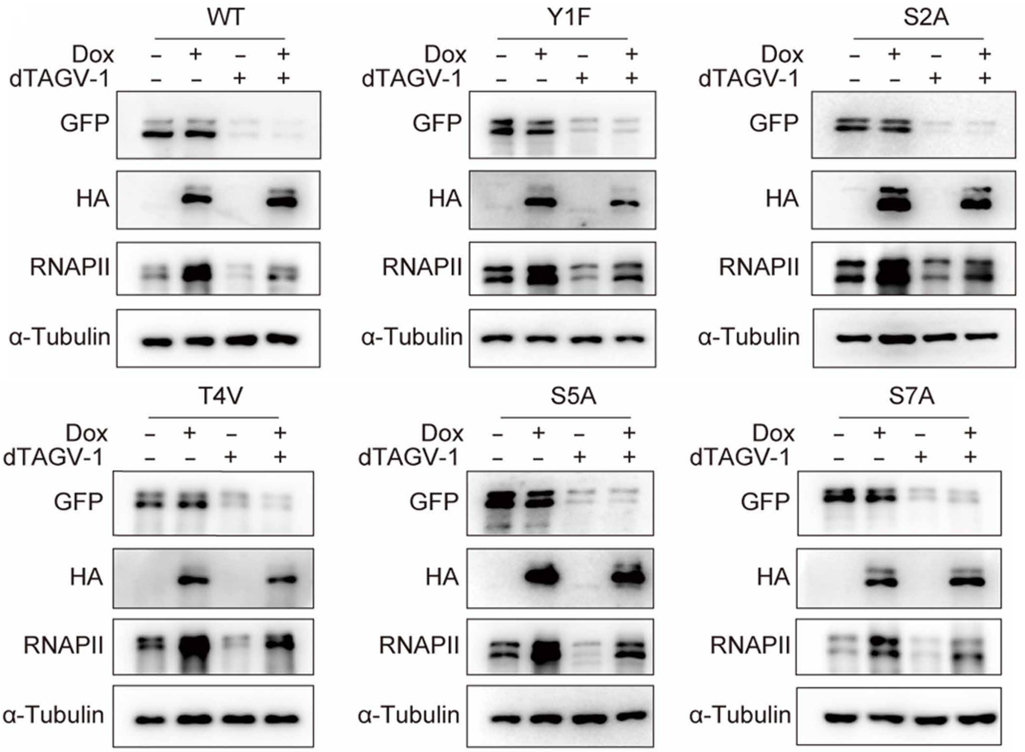
Treatment of A549 RPB1dTAG cells with dTAGV-1 (100 nM; 4-12 h) effectively degrades GFP-tagged wild-type RNAPII, enabling acute replacement with Doxycycline (HY-N0565)-induced HA-tagged RNAPII phosphorylation site mutants under conditions where their expression levels match those of wild-type RNAPII[2].
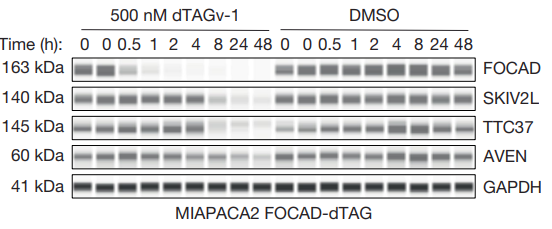
dTAGV-1 (500 nM; 0-48 h) induces rapid degradation of FOCAD protein in MIAPACA2 cells, which in turn causes post-translational depletion of SKIV2L, TTC37 and AVEN proteins without affecting their RNA levels[3].
MedChemExpress (MCE) has not independently confirmed the accuracy of these methods. They are for reference only.
-
Cell Line:PATU-8902 LACZ-FKBP12F36V
-
Concentration:500 nM (in combination with 125-2000 nM THAL-SNS-032 (HY-123937))
-
Incubation Time:24 h
-
Result:Alone, did not alter CDK9 protein levels.
In combination with THAL-SNS-032, led to pronounced degradation of both LACZ-FKBP12F36V and CDK9 at levels comparable to treatment with each degrader alone, avoiding substrate competition effects.
-
Cell Line:PATU-8902 FKBP12F36V-KRASG12V; KRAS-/- (3D-spheroid suspensions)
-
Concentration:0.1, 1, 10, 100 nM, 1, 10 μM
-
Incubation Time:120 h
-
Result:Diminished 3D-spheroid cell proliferation to levels comparable to CRBN-recruiting dTAG molecules.
-
Cell Line:A549 cells expressing GFP-FKBP12F36V-tagged wild-type RNAPII (RPB1dTAG) with inducible HA-tagged RNAPII mutants (WT, Y1F, S2A, T4V, S5A, S7A)
-
Concentration:100 nM
-
Incubation Time:4 h; 12 h
-
Result:Rapidly degraded GFP-tagged wild-type RPB1 after 4 hours of treatment.
Confirmed HA-tagged RNAPII mutants were expressed at levels comparable to wild-type RNAPII.
| Species | Dose | Route | AUCinf | T1/2 |
|---|---|---|---|---|
| Mice[1] | 10 mg/kg | i.p. | 18517 ng·h/mL | 4.43 h |
MedChemExpress (MCE) has not independently confirmed the accuracy of these methods. They are for reference only.
-
Animal Model:NOD.Cg-Prkdcscid Il2rgtm1Wjl/SzJ (NSG) (8-week-old female, immunocompromised, leukemia model via tail vein injection of MV4;11 luc-FKBP12F36V cells)[1]
-
Dosage:35 mg/kg
-
Administration:i.p.; daily; 3 consecutive days
-
Result:Induced striking loss of bioluminescent signal 4 hours after the first administration.
Maintained consistent loss of bioluminescent signal 4 hours after each of the three administrations.
Showed evident degradation of bioluminescent signal 28 hours after the final administration.


Chemical Information
-
CAS No. 2451573-86-5
-
Appearance Solid
-
Molecular Weight 1247.54
-
Formula C68H90N6O14S
-
Color White to off-white
-
SMILES
O=C([C@H]1N(CCCC1)C([C@H](C2=CC(OC)=C(C(OC)=C2)OC)CC)=O)O[C@@H](C3=C(C=CC=C3)OCC(NCCCCCCC(N[C@@H](C(C)(C)C)C(N4[C@@H](C[C@H](C4)O)C(N[C@H](C5=CC=C(C6=C(C)N=CS6)C=C5)C)=O)=O)=O)=O)CCC7=CC(OC)=C(C=C7)OC
-
Shipping
Room temperature in continental US; may vary elsewhere.
-
Storage
Powder -20°C 3 years 4°C 2 years In solvent -80°C 6 months -20°C 1 month


Publications (6)
-
Journal Impact Factor
-
Most Recent
-
Nature
2025 Feb;638(8052):1095-1103. PMID: 39910291
dTAGV-1 purchased from MedChemExpress. Usage Cited in: Nature. 2025 Feb;638(8052):1095-1103. [Abstract]
dTAGV-1 hydrochloride (500 nM; 0-48 h) depleted FOCAD protein levels within four hours. Following FOCAD degradation, levels of SKIV2L, TTC37 and AVEN protein decreased by 8 h, reaching a maximum by 2 days in MIAPACA2 FOCAD-dTAG cells.
-
Sci Adv
FeaSion decodes the regulatory landscape and functional diversity of RNA polymerase II CTD phosphorylation. [Abstract]2025 Nov 28;11(48):eadz2345. PMID: 41313762
dTAGV-1 purchased from MedChemExpress. Usage Cited in: Sci Adv. 2025 Nov 28;11(48):eadz2345. [Abstract]
Western blot analysis of total RNAPII, degraded RPB1 (tagged with GFP), and RNAPIImut (tagged with HA; WT, Y1F, S2A, T4V, S5A and S7A) levels before and after Doxycycline (Dox) or dTAGV-1 TFA (100 nM) treatment. α-Tubulin served as the loading control.
-
-
dTAGV-1 purchased from MedChemExpress. Usage Cited in: Mayo Clinic. 2025.
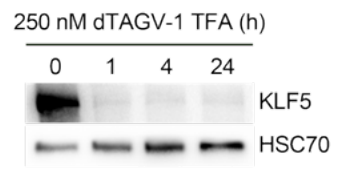
Representative Western blot analysis of KLF5 after 250 nM dTAGV-1 TFA treatment for 0, 1, 4 and 24 h. HSC70 was used as a loading control.
-
-


Solvent & Solubility
DMSO : 75 mg/mL (60.12 mM; Need ultrasonic; Hygroscopic DMSO has a significant impact on the solubility of product, please use newly opened DMSO)
Please refer to the solubility information to select the appropriate solvent. Once prepared, please aliquot and store the solution to prevent product inactivation from repeated freeze-thaw cycles.
Storage method and period of stock solution: -80°C, 6 months; -20°C, 1 month. When stored at -80°C, please use it within 6 months. When stored at -20°C, please use it within 1 month.
Please refer to the solubility information to select the appropriate solvent. Once prepared, please aliquot and store the solution to prevent product inactivation from repeated freeze-thaw cycles.
Storage method and period of stock solution: -80°C, 6 months; -20°C, 1 month. When stored at -80°C, please use it within 6 months. When stored at -20°C, please use it within 1 month.
Concentration (start) × Volume (start) = Concentration (final) × Volume (final)
Select the appropriate dissolution method based on your experimental animal and administration route.
- For the following dissolution methods, please ensure to first prepare a clear stock solution using an In Vitro approach and then sequentially add co-solvents:
- To ensure reliable experimental results, the clarified stock solution can be appropriately stored based on storage conditions. As for the working solution for In Vivo experiments, it is recommended to prepare freshly and use it on the same day.
- The percentages shown for the solvents indicate their volumetric ratio in the final prepared solution. If precipitation or phase separation occurs during preparation, heat and/or sonication can be used to aid dissolution.
Please enter the basic information of animal experiments:
-
-
-
-
Recommended: Prepare an additional quantity of animals to account for potential losses during experiments.
Please enter your animal formula composition:
-
%DMSO +
Recommended: Keep the proportion of DMSO in working solution below 2% if your animal is weak.
-
%+
-
+%Tween-80 + +
-
%Saline +
The co-solvents required include: DMSO, . All of co-solvents are available by MedChemExpress (MCE). , Tween 80. All of co-solvents are available by MedChemExpress (MCE).
Working solution concentration: 0.22 mg/mL
Method for preparing stock solution: mg drug dissolved in μL DMSO. Stock solution concentration: mg/mL.
1. Take μL DMSO stock solution;
2. Add μL .
μL , mix evenly;
3. Then add μL Tween 80, mix evenly;
4. Then add μL
Please ensure that the stock solution in the first step is dissolved to a clear state, and add co-solvents in sequence. You can use ultrasonic heating (ultrasonic cleaner, recommended frequency 20-40 kHz), vortexing, etc. to assist dissolution.


Purity & Documentation
-
Data Sheet (281 KB)
-
SDS (251 KB)
- English - EN (251 KB)
- Français - FR (251 KB)
- Deutsch - DE (251 KB)
- Norwegian - NO (251 KB)
- Español - ES (251 KB)
- Swedish - SV (251 KB)
- Italian - IT (251 KB)
- Korean - KR (251 KB)
- Portuguese - PT (251 KB)
-
Handling Instructions (2659 KB)
References
[1]. Nabet B, et al. Rapid and direct control of target protein levels with VHL-recruiting dTAG molecules. Nature communications. 2020 Sep 18;11(1):4687. [Content Brief]
[2]. Zhu J, et al. FeaSion decodes the regulatory landscape and functional diversity of RNA polymerase II CTD phosphorylation. Science advances. 2025 Nov 28;11(48):eadz2345. [Content Brief]
[3]. Prindle V, et al. Synthetic lethality of mRNA quality control complexes in cancer. Nature. 2025 Feb;638(8052):1095-1103. [Content Brief]


Complete Stock Solution Preparation Table
Please refer to the solubility information to select the appropriate solvent. Once prepared, please aliquot and store the solution to prevent product inactivation from repeated freeze-thaw cycles.
Storage method and period of stock solution: -80°C, 6 months; -20°C, 1 month. When stored at -80°C, please use it within 6 months. When stored at -20°C, please use it within 1 month.
| Optional Solvent | Concentration Solvent Mass | 1 mg | 5 mg | 10 mg | 25 mg |
|---|---|---|---|---|---|
| DMSO | 1 mM | 0.8016 mL | 4.0079 mL | 8.0158 mL | 20.0394 mL |
| 5 mM | 0.1603 mL | 0.8016 mL | 1.6032 mL | 4.0079 mL | |
| 10 mM | 0.0802 mL | 0.4008 mL | 0.8016 mL | 2.0039 mL | |
| 15 mM | 0.0534 mL | 0.2672 mL | 0.5344 mL | 1.3360 mL | |
| 20 mM | 0.0401 mL | 0.2004 mL | 0.4008 mL | 1.0020 mL | |
| 25 mM | 0.0321 mL | 0.1603 mL | 0.3206 mL | 0.8016 mL | |
| 30 mM | 0.0267 mL | 0.1336 mL | 0.2672 mL | 0.6680 mL | |
| 40 mM | 0.0200 mL | 0.1002 mL | 0.2004 mL | 0.5010 mL | |
| 50 mM | 0.0160 mL | 0.0802 mL | 0.1603 mL | 0.4008 mL | |
| 60 mM | 0.0134 mL | 0.0668 mL | 0.1336 mL | 0.3340 mL |


dTAGV-1 Related Classifications
HY-145514D Related Classifications
 Powered by Bioz