



PAD4-IN-2
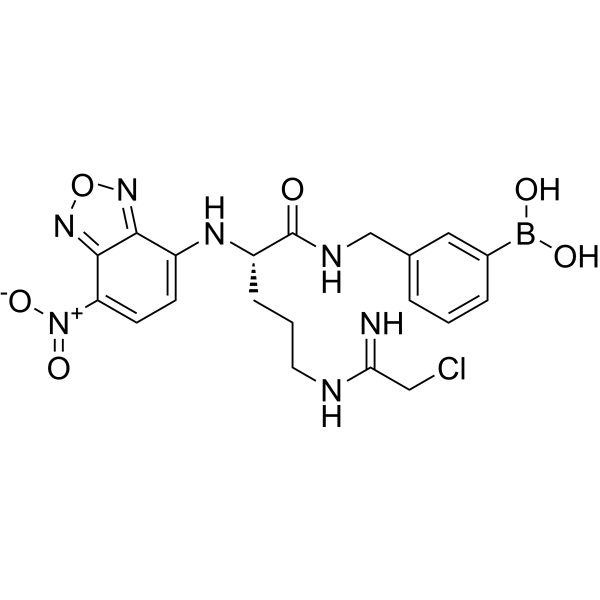
PAD4-IN-2 is a highly tumor-targeted and irreversible PAD4 inhibitor with an IC50 of 1.94 μM. It selectively recognizes sialic acid on tumor surfaces and accumulates in tumor tissues, with distribution in the cytoplasm of tumor cells and nuclei of neutrophils. PAD4-IN-2 inhibits the PAD4-H3cit-NETs (Neutrophil Extracellular Traps) pathway, reduces senescent tumor-associated neutrophils, and promotes M1 macrophage polarization. The compound exhibits potent anti-tumor and anti-metastatic activities and is suitable for breast cancer research.
商品は「研究用試薬」です。人や動物の医療用・臨床診断用・食品用の製品ではありません。
研究用途以外に使用した場合、当社は一切の責任を負いかねます。
- CAS 番号: 2642327-52-2
- 分子式: C20H23BClN7O6
- 分子量:503.70
-
保管条件:
Please store the product under the recommended conditions in the Certificate of Analysis.

To place orders, for customer services and technical support, please contact: MedChemExpress USA
Tel: 609-228-6898 E-mail: [email protected] [email protected]


-
 生物活性
生物活性
-
化学情報
- 純度とドキュメンテーション
- 参考文献
-
 Help & FAQs




生物活性
製品説明
IC50 & Target
IC50: 1.94 μM (PAD4)[1].
体外実験
PAD4-IN-2 (compound 5i) inhibits PAD4 enzyme activity in a colorimetric assay (IC50 = 1.94 μM) and exhibits negligible cytotoxicity in LLC, 4T1, and normal HL7702 cells after 48 h treatment (IC50 > 100 μM)[1].
PAD4-IN-2 (25-100 μM; 48 h) effectively inhibits the monoclonal proliferation and dose-dependently suppresses the migration of 4T1 cells[1].
PAD4-IN-2 (50–100 μM; 1–48 h) is selectively taken up by 4T1 cells in a time-dependent manner but not by normal HL7702 cells, induces mitochondrial shrinkage and pseudopodia reduction, localizes to neutrophil nuclei to decrease histone H3 citrullination (H3cit) levels, and inhibits neutrophil extracellular trap (NET) formation[1].
MedChemExpress (MCE) has not independently confirmed the accuracy of these methods. They are for reference only.
-
Cell Line:LLC, 4T1, and HL7702 cells
-
Concentration:3.125, 6.25, 12.5, 25, 50, and 100 μM
-
Incubation Time:48 h
-
Result:Showed no significant lethal effect on either tumor or normal cells, with an IC50 value greater than 100 μM.
-
Cell Line:4T1 cells
-
Concentration:25, 50, and 100 μM
-
Incubation Time:48 h
-
Result:Reduced the number of single cell proliferation significantly and effectively inhibited the monoclonal proliferation of tumor cells.
-
Cell Line:4T1 cells
-
Concentration:25, 50, and 100 μM
-
Incubation Time:48 h
-
Result:Inhibited tumor cell migration in a dose-dependent manner, and significantly decreased both the number of migrated cells and the migration distance.
-
Cell Line:4T1 cells and bone marrow neutrophils
-
Concentration:50 μM and 100 μM
-
Incubation Time:48 h
-
Result:Localized to the cytoplasm of tumor cells and the nucleus of neutrophils, decreased intracellular histone 3 citrullination (H3cit) levels, and significantly inhibited the formation of neutrophil extracellular traps (NETs).
体内実験
PAD4-IN-2 (5.04 mg/kg; i.p. ; once daily for 7 days) shows initial antitumor efficacy in an S180 sarcoma mouse model[1].
PAD4-IN-2 (1.01-5.04 mg/kg; i.v. ; every day for 21 days) decreases NETs formation, alters immune cells infiltration in the tumor microenvironment, and exhibits no significant hepatotoxicity or nephrotoxicity in vivo[1].
MedChemExpress (MCE) has not independently confirmed the accuracy of these methods. They are for reference only.
-
Animal Model:S180 sarcoma mouse model (Kunming mice)[1]
-
Dosage:10 μmol/kg
-
Administration:Intraperitoneal injection (i.p.), once daily for 7 days
-
Result:Inhibited tumor growth with an in vivo tumor inhibition rate (TIR) of 49.2%.
-
Animal Model:Orthotopic 4T1 breast cancer mouse model (BALB/c female mice)[1]
-
Dosage:2, 5, and 10 μmol/kg
-
Administration:Tail vein intravenous injection (i.v.), once daily for 21 days
-
Result:Reduced primary tumor volume and tumor weight substantially at the dose of 10 μmol/kg.
Suppressed the number of metastatic tumor nodules in the lungs markedly in a dose-dependent manner.
Maintained stable body weight in treated mice throughout the administration period.
-
Animal Model:Orthotopic 4T1 breast cancer mouse model (BALB/c female mice)[1]
-
Dosage:10 μmol/kg
-
Administration:Tail vein intravenous injection (i.v.), once daily for 21 days
-
Result:Showed intact alveolar structures and absence of tumor cell lesions in H&E-stained lung sections.
Decreased the number of Ly6G-positive neutrophils and H3cit-positive cells in immunofluorescence-stained tumor sections.
Caused no significant variations in serum levels of Cr, BUN, AST, and ALT compared with the normal saline control group.
Exhibited no apparent histopathological damage or organic lesions in H&E-stained sections of the heart, liver, spleen, and kidney tissues.
Reduced the proportion of aged neutrophils (Naged CD194hi CD62Llo) in tumor tissues.Increased the ratio of M1-type macrophages in tumor tissues.


化学情報
-
CAS 番号 2642327-52-2
-
分子量 503.70
-
分子式 C20H23BClN7O6
-
SMILES
O=C(NCC1=CC=CC(B(O)O)=C1)[C@H](CCCNC(CCl)=N)NC2=CC=C([N+]([O-])=O)C3=NON=C32
-
輸送条件
Room temperature in continental US; may vary elsewhere.
-
保管条件
Please store the product under the recommended conditions in the Certificate of Analysis.


純度とドキュメンテーション
参考文献

Calculators
濃度 (開始) × 体積 (開始) = 濃度 (終了) × 体積 (終了)


PAD4-IN-2 関連分類
HY-155052 関連分類
 Powered by Bioz