



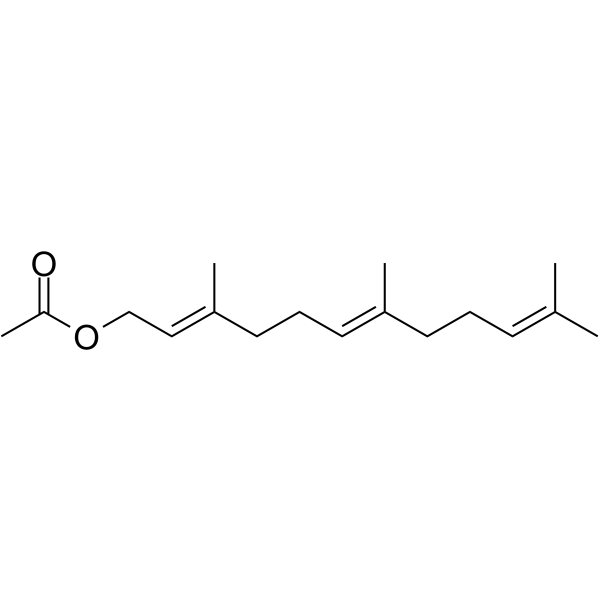
Farnesyl acetate
Farnesyl acetate is a sesquiterpene isolated from the leaves of Amomum gagnepainii. Farnesyl acetate has significant toxicity against red palm weevil larvae with a LD50 of 7867 ppm.
For research use only. We do not sell to patients.
- CAS No.: 29548-30-9
- Formula: C17H28O2
- Molecular Weight:264.40
-
Storage:Pure form -20°C, 3 years ; In solvent -80°C, 6 months , -20°C, 1 month

To place orders, for customer services and technical support, please contact: MedChemExpress USA
Tel: 609-228-6898 E-mail: [email protected] [email protected]


-
 Biological Activity
-
Chemical Information
- Purity & Documentation
- References
-
 Help & FAQs





Biological Activity


Chemical Information
-
CAS No. 29548-30-9
-
Appearance Liquid (Density: 0.91 g/cm3)
-
Molecular Weight 264.40
-
Formula C17H28O2
-
SMILES
C/C(C)=C\CC/C(C)=C/CC/C(C)=C/COC(C)=O
-
Structure Classification
-
Initial Source
-
Shipping
Room temperature in continental US; may vary elsewhere.
-
Storage
Pure form -20°C 3 years In solvent -80°C 6 months -20°C 1 month


Purity & Documentation
References
[1]. Meigs TE, et al. Farnesyl acetate, a derivative of an isoprenoid of the mevalonate pathway, inhibits DNA replication in hamster and human cells. Exp Cell Res. 1995 Aug;219(2):461-70. [Content Brief]
[2]. Guo D, et al. Biosynthesis of advanced biofuel farnesyl acetate using engineered Escherichia coli. Bioresour Technol. 2018 Dec;269:577-580. [Content Brief]
[3]. Hussain A, et al. Lethality of Sesquiterpenes Reprogramming Red Palm Weevil Detoxification Mechanism for Natural Novel Biopesticide Development. Molecules. 2019 Apr 26;24(9). [Content Brief]

Calculators
Concentration (start) × Volume (start) = Concentration (final) × Volume (final)


Farnesyl acetate Related Classifications
HY-128430 Related Classifications
 Powered by Bioz