



Tuberostemonine
Based on 1 publication(s) in Google Scholar
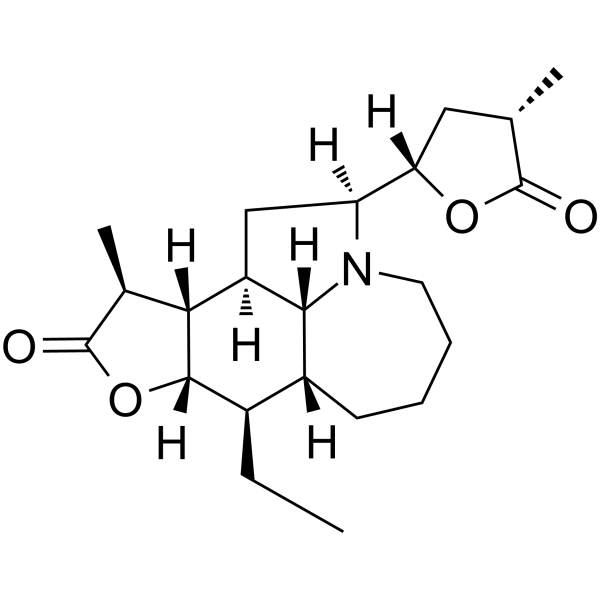
Tuberostemonine is a stenine alkaloid that can be isolated from Stemona tuberosa and Stemona sessifolia. Tuberostemonine is an antimalarial agent that has inhibitory activity against Ferredoxin-NADP+ reductases (FNRs) from Plasmodium falciparum (PfFNR). Tuberostemonine can reduce the number of citric acid-induced coughs in guinea pigs. Tuberostemonine decreases bronchoalveolar lavage fluid (BALF), neutrophil and macrophage infiltration and reduces peribronchial and perivascular inflammatory cell infiltration in mouse model of acute lung inflammation. Tuberostemonine has a level of activity as a feeding deterrent .
연구목적의 판매만을 진행합니다. 환자를 대상으로 한 판매는 하지 않습니다.
- Purity : 99.86%
- CAS No.: 6879-01-2
- 화학식: C22H33NO4
- 분자량:375.50
-
보관:
-20°C, sealed storage, away from moisture and light
* In solvent : -80°C, 6 months; -20°C, 1 month (sealed storage, away from moisture and light)

To place orders, for customer services and technical support, please contact: MedChemExpress USA
Tel: 609-228-6898 E-mail: [email protected] [email protected]


-
 Biological Activity
-
Chemical Information
-
용액&용해도
- Protocol
- 순도&문서
- References
-
 Help & FAQs


Publications Citing Use of MedChemExpress (MCE) Tuberostemonine
MoreAll Parasite Isoforms
More

Biological Activity
제품 설명
IC50 & Target
|
Plasmodium |
In Vitro
Tuberostemonine (100 ppm) shows highest inhibition (55%) of the diaphorase activity of PfFNR and can inhibit electron transfer process of PfFNR to PfFd enzyme[1].
MedChemExpress (MCE) has not independently confirmed the accuracy of these methods. They are for reference only.
In Vivo
MedChemExpress (MCE) has not independently confirmed the accuracy of these methods. They are for reference only.
-
Animal Model:C57BL/6 male mice with cigarette smoke (CS)-induced lung inflammation[4]
-
Dosage:1, 5, 10 mg/kg
-
Administration:Intraperitoneal injection (i.p.), single dose
-
Result:Significantly attenuated the body weight loss associated with CS exposure.
Significantly decreased in the number of total cells. Neutrophils, and macrophages.
Suppressed the secretion of keratinocyte chemoattractant (KC) in the lungs in a dose-dependent manner and showed a reduced secretion of MCP-1 compared with CS group.
Inhibited the airway inflammation.
Attenuated the epithelial thickening occurred in response to CS exposure.


Chemical Information
-
CAS No. 6879-01-2
-
Appearance Solid
-
분자량 375.50
-
화학식 C22H33NO4
-
Color White to off-white
-
SMILES
[H][C@@]([C@]1([H])[C@@]23[H])(CCCCN1[C@]([H])([C@@]4([H])OC([C@@H](C)C4)=O)C3)[C@@H](CC)[C@]([C@]2([H])[C@@H]5C)([H])OC5=O
-
Structure Classification
-
Initial Source
-
선적
Room temperature in continental US; may vary elsewhere.
-
보관
-20°C, sealed storage, away from moisture and light
* In solvent : -80°C, 6 months; -20°C, 1 month (sealed storage, away from moisture and light)


Publications (1)
-
Journal Impact Factor
-
Most Recent


용액&용해도
In Vitro:
DMSO : 50 mg/mL (133.16 mM; ultrasonic and warming and heat to 60°C; Hygroscopic DMSO has a significant impact on the solubility of product, please use newly opened DMSO)
Please refer to the solubility information to select the appropriate solvent. Once prepared, please aliquot and store the solution to prevent product inactivation from repeated freeze-thaw cycles.
Storage method and period of stock solution: -80°C, 6 months; -20°C, 1 month (sealed storage, away from moisture and light). When stored at -80°C, please use it within 6 months. When stored at -20°C, please use it within 1 month.
Please refer to the solubility information to select the appropriate solvent. Once prepared, please aliquot and store the solution to prevent product inactivation from repeated freeze-thaw cycles.
Storage method and period of stock solution: -80°C, 6 months; -20°C, 1 month (sealed storage, away from moisture and light). When stored at -80°C, please use it within 6 months. When stored at -20°C, please use it within 1 month.
Concentration (start) × Volume (start) = Concentration (final) × Volume (final)
In Vivo:
Select the appropriate dissolution method based on your experimental animal and administration route.
- For the following dissolution methods, please ensure to first prepare a clear stock solution using an In Vitro approach and then sequentially add co-solvents:
- To ensure reliable experimental results, the clarified stock solution can be appropriately stored based on storage conditions. As for the working solution for In Vivo experiments, it is recommended to prepare freshly and use it on the same day.
- The percentages shown for the solvents indicate their volumetric ratio in the final prepared solution. If precipitation or phase separation occurs during preparation, heat and/or sonication can be used to aid dissolution.
In Vivo Dissolution Calculator
Please enter the basic information of animal experiments:
-
-
-
-
Recommended: Prepare an additional quantity of animals to account for potential losses during experiments.
Please enter your animal formula composition:
-
%DMSO +
Recommended: Keep the proportion of DMSO in working solution below 2% if your animal is weak.
-
%+
-
+%Tween-80 + +
-
%Saline +
The co-solvents required include: DMSO, . All of co-solvents are available by MedChemExpress (MCE). , Tween 80. All of co-solvents are available by MedChemExpress (MCE).
Working solution concentration: 0.22 mg/mL
Method for preparing stock solution: mg drug dissolved in μL DMSO. Stock solution concentration: mg/mL. * In solvent : -80°C, 6 months; -20°C, 1 month (sealed storage, away from moisture and light)
1. Take μL DMSO stock solution;
2. Add μL .
μL , mix evenly;
3. Then add μL Tween 80, mix evenly;
4. Then add μL
Please ensure that the stock solution in the first step is dissolved to a clear state, and add co-solvents in sequence. You can use ultrasonic heating (ultrasonic cleaner, recommended frequency 20-40 kHz), vortexing, etc. to assist dissolution.


순도&문서
-
Data Sheet (280 KB)
-
SDS (393 KB)
- English - EN (393 KB)
- Français - FR (393 KB)
- Deutsch - DE (393 KB)
- Norwegian - NO (393 KB)
- Español - ES (393 KB)
- Swedish - SV (393 KB)
- Italian - IT (393 KB)
- Korean - KR (393 KB)
- Portuguese - PT (393 KB)
-
Handling Instructions (2659 KB)
References
[1]. Pudjiastuti P, et al. Inhibitory Activity and Docking Analysis of Antimalarial Agents from Stemona sp. toward Ferredoxin-NADP+ Reductase from Malaria Parasites. J Parasitol Res. 2018 Aug 26;2018:3469132. [Content Brief]
[2]. Wipf, P., & Spencer, S. R. (2005). Asymmetric total syntheses of tuberostemonine, didehydrotuberostemonine, and 13-epituberostemonine. Journal of the American Chemical Society, 127(1), 225–235. [Content Brief]
[3]. Zhou, X., et al., (2009). Oral absorption and antitussive activity of tuberostemonine alkaloids from the roots of Stemona tuberosa. Planta medica, 75(6), 575–580. [Content Brief]
[4]. Jung, K. H., et al., (2016). The therapeutic effects of tuberostemonine against cigarette smoke-induced acute lung inflammation in mice. European journal of pharmacology, 774, 80–86. [Content Brief]


Complete Stock Solution Preparation Table
Please refer to the solubility information to select the appropriate solvent. Once prepared, please aliquot and store the solution to prevent product inactivation from repeated freeze-thaw cycles.
Storage method and period of stock solution: -80°C, 6 months; -20°C, 1 month (sealed storage, away from moisture and light). When stored at -80°C, please use it within 6 months. When stored at -20°C, please use it within 1 month.
| Optional Solvent | Concentration Solvent Mass | 1 mg | 5 mg | 10 mg | 25 mg |
|---|---|---|---|---|---|
| DMSO | 1 mM | 2.6631 mL | 13.3156 mL | 26.6312 mL | 66.5779 mL |
| 5 mM | 0.5326 mL | 2.6631 mL | 5.3262 mL | 13.3156 mL | |
| 10 mM | 0.2663 mL | 1.3316 mL | 2.6631 mL | 6.6578 mL | |
| 15 mM | 0.1775 mL | 0.8877 mL | 1.7754 mL | 4.4385 mL | |
| 20 mM | 0.1332 mL | 0.6658 mL | 1.3316 mL | 3.3289 mL | |
| 25 mM | 0.1065 mL | 0.5326 mL | 1.0652 mL | 2.6631 mL | |
| 30 mM | 0.0888 mL | 0.4439 mL | 0.8877 mL | 2.2193 mL | |
| 40 mM | 0.0666 mL | 0.3329 mL | 0.6658 mL | 1.6644 mL | |
| 50 mM | 0.0533 mL | 0.2663 mL | 0.5326 mL | 1.3316 mL | |
| 60 mM | 0.0444 mL | 0.2219 mL | 0.4439 mL | 1.1096 mL | |
| 80 mM | 0.0333 mL | 0.1664 mL | 0.3329 mL | 0.8322 mL | |
| 100 mM | 0.0266 mL | 0.1332 mL | 0.2663 mL | 0.6658 mL |


Tuberostemonine Related Classifications
HY-N0352 Related Classifications
 Powered by Bioz