



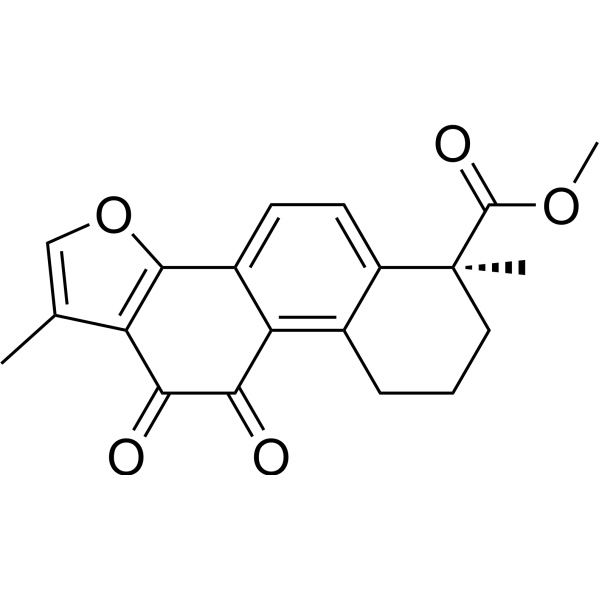
Methyl tanshinonate
Methyl tanshinonate is a tanshinone, that can be isolated from Salvia miltiorrhiza (S. miltiorrhiza) Bunge (Lamiaceae). Methyl tanshinonate is a potent inhibitor of Mpro enzyme in SARS-CoV (IC50 = 21.1 µM). Methyl tanshinonate can be used for diabetes and SARS-CoV research.
For research use only. We do not sell to patients.
- CAS No.: 18887-19-9
- Formula: C20H18O5
- Molecular Weight:338.35
-
Storage:
Please store the product under the recommended conditions in the Certificate of Analysis.

To place orders, for customer services and technical support, please contact: MedChemExpress USA
Tel: 609-228-6898 E-mail: [email protected] [email protected]


-
 Biological Activity
-
Chemical Information
- Protocols
- Purity & Documentation
- References
-
 Help & FAQs




Biological Activity
Description
Cellular Effect
|
Cell Line

|
Type | Value | Description | References |
|---|---|---|---|---|
| AGS | IC50 |
>50 μM
Compound: 5, methyl tanshinonate
|
Viability of human AGS cells under normoxic conditions after 24 hrs by MTT assay
Viability of human AGS cells under normoxic conditions after 24 hrs by MTT assay
|
[PMID: 17583950] |
| AGS | IC50 |
7.48 μM
Compound: 5, methyl tanshinonate
|
Inhibition of HIF1 activation in human AGS cells assessed as inhibition of hypoxia-induced luciferase expression after 16 hrs by reporter assay
Inhibition of HIF1 activation in human AGS cells assessed as inhibition of hypoxia-induced luciferase expression after 16 hrs by reporter assay
|
[PMID: 17583950] |
| Hep 3B2 | IC50 |
>50 μM
Compound: 5, methyl tanshinonate
|
Viability of human Hep3B cells under normoxic conditions after 24 hrs by MTT assay
Viability of human Hep3B cells under normoxic conditions after 24 hrs by MTT assay
|
[PMID: 17583950] |
| Hep 3B2 | IC50 |
7.34 μM
Compound: 5, methyl tanshinonate
|
Inhibition of HIF1 activation in human Hep3B cells assessed as inhibition of hypoxia-induced luciferase expression after 16 hrs by reporter assay
Inhibition of HIF1 activation in human Hep3B cells assessed as inhibition of hypoxia-induced luciferase expression after 16 hrs by reporter assay
|
[PMID: 17583950] |


Chemical Information
-
CAS No. 18887-19-9
-
Molecular Weight 338.35
-
Formula C20H18O5
-
SMILES
O=C1C2=C(CCC[C@]3(C)C(OC)=O)C3=CC=C2C4=C(C(C)=CO4)C1=O
-
Structure Classification
-
Initial Source
-
Shipping
Room temperature in continental US; may vary elsewhere.
-
Storage
Please store the product under the recommended conditions in the Certificate of Analysis.


Purity & Documentation
References
[1]. Kim DH, et al. Characterization of the inhibitory activity of natural tanshinones from Salvia miltiorrhiza roots on protein tyrosine phosphatase 1B. Chem Biol Interact. 2017 Dec 25;278:65-73. [Content Brief]
[2]. Ni L, et al. Qualitative analysis of the roots of Salvia miltiorrhiza and Salvia yunnanensis based on NIR, UHPLC and LC-MS-MS. J Pharm Biomed Anal. 2019 Jun 5;170:295-304. [Content Brief]
[3]. Diniz LRL, et al. Bioactive Terpenes and Their Derivatives as Potential SARS-CoV-2 Proteases Inhibitors from Molecular Modeling Studies. Biomolecules. 2021 Jan 7;11(1):74. [Content Brief]

Calculators
Concentration (start) × Volume (start) = Concentration (final) × Volume (final)


Methyl tanshinonate Related Classifications
HY-126416 Related Classifications
 Powered by Bioz