



MS39

Based on 1 Customer Validation
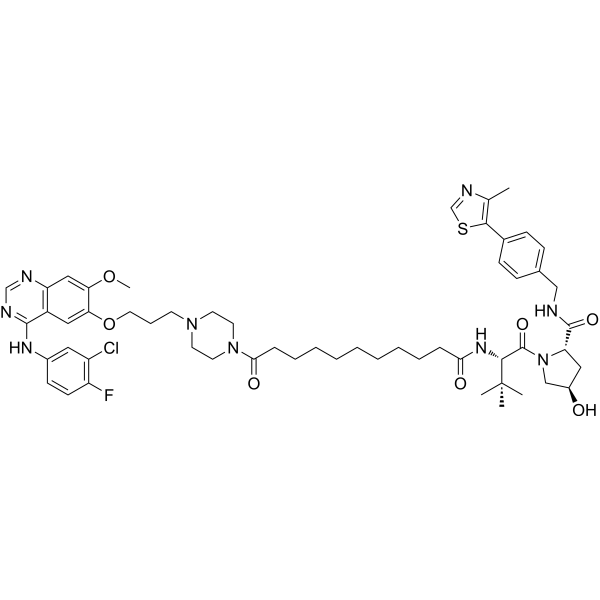
MS39 (compound 6) is a PROTAC targeting EGFR. MS39 reduces the expression of EGFR and downstream signaling in HCC-827 and H3255 cells. MS39 inhibits the proliferation of H3255 cells.
(Pink: EGFR ligand (HY-W109039); Blue: ligand (HY-125845); Black: linker (HY-W014125)).
For research use only. We do not sell to patients.
- Purity : 99.89%
- CAS No.: 2675490-92-1
- Formula: C55H71ClFN9O7S
- Molecular Weight:1056.72
-
Storage:
-20°C, protect from light, stored under nitrogen
* In solvent : -80°C, 6 months; -20°C, 1 month (protect from light, stored under nitrogen)

To place orders, for customer services and technical support, please contact: MedChemExpress USA
Tel: 609-228-6898 E-mail: [email protected] [email protected]


-
 Biological Activity
-
Chemical Information
-
Solvent & Solubility
- Protocols
- Purity & Documentation
- References
-
 Help & FAQs




Biological Activity
Description
Cellular Effect
|
Cell Line

|
Type | Value | Description | References |
|---|---|---|---|---|
| HCC827 | DC50 |
5 nM
Compound: 6; MS39
|
Protac activity at VHL/EGFR exon 19 deletion mutant in human HCC827 cells assessed as induction of EGFR degradation treated 8 hrs post serum starvation measured after 16 hrs by Western blot analysis
Protac activity at VHL/EGFR exon 19 deletion mutant in human HCC827 cells assessed as induction of EGFR degradation treated 8 hrs post serum starvation measured after 16 hrs by Western blot analysis
|
[PMID: 31895569] |
| HCC827 | GI50 |
0.23 μM
Compound: 2; MS39
|
Antiproliferative activity against human HCC827 cells assessed as cell growth inhibition incubated for 3 days by CCK-8 assay
Antiproliferative activity against human HCC827 cells assessed as cell growth inhibition incubated for 3 days by CCK-8 assay
|
[PMID: 35675209] |
In Vitro
MS39 (11-point 3-fold dilution series up to 30 μM) binds with high affinity to both purified wild-type EGFR (Kd=11 nM) and EGFRL858R mutant (Kd=12 ± 7 nM) proteins in a competitive binding assay[1].
MS39 (1-10000 nM; 16 h) potently induces concentration-dependent degradation of EGFR e19d in HCC-827 cells with a DC50 of 5.0 nM over 16 h, and inhibits downstream EGFR-AKT signaling[1].
MS39 (1-10000 nM; 16 h) potently induces concentration-dependent degradation of EGFRL858R in H3255 cells with a DC50 of 3.3 nM over 16 h, and inhibits downstream EGFR-AKT signaling[1].
MedChemExpress (MCE) has not independently confirmed the accuracy of these methods. They are for reference only.
-
Cell Line:HCC-827 lung cancer cells (expressing EGFR with exon 19 deletion, EGFR e19d)
-
Concentration:1-10000 nM
-
Incubation Time:16 h
-
Result:Induced concentration-dependent degradation of EGFR e19d, achieving over 95% maximum degradation at 50 nM.
Reached a half-maximal degradation concentration (DC50) of 5.0 nM.
Showed a slight "hook effect" at 10000 nM.
Potently inhibited EGFR autophosphorylation (p-EGFR) and AKT phosphorylation (p-AKT).
-
Cell Line:H3255 lung cancer cells (expressing EGFR L858R mutant)
-
Concentration:1-10000 nM
-
Incubation Time:16 h
-
Result:Induced concentration-dependent degradation of EGFR L858R, achieving over 95% maximum degradation at 50 nM.
Reached a half-maximal degradation concentration (DC50) of 3.3 nM.
Showed no "hook effect" at 10000 nM.
Potently inhibited EGFR autophosphorylation (p-EGFR) and AKT phosphorylation (p-AKT).
-
Cell Line:OVCAR-8 ovarian cancer cells (expressing wild-type EGFR), H1299 lung cancer cells (expressing wild-type EGFR)
-
Concentration:1-10000 nM
-
Incubation Time:16 h
-
Result:Did not significantly reduce WT EGFR protein levels in either cell line.
-
Cell Line:HCC-827 lung cancer cells (expressing EGFR e19d)
-
Concentration:100 nM
-
Incubation Time:0, 1, 2, 4, 8, 12, 24 h
-
Result:Induced time-dependent degradation of EGFR e19d, reducing EGFR protein levels by ~50% after 4 h.
Achieved near-complete degradation by 12 h, and sustained complete degradation for up to 24 h.
Reached a half-life (t1/2) of EGFR degradation of 4 h.
Showed robust inhibition of p-AKT after 1 h of treatment.
-
Cell Line:H3255 lung cancer cells (expressing EGFR L858R mutant)
-
Concentration:100 nM
-
Incubation Time:0, 1, 2, 4, 8, 12, 24 h
-
Result:Induced time-dependent degradation of EGFR L858R, reducing EGFR protein levels by ~50% after 4 h.
Achieved near-complete degradation by 12 h, and sustained complete degradation for up to 24 h.
Reached a half-life (t1/2) of EGFR degradation of 4 h.
Showed inhibition of p-AKT in a time-dependent manner.
-
Cell Line:HCC-827 lung cancer cells (expressing EGFR e19d)
-
Concentration:100 nM, 1000 nM
-
Incubation Time:16 h
-
Result:Showed a more pronounced EGFR degradation effect in serum-free medium compared to medium containing 10% FBS.
-
Cell Line:H3255 lung cancer cells (expressing EGFR L858R mutant)
-
Concentration:100 nM, 1000 nM
-
Incubation Time:16 h
-
Result:Showed a more pronounced EGFR degradation effect in serum-free medium compared to medium containing 20% FBS.
-
Cell Line:H3255 lung cancer cells (expressing EGFR L858R mutant)
-
Concentration:100 nM (MS39; 8 h), 2 h pretreatments with blocking agents
-
Incubation Time:8 h (MS39 treatment), 2 h (pretreatment with blocking agents)
-
Result:Induced EGFR degradation that was blocked by pretreatment with MLN4924, VH-298, or gefitinib.
-
Cell Line:HCC-827 lung cancer cells (expressing EGFR e19d)
-
Concentration:100 nM
-
Incubation Time:12 h (treatment), 0, 1, 2, 4, 8, 12, 24, 48 h (post-washout analysis)
-
Result:Induced EGFR degradation with EGFR protein levels recovering by 24 h post-washout.
Induced inhibition of p-EGFR with recovery by 24 h post-washout.
Induced inhibition of p-AKT with recovery by 48 h post-washout.
-
Cell Line:H3255 lung cancer cells (expressing EGFR L858R mutant)
-
Concentration:100 nM
-
Incubation Time:12 h (treatment), 0, 1, 2, 4, 8, 12, 24, 48 h (post-washout analysis)
-
Result:Induced EGFR degradation with EGFR protein levels recovering by 24 h post-washout.
Showed slightly prolonged EGFR degradation and autophosphorylation inhibition compared to HCC-827 cells.
-
Cell Line:H3255 lung cancer cells (expressing EGFR L858R mutant)
-
Concentration:Serial dilution series
-
Incubation Time:3 days
-
Result:Effectively inhibited H3255 cell proliferation.
Was more potent than its negative control compound 27 (MS39N) and the previously reported EGFR degrader PROTAC3.
In Vivo
MedChemExpress (MCE) has not independently confirmed the accuracy of these methods. They are for reference only.
-
Animal Model:Swiss Albino (male)[1]
-
Dosage:50 mg/kg
-
Administration:i.p.; single dose
-
Result:Maintained high plasma concentrations (approximately 5 μM) for over 8 hours post-dosing.
Measured approximately 1 μM plasma concentration at 24 hours post-dosing.
Clinical Trial
| NCT Number | Sponsor | Condition | Start Date |
Phase
|
|---|---|---|---|---|
| NCT01329991 | 2011-05 | PHASE1 |


Chemical Information
-
CAS No. 2675490-92-1
-
Appearance Solid
-
Molecular Weight 1056.72
-
Formula C55H71ClFN9O7S
-
Color White to off-white
-
SMILES
COC(C(OCCCN1CCN(CC1)C(CCCCCCCCCC(N[C@@H](C(C)(C)C)C(N2[C@@H](C[C@H](C2)O)C(NCC3=CC=C(C4=C(C)N=CS4)C=C3)=O)=O)=O)=O)=C5)=CC6=C5C(NC7=CC(Cl)=C(C=C7)F)=NC=N6
-
Shipping
Room temperature in continental US; may vary elsewhere.
-
Storage
-20°C, protect from light, stored under nitrogen
* In solvent : -80°C, 6 months; -20°C, 1 month (protect from light, stored under nitrogen)


Solvent & Solubility
In Vitro:
DMSO : 100 mg/mL (94.63 mM; Need ultrasonic; Hygroscopic DMSO has a significant impact on the solubility of product, please use newly opened DMSO)
Please refer to the solubility information to select the appropriate solvent. Once prepared, please aliquot and store the solution to prevent product inactivation from repeated freeze-thaw cycles.
Storage method and period of stock solution: -80°C, 6 months; -20°C, 1 month (protect from light, stored under nitrogen). When stored at -80°C, please use it within 6 months. When stored at -20°C, please use it within 1 month.
Please refer to the solubility information to select the appropriate solvent. Once prepared, please aliquot and store the solution to prevent product inactivation from repeated freeze-thaw cycles.
Storage method and period of stock solution: -80°C, 6 months; -20°C, 1 month (protect from light, stored under nitrogen). When stored at -80°C, please use it within 6 months. When stored at -20°C, please use it within 1 month.
Concentration (start) × Volume (start) = Concentration (final) × Volume (final)


Purity & Documentation
-
Data Sheet (281 KB)
-
SDS (252 KB)
- English - EN (252 KB)
- Français - FR (252 KB)
- Deutsch - DE (252 KB)
- Norwegian - NO (252 KB)
- Español - ES (252 KB)
- Swedish - SV (252 KB)
- Italian - IT (252 KB)
- Korean - KR (252 KB)
- Portuguese - PT (252 KB)
-
Handling Instructions (2659 KB)
References


Complete Stock Solution Preparation Table
Please refer to the solubility information to select the appropriate solvent. Once prepared, please aliquot and store the solution to prevent product inactivation from repeated freeze-thaw cycles.
Storage method and period of stock solution: -80°C, 6 months; -20°C, 1 month (protect from light, stored under nitrogen). When stored at -80°C, please use it within 6 months. When stored at -20°C, please use it within 1 month.
| Optional Solvent | Concentration Solvent Mass | 1 mg | 5 mg | 10 mg | 25 mg |
|---|---|---|---|---|---|
| DMSO | 1 mM | 0.9463 mL | 4.7316 mL | 9.4632 mL | 23.6581 mL |
| 5 mM | 0.1893 mL | 0.9463 mL | 1.8926 mL | 4.7316 mL | |
| 10 mM | 0.0946 mL | 0.4732 mL | 0.9463 mL | 2.3658 mL | |
| 15 mM | 0.0631 mL | 0.3154 mL | 0.6309 mL | 1.5772 mL | |
| 20 mM | 0.0473 mL | 0.2366 mL | 0.4732 mL | 1.1829 mL | |
| 25 mM | 0.0379 mL | 0.1893 mL | 0.3785 mL | 0.9463 mL | |
| 30 mM | 0.0315 mL | 0.1577 mL | 0.3154 mL | 0.7886 mL | |
| 40 mM | 0.0237 mL | 0.1183 mL | 0.2366 mL | 0.5915 mL | |
| 50 mM | 0.0189 mL | 0.0946 mL | 0.1893 mL | 0.4732 mL | |
| 60 mM | 0.0158 mL | 0.0789 mL | 0.1577 mL | 0.3943 mL | |
| 80 mM | 0.0118 mL | 0.0591 mL | 0.1183 mL | 0.2957 mL |


MS39 Related Classifications
HY-157581 Related Classifications
 Powered by Bioz