7 Results for "

10:0 PA

" in MedChemExpress (MCE) Product Catalog:
Products (7)

7 Results for "10:0 PA" in MCE Product Catalog:

3
3 Cited Publications
Cat. No.: HY-111056
CAS No.: 940290-58-4
Purity:  99.72%
Target:  

Ser/Thr Protease

Research Areas:  

Cancer

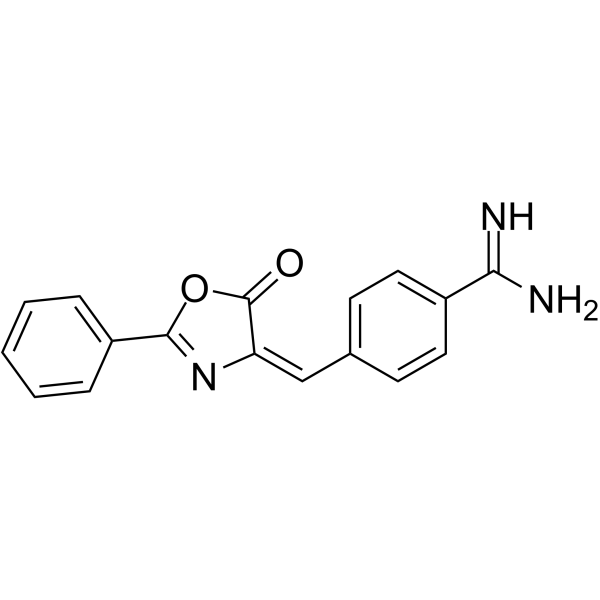
UK122 is a potent and selective urokinase-type plasminogen activator (uPA) inhibitor with an IC50 of 0.2 μM. UK122 shows no or little inhibition of tissue-type PA (tPA), plasmin, thrombin, and trypsin (all IC50>100 μM). UK122, 4-oxazolidinone analogue, is an anticancer agent and inhibits cancer cell migration and invasion .
loading...
    loading...
3
3 Cited Publications
Cat. No.: HY-111056A
Target:  

Ser/Thr Protease

Research Areas:  

Cancer

UK122 hydrochloride is a potent and selective urokinase-type plasminogen activator (uPA) inhibitor with an IC50 of 0.2 μM. UK122 hydrochloride shows no or little inhibition of tissue-type PA (tPA), plasmin, thrombin, and trypsin (all IC50s > 100 μM). UK122 hydrochloride, a 4-oxazolidinone analogue, is an anticancer agent and inhibits cancer cell migration and invasion .
loading...
    loading...
Cat. No.: HY-162965
CAS No.: 901728-48-1
Target:  

Proteasome

Research Areas:  

Cancer

Immunoproteasome activator 1 (compound A) is a selective immunoproteasome activator that increases the presentation of individual MHC-I–bound peptides by over 100-fold. Immunoproteasome activator 1 binds to the proteasome structural subunit PSMA1 and promotes the association of the proteasome activator PA28α/β (PSME1/PSME2) with immunoproteasomes .
loading...
    loading...
Cat. No.: HY-W339758
CAS No.: 321883-64-1
Synonyms: 1,2-Didecanoyl-sn-glycero-3-phosphate sodium
10:0 PA (1,2-Didecanoyl-sn-glycero-3-phosphate) sodium is an anionic lipid that can be used to prepare nanoemulsions to improve the oral bioavailability of Etoposide (HY-13629) .
loading...
    loading...
Cat. No.: HY-16979
CAS No.: 189015-24-5
Target:  

Opioid Receptor

Research Areas:  

Neurological Disease

RK-851 is a highly selective and orally active δ-opioid receptor antagonist, with a negative logarithm of the antagonist concentration (pA2) of 8.84. TRK-851 exhibits the selectivity for the δ receptor of more than 100 times higher than that for the μ or κ receptors. TRK-851 exhibits a potent antitussive effect in a rat model of capsaicin-induced cough. TRK-851 can be used for research on antitussive effects .
loading...
    loading...
Cat. No.: HY-181404
Target:  

Fungal P-glycoprotein

Research Areas:  

Infection

PA36-2 is an Mdr1 inhibitor and azole resistance reversal agent, with a IC50 of 1.0 μg/mL and a Kd of 4.209 μM against Candida albicans Mdr1. By effectively inhibiting the activity of the Mdr1 efflux pump, PA36-2 prevents the pumping of substrates out of cells, enhances the intracellular accumulation of azole antibiotics, and exerts a synergistic effect with antifungal agents such as Fluconazole (FLC) (HY-B0101). PA36-2 can be used in the research of azole-resistant candidiasis .
loading...
    loading...
Cat. No.: HY-L100
147 compounds

Cancer is a multi-step process which involves initiation, promotion and progression. Chemical carcinogens can alter any of these processes to induce their carcinogenic effects. People are continuously exposed exogenously to varying amounts of chemicals that have been shown to have carcinogenic or mutagenic properties in experimental systems. Exposure can occur exogenously when these agents are present in food, air or water, and also endogenously when they are products of metabolism or pathophysiologic states such as inflammation. The administration of chemical carcinogens is one of the most commonly used methods to induce tumors in several organs in laboratory animals in order to study oncologic diseases of humans. MCE offers a unique collection of 147 chemical carcinogens which have been identified with carcinogenic activity either in humans or in animal models. MCE Tumorigenesis-Related Compound Library is a powerful tool for studying oncologic diseases of humans. Standard opration based on safety data sheet will not cause harm to the body.

