1. Search Result
Search Result
Results for "

BJ

" in MedChemExpress (MCE) Product Catalog:

14

Inhibitors & Agonists

3

Natural
Products

1

Antibodies

Cat. No. Product Name Target Research Areas Chemical Structure
  • HY-N6005

    Bacterial Fungal Apoptosis Bcl-2 Family Infection Metabolic Disease Cancer
    Methyl caffeate is a phenylpropanoid, antibacterial agent, and Apoptosis-inducing agent. Methyl caffeate can be isolated from the flowers of peach Prunus persica (L.). Methyl caffeate upregulates the expression of pro-apoptotic proteins Bid, Bax and p53, and downregulates the expression of anti-apoptotic protein BCL-2. Methyl caffeate downregulates SASP factors. Methyl caffeate enhances glucose-stimulated insulin secretion. Methyl caffeate inhibits the growth of Gram-positive bacteria, Gram-negative bacteria, fungi, and Mycobacterium tuberculosis strains. Methyl caffeate can be used in studies related to breast cancer, type 2 diabetes, and tuberculosis .
    Methyl caffeate
  • HY-156449

    STING IKK Inflammation/Immunology
    STING-IN-7 is a potent STING inhibitor with an IC50 of 11.5 nM. STING-IN-7 can inhibit the phosphorylation of STING, IRF3, and TBK1. STING-IN-7 can be used in the research of autoimmune and inflammatory diseases .
    STING-IN-7
  • HY-N11690

    Na+/K+ ATPase Cardiovascular Disease Cancer
    Oleandrigenin is a potent cardiotonic steroid. Oleandrigenin shows Na +/K +-ATP-ase inhibiting and cytotoxic activities .
    Oleandrigenin
  • HY-176162

    Reactive Oxygen Species (ROS) Apoptosis Cancer
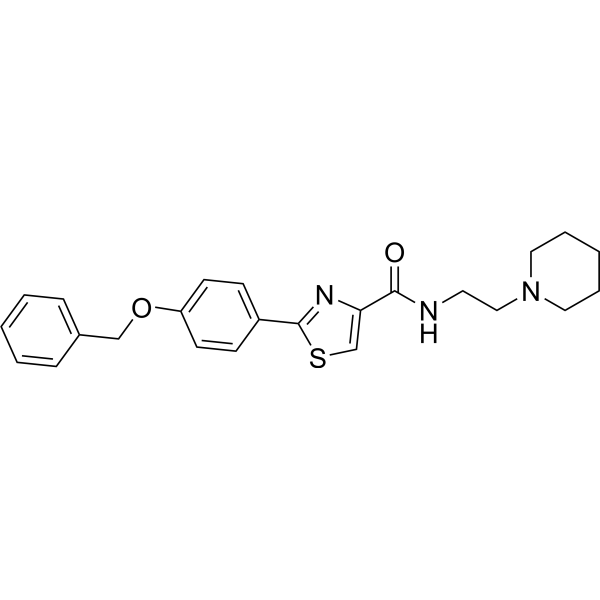
    BJ-13 is a reactive oxygen species (ROS) inducer that can lead to mitochondrial membrane potential collapse and caspase-dependent apoptosis. BJ-13 inhibits the proliferation of SGC-7901, U-87MG, and HepG-2 cancer cells (IC50 values of 15.33, 27.18, and 20.44 nM, respectively). BJ-13 can be used in the study of gastric cancer .
    BJ-13
  • HY-178773

    Sirtuin Apoptosis Infection
    SIRT2-IN-18 (Compound 8) is a SIRT2 inhibitor with IC50s of 5.3  and 12.3 μM for SmSIRT2 and hSIRT2, respectively. SIRT2-IN-18 shows potent antischistosomal activities against both Liberian and Puerto Rican strains of Schistosoma mansoni and reduces schistosomula and adult worm pair viability, pairing, and egg production, with low cytotoxicity in mammalian cells. SIRT2-IN-18 increases histone H3 hyperacetylation and induces cytochrome c-mediated apoptosis .
    SIRT2-IN-18
  • HY-169477

    Biochemical Assay Reagents Cancer
    PAMAM Dendrimer G0.5 Carboxylate sodium is a polyamidoamine (PAMAM) dendrimer with carboxylate termini. PAMAM Dendrimer G0.5 Carboxylate sodium conjugated with DACHPt is cytotoxic to A2780 ovarian cancer cells, MCF-7 breast cancer cells, Caco-2 colon cancer cells and BJ fibroblasts with IC50 values of 0.03, 1.6, 0.18 and 3 µM, respectively .
    PAMAM dendrimer G0.5 carboxylate sodium (8.78% w/w in water)
  • HY-182614

    Src Cathepsin PI3K Akt Ras Raf ERK MMP Cancer
    BJ-2302 is a Src kinase inhibitor with an IC50 of 3.23 μM, and inhibits cathepsin S (CTSS) activity [2].BJ-2302 binds to Src, suppresses PI3K/AKT and Ras/Raf/ERK pathways, and reduces CTSS and MMP-9 expression [3].BJ-2302 inhibits cancer cell invasion, metastasis, proliferation, and tumor growth [3].BJ-2302 does not induce cytotoxicity in normal breast epithelial cells [3].BJ-2302 can be used for the research of breast cancer and triple-negative breast cancer .
    BJ-2302
  • HY-163126

    Cholinesterase (ChE) Cancer
    AChE-IN-52 (compound A6) is an acetylcholinesterase (AChE) inhibitor. AChE-IN-52 shows antitumor efficacy, especially against breast cancer MCF-7 cells. AChE-IN-52 significantly disrupts the amino acid metabolism and inhibits migration of MCF-7. AChE-IN-52 plays anticancer role by regulating Best1 and HIST1H2BJ .
    AChE-IN-52
  • HY-N12887

    Mitochondrial Metabolism Others Cancer
    Mycothiazole is an inhibitor for mitochondrial electron transport chain (ETC) complex I. Mycothiazole exhibits cytotoxicity in cancer cells Huh7 (IC50 is 55.8 μM), U87 and MCF7. Mycothiazole induces apoptosis in Huh7. Mycothiazole utilizes the unfolded protein response (UPR) and heat shock response (HSR) pathway involved transcription factors ATFS-1 and HSF1, to extend the lifespan of C. elegans .
    Mycothiazole
  • HY-183306

    mTOR STAT Neurological Disease Inflammation/Immunology Cancer
    mTOR/STAT3-IN-1 is a dual mTOR/STAT3 inhibitor. mTOR/STAT3-IN-1 exhibits potent mTOR inhibitory activity and moderate STAT3 inhibitory activity, while exerting cell type-dependent antiproliferative and senolytic activities in human cell lines. mTOR/STAT3-IN-1 can be used in the research of glioblastoma and aging-related diseases .
    mTOR/STAT3-IN-1
  • HY-183307

    mTOR STAT Neurological Disease Cancer
    mTOR-IN-29 (Compound 4k) is an mTOR inhibitor with a IC50 of ~120 nM. mTOR-IN-29 inhibits mTOR kinase activity without affecting the phosphorylation of STAT3. mTOR-IN-29 acts as a cytotoxic agent against proliferating and senescent cells. mTOR-IN-29 can be used in studies related to glioblastoma .
    mTOR-IN-29
  • HY-181066

    Angiotensin-converting Enzyme (ACE) SARS-CoV Infection
    ACE2-SP PPI-IN-1 is an inhibitor of the interaction between the SARS-CoV-2 spike protein and ACE2, with an IC50 of 2162.77 nM. ACE2-SP PPI-IN-1 exhibits low cytotoxicity in human fibroblasts. ACE2-SP PPI-IN-1 binds to the interface region between the spike protein RBD and ACE2, reducing the flexibility of the critical receptor-binding loop and maintaining the structural compactness of the spike protein. ACE2-SP PPI-IN-1 can be used for research related to SARS-CoV-2 .
    ACE2-SP PPI-IN-1
  • HY-183308

    Fungal Infection
    Antifungal agent-161 (Compound 7) is an Antifungal agent. Antifungal agent-161 potently inhibits Candida albicans ATCC 36082 (with a MIC of 1.32 μM) and Candida glabrata ATCC 2001 (with a MIC of 1.66 μM). Antifungal agent-161 reduces fungal loads in infected mice and eliminates Candida albicans and Candida glabrata infections. Antifungal agent-161 can be used for the research of candidiasis .
    Antifungal agent-161
  • HY-W743094

    Drug Derivative Inflammation/Immunology Cancer
    Methylstenbolone is a steroid and an anti-inflammatory agent. Methylstenbolone inhibits nitric oxide production in macrophages and exhibits cytotoxicity against breast cancer cells and normal fibroblasts. Methylstenbolone can be used for the research of inflammation and breast cancer .
    Methylstenbolone

Inquiry Online

Your information is safe with us. * Required Fields.

Salutation


Country or Region *

Applicant Name *


Organization Name *

Department *


Email Address *


Product Name *

Cat. No.


Requested quantity *

Phone Number *


Remarks

Inquiry Online

Inquiry Information

Product Name:
Cat. No.:
Quantity:
MCE Japan Authorized Agent:

