5 Results for "

DNA denaturation

" in MedChemExpress (MCE) Product Catalog:
Products (5)

5 Results for "DNA denaturation" in MCE Product Catalog:

Cat. No.: HY-172445
CAS No.: 438545-06-3
Synonyms: SS-DNA
Deoxyribonucleic acid sodium salt from salmon testes (SS-DNA) is a double-stranded deoxyribonucleic acid sodium salt extracted from salmon testes, which serves as an anti-adhesion agent and surface passivating agent for the surface of gold plasmonic sensors. Deoxyribonucleic acid sodium salt from salmon testes forms a nanoscale-thick film on the surface of gold plasmonic sensors, preventing non-specific adsorption of subsequent DNA analyte layers .
loading...
    loading...
Cat. No.: HY-W012954B
CAS No.: 75-57-0
Synonyms: Tetramethylammonium chloride, for molecular biology, 99%(T)
TMA chloride, for molecular biology, 99%(T) (Tetramethylammonium chloride, for molecular biology, 99%(T)) can increase the specificity of hybridization and raise the DNA denaturation temperature in PCR.
loading...
    loading...
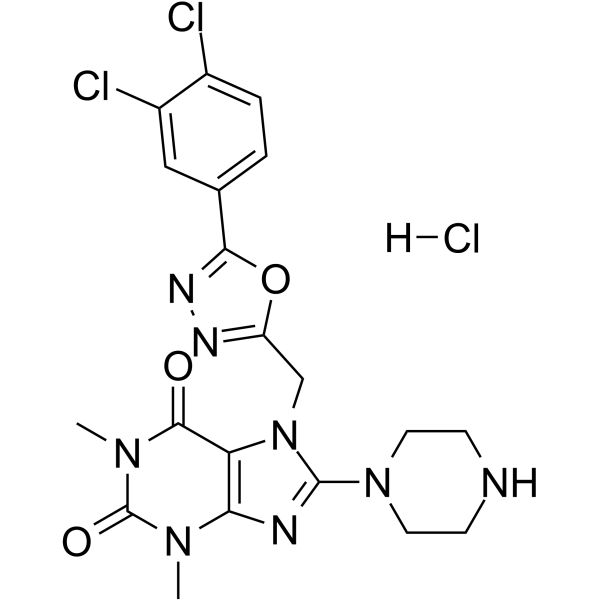
Cat. No.: HY-125209A
CAS No.: 2253744-57-7
Research Areas:  

Cancer

TH5427 hydrochloride is a NUDT5 inhibitor with a human target IC50 of 29 nM, ~690-fold selectivity over MTH1 in vitro, and selective functional inhibition over other NUDIX hydrolases including NUDT9 .TH5427 hydrochloride binds to the active site of NUDT5, blocking enzymatic activity related to ADP-ribose metabolism and PAR-derived ATP synthesis .TH5427 hydrochloride blocks progestin-dependent nuclear ATP synthesis, impairs progestin-induced chromatin remodeling, inhibits histone H1 displacement, disrupts progestin-dependent gene regulation, and abrogates progestin-dependent proliferation in breast cancer cells .TH5427 hydrochloride functions as a versatile probe to study nuclear ATP dynamics and ADP-ribose-related metabolism in cells .TH5427 hydrochloride engages NUDT5 at physiological temperatures, as demonstrated by Drug Affinity Responsive Target Stability (DARTS) assay .TH5427 hydrochloride stabilizes NUDT5 against thermal denaturation in cell lysates and intact cells, as shown by cellular thermal shift assay (CETSA) .TH5427 hydrochloride functionally inhibits NUDT5 activity, leading to downstream effects on oxidative DNA damage and DNA replication in triple-negative breast cancer (TNBC) cells .TH5427 hydrochloride suppresses proliferation of TNBC cells without inducing cell death or apoptosis, slows DNA replication in TNBC cells, promotes accumulation of oxidative DNA lesions, and triggers DNA damage response in TNBC cells .TH5427 hydrochloride suppresses growth of TNBC cells in vitro, inhibits growth of TNBC xenograft tumors in nude mice in vivo, and shows greater potency against TNBC cell lines compared to ER-positive and normal-like breast cell lines .TH5427 hydrochloride can be used for the research of breast cancer and triple-negative breast cancer .
loading...
    loading...
Cat. No.: HY-W778375
CAS No.: 73489-97-1
Target:  

Apoptosis

Research Areas:  

Inflammation/Immunology Cancer

Hesperetin triacetate is an active compound with anti-inflammatory and anti-tumor activities. Hesperetin triacetate inhibits bovine serum albumin denaturation in vitro. Hesperetin triacetate inhibits carrageenan-induced paw swelling in mice in vivo. Hesperetin triacetate exhibits anti-proliferative activity against breast cancer cells. Hesperetin triacetate induces DNA degradation and apoptosis in breast cancer cells. Hesperetin triacetate can be used in studies related to breast cancer and inflammation .
loading...
    loading...
Cat. No.: HY-183480
CAS No.: 80841-47-0
Synonyms: CI-921; NSC 343499
Target:  

Topoisomerase

Research Areas:  

Cancer

Asulacrine (CI-921) is an orally active DNA intercalating topoisomerase II inhibitor. Asulacrine binds to DNA via intercalation, with its acridine chromophore intercalated between base pairs and substituents located in the major/minor grooves, which stabilizes DNA against acid denaturation. Asulacrine acts as a cell cycle inhibitor, disruptor, and arrest inducer, slowing cell progression in late S/G2 phase, causing G2 phase arrest and inducing unbalanced growth. Asulacrine inhibits cell growth, clonogenicity, and colony formation, and leads to histological destruction of tumor cells. Compared to cells in exponential growth phase, Asulacrine exhibits lower toxicity to quiescent cells; its activity depends on cationic properties, and it has better water solubility and metabolic stability. Asulacrine can be used in research related to leukemia, lung cancer, colon cancer, breast cancer, melanoma, adriamycin-resistant mammary adenocarcinoma, and mouse solid tumors .
loading...
    loading...

