6 Results for "

Mycobacterium leprae

" in MedChemExpress (MCE) Product Catalog:
Products (6)

6 Results for "Mycobacterium leprae" in MCE Product Catalog:

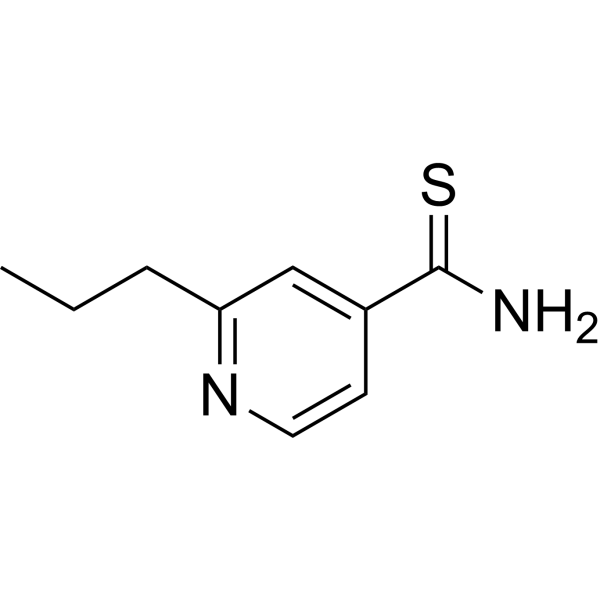
Cat. No.: HY-B0306
CAS No.: 14222-60-7
Synonyms: Protionamide
Target:  

Bacterial

Research Areas:  

Infection

Prothionamide is an orally active thioamide antibacterial agent. Prothionamide is a substrate of OCT1 with a Km value of 805.8 μM. Prothionamide reacts with NAD to form a covalent adduct, with the adduct being a tight-binding inhibitor of Mycobacterium tuberculosis and Mycobacterium leprae InhA. Prothionamide can effectively inhibit the growth of Mycobacterium tuberculosis (MIC = ~0.5 µg/mL) and Mycobacterium leprae. Prothionamide is used in the research of tuberculosis and leprosy .
loading...
    loading...
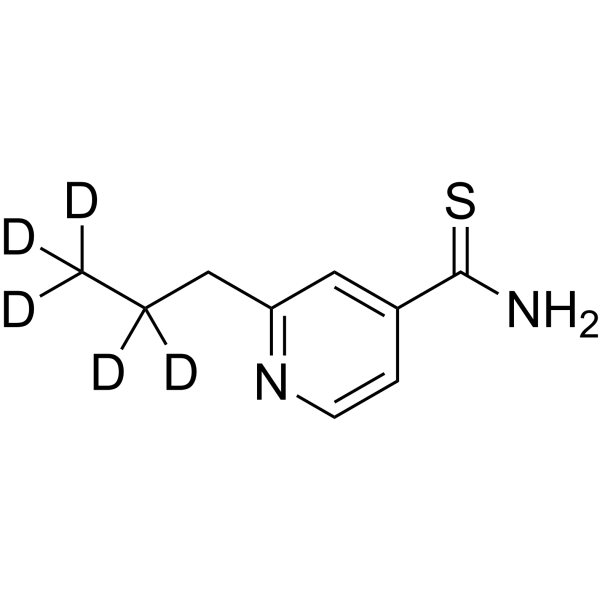
Cat. No.: HY-B0306S
CAS No.: 1330261-26-1
Synonyms: Protionamide-d5
Prothionamide-d5 is deuterium labeled Prothionamide (HY-B0306). Prothionamide is an orally active thioamide antibacterial agent. Prothionamide is a substrate of OCT1 with a Km value of 805.8 μM. Prothionamide reacts with NAD to form a covalent adduct, with the adduct being a tight-binding inhibitor of Mycobacterium tuberculosis and Mycobacterium leprae InhA. Prothionamide can effectively inhibit the growth of Mycobacterium tuberculosis (MIC = ~0.5 µg/mL) and Mycobacterium leprae. Prothionamide is used in the research of tuberculosis and leprosy .
loading...
    loading...
Cat. No.: HY-B0306R
CAS No.: 14222-60-7
Synonyms: Protionamide (Standard)
Research Areas:  

Infection

Prothionamide (Standard) is the analytical standard of Prothionamide (HY-B0306). This product is intended for research and analytical applications. Prothionamide is an orally active thioamide antibacterial agent. Prothionamide is a substrate of OCT1 with a Km value of 805.8 μM. Prothionamide reacts with NAD to form a covalent adduct, with the adduct being a tight-binding inhibitor of Mycobacterium tuberculosis and Mycobacterium leprae InhA. Prothionamide can effectively inhibit the growth of Mycobacterium tuberculosis (MIC = ~0.5 µg/mL) and Mycobacterium leprae. Prothionamide is used in the research of tuberculosis and leprosy .
loading...
    loading...
Cat. No.: HY-15390
CAS No.: 500-89-0
Purity:  99.33%
Synonyms: CIBA-1906
Target:  

Bacterial

Research Areas:  

Infection

Thiambutosine is an inhibitor of Mycobacterium leprae with low oral activity. In animal experiments, Thiambutosine can inhibit leprosy infection by intramuscular injection .
loading...
    loading...
Cat. No.: HY-118647
CAS No.: 584-69-0
Synonyms: Etisul
Target:  

Bacterial

Research Areas:  

Infection

Ditophal is an orally active thiol ester anti-tuberculosis and anti-leprosy agent. Ditophal combats Mycobacterium tuberculosis infections in subcutaneous and intracerebral sites in guinea pigs, including isoniazid (HY-B0329)-resistant strains. Ditophal alters the staining characteristics of Mycobacterium leprae and reduces the bacterial index of leprosy. Ditophal causes ulcers at the injection site when administered subcutaneously to guinea pigs at high doses. Ditophal can be used in the research of tuberculosis and leprosy .
loading...
    loading...
Cat. No.: HY-W780694
CAS No.: 112654-98-5
PD 124816 is an orally active fluoroquinolone antibiotic. PD 124816 exerts broad-spectrum antibacterial effects by inhibiting DNA gyrase (topoisomerase IV), and it has no cross-resistance with commonly used antibiotics. PD 124816 is effective against both Gram-positive and Gram-negative bacteria (MIC₉₀ ≤ 0.06 μg/mL), and the MIC₉₀ for anaerobic bacteria (Peptostreptococcus fragi) is 1 μg/mL. PD 124816 exhibits complete bactericidal activity in a mouse model of Mycobacterium leprae infection. PD 124816 can be used for studying mixed infections and infections caused by drug-resistant bacteria .
loading...
    loading...

