Search Result
Results for "
Reactive dye
" in MedChemExpress (MCE) Product Catalog:
3
Biochemical Assay Reagents
| Cat. No. |
Product Name |
Target |
Research Areas |
Chemical Structure |
-
- HY-D0819
-
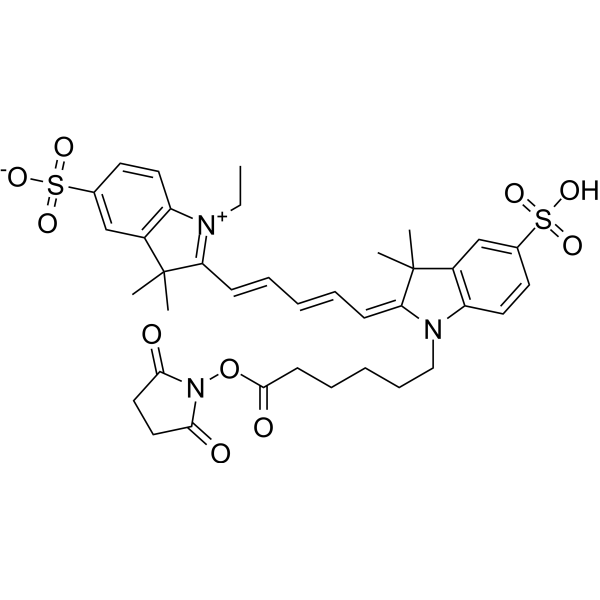
CY5-SE
Maximum Cited Publications
37 Publications Verification
Cy5 NHS Ester; Sulfo-Cyanine5 Succinimidyl Ester
|
Fluorescent Dye
|
Others
|
|
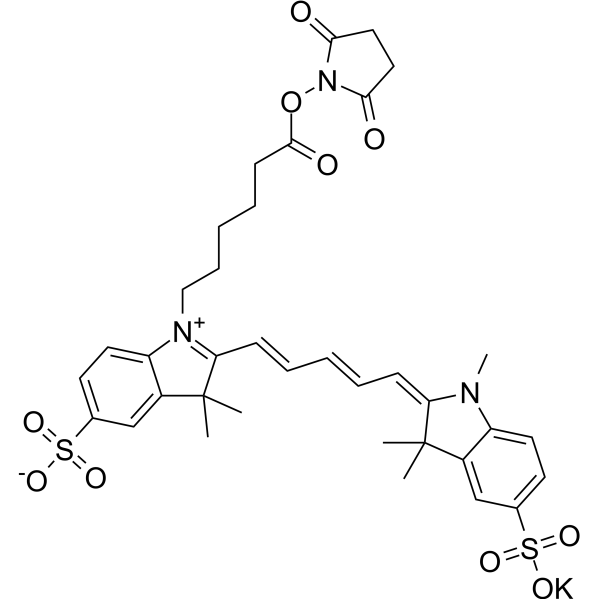
Cy5-SE (Cy5 NHS Ester) is a reactive dye for the labeling of amino-groups in peptides, proteins, and oligonucleotides. This dye requires small amount of organic co-solvent (such as DMF or DMSO) to be used in labeling reaction. This reagent is ideal for very cost-efficient labeling of soluble proteins, as well as all kinds of peptides and oligonucleotides. This reagent also works well in organic solvents for small molecule labeling.
Excitation (nm):649, Emission (nm): 670.
|
-
-
- HY-138200
-
|
Cyanine5 maleimide
|
DNA Stain
Fluorescent Dye
|
Others
|
|
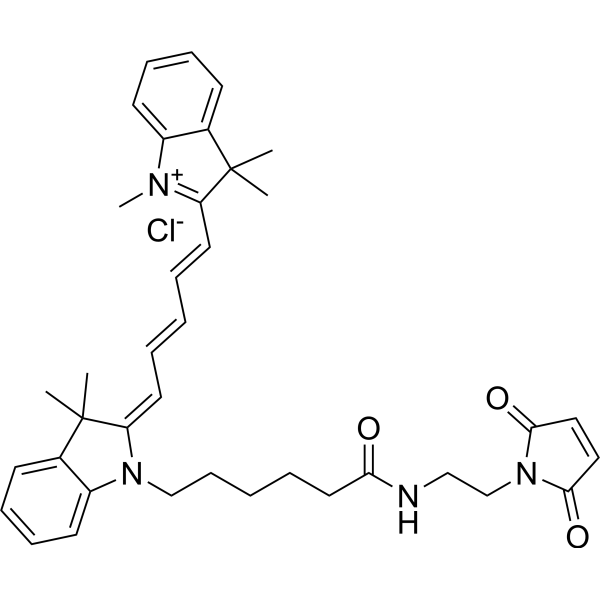
Cy5 maleimide (Cyanine5 maleimide) is a single-reactive dye containing a maleimide group and a CY5 fluorescent group, which can selectively couple with a thiol group. Cy5 maleimide can be used to label antibodies, peptides, or proteins (Ex/Em = 646/664 nm).
|
-
-
- HY-D0819A
-
|
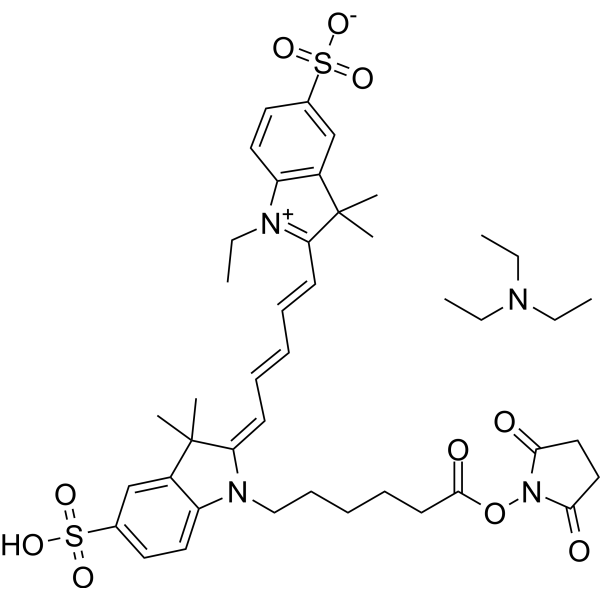
Cy5 NHS Ester triethylamine salt; Sulfo-Cyanine5 Succinimidyl Ester triethylamine salt
|
Fluorescent Dye
|
Others
|
|
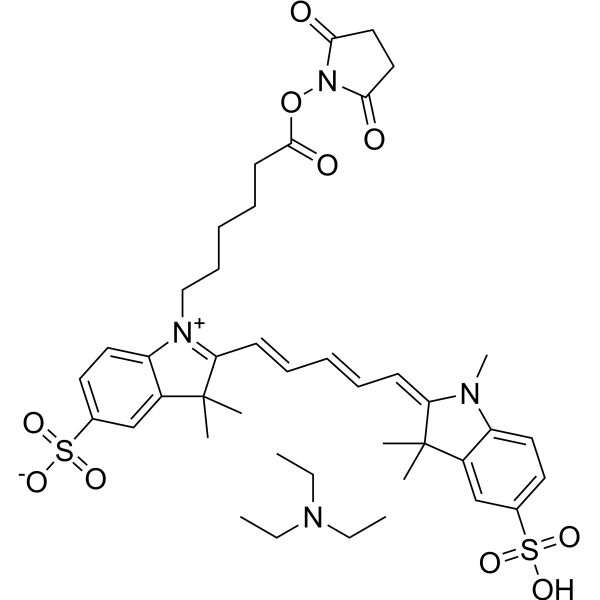
Cy5-SE (Cy5 NHS Ester) triethylamine salt is a reactive dye for the labeling of amino-groups in peptides, proteins, and oligonucleotides. Cy5-SE triethylamine salt is ideal for very cost-efficient labeling of soluble proteins, as well as all kinds of peptides and oligonucleotides Ex=649 nm; Em=670 nm) .
|
-
-
- HY-D0069
-
|
|
Fluorescent Dye
|
Others
Cancer
|
|
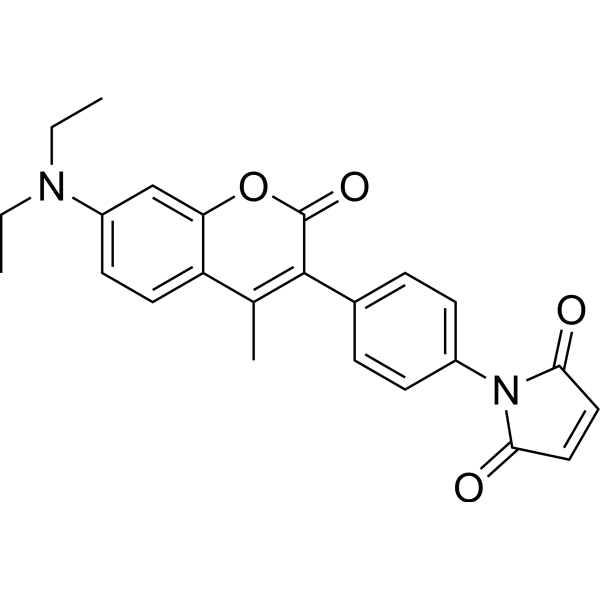
CPM is a maleimide derivative, acting as a blue fluorescent thiol-reactive dye (excitation/emission maxima of 387/463 nm) .
|
-
-
- HY-D0049
-
|
6-TAMRA-NHS ester; 6-Carboxytetramethylrhodamine N-succinimidyl ester
|
DNA Stain
|
Others
|
|
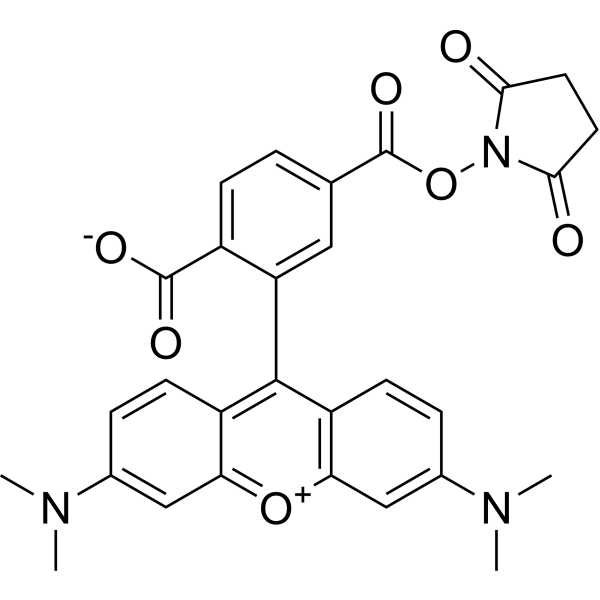
6-TAMRA-SE (6-TAMRA-NHS ester) is a fluorescent dye carrying the amine reactive group. 6-TAMRA-SE is one of the traditional fluorophores used for automated DNA sequencing .
|
-
-
- HY-135415
-
|
|
Fluorescent Dye
|
Others
|
|
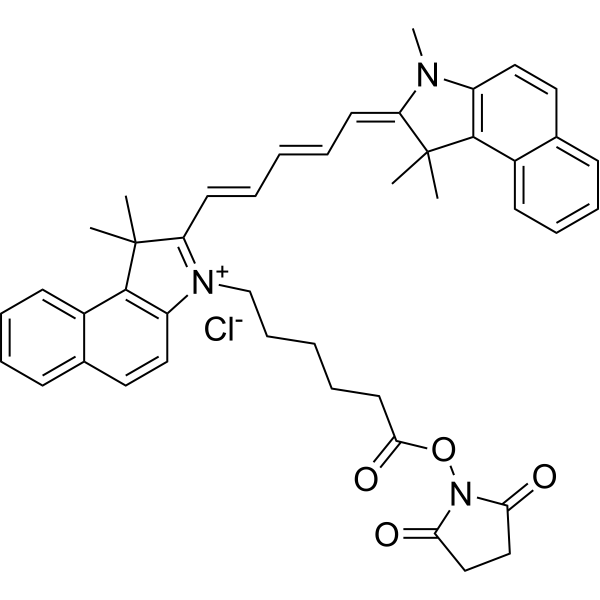
Cyanine5.5 NHS ester chloride is a reactive dye for the labeling of proteins, and antibodies and small molecular compounds .
|
-
-
- HY-103469
-
|
PO1
|
Fluorescent Dye
|
Others
|
|
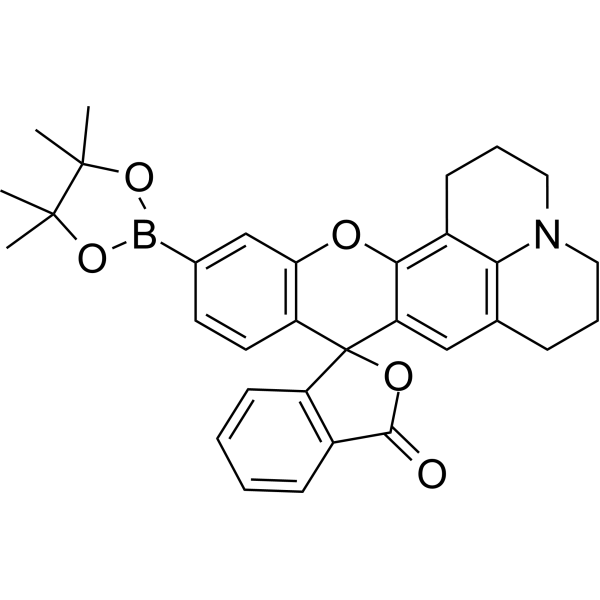
Peroxy Orange 1 (PO1) is a new H2O2 specific probe that can bind to green fluorescent highly reactive oxygen species (hROS) probe APF. Peroxy Orange 1 is also a living cell dye .
|
-
-
- HY-D0331
-
-
-
- HY-125815
-
|
|
Fluorescent Dye
|
Others
|
|
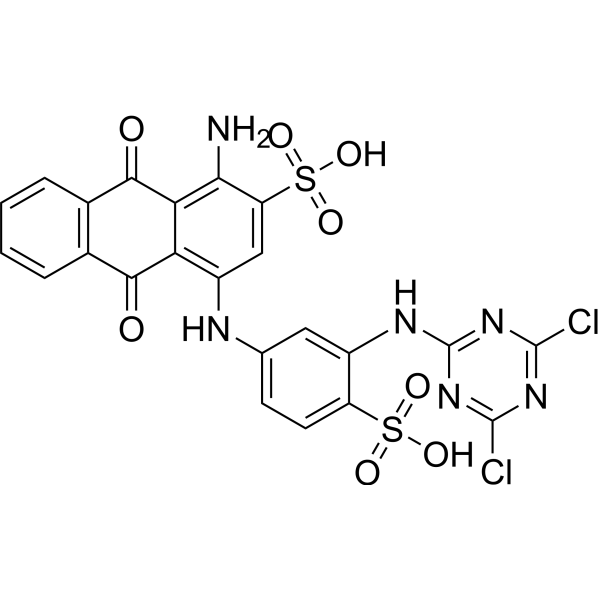
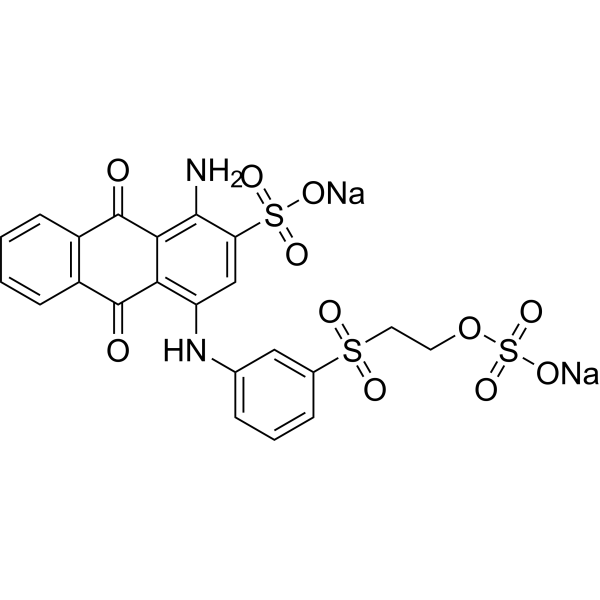
Reactive Blue 4 is an anthraquinone dye used extensively in the textile industry. Reactive Blue 4 is a single colorimetric chemosensor for sequential determination of multiple analytes with different optical responses in aqueous media .
|
-
-
- HY-D1744
-
|
|
Fluorescent Dye
|
Others
|
|
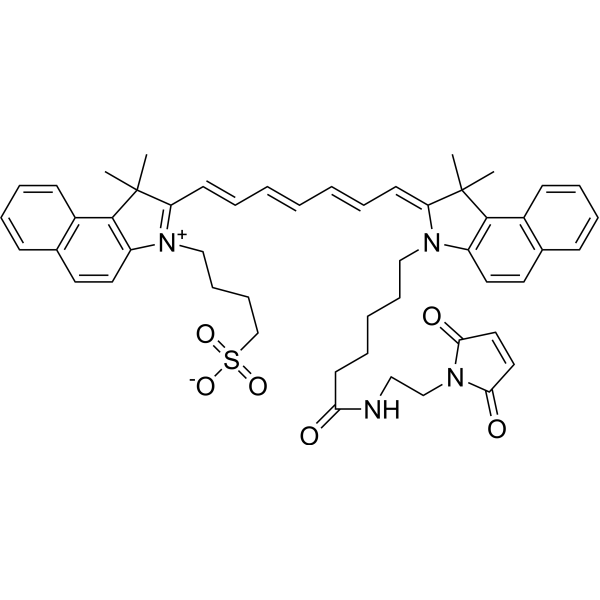
ICG Maleimide is thiol reactive near infrared (NIR) fluorescent dye and used to generate a stable fluorescence signal in bioimaging (Ex/Em = 789/813 nm).
|
-
-
- HY-D1605
-
|
|
Fluorescent Dye
|
Others
|
|
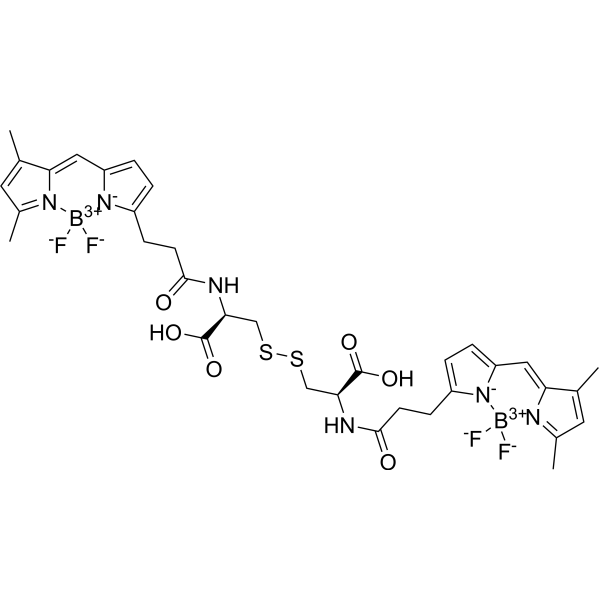
BODIPY FL L-Cystine is a thiol-reactive, green-fluorescent dye. BODIPY FL L-Cystine can be the labeling of membrane proteins, proteins with hydrophobic binding sites, or hydrophobic ligands. (λex=504 nm, λem=511 nm) .
|
-
-
- HY-123749
-
|
5-TMRIA
|
Fluorescent Dye
|
Others
|
|
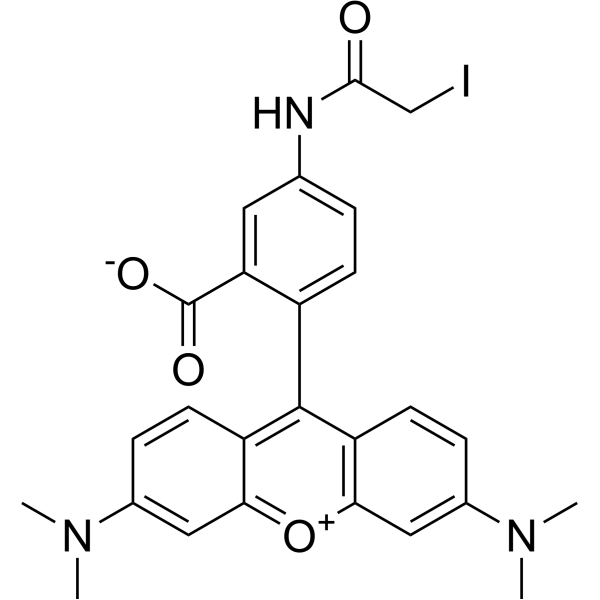
Tetramethylrhodamine-5-iodoacetamide (5-TMRIA) is a thiol-selective reactive dye that is used to non-specifically label proteins via the cysteine residues. Tetramethylrhodamine-5-iodoacetamide (5-TMRIA) can be used to covalently label DNA fragments .
|
-
-
- HY-135413A
-
-
-
- HY-D0026
-
|
7-Amino-4-methyl-3-coumarinacetic acid N-succinimidyl ester
|
Fluorescent Dye
|
Others
|
|
AMCA,SE (7-Amino-4-methyl-3-coumarinacetic acid N-succinimidyl ester) is a bright blue fluorescent dye. AMCA,SE reacts with amino groups and is excited by ultraviolet light. AMCA,SE can be used for amine reactive labeling (Ex/Em = 354/440 nm) .
|
-
-
- HY-D2746
-
|
|
Fluorescent Dye
|
Others
|
|
Cy5.5 bis-NHS ester is a reactive cyanine dye containing NHS ester which can be used to label amine groups in peptides, proteins, and oligonucleotides.
|
-
-
- HY-D2173
-
|
|
Fluorescent Dye
|
Others
|
|
AF488 azide is a fluorescent dye that can be used to determine the reactivity of immobilized DIBO groups. AF488 azide exhibits the λem and λex wavelength of 520 nm and 470 nm, respectively .
|
-
-
- HY-D1085
-
|
|
Fluorescent Dye
|
Others
|
|
AMCA-X-SE is a coumarin derivative that generates fixed blue fluorescence and an NHS-activated ester that forms stable amide bonds with primary amine groups. It is used as a reactive dye for labeling amino groups of peptides, proteins, and oligonucleotides. Maximum excitation/emission wavelength: 354/442 nm .
|
-
-
- HY-D1623
-
|
|
Fluorescent Dye
|
Others
|
|
Cyanine3 carboxylic acid chloride is a non-toxic red fluorescent dye with good solubility in organic solvents. Cyanine3 carboxylic acid chloride can be used as a non-reactive fluorophore for experimental control and calibration. Cyanine3 carboxylic acid chloride can also be synthesized with targeted agents as fluorescent probes for rapid detection of agent reactions .
|
-
-
- HY-114351
-
|
|
Fluorescent Dye
|
Others
|
|
BODIPY FL Hydrazide is a green-fluorescent dye, BODIPY FL Hydrazide is reactive with aldehyde/ketone on polysaccharides and glycoproteins, yielding a reversible Schiff base product that can be transformed to a stable linkage using a reducing agent like sodium borohydride or sodium cyanoborohydride. (λex=495 nm, λem=516 nm) .
|
-
-
- HY-DY1063
-
|
|
Fluorescent Dye
|
Others
|
Cy5-SE (Cy5 NHS Ester) (solution) is a reactive dye for the labeling of amino-groups in peptides, proteins, and oligonucleotides. This dye requires small amount of organic co-solvent (such as DMF or DMSO) to be used in labeling reaction. This reagent is ideal for very cost-efficient labeling of soluble proteins, as well as all kinds of peptides and oligonucleotides. This reagent also works well in organic solvents for small molecule labeling.
Excitation (nm) :649, Emission (nm) : 670. Solvent and concentration: DMSO: 10 mM
|
-
-
- HY-D1225
-
|
|
Fluorescent Dye
|
|
|
Reactive red 180 is common textile dyes that can be adsorbed onto single-walled carbon nanotubes (SWCNTs) through electrostatic interactions, allowing the separation of residual dyes.
|
-
-
- HY-135413B
-
|
Sulfo-Cyanine5 NHS ester triethylamine
|
DNA Stain
|
Others
|
|
MeCY5-NHS ester (potassium) is a reactive dye and can be used for labeling protein nucleic acid .
|
-
-
- HY-D1319A
-
|
Cy5 acid bromide
|
Fluorescent Dye
|
Others
|
|
Cyanine5 carboxylic acid (bromide) is a fluorescent dye containing a non-activated carboxylic acid (Ex=646 nm, Em=662 nm). Cyanine5 carboxylic acid chloride is an non-reactive dye that can be used in control samples .
|
-
-
- HY-D1021
-
|
Aminoallyl-dUTP sodium salt
|
DNA/RNA Synthesis
|
Others
|
|
AA-dUTP (Aminoallyl-dUTP) sodium salt is a reverse transcriptase and DNA polymerase I substrate with probe precursor activity. AA-dUTP sodium salt undergoes enzymatic incorporation into DNA during cDNA synthesis and nick translation. AA-dUTP sodium salt generates amine-modified DNA, which can be used for labeling with amine-reactive fluorescent dyes .
|
-
-
- HY-130736
-
|
JF549, SE; JF549, NHS
|
Fluorescent Dye
|
Others
|
|
Janelia Fluor® 549, SE (JF549, SE) is a cell-permeable fluorescent dye with an NHS ester (succinimidyl ester (SE)) reactive group. NHS esters react with primary amines and are commonly used to conjugate dyes to proteins, antibodies, amine-modified oligonucleotides, and other molecules. Janelia Fluor® 549, SE also acts as a ligand for self-labeling tags such as HaloTag and SNAP-tag, and can be used in live-cell imaging studies (Ex/Em = 549 nm/571 nm) .\n
|
-
-
- HY-D1138
-
|
|
Fluorescent Dye
|
|
|
Reactive red 120 is common textile dyes that can be adsorbed onto single-walled carbon nanotubes (SWCNTs) through electrostatic interactions, allowing the separation of residual dyes.
|
-
-
- HY-D0135
-
|
|
Fluorescent Dye
|
Others
|
|
12-(7-Nitrobenzofurazan-4-ylamino)dodecanoic acid is an amine-reactive fluorescent dye .
|
-
-
- HY-D0112
-
|
|
Fluorescent Dye
|
Others
|
|
7-Hydroxycoumarin-4-acetic acid, a pH-indicator dye, is covalently bound to bovine serum albumin (BSA) at the positions of reactive amino groups (λmax=326 nm) .
|
-
-
- HY-D1372
-
|
|
Fluorescent Dye
|
Others
|
|
Cyanine3 amine hydrochloride, an analog of Cyanine3 amine, is a potent green fluorescent dye. Cyanine3 amine hydrochloride has the primary amine group and is covalently coupled with reactive groups such as NHS esters, carboxy groups (after carbodiimide activation), and epoxides. (λex=555 nm, λem=570 nm) .
|
-
-
- HY-D1372A
-
|
|
Fluorescent Dye
|
Others
|
|
Cyanine3 amine (TFA), an analog of Cyanine3 amine, is a potent green fluorescent dye. Cyanine3 amine (TFA) has the primary amine group and is covalently coupled with reactive groups such as NHS esters, carboxy groups (after carbodiimide activation), and epoxides. (λex=555 nm, λem=570 nm) .
|
-
-
- HY-D2529
-
|
|
Fluorescent Dye
|
Others
|
|
Cy5-PEG2000-SH is a fluorescent labeling reagent that combines Cy5 (HY-D0821) fluorescent dye, polyethylene glycol (PEG) and sulfhydryl (SH) derivatives, and is suitable for molecular coupling. SH is highly reactive and can react with a variety of functional groups (such as maleimide) to form stable thioether bonds.
|
-
-
- HY-D1886
-
|
|
Fluorescent Dye
|
Others
|
|
Vari Fluor 647 SE is a fluorescent dye, SE stands for "succinimidyl ester". Vari Fluor 647 SE belongs to the Vari Fluor family of labeling reagents used in cell and molecular biology research. Vari Fluor 647 SE can react with an amino group to form a covalent bond, thereby introducing Vari Fluor 647 dye into the target molecule or cell. Vari Fluor 647 SE is a reactive dye that produces a fluorescent signal after binding to a target molecule or cell.
|
-
-
- HY-D0374
-
|
|
Fluorescent Dye
|
Others
|
|
Reactive Blue 4 sodium is an anthraquinone dye used extensively in the textile industry. Reactive Blue 4 sodium is a single colorimetric chemosensor for sequential determination of multiple analytes with different optical responses in aqueous media .
|
-
-
- HY-W998687
-
|
|
Fluorescent Dye
|
Others
|
|
Cy5 dimethyl is a free non-activated dye. This dye has limited water solubility, but can be dissolved in mixtures of water with organic phase (DMF, DMSO, alcohols) to obtain useful concentrations of the material in solution. This molecule can be considered non-reactive dye for the use in control samples, and for instrument calibration.
|
-
-
- HY-D2497
-
|
|
Fluorescent Dye
|
Others
|
|
Sulfo Cy7 bis-SH is a fluorescent dye that contains sulfonated Cyanine7 (Sulfo-CY7) fluorescent dye and thiol (-SH) functional group. SH is highly reactive and can react with a variety of functional groups (such as maleimide) to form stable thioether bonds .
|
-
-
- HY-W998707
-
|
|
Fluorescent Dye
|
Others
|
|
TAMRA amine, 5-isomer hydrochloride is a rhodamine dye with excitation/emission maximum 553/575 nm. The amine group is reactive with carboxylic acids, activated NHS esters, carbonyls (ketone, aldehyde) etc.
|
-
-
- HY-W927359
-
|
|
Fluorescent Dye
|
Others
|
|
Fluorescein hydrazide (3,6-Dihydroxyxanthane) is a fluorescein dye that can be used for the fluorophotometric determination of hydrogen peroxide (H2O2) and other reactive oxygen species (ROS) .
|
-
-
- HY-D2750
-
|
|
Fluorescent Dye
|
Others
|
|
Sulfo-Cy5 Picolyl Azide is a fluorophore featuring a sulfonate group and an azide. Azide groups are click chemistry handles which are reactive towards terminal alkynes and strained cyclooctynes such as BCN or DBCO. Cy5 is a cyanine dye with excitation and emission maxima at 651 nm and 670 nm respectively. The sulfonate group on the Cy5 dye increases this compound’s water solubility.
|
-
-
- HY-172721
-
|
|
Fluorescent Dye
|
Others
|
|
Cy3B maleimide is a mono-reactive dye containing maleimide group, which can selectively and efficiently attach Cyanine3 fluorophore (an analog of Cy3) to proteins and peptides containing cysteine residues, as well as to other thiolated molecules (such as thiol-containing oligonucleotides). Cy3B is an improved version of Cy3 dyes with significantly increased fluorescence quantum yield and photostability.
|
-
-
- HY-D1352A
-
|
|
Fluorescent Dye
|
Others
|
|
Sulfo-Cyanine7 NHS ester (TEA) is an amine-reactive succinimide ester. Sulfo-Cyanine7 NHS ester (TEA) reagent allows to prepare sulfo-Cyanine7-labeled biomolecules, such as proteins, with ease. Dye labeled molecules can be subsequently used for various research and agent design related experiments.
|
-
-
- HY-D1596A
-
|
Cy3.5 NHS ester bromide; Cy 3.5 bromide
|
Fluorescent Dye
|
Others
|
|
Cyanine 3.5 bromide (Cy3.5 NHS ester bromide) is an analog of the Cy3.5 fluorophore. Cyanine 3.5 bromide is a red reactive fluorescent dye. Cyanine 3.5 bromide is used to label amino groups in peptides, proteins, and oligonucleotides. (λex=591 nm, λem=604 nm) .
|
-
-
- HY-D2531
-
|
|
Fluorescent Dye
|
Others
|
|
Cy5-PEG5000-SH is a fluorescent labeling reagent that combines Cy5 (HY-D0821) fluorescent dye, polyethylene glycol (PEG) and sulfhydryl (SH) derivatives, and is suitable for molecular coupling. SH is highly reactive and can react with a variety of functional groups (such as maleimide) to form stable thioether bonds.
|
-
-
- HY-151713
-
|
|
Fluorescent Dye
|
Others
|
|
Sulfo-Cy3-Methyltetrazine (figure 7 compound 5) is a click chemistry reagent containing methyltetrazine and a water-soluble dye. Sulfo-Cy3-Methyltetrazine shows good stability at physiological pH. Sulfo-Cy3-Methyltetrazine can be coupled to trans-cyclooctene and is also highly reactive towards cyclooctene .
|
-
-
- HY-D0661
-
|
|
Fluorescent Dye
|
|
|
Reactive red 45 is common textile dyes that can be adsorbed onto single-walled carbon nanotubes (SWCNTs) through electrostatic interactions, allowing the separation of residual dyes.
|
-
-
- HY-D0622
-
|
|
Fluorescent Dye
|
|
|
Reactive Green 19 is common textile dyes that can be adsorbed onto single-walled carbon nanotubes (SWCNTs) through electrostatic interactions, allowing the separation of residual dyes.
|
-
-
- HY-D0514
-
|
|
Fluorescent Dye
|
|
|
Reactive blue 5 is common textile dyes that can be adsorbed onto single-walled carbon nanotubes (SWCNTs) through electrostatic interactions, allowing the separation of residual dyes.
|
-
-
- HY-D1309
-
|
|
Fluorescent Dye
|
|
|
Sulfo-cyanine3 NHS ester sodium is a water-soluble cyanine dye that contains NHS ester groups and is amino-reactive.
|
-
-
- HY-D1611
-
|
|
Fluorescent Dye
|
Others
|
|
BODIPY FL-C5 NHS Ester is a green-fluorescent dye that is reactive with primary amines on biomolecules such as peptides, proteins, modified nucleotides and biopolymers .
|
-
-
- HY-D0655
-
|
|
Fluorescent Dye
|
Others
|
|
Reactive red 24 is a multifunctional dye. Dyes are important tools in biological experiments. They can help researchers observe and analyze cell structures, track biomolecules, evaluate cell functions, distinguish cell types, detect biomolecules, study tissue pathology and monitor microorganisms. Their applications range from basic scientific research to clinical A wide range of diagnostics. Dyes are also widely used in traditional fields such as textile dyeing, as well as in emerging fields such as functional textile processing, food pigments and dye-sensitized solar cells.
|
-
-
- HY-D0634
-
|
|
Fluorescent Dye
|
Others
|
|
Reactive Black 39 is a multifunctional dye. Dyes are important tools in biological experiments. They can help researchers observe and analyze cell structures, track biomolecules, evaluate cell functions, distinguish cell types, detect biomolecules, study tissue pathology and monitor microorganisms. Their applications range from basic scientific research to clinical A wide range of diagnostics. Dyes are also widely used in traditional fields such as textile dyeing, as well as in emerging fields such as functional textile processing, food pigments and dye-sensitized solar cells.
|
-
- HY-D1338
-
|
Cy 3.5 carboxylic acid chloride
|
Fluorescent Dye
|
Others
|
|
Cyanine3.5 carboxylic acid chloride is an anthocyanin dye. Cyanine3.5 carboxylic acid chloride is Cyanine3.5 free unactivated monofunctional carboxylic acid and can be used as a reference or control for non-reactive dye. Cyanine3.5 also is an analog of Cy3.5 fluorophore .
|
-
- HY-D2182
-
|
|
Fluorescent Dye
|
Others
|
|
Preactivated PE-Cy5 Maleimide is a sulfhydryl reactive dye that reacts with free sulfhydryl groups on proteins. Preactivated APC-Cy5.5 Maleimide binds easily to proteins or antibodies, and does not change the spectral characteristics of APC-Cy/YF after activation.
|
-
- HY-D0152
-
|
|
Fluorescent Dye
|
Others
|
|
Tetramethylrhodamine-6-maleimide is a fluorescent dye with a reactive sulfhydryl-specific moiety is covalently coupled to this cysteine. Tetramethylrhodamine-6-maleimide can be used as labels to detect local protein motions of the fully active Na+/K+-ATPase in real time .
|
-
- HY-D2180
-
|
|
Fluorescent Dye
|
Others
|
|
Preactivated APC-Cy5.5 Maleimide is a sulfhydryl reactive dye that reacts with free sulfhydryl groups on proteins. Preactivated APC-Cy5.5 Maleimide binds easily to proteins or antibodies, and does not change the spectral characteristics of APC-Cy/YF after activation.
|
-
- HY-D0115
-
|
|
DNA Stain
|
Others
|
|
7-Hydroxycoumarin-3-carboxylic acid N-succinimidyl ester is the amine-reactive succinimidyl ester of 7-Hydroxycoumarin-3-carboxylic acid. 7-Hydroxycoumarin-3-carboxylic acid N-succinimidyl ester is a blue fluorescent dye for labeling proteins and nucleic acids .
|
-
- HY-D1596
-
|
Cy3.5 NHS ester chloride; Cy 3.5 chloride
|
Fluorescent Dye
|
Others
|
|
Cyanine 3.5 (Cy3.5 NHS ester) chloride is an analog of Cy3.5 fluorophore. Cyanine 3.5 chloride is a reactive, red fluorescent dye. Cyanine 3.5 chloride is used for labeling of amino-groups in peptides, proteins, and oligonucleotides. (λex=591 nm, λem=604 nm) .
|
-
- HY-D2532
-
|
|
Fluorescent Dye
|
Others
|
|
Cy5-PEG10000-SH is a fluorescent labeling reagent that combines Cy5 (HY-D0821) fluorescent dye, polyethylene glycol (PEG) and sulfhydryl (SH) derivatives, and is suitable for molecular coupling. SH is highly reactive and can react with a variety of functional groups (such as maleimide) to form stable thioether bonds.
|
-
- HY-D1607
-
|
|
Fluorescent Dye
|
Others
|
|
BODIPY FL SSE is a potent fluorescent dye. BODIPY FL SSE is used to label the primary amines (R-NH2) of proteins, amine-modified oligonucleotides, and other amine-containing molecules. BODIPY FL SSE can reactive with primary amines on biomolecules to emit green fluorescence. (λex=502 nm, λem=511 nm) .
|
-
- HY-135413
-
-
- HY-D1112
-
|
|
Fluorescent Dye
|
Others
|
|
TFAX 546,SE triethylammonium, an amine reactive yellow fluorescent dye, can forms bright and photostable conjugates with proteins and antibodies .
|
-
- HY-W320994
-
|
Enanthamide
|
Fluorescent Dye
|
Others
|
|
Heptanamide (Enanthamide) is a metabolite of azo dye Reactive Black 5 (RB5). Heptanamide can be used for bioremediation of azo dyes contaminated environments research
|
-
- HY-D1619
-
|
|
Fluorescent Dye
|
Others
|
|
Cyanine3 hydrazide dichloride is a carbonyl reactive dye. Cyanine3 hydrazide dichloride allows the labelling of various carbonyl-containing molecules such as antibodies and other glycoproteins after oxidation by periodate, proteins or reducing sugars after oxidative stress or deamination .
|
-
- HY-D0668
-
|
|
Fluorescent Dye
|
|
|
Reactive orange 13 is common textile dyes that can be adsorbed onto single-walled carbon nanotubes (SWCNTs) through electrostatic interactions, allowing the separation of residual dyes.
|
-
- HY-D0639
-
|
|
Fluorescent Dye
|
|
|
Reactive Brown 23 is common textile dyes that can be adsorbed onto single-walled carbon nanotubes (SWCNTs) through electrostatic interactions, allowing the separation of residual dyes.
|
-
- HY-D0669
-
|
|
Fluorescent Dye
|
|
|
Reactive orange 4 is common textile dyes that can be adsorbed onto single-walled carbon nanotubes (SWCNTs) through electrostatic interactions, allowing the separation of residual dyes.
|
-
- HY-D0692
-
|
|
Fluorescent Dye
|
|
|
Reactive red 124 is common textile dyes that can be adsorbed onto single-walled carbon nanotubes (SWCNTs) through electrostatic interactions, allowing the separation of residual dyes.
|
-
- HY-D0522
-
|
|
Fluorescent Dye
|
|
|
Reactive orange 16 is common textile dyes that can be adsorbed onto single-walled carbon nanotubes (SWCNTs) through electrostatic interactions, allowing the separation of residual dyes.
|
-
- HY-D1243
-
|
|
Fluorescent Dye
|
|
|
Reactive yellow 3 is common textile dyes that can be adsorbed onto single-walled carbon nanotubes (SWCNTs) through electrostatic interactions, allowing the separation of residual dyes.
|
-
- HY-D0653
-
|
|
Fluorescent Dye
|
|
|
Reactive orange 35 is common textile dyes that can be adsorbed onto single-walled carbon nanotubes (SWCNTs) through electrostatic interactions, allowing the separation of residual dyes.
|
-
- HY-D0691
-
|
|
Fluorescent Dye
|
|
|
Reactive yellow 25 is common textile dyes that can be adsorbed onto single-walled carbon nanotubes (SWCNTs) through electrostatic interactions, allowing the separation of residual dyes.
|
-
- HY-D0584
-
|
|
Fluorescent Dye
|
|
|
Reactive orange 86 is common textile dyes that can be adsorbed onto single-walled carbon nanotubes (SWCNTs) through electrostatic interactions, allowing the separation of residual dyes.
|
-
- HY-D0700
-
|
|
Fluorescent Dye
|
|
|
Reactive red 24:1 is common textile dyes that can be adsorbed onto single-walled carbon nanotubes (SWCNTs) through electrostatic interactions, allowing the separation of residual dyes.
|
-
- HY-D1310
-
|
|
Fluorescent Dye
|
Others
|
|
Sulfo-cyanine3.5 NHS ester tripotassium is a water-soluble cyanine dye that contains NHS ester groups and is amino-reactive.
|
-
- HY-D1469
-
|
R6G-SE
|
Fluorescent Dye
|
Others
|
|
5-Carboxyrhodamine 6G succinimidyl ester (R6G-SE) is an amine reactive fluorescent dye .
|
-
- HY-D2770
-
|
|
Fluorescent Dye
|
Others
|
|
Cyanine3.5 dimethyl is a non-sulfonated cyanine dye with good solubility in organic solvents and bright fluorescence in the yellow-orange spectrum range. The dye can be used as a non-reactive fluorophore for control experiments, calibration, and other technical applications.
|
-
- HY-D1756
-
|
|
Fluorescent Dye
|
Others
|
|
ROX NHS ester, 6-isomer is a highly fluorescent, and photostable rhodamine dye for various applications. ROX labeled oligonucleotide probes are often used in qPCR, and qPCR instruments have ROX channel. This is reactive dye for the labeling of amino-groups in peptides, proteins, and amino-oligonucleotides. Pure single isomer.
|
-
- HY-D0678
-
|
|
Fluorescent Dye
|
Others
|
|
C.I. Reactive yellow 86 is a multifunctional dye. Dyes are important tools in biological experiments. They can help researchers observe and analyze cell structures, track biomolecules, evaluate cell functions, distinguish cell types, detect biomolecules, study tissue pathology and monitor microorganisms. Their applications range from basic scientific research to clinical A wide range of diagnostics. Dyes are also widely used in traditional fields such as textile dyeing, as well as in emerging fields such as functional textile processing, food pigments and dye-sensitized solar cells.
|
-
- HY-D2757
-
|
|
Fluorescent Dye
|
Others
|
|
5(6)-Carboxyrhodamine 110 NHS Ester is the nonsulfonated analog of the BP Fluor 488 dye. The amine-reactive 5(6)-Carboxyrhodamine 110 NHS ester can be used to create bright and photostable green-fluorescent bioconjugates with excitation/emission maxima ~502/527 nm.
The conjugates of this dye often used for Fluorescence Correlation Spectroscopy (FCS).
|
-
- HY-D2093
-
|
|
Fluorescent Dye
|
Others
|
|
PE-VF750 Maleimide is a thiol-reactive double-dye dye that contains maleimide groups that can react with thiol groups to form covalent bonds. Ex/Em=495-566/777 nm. PE-VF750 Maleimide contains two dyes, PE and VF, with excitation wavelengths (Ex) of 495 nm and 566 nm, respectively. PE-VF594 Maleimide has an emission wavelength (Em) of 777 nm.
|
-
- HY-169754
-
|
|
Fluorescent Dye
|
Others
|
|
BP Fluor 350 NHS ester is an amine reactive, water soluble, blue emitting dye used to specifically and efficiently modify primary amines at pH 7-9 to form stable covalent amide bonds .
|
-
- HY-D2752
-
|
|
Fluorescent Dye
|
Others
|
|
Cy5.5 dimethyl is a free non-activated dye and can be used as a non-reactive fluorophore for experiment controls and instrument calibration. It is a non-sulfonated reagent with good solubility in organic solvents and limited aquous solubility.
|
-
- HY-172284
-
|
|
Fluorescent Dye
|
Others
|
|
6-TAMRA cadaverine has achieved prominence as a dye for oligonucleotide labeling and automated DNA sequencing applications. The amino group (NH2) is reactive with carboxylic acids, activated NHS esters, carbonyls (ketone, aldehyde), etc.
|
-
- HY-W749072
-
|
|
Fluorescent Dye
|
Others
|
|
BP Fluor 568 NHS ester is an amine-reactive, orange fluorescent dye routinely used to label proteins or antibodies through the primary amines (Lys), amine-modified oligonucleotides, and other amine-containing biomolecules (Ex/Em: 578 nm/602 nm) .
|
-
- HY-D1352
-
|
|
Fluorescent Dye
|
Others
|
|
Sulfo-Cyanine7 NHS ester potassium is an amine-reactive succinimide ester. Sulfo-Cyanine7 NHS ester reagent allows to prepare sulfo-Cyanine7-labeled biomolecules, such as proteins, with ease. Dye labeled molecules can be subsequently used for various research and agent design related experiments.
|
-
- HY-D2740
-
|
|
Fluorescent Dye
|
Others
|
|
ROX azide, 6-isomer is an alkyne-reactive derivative of ROX (Rhodamine X, Rhodamine 101) dye. ROX is a red-emitting fluorophore possessing high brightness and fluorescence quantum yield. This reagent is a pure 6-isomer. It is used for labeling alkyne and cycloalkyne-containing biomolecules via copper-catalyzed and copper-free click chemistry reactions.
|
-
- HY-D2509
-
|
|
Fluorescent Dye
|
Others
|
|
Cy3-PEG1000-SH is a fluorescent labeling reagent that combines Cy3 (HY-D0822) fluorescent dye, polyethylene glycol (PEG) and sulfhydryl (SH) derivatives, and is suitable for molecular coupling. SH is highly reactive and can react with a variety of functional groups (such as maleimide) to form stable thioether bonds .
|
-
- HY-D2883E
-
|
Rhodamine B-PEG5000-SH
|
Fluorescent Dye
|
Others
|
|
RB-PEG5000-SH (Rhodamine B-PEG5000-SH) is a fluorescent dye composed of Rhodamine B (HY-Y0016), PEG and sulfhydryl (SH). SH is highly reactive and can react with a variety of functional groups (such as maleimide) to form stable thioether bonds (Ex/Em=546/610 nm) .
|
-
- HY-D2883D
-
|
Rhodamine B-PEG3400-SH
|
Fluorescent Dye
|
Others
|
|
RB-PEG3400-SH (Rhodamine B-PEG3400-SH) is a fluorescent dye composed of Rhodamine B (HY-Y0016), PEG and sulfhydryl (SH). SH is highly reactive and can react with a variety of functional groups (such as maleimide) to form stable thioether bonds (Ex/Em=546/610 nm) .
|
-
- HY-D2883
-
|
Rhodamine B-PEG400-SH
|
Fluorescent Dye
|
Others
|
|
RB-PEG400-SH (Rhodamine B-PEG400-SH) is a fluorescent dye composed of Rhodamine B (HY-Y0016), PEG and sulfhydryl (SH). SH is highly reactive and can react with a variety of functional groups (such as maleimide) to form stable thioether bonds (Ex/Em=546/610 nm) .
|
-
- HY-135415A
-
|
|
Fluorescent Dye
|
Others
|
|
Cyanine5.5 NHS ester chloride TEA is a reactive dye for the labeling of proteins, and antibodies and small molecular compounds .
|
-
- HY-W998644
-
|
|
Fluorescent Dye
|
Others
|
|
PB LC acid is a blue-fluorescent dye that is reactive with primary amines on biomolecules such as peptides, proteins, modified nucleotides and biopolymers (Ex/Em = 410/455 nm) .
|
-
- HY-D3219
-
|
|
Fluorescent Dye
|
Others
|
|
Ctrl-CPF1 is a control dye for Copper Phosphorus Fluor 1 (CPF1), which exhibits no metal-dependent fluorescence response and shows no reactivity toward Cu + .
|
-
- HY-D3270
-
|
|
Fluorescent Dye
|
Others
|
|
IR 750 Maleimide is a near-infrared fluorescent dye composed of IRDye 750 near-infrared fluorophore and maleimide reactive group. IR 750 Maleimide can be applied to fluorescent labeling, imaging and detection.
|
-
- HY-D3271
-
|
|
Fluorescent Dye
|
Others
|
|
IR 750 NHS ester is a near-infrared fluorescent dye composed of IRDye 750 near-infrared fluorophore and NHS ester reactive group. IR 750 NHS ester can be applied to fluorescent labeling, imaging and detection.
|
-
- HY-D2530
-
|
|
Fluorescent Dye
|
Others
|
|
Cy5-PEG3400-SH is a fluorescent labeling reagent that combines Cy5 (HY-D0821) fluorescent dye, polyethylene glycol (PEG) and sulfhydryl (SH) derivatives, and is suitable for molecular coupling. SH is highly reactive and can react with a variety of functional groups (such as maleimide) to form stable thioether bonds.
|
-
- HY-D2883A
-
|
Rhodamine B-PEG600-SH
|
Fluorescent Dye
|
Others
|
|
RB-PEG600-SH (Rhodamine B-PEG600-SH) is a fluorescent dye composed of Rhodamine B (HY-Y0016), PEG and sulfhydryl (SH). SH is highly reactive and can react with a variety of functional groups (such as maleimide) to form stable thioether bonds (Ex/Em=546/610 nm) .
|
-
- HY-D2883B
-
|
Rhodamine B-PEG1000-SH
|
Fluorescent Dye
|
Others
|
|
RB-PEG1000-SH (Rhodamine B-PEG1000-SH) is a fluorescent dye composed of Rhodamine B (HY-Y0016), PEG and sulfhydryl (SH). SH is highly reactive and can react with a variety of functional groups (such as maleimide) to form stable thioether bonds (Ex/Em=546/610 nm) .
|
-
- HY-D2883C
-
|
Rhodamine B-PEG2000-SH
|
Fluorescent Dye
|
Others
|
|
RB-PEG2000-SH (Rhodamine B-PEG2000-SH) is a fluorescent dye composed of Rhodamine B (HY-Y0016), PEG and sulfhydryl (SH). SH is highly reactive and can react with a variety of functional groups (such as maleimide) to form stable thioether bonds (Ex/Em=546/610 nm) .
|
-
- HY-D2883H
-
|
Rhodamine B-PEG10000-SH
|
Fluorescent Dye
|
Others
|
|
RB-PEG10000-SH (Rhodamine B-PEG10000-SH) is a fluorescent dye composed of Rhodamine B (HY-Y0016), PEG and sulfhydryl (SH). SH is highly reactive and can react with a variety of functional groups (such as maleimide) to form stable thioether bonds (Ex/Em=546/610 nm) .
|
-
- HY-D2512
-
|
|
Fluorescent Dye
|
Others
|
|
Cy3-PEG5000-SH is a fluorescent labeling reagent that combines Cy3 (HY-D0822) fluorescent dye, polyethylene glycol (PEG) and sulfhydryl (SH) derivatives, and is suitable for molecular coupling. SH is highly reactive and can react with a variety of functional groups (such as maleimide) to form stable thioether bonds .
|
-
- HY-D2589
-
|
|
Fluorescent Dye
|
Others
|
|
Cy7.5 PEG-SH is a fluorescent labeling reagent that combines CY7.5 (HY-D0926) fluorescent dye, polyethylene glycol (PEG) and sulfhydryl (SH) derivatives, and is suitable for molecular coupling. SH is highly reactive and can react with a variety of functional groups (such as maleimide) to form stable thioether bonds (Ex/Em = 770/820 nm).
|
-
- HY-W325356
-
|
|
Fluorescent Dye
|
Cancer
|
|
Tert-butyl 3,5-dinitrobenzoate is an intermediate or reactant in organic synthesis and can also play a role in drug synthesis, dye preparation and other chemical fields.The nitro functional group of Tert-butyl 3,5-dinitrobenzoate has certain reactivity in organic chemistry and can participate in various reactions, such as electrophilic substitution, aromatic amine reaction, etc .
|
-
- HY-D0820
-
|
Sulfo-Cyanine5-alkyne
|
Fluorescent Dye
|
Others
|
|
CY5-YNE (Sulfo-Cyanine5-alkyne) is a reactive dye for the labeling of amino-groups in peptides, proteins, and oligonucleotides (Ex: 650 nM; Em: 680 nm). CY5-YNE is a click chemistry reagent, it contains an Alkyne group and can undergo copper-catalyzed azide-alkyne cycloaddition (CuAAc) with molecules containing Azide groups.
|
-
- HY-D2556
-
|
|
Fluorescent Dye
|
Others
|
|
Cy5.5-PEG1000-SH is a fluorescent labeling reagent that combines Cy5.5 (HY-D0924) fluorescent dye, polyethylene glycol (PEG) and sulfhydryl (SH) derivatives, and is suitable for molecular coupling. SH is highly reactive and can react with a variety of functional groups (such as maleimide) to form stable thioether bonds.
|
-
- HY-D2557
-
|
|
Fluorescent Dye
|
Others
|
|
Cy5.5-PEG3400-SH is a fluorescent labeling reagent that combines Cy5.5 (HY-D0924) fluorescent dye, polyethylene glycol (PEG) and sulfhydryl (SH) derivatives, and is suitable for molecular coupling. SH is highly reactive and can react with a variety of functional groups (such as maleimide) to form stable thioether bonds.
|
-
- HY-D2559
-
|
|
Fluorescent Dye
|
Others
|
|
Cy5.5-PEG10000-SH is a fluorescent labeling reagent that combines Cy5.5 (HY-D0924) fluorescent dye, polyethylene glycol (PEG) and sulfhydryl (SH) derivatives, and is suitable for molecular coupling. SH is highly reactive and can react with a variety of functional groups (such as maleimide) to form stable thioether bonds.
|
-
- HY-W247098
-
|
DHR 6G
|
Reactive Oxygen Species (ROS)
|
Cancer
|
|
Dihydrorhodamine 6G (DHR 6G) is the reduced form of Rhodamine 6G, which is used as fluorescent mitochondrial dye. It is nonfluorescent, but it readily enters most of the cells and is oxidized by oxidative species or by cellular redox systems to the fluorescent rhodamine 6G that accumulates in mitochondrial membranes. Dihydrorhodamine 6G is useful for detecting reactive oxygen species (ROS) including superoxide .
|
-
- HY-D2558
-
|
|
Fluorescent Dye
|
Others
|
|
Cy5.5-PEG5000-SH is a fluorescent labeling reagent that combines Cy5.5 (HY-D0924) fluorescent dye, polyethylene glycol (PEG) and sulfhydryl (SH) derivatives, and is suitable for molecular coupling. SH is highly reactive and can react with a variety of functional groups (such as maleimide) to form stable thioether bonds.
|
-
- HY-D0820A
-
|
Sulfo-Cyanine5-alkyne triethylamine
|
Fluorescent Dye
|
Others
|
|
CY5-YNE (Sulfo-Cyanine5-alkyne) triethylamine is a reactive dye for the labeling of amino-groups in peptides, proteins, and oligonucleotides (Ex: 650 nM; Em: 680 nm). CY5-YNE triethylamine is a click chemistry reagent, it contains an Alkyne group and can undergo copper-catalyzed azide-alkyne cycloaddition (CuAAc) with molecules containing Azide groups.
|
-
- HY-D2381
-
|
|
Fluorescent Dye
|
Others
|
|
AF 488 maleimide is a thiol-reactive dye used to label SH groups of proteins, which can attach the AF 488 fluorophore to cysteine residue-containing proteins and peptides as well as other thiolated molecules. AF 488 maleimide enables real-time visualization of dynamic pilus extension and retraction in live bacterial cells via epifluorescence microscopy (Ex/Em = 470/520 nm) .
|
-
- HY-D2763
-
|
|
Fluorescent Dye
|
Others
|
|
BP Fluor 532 maleimide is a photostable, bright yellow-fluorescent dye with pH insensitive emission from pH 4 to pH 10. The excitation of BP Fluor 532 is ideally suited for the frequency-doubled Nd:YAG laser line. BP Fluor 532 dye can be conjugated to a variety of antibodies, peptides, proteins, tracers, and amplification substrates, and is often used for the generation of stable signals in imaging and flow cytometry.
Maleimide is the most popular sulfhydryl-reactive group for conjugating the dye to a thiol group on a protein, oligonucleotide thiophosphate, or low molecular weight ligand. The maleimide group specifically and efficiently reacts with reduced thiols (sulfhydryl groups, –SH) at pH 6.5 to 7.5 to form a stable thioether bond. The resulting conjugates exhibit brighter fluorescence and greater photostability than the conjugates of many other spectrally similar fluorophores.
|
-
- HY-D2773
-
|
|
Fluorescent Dye
|
Others
|
|
5-Carboxyrhodamine 110 NHS Ester is the nonsulfonated analog of the BP Fluor 488 dye. The amine-reactive 5(6)-Carboxyrhodamine 110 NHS Ester can be used to create bright and photostable green-fluorescent bioconjugates with excitation/emission maxima ~502/527 nm. For many applications, the dye is preferred over 5-(6)-carboxyfluorescein NHS ester or FITC because of its exceptional photostability and fluorescence insensitivity to pH (4-9).
Although the mixed isomers of Carboxyrhodamine 110 NHS Ester preferred, routinely used fluorescent dye for labeling proteins, peptides and nucleotides, purification of peptide and nucleotides labeled with 5(6) isomers might be troublesome due to significant signal broadening in HPLC purification. Peptides and nucleotides labeled with a single isomer usually give better resolution in HPLC purification that is often required in the conjugation processes.
|
-
- HY-D2895E
-
|
Rhodamine B-PEG5000-NH2
|
Fluorescent Dye
|
Others
|
|
RB-PEG5000-NH2 (Rhodamine B-PEG5000-NH2) is a fluorescent dye composed of Rhodamine B (HY-Y0016), PEG and an amino group. The reactive primary amine or NH2 groups can react rapidly with activated carboxylic acids such as NHS esters to form stable amide bonds (Ex/Em=546/610 nm) .
|
-
- HY-D2895A
-
|
Rhodamine B-PEG600-NH2
|
Fluorescent Dye
|
Others
|
|
RB-PEG600-NH2 (Rhodamine B-PEG600-NH2) is a fluorescent dye composed of Rhodamine B (HY-Y0016), PEG and an amino group. The reactive primary amine or NH2 groups can react rapidly with activated carboxylic acids such as NHS esters to form stable amide bonds (Ex/Em=546/610 nm) .
|
-
- HY-D2895C
-
|
Rhodamine B-PEG2000-NH2
|
Fluorescent Dye
|
Others
|
|
RB-PEG2000-NH2 (Rhodamine B-PEG2000-NH2) is a fluorescent dye composed of Rhodamine B (HY-Y0016), PEG and an amino group. The reactive primary amine or NH2 groups can react rapidly with activated carboxylic acids such as NHS esters to form stable amide bonds (Ex/Em=546/610 nm) .
|
-
- HY-D2895H
-
|
Rhodamine B-PEG10000-NH2
|
Fluorescent Dye
|
Others
|
|
RB-PEG10000-NH2 (Rhodamine B-PEG10000-NH2) is a fluorescent dye composed of Rhodamine B (HY-Y0016), PEG and an amino group. The reactive primary amine or NH2 groups can react rapidly with activated carboxylic acids such as NHS esters to form stable amide bonds (Ex/Em=546/610 nm) .
|
-
- HY-D2895D
-
|
Rhodamine B-PEG3400-NH2
|
Fluorescent Dye
|
Others
|
|
RB-PEG3400-NH2 (Rhodamine B-PEG3400-NH2) is a fluorescent dye composed of Rhodamine B (HY-Y0016), PEG and an amino group. The reactive primary amine or NH2 groups can react rapidly with activated carboxylic acids such as NHS esters to form stable amide bonds (Ex/Em=546/610 nm) .
|
-
- HY-D2895B
-
|
Rhodamine B-PEG1000-NH2
|
Fluorescent Dye
|
Others
|
|
RB-PEG1000-NH2 (Rhodamine B-PEG1000-NH2) is a fluorescent dye composed of Rhodamine B (HY-Y0016), PEG and an amino group. The reactive primary amine or NH2 groups can react rapidly with activated carboxylic acids such as NHS esters to form stable amide bonds (Ex/Em=546/610 nm) .
|
-
- HY-D2895
-
|
Rhodamine B-PEG400-NH2
|
Fluorescent Dye
|
Others
|
|
RB-PEG400-NH2 (Rhodamine B-PEG400-NH2) is a fluorescent dye composed of Rhodamine B (HY-Y0016), PEG and an amino group. The reactive primary amine or NH2 groups can react rapidly with activated carboxylic acids such as NHS esters to form stable amide bonds (Ex/Em=546/610 nm) .
|
-
- HY-15930
-
|
BM blue; Sure Blue TMB
|
Fluorescent Dye
MOFs
Reactive Oxygen Species (ROS)
|
Others
|
|
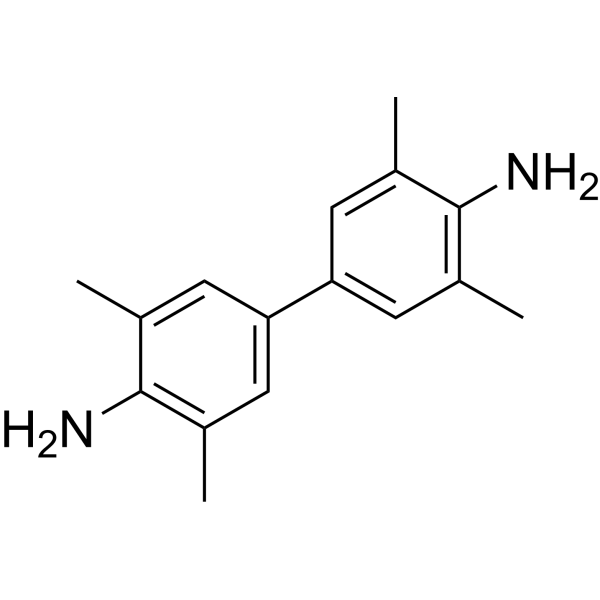
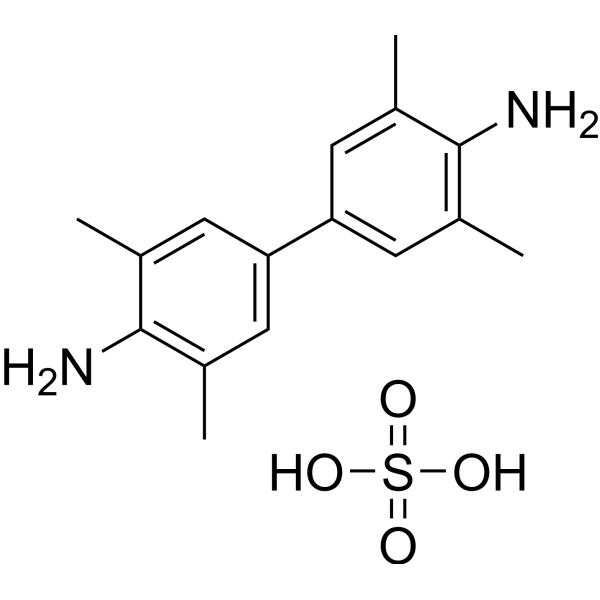
TMB is a non-toxic, non-mutagenic, colorless dye that is also used as a chromogenic agent in enzyme detection systems based on horseradish peroxidase (HRP). TMB can function as a photoacoustic probe for reactive oxygen and nitrogen species (ROS/RNS), reacting with hypochlorite, hydrogen peroxide, singlet oxygen, and nitrogen dioxide to produce blue oxidation products. TMB can detect the singlet oxygen produced by the outer membrane of Escherichia coli ATCC 25922 .
|
-
- HY-D2738
-
|
|
Fluorescent Dye
|
Others
|
|
BP Fluor 532 NHS ester is an amine reactive, yellow-emitting dye routinely used to label proteins or antibodies through primary amines (Lys), amine-modified oligonucleotides, and other amine-containing biomolecules. The labeling occurs most efficiently at pH 7-9 and forms a stable, covalent amide bond.
BP Fluor 532 is a bright yellow-fluorescent dye with pH insensitive emission from pH 4 to pH 10. The excitation of BP Fluor 532 is ideally suited for the frequency-doubled Nd:YAG laser line. BP Fluor 532 can be conjugated to a variety of antibodies, peptides, proteins, tracers, and amplification substrates, and is often used for the generation of stable signals in imaging and flow cytometry.
|
-
- HY-W800701
-
|
|
Biochemical Assay Reagents
|
Others
|
|
BP Fluor 546 DBCO is an azide-reactive probe that can be used for imaging azide-tagged biomolecules via a copper-free click reaction. The DBCO moiety reacts with azides to form a stable triazole and does not require a Cu-catalyst or elevated temperatures. In applications where the presence of copper is a concern, BP Fluor 546 DBCO is an ideal alternative to copper-requiring fluorescent alkynes.
BP Fluor 546 is a water-soluble, pH-insensitive (from pH 4-10), orange-fluorescent dye with absorption and emission maxima at 554 and 570 nm, respectively. It can be used with the 488 nm and 532 nm laser lines. BP Fluor 546 dye conjugates to a variety of antibodies, peptides, proteins, tracers, and amplification substrates, which are often used for generating stable signals in imaging and flow cytometry.
|
-
- HY-W130236
-
|
|
Cholinesterase (ChE)
|
Cancer
|
|
Methylene Violet 3RAX is a phenazine dye to stain the mitochondria of cells. Methylene Violet 3RAX can change the molecular structure of DNA, undermine the module of DNA, and induce the generation of the reactive singlet oxygen. Methylene Violet 3RAX shows inhibition for human erythrocyte AChE and human plasma BChE with an Kis of 1.58, 0.51 μM, respectively. Methylene Violet 3RAX has the potential for the research of potential photosensitizers for mitochondrial targeting action in PDT (photodynamic therapy) .
|
-
- HY-15930A
-
|
BM blue dihydrochloride; Sure Blue TMB dihydrochloride
|
Fluorescent Dye
Reactive Oxygen Species (ROS)
|
Others
|
|
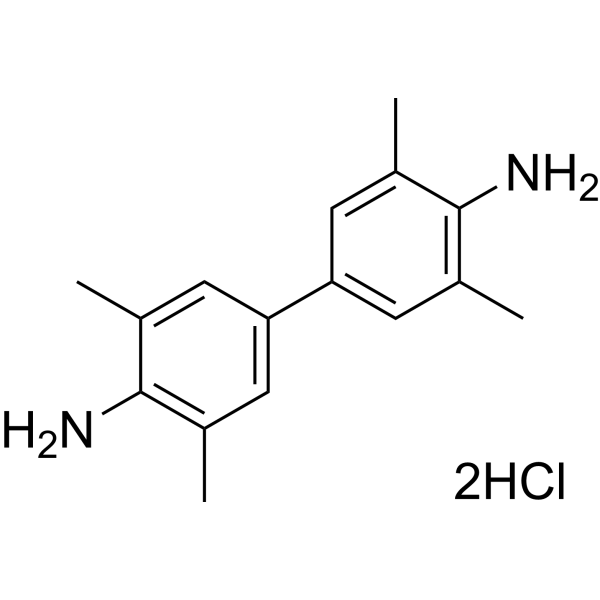
TMB dihydrochloride is the dihydrochloride form of TMB (HY-15930). TMB dihydrochloride is a non-toxic, non-mutagenic, colorless dye that is also used as a chromogenic agent in enzyme detection systems based on horseradish peroxidase (HRP). TMB dihydrochloride can function as a photoacoustic probe for reactive oxygen and nitrogen species (ROS/RNS), reacting with hypochlorite, hydrogen peroxide, singlet oxygen, and nitrogen dioxide to produce blue oxidation products. TMB dihydrochloride can detect the singlet oxygen produced by the outer membrane of Escherichia coli ATCC 25922 .
|
-
- HY-D2169
-
|
|
Fluorescent Dye
|
Others
|
|
AF 568 carboxylic acid is the non-reactive form of the orange fluorescent dye AF 568. AF 568 has an absorption wavelength of 590-720 nm (FRET) and an emission wavelength of 515-720 nm. AF 568 alkyne forms stable covalent bonds by reacting carboxylic acid groups with molecules bearing amino groups. Copper-catalyzed azide-alkyne cycloaddition (CuAAc) can occur with molecules containing Alkyne groups. Strain-promoted alkyne-azide cycloaddition (SPAAC) can also occur with molecules containing DBCO or BCN groups .
|
-
- HY-15930C
-
|
BM blue monosulfate; Sure Blue TMB monosulfate
|
Fluorescent Dye
Reactive Oxygen Species (ROS)
|
Others
|
|
TMB monosulfate is the monosulfate form of TMB (HY-15930). TMB monosulfate is a non-toxic, non-mutagenic, colorless dye that is also used as a chromogenic agent in enzyme detection systems based on horseradish peroxidase (HRP). TMB monosulfate can function as a photoacoustic probe for reactive oxygen and nitrogen species (ROS/RNS), reacting with hypochlorite, hydrogen peroxide, singlet oxygen, and nitrogen dioxide to produce blue oxidation products. TMB monosulfate can detect the singlet oxygen produced by the outer membrane of Escherichia coli ATCC 25922 .
|
-
- HY-15930R
-
|
BM blue (Standard); Sure Blue TMB (Standard)
|
Fluorescent Dye
Reactive Oxygen Species (ROS)
Reference Standards
|
Others
|
|
TMB (Standard) is the analytical standard of TMB. This product is intended for research and analytical applications. TMB is a non-toxic, non-mutagenic, colorless dye that is also used as a chromogenic agent in enzyme detection systems based on horseradish peroxidase (HRP). TMB can function as a photoacoustic probe for reactive oxygen and nitrogen species (ROS/RNS), reacting with hypochlorite, hydrogen peroxide, singlet oxygen, and nitrogen dioxide to produce blue oxidation products. TMB can detect the singlet oxygen produced by the outer membrane of Escherichia coli ATCC 25922 .
|
-
- HY-15930B
-
|
Sure Blue TMB dihydrochloride x.hydrate
|
Fluorescent Dye
Reactive Oxygen Species (ROS)
|
Others
|
|
TMB (dihydrochloride x.hydrate) is the dihydrochloride x hydrate form of TMB (HY-15930). TMB (dihydrochloride x.hydrate) is a non-toxic, non-mutagenic, colorless dye that is also used as a chromogenic agent in enzyme detection systems based on horseradish peroxidase (HRP). TMB (dihydrochloride x.hydrate) can function as a photoacoustic probe for reactive oxygen and nitrogen species (ROS/RNS), reacting with hypochlorite, hydrogen peroxide, singlet oxygen, and nitrogen dioxide to produce blue oxidation products. TMB (dihydrochloride x.hydrate) can detect the singlet oxygen produced by the outer membrane of Escherichia coli ATCC 25922 .
|
-
- HY-15941
-
|
Fluorescein 5(6)-isothiocyanate; Fluorescein isothiocyanate 5- and 6- isomers
|
Fluorescent Dye
|
Others
|
|
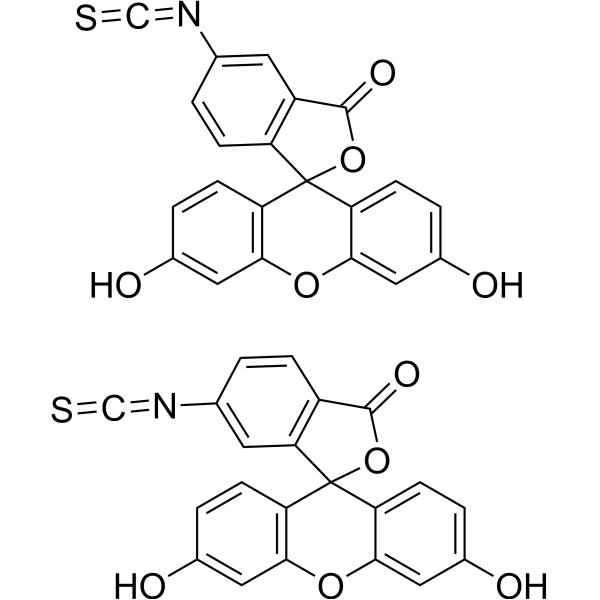
5(6)-FITC (Fluorescein 5(6)-isothiocyanate) is an amine-reactive derivative of a fluorescent dye, characterized by high absorbance and excellent fluorescence quantum yield. The isothiocyanate group of FITC can react with various functional groups on proteins, including amines, thiols, imidazoles, tyrosines and carbonyls, enabling the labeling of proteins such as antibodies and lectins. 5(6)-FITC has a wide range of applications, including flow cytometry, immunofluorescence, protease assays and conjugation. The maximum excitation/emission wavelengths are 492/518 nm .
|
-
- HY-D1583
-
|
DBCO-Cy5 hexafluorophosphate; Cyanine5 dibenzocyclooctyne hexafluorophosphate
|
Fluorescent Dye
|
Others
|
|
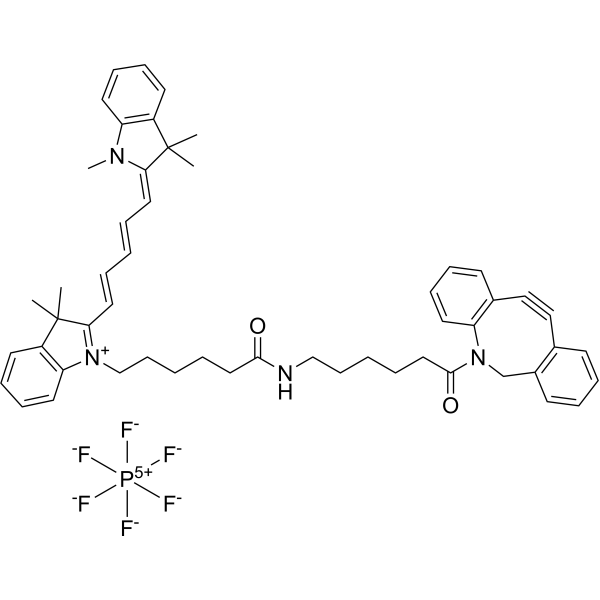
Cyanine5 DBCO (DBCO-Cy5) hexafluorophosphate is a low-toxicity azide reactive probe (NIR fluorescent dye), for imaging azide-labeled biomolecules via a copper-free "click-through" reaction. Cyanine5 DBCO hexafluorophosphate has no apparent cytotoxicity or animal toxicity and shows no damage to the physiological functions of cells other than the target cells (azide-labeled cells). Cyanine5 DBCO hexafluorophosphate can be used to label and track cells in vitro and in vivo (Ex=635 nm, Em=650-700 nm) .
|
-
- HY-D2907
-
|
DBCO-Cy5; Cyanine5 dibenzocyclooctyne
|
Fluorescent Dye
|
Others
|
|
Cyanine5 DBCO (DBCO-Cy5) is a low-toxicity azide reactive probe (NIR fluorescent dye), for imaging azide-labeled biomolecules via a copper-free "click-through" reaction. Cyanine5 DBCO has no apparent cytotoxicity or animal toxicity and shows no damage to the physiological functions of cells other than the target cells (azide-labeled cells). Cyanine5 DBCO can be used to label and track cells in vitro and in vivo (Ex=635 nm, Em=650-700 nm) .
|
-
- HY-D2765
-
|
|
Biochemical Assay Reagents
|
Others
|
|
BP Fluor 405 Cadaverine is a carbonyl-reactive building block used to modify carboxylic groups in the presence of activators (e.g. EDC or DCC) or activated esters (e.g. NHS esters) through a stable amide bond. Another common application for BP Fluor 405 Cadaverine is cell fixing by treatment with formaldehyde or glutaraldehyde.
BP Fluor 405 is a water-soluble, blue-fluorescent dye that is often used in multi-color applications, including flow cytometry and super-resolution microscopy using STORM. Its excitation is ideally suited for the 407 nm spectral line of the krypton laser or the 408 nm violet laser diode.
|
-
- HY-DY1068
-
|
|
Fluorescent Dye
|
Others
|
Cyanine5 DBCO (DBCO-Cy5) hexafluorophosphate (solution) is a low-toxicity azide reactive probe (NIR fluorescent dye) , for imaging azide-labeled biomolecules via a copper-free "click-through" reaction. Cyanine5 DBCO hexafluorophosphate has no apparent cytotoxicity or animal toxicity and shows no damage to the physiological functions of cells other than the target cells (azide-labeled cells). Cyanine5 DBCO hexafluorophosphate can be used to label and track cells in vitro and in vivo (Ex=635 nm, Em=650-700 nm) . Solvent and concentration: DMSO: 10 mM
|
-
- HY-169798
-
|
|
Fluorescent Dye
VSV
|
Infection
|
1,9-Dimethylmethylene blue is a photosensitizer, virus inactivator and hemoglobin oxidant derived from methylene blue. When activated, 1,9-Dimethylmethylene blue generates reactive oxygen species including singlet oxygen, and acts as a metachromatic dye. When activated in monomeric or dimeric form, 1,9-Dimethylmethylene blue induces photoinactivation of R17 phage and vesicular stomatitis virus and oxidizes hemoglobin via non-singlet oxygen reactive oxygen species or singlet oxygen-mediated pathways, respectively. The monomeric form, with higher nucleic acid affinity, achieves virus inactivation under specific conditions without forming methemoglobin. 1,9-Dimethylmethylene blue binds to substances such as glycosaminoglycans to produce color changes. Although it is susceptible to interference from non-glycosaminoglycan components in urine, it is still applicable to spectrophotometric analysis for glycosaminoglycan quantification. With these unique photochemical and binding properties, 1,9-Dimethylmethylene blue is widely used in studies of viral infections and related biochemical analyses .
|
-
- HY-172728
-
|
|
Fluorescent Dye
|
Others
|
|
Difluorocarboxyfluorescein NHS Ester, 6-isomer is an amine-reactive fluorinated analog of fluorescein that overcomes some of the key limitations of fluorescein, including greater photostability and a lower pKa (pKa ~ 4.7 versus 6.4 for fluorescein), making its fluorescence essentially pH insensitive in the physiological pH range. Although the mixed isomers of Difluorocarboxyfluorescein NHS Ester, is a preferred, routinely used fluorescent dye for labeling proteins, peptides and nucleotides, purification of peptide and nucleotides labeled with 5(6) isomers might be troublesome due to significant signal broadening in HPLC purification. Peptides and nucleotides labeled with a single isomer usually give better resolution in HPLC purification that is often required in the conjugation processes.
|
-
- HY-D0015
-
|
|
Fluorescent Dye
|
Others
|
|
Cresol red, 97% is an acidic phenolsulfonphthalein triphenylmethane dye. Cresol red, 97% generates reactive oxygen species and singlet oxygen under ultrasonic irradiation, interacts with bovine serum albumin, alters the structure of bovine serum albumin, and oxidizes the fluorescent amino acid residues of bovine serum albumin. Cresol red, 97% can be decolorized and biodegraded by *Absidia spinosa* M15, producing phenylacetic acid and benzoic acid metabolites. Cresol red, 97% serves as a pH indicator (orange at pH 1.8-yellow at pH 2.0, yellow at pH 7.0-purple at pH 8.8). Cresol red, 97% can be used to indicate pH, temperature and salinity .
|
-
- HY-D2768
-
|
|
Fluorescent Dye
|
Others
|
|
BP Fluor 430 NHS Ester is a water-soluble, green-fluorescent dye that is often used in multi-color applications, including flow cytometry and super-resolution microscopy using STORM. Its excitation is ideally suited for the 407 nm spectral line of the krypton laser or the 408 nm violet laser diode. BP Fluor 405 conjugates are pH-insensitive from pH 4 to pH 10.
The NHS ester (or succinimidyl ester) is the most popular amine reactive group for labeling the primary amines of proteins (Lys), amine-modified oligonucleotides, and other amine-containing molecules. Proteins can be labeled with BP Fluor 430 NHS Ester at high molar ratios without significant self-quenching, leading to brighter conjugates and more sensitive detection.
|
-
- HY-D2771
-
|
|
Fluorescent Dye
|
Others
|
|
BP Fluor 405 NHS Ester is a water-soluble, blue-fluorescent dye that is often used in multi-color applications, including flow cytometry and super-resolution microscopy using STORM. Its excitation is ideally suited for the 407 nm spectral line of the krypton laser or the 408 nm violet laser diode. BP Fluor 405 conjugates are pH-insensitive from pH 4 to pH 10.
The NHS ester (or succinimidyl ester) is the most popular amine reactive group for labeling with the primary amines of proteins (Lys), amine-modified oligonucleotides, and other amine-containing molecules. Proteins can be labeled with BP Fluor 405 NHS Ester at high molar ratios without significant self-quenching, leading to brighter conjugates and more sensitive detection. BP Fluor 405 conjugates can also be used for the detection of abundance targets.
|
-
| Cat. No. |
Product Name |
Type |
-
- HY-D0819
-
CY5-SE
Maximum Cited Publications
37 Publications Verification
Cy5 NHS Ester; Sulfo-Cyanine5 Succinimidyl Ester
|
Fluorescent Dye
|
|
Cy5-SE (Cy5 NHS Ester) is a reactive dye for the labeling of amino-groups in peptides, proteins, and oligonucleotides. This dye requires small amount of organic co-solvent (such as DMF or DMSO) to be used in labeling reaction. This reagent is ideal for very cost-efficient labeling of soluble proteins, as well as all kinds of peptides and oligonucleotides. This reagent also works well in organic solvents for small molecule labeling.
Excitation (nm):649, Emission (nm): 670.
|
-
- HY-138200
-
|
Cyanine5 maleimide
|
Fluorescent Dye
|
|
Cy5 maleimide (Cyanine5 maleimide) is a single-reactive dye containing a maleimide group and a CY5 fluorescent group, which can selectively couple with a thiol group. Cy5 maleimide can be used to label antibodies, peptides, or proteins (Ex/Em = 646/664 nm).
|
-
- HY-D0819A
-
|
Cy5 NHS Ester triethylamine salt; Sulfo-Cyanine5 Succinimidyl Ester triethylamine salt
|
Fluorescent Dye
|
|
Cy5-SE (Cy5 NHS Ester) triethylamine salt is a reactive dye for the labeling of amino-groups in peptides, proteins, and oligonucleotides. Cy5-SE triethylamine salt is ideal for very cost-efficient labeling of soluble proteins, as well as all kinds of peptides and oligonucleotides Ex=649 nm; Em=670 nm) .
|
-
- HY-D0069
-
|
|
Fluorescent Dye
|
|
CPM is a maleimide derivative, acting as a blue fluorescent thiol-reactive dye (excitation/emission maxima of 387/463 nm) .
|
-
- HY-D0049
-
|
6-TAMRA-NHS ester; 6-Carboxytetramethylrhodamine N-succinimidyl ester
|
Fluorescent Dye
|
|
6-TAMRA-SE (6-TAMRA-NHS ester) is a fluorescent dye carrying the amine reactive group. 6-TAMRA-SE is one of the traditional fluorophores used for automated DNA sequencing .
|
-
- HY-135415
-
|
|
Fluorescent Dye
|
|
Cyanine5.5 NHS ester chloride is a reactive dye for the labeling of proteins, and antibodies and small molecular compounds .
|
-
- HY-103469
-
|
PO1
|
Fluorescent Dye
|
|
Peroxy Orange 1 (PO1) is a new H2O2 specific probe that can bind to green fluorescent highly reactive oxygen species (hROS) probe APF. Peroxy Orange 1 is also a living cell dye .
|
-
- HY-D0331
-
|
|
Fluorescent Dye
|
|
Reactive Blue 19 is an anthraquinone dye that can be used in the textile industry .
|
-
- HY-125815
-
|
|
Fluorescent Dye
|
|
Reactive Blue 4 is an anthraquinone dye used extensively in the textile industry. Reactive Blue 4 is a single colorimetric chemosensor for sequential determination of multiple analytes with different optical responses in aqueous media .
|
-
- HY-D1744
-
|
|
Fluorescent Dye
|
|
ICG Maleimide is thiol reactive near infrared (NIR) fluorescent dye and used to generate a stable fluorescence signal in bioimaging (Ex/Em = 789/813 nm).
|
-
- HY-D1605
-
|
|
Fluorescent Dye
|
|
BODIPY FL L-Cystine is a thiol-reactive, green-fluorescent dye. BODIPY FL L-Cystine can be the labeling of membrane proteins, proteins with hydrophobic binding sites, or hydrophobic ligands. (λex=504 nm, λem=511 nm) .
|
-
- HY-123749
-
|
5-TMRIA
|
Fluorescent Dye
|
|
Tetramethylrhodamine-5-iodoacetamide (5-TMRIA) is a thiol-selective reactive dye that is used to non-specifically label proteins via the cysteine residues. Tetramethylrhodamine-5-iodoacetamide (5-TMRIA) can be used to covalently label DNA fragments .
|
-
- HY-D0026
-
|
7-Amino-4-methyl-3-coumarinacetic acid N-succinimidyl ester
|
Fluorescent Dye
|
|
AMCA,SE (7-Amino-4-methyl-3-coumarinacetic acid N-succinimidyl ester) is a bright blue fluorescent dye. AMCA,SE reacts with amino groups and is excited by ultraviolet light. AMCA,SE can be used for amine reactive labeling (Ex/Em = 354/440 nm) .
|
-
- HY-D2381
-
|
|
Fluorescent Dye
|
|
AF 488 maleimide is a thiol-reactive dye used to label SH groups of proteins, which can attach the AF 488 fluorophore to cysteine residue-containing proteins and peptides as well as other thiolated molecules. AF 488 maleimide enables real-time visualization of dynamic pilus extension and retraction in live bacterial cells via epifluorescence microscopy (Ex/Em = 470/520 nm) .
|
-
- HY-D2746
-
|
|
Fluorescent Dye
|
|
Cy5.5 bis-NHS ester is a reactive cyanine dye containing NHS ester which can be used to label amine groups in peptides, proteins, and oligonucleotides.
|
-
- HY-D2173
-
|
|
Fluorescent Dye
|
|
AF488 azide is a fluorescent dye that can be used to determine the reactivity of immobilized DIBO groups. AF488 azide exhibits the λem and λex wavelength of 520 nm and 470 nm, respectively .
|
-
- HY-D1085
-
|
|
Fluorescent Dye
|
|
AMCA-X-SE is a coumarin derivative that generates fixed blue fluorescence and an NHS-activated ester that forms stable amide bonds with primary amine groups. It is used as a reactive dye for labeling amino groups of peptides, proteins, and oligonucleotides. Maximum excitation/emission wavelength: 354/442 nm .
|
-
- HY-D1623
-
|
|
Fluorescent Dye
|
|
Cyanine3 carboxylic acid chloride is a non-toxic red fluorescent dye with good solubility in organic solvents. Cyanine3 carboxylic acid chloride can be used as a non-reactive fluorophore for experimental control and calibration. Cyanine3 carboxylic acid chloride can also be synthesized with targeted agents as fluorescent probes for rapid detection of agent reactions .
|
-
- HY-114351
-
|
|
Fluorescent Dye
|
|
BODIPY FL Hydrazide is a green-fluorescent dye, BODIPY FL Hydrazide is reactive with aldehyde/ketone on polysaccharides and glycoproteins, yielding a reversible Schiff base product that can be transformed to a stable linkage using a reducing agent like sodium borohydride or sodium cyanoborohydride. (λex=495 nm, λem=516 nm) .
|
-
- HY-D0820
-
|
Sulfo-Cyanine5-alkyne
|
Fluorescent Dye
|
|
CY5-YNE (Sulfo-Cyanine5-alkyne) is a reactive dye for the labeling of amino-groups in peptides, proteins, and oligonucleotides (Ex: 650 nM; Em: 680 nm). CY5-YNE is a click chemistry reagent, it contains an Alkyne group and can undergo copper-catalyzed azide-alkyne cycloaddition (CuAAc) with molecules containing Azide groups.
|
-
- HY-DY1063
-
|
|
Fluorescent Dye
|
Cy5-SE (Cy5 NHS Ester) (solution) is a reactive dye for the labeling of amino-groups in peptides, proteins, and oligonucleotides. This dye requires small amount of organic co-solvent (such as DMF or DMSO) to be used in labeling reaction. This reagent is ideal for very cost-efficient labeling of soluble proteins, as well as all kinds of peptides and oligonucleotides. This reagent also works well in organic solvents for small molecule labeling.
Excitation (nm) :649, Emission (nm) : 670. Solvent and concentration: DMSO: 10 mM
|
-
- HY-D1225
-
|
|
Fluorescent Dye
|
|
Reactive red 180 is common textile dyes that can be adsorbed onto single-walled carbon nanotubes (SWCNTs) through electrostatic interactions, allowing the separation of residual dyes.
|
-
- HY-D1319A
-
|
Cy5 acid bromide
|
Fluorescent Dye
|
|
Cyanine5 carboxylic acid (bromide) is a fluorescent dye containing a non-activated carboxylic acid (Ex=646 nm, Em=662 nm). Cyanine5 carboxylic acid chloride is an non-reactive dye that can be used in control samples .
|
-
- HY-130736
-
|
JF549, SE; JF549, NHS
|
Fluorescent Dye
|
|
Janelia Fluor® 549, SE (JF549, SE) is a cell-permeable fluorescent dye with an NHS ester (succinimidyl ester (SE)) reactive group. NHS esters react with primary amines and are commonly used to conjugate dyes to proteins, antibodies, amine-modified oligonucleotides, and other molecules. Janelia Fluor® 549, SE also acts as a ligand for self-labeling tags such as HaloTag and SNAP-tag, and can be used in live-cell imaging studies (Ex/Em = 549 nm/571 nm) .\n
|
-
- HY-D1138
-
|
|
Fluorescent Dye
|
|
Reactive red 120 is common textile dyes that can be adsorbed onto single-walled carbon nanotubes (SWCNTs) through electrostatic interactions, allowing the separation of residual dyes.
|
-
- HY-D0135
-
|
|
Fluorescent Dye
|
|
12-(7-Nitrobenzofurazan-4-ylamino)dodecanoic acid is an amine-reactive fluorescent dye .
|
-
- HY-D0112
-
|
|
Fluorescent Dye
|
|
7-Hydroxycoumarin-4-acetic acid, a pH-indicator dye, is covalently bound to bovine serum albumin (BSA) at the positions of reactive amino groups (λmax=326 nm) .
|
-
- HY-D1372
-
|
|
Fluorescent Dye
|
|
Cyanine3 amine hydrochloride, an analog of Cyanine3 amine, is a potent green fluorescent dye. Cyanine3 amine hydrochloride has the primary amine group and is covalently coupled with reactive groups such as NHS esters, carboxy groups (after carbodiimide activation), and epoxides. (λex=555 nm, λem=570 nm) .
|
-
- HY-D1372A
-
|
|
Fluorescent Dye
|
|
Cyanine3 amine (TFA), an analog of Cyanine3 amine, is a potent green fluorescent dye. Cyanine3 amine (TFA) has the primary amine group and is covalently coupled with reactive groups such as NHS esters, carboxy groups (after carbodiimide activation), and epoxides. (λex=555 nm, λem=570 nm) .
|
-
- HY-D2529
-
|
|
Fluorescent Dye
|
|
Cy5-PEG2000-SH is a fluorescent labeling reagent that combines Cy5 (HY-D0821) fluorescent dye, polyethylene glycol (PEG) and sulfhydryl (SH) derivatives, and is suitable for molecular coupling. SH is highly reactive and can react with a variety of functional groups (such as maleimide) to form stable thioether bonds.
|
-
- HY-D1886
-
|
|
Fluorescent Dye
|
|
Vari Fluor 647 SE is a fluorescent dye, SE stands for "succinimidyl ester". Vari Fluor 647 SE belongs to the Vari Fluor family of labeling reagents used in cell and molecular biology research. Vari Fluor 647 SE can react with an amino group to form a covalent bond, thereby introducing Vari Fluor 647 dye into the target molecule or cell. Vari Fluor 647 SE is a reactive dye that produces a fluorescent signal after binding to a target molecule or cell.
|
-
- HY-D0374
-
|
|
Fluorescent Dye
|
|
Reactive Blue 4 sodium is an anthraquinone dye used extensively in the textile industry. Reactive Blue 4 sodium is a single colorimetric chemosensor for sequential determination of multiple analytes with different optical responses in aqueous media .
|
-
- HY-W998687
-
|
|
Fluorescent Dye
|
|
Cy5 dimethyl is a free non-activated dye. This dye has limited water solubility, but can be dissolved in mixtures of water with organic phase (DMF, DMSO, alcohols) to obtain useful concentrations of the material in solution. This molecule can be considered non-reactive dye for the use in control samples, and for instrument calibration.
|
-
- HY-D2497
-
|
|
Fluorescent Dye
|
|
Sulfo Cy7 bis-SH is a fluorescent dye that contains sulfonated Cyanine7 (Sulfo-CY7) fluorescent dye and thiol (-SH) functional group. SH is highly reactive and can react with a variety of functional groups (such as maleimide) to form stable thioether bonds .
|
-
- HY-W998707
-
|
|
Fluorescent Dye
|
|
TAMRA amine, 5-isomer hydrochloride is a rhodamine dye with excitation/emission maximum 553/575 nm. The amine group is reactive with carboxylic acids, activated NHS esters, carbonyls (ketone, aldehyde) etc.
|
-
- HY-W927359
-
|
|
Fluorescent Dye
|
|
Fluorescein hydrazide (3,6-Dihydroxyxanthane) is a fluorescein dye that can be used for the fluorophotometric determination of hydrogen peroxide (H2O2) and other reactive oxygen species (ROS) .
|
-
- HY-D2750
-
|
|
Fluorescent Dye
|
|
Sulfo-Cy5 Picolyl Azide is a fluorophore featuring a sulfonate group and an azide. Azide groups are click chemistry handles which are reactive towards terminal alkynes and strained cyclooctynes such as BCN or DBCO. Cy5 is a cyanine dye with excitation and emission maxima at 651 nm and 670 nm respectively. The sulfonate group on the Cy5 dye increases this compound’s water solubility.
|
-
- HY-172721
-
|
|
Fluorescent Dye
|
|
Cy3B maleimide is a mono-reactive dye containing maleimide group, which can selectively and efficiently attach Cyanine3 fluorophore (an analog of Cy3) to proteins and peptides containing cysteine residues, as well as to other thiolated molecules (such as thiol-containing oligonucleotides). Cy3B is an improved version of Cy3 dyes with significantly increased fluorescence quantum yield and photostability.
|
-
- HY-D1352A
-
|
|
Fluorescent Dye
|
|
Sulfo-Cyanine7 NHS ester (TEA) is an amine-reactive succinimide ester. Sulfo-Cyanine7 NHS ester (TEA) reagent allows to prepare sulfo-Cyanine7-labeled biomolecules, such as proteins, with ease. Dye labeled molecules can be subsequently used for various research and agent design related experiments.
|
-
- HY-D1596A
-
|
Cy3.5 NHS ester bromide; Cy 3.5 bromide
|
Fluorescent Dye
|
|
Cyanine 3.5 bromide (Cy3.5 NHS ester bromide) is an analog of the Cy3.5 fluorophore. Cyanine 3.5 bromide is a red reactive fluorescent dye. Cyanine 3.5 bromide is used to label amino groups in peptides, proteins, and oligonucleotides. (λex=591 nm, λem=604 nm) .
|
-
- HY-D2531
-
|
|
Fluorescent Dye
|
|
Cy5-PEG5000-SH is a fluorescent labeling reagent that combines Cy5 (HY-D0821) fluorescent dye, polyethylene glycol (PEG) and sulfhydryl (SH) derivatives, and is suitable for molecular coupling. SH is highly reactive and can react with a variety of functional groups (such as maleimide) to form stable thioether bonds.
|
-
- HY-151713
-
|
|
Fluorescent Dye
|
|
Sulfo-Cy3-Methyltetrazine (figure 7 compound 5) is a click chemistry reagent containing methyltetrazine and a water-soluble dye. Sulfo-Cy3-Methyltetrazine shows good stability at physiological pH. Sulfo-Cy3-Methyltetrazine can be coupled to trans-cyclooctene and is also highly reactive towards cyclooctene .
|
-
- HY-D2556
-
|
|
Fluorescent Dye
|
|
Cy5.5-PEG1000-SH is a fluorescent labeling reagent that combines Cy5.5 (HY-D0924) fluorescent dye, polyethylene glycol (PEG) and sulfhydryl (SH) derivatives, and is suitable for molecular coupling. SH is highly reactive and can react with a variety of functional groups (such as maleimide) to form stable thioether bonds.
|
-
- HY-D0661
-
|
|
Fluorescent Dye
|
|
Reactive red 45 is common textile dyes that can be adsorbed onto single-walled carbon nanotubes (SWCNTs) through electrostatic interactions, allowing the separation of residual dyes.
|
-
- HY-D0622
-
|
|
Fluorescent Dye
|
|
Reactive Green 19 is common textile dyes that can be adsorbed onto single-walled carbon nanotubes (SWCNTs) through electrostatic interactions, allowing the separation of residual dyes.
|
-
- HY-D0514
-
|
|
Fluorescent Dye
|
|
Reactive blue 5 is common textile dyes that can be adsorbed onto single-walled carbon nanotubes (SWCNTs) through electrostatic interactions, allowing the separation of residual dyes.
|
-
- HY-D1309
-
|
|
Fluorescent Dye
|
|
Sulfo-cyanine3 NHS ester sodium is a water-soluble cyanine dye that contains NHS ester groups and is amino-reactive.
|
-
- HY-D1611
-
|
|
Fluorescent Dye
|
|
BODIPY FL-C5 NHS Ester is a green-fluorescent dye that is reactive with primary amines on biomolecules such as peptides, proteins, modified nucleotides and biopolymers .
|
-
- HY-D0655
-
|
|
Fluorescent Dye
|
|
Reactive red 24 is a multifunctional dye. Dyes are important tools in biological experiments. They can help researchers observe and analyze cell structures, track biomolecules, evaluate cell functions, distinguish cell types, detect biomolecules, study tissue pathology and monitor microorganisms. Their applications range from basic scientific research to clinical A wide range of diagnostics. Dyes are also widely used in traditional fields such as textile dyeing, as well as in emerging fields such as functional textile processing, food pigments and dye-sensitized solar cells.
|
-
- HY-D0634
-
|
|
Fluorescent Dye
|
|
Reactive Black 39 is a multifunctional dye. Dyes are important tools in biological experiments. They can help researchers observe and analyze cell structures, track biomolecules, evaluate cell functions, distinguish cell types, detect biomolecules, study tissue pathology and monitor microorganisms. Their applications range from basic scientific research to clinical A wide range of diagnostics. Dyes are also widely used in traditional fields such as textile dyeing, as well as in emerging fields such as functional textile processing, food pigments and dye-sensitized solar cells.
|
- HY-D2182
-
|
|
Fluorescent Dye
|
|
Preactivated PE-Cy5 Maleimide is a sulfhydryl reactive dye that reacts with free sulfhydryl groups on proteins. Preactivated APC-Cy5.5 Maleimide binds easily to proteins or antibodies, and does not change the spectral characteristics of APC-Cy/YF after activation.
|
- HY-D0152
-
|
|
Fluorescent Dye
|
|
Tetramethylrhodamine-6-maleimide is a fluorescent dye with a reactive sulfhydryl-specific moiety is covalently coupled to this cysteine. Tetramethylrhodamine-6-maleimide can be used as labels to detect local protein motions of the fully active Na+/K+-ATPase in real time .
|
- HY-D2180
-
|
|
Fluorescent Dye
|
|
Preactivated APC-Cy5.5 Maleimide is a sulfhydryl reactive dye that reacts with free sulfhydryl groups on proteins. Preactivated APC-Cy5.5 Maleimide binds easily to proteins or antibodies, and does not change the spectral characteristics of APC-Cy/YF after activation.
|
- HY-D0115
-
|
|
Fluorescent Dye
|
|
7-Hydroxycoumarin-3-carboxylic acid N-succinimidyl ester is the amine-reactive succinimidyl ester of 7-Hydroxycoumarin-3-carboxylic acid. 7-Hydroxycoumarin-3-carboxylic acid N-succinimidyl ester is a blue fluorescent dye for labeling proteins and nucleic acids .
|
- HY-D1596
-
|
Cy3.5 NHS ester chloride; Cy 3.5 chloride
|
Fluorescent Dye
|
|
Cyanine 3.5 (Cy3.5 NHS ester) chloride is an analog of Cy3.5 fluorophore. Cyanine 3.5 chloride is a reactive, red fluorescent dye. Cyanine 3.5 chloride is used for labeling of amino-groups in peptides, proteins, and oligonucleotides. (λex=591 nm, λem=604 nm) .
|
- HY-D2532
-
|
|
Fluorescent Dye
|
|
Cy5-PEG10000-SH is a fluorescent labeling reagent that combines Cy5 (HY-D0821) fluorescent dye, polyethylene glycol (PEG) and sulfhydryl (SH) derivatives, and is suitable for molecular coupling. SH is highly reactive and can react with a variety of functional groups (such as maleimide) to form stable thioether bonds.
|
- HY-D1607
-
|
|
Fluorescent Dye
|
|
BODIPY FL SSE is a potent fluorescent dye. BODIPY FL SSE is used to label the primary amines (R-NH2) of proteins, amine-modified oligonucleotides, and other amine-containing molecules. BODIPY FL SSE can reactive with primary amines on biomolecules to emit green fluorescence. (λex=502 nm, λem=511 nm) .
|
- HY-D2589
-
|
|
Fluorescent Dye
|
|
Cy7.5 PEG-SH is a fluorescent labeling reagent that combines CY7.5 (HY-D0926) fluorescent dye, polyethylene glycol (PEG) and sulfhydryl (SH) derivatives, and is suitable for molecular coupling. SH is highly reactive and can react with a variety of functional groups (such as maleimide) to form stable thioether bonds (Ex/Em = 770/820 nm).
|
- HY-135413
-
|
Sulfo-Cyanine5 NHS ester
|
Fluorescent Dye
|
|
MeCY5-NHS estera is a reactive dye. MeCY5-NHS estera can be used for the labeling of proteins and nucleic acids.
|
- HY-D1112
-
|
|
Fluorescent Dye
|
|
TFAX 546,SE triethylammonium, an amine reactive yellow fluorescent dye, can forms bright and photostable conjugates with proteins and antibodies .
|
- HY-D1619
-
|
|
Fluorescent Dye
|
|
Cyanine3 hydrazide dichloride is a carbonyl reactive dye. Cyanine3 hydrazide dichloride allows the labelling of various carbonyl-containing molecules such as antibodies and other glycoproteins after oxidation by periodate, proteins or reducing sugars after oxidative stress or deamination .
|
- HY-D0668
-
|
|
Fluorescent Dye
|
|
Reactive orange 13 is common textile dyes that can be adsorbed onto single-walled carbon nanotubes (SWCNTs) through electrostatic interactions, allowing the separation of residual dyes.
|
- HY-D0639
-
|
|
Fluorescent Dye
|
|
Reactive Brown 23 is common textile dyes that can be adsorbed onto single-walled carbon nanotubes (SWCNTs) through electrostatic interactions, allowing the separation of residual dyes.
|
- HY-D0669
-
|
|
Fluorescent Dye
|
|
Reactive orange 4 is common textile dyes that can be adsorbed onto single-walled carbon nanotubes (SWCNTs) through electrostatic interactions, allowing the separation of residual dyes.
|
- HY-D0692
-
|
|
Fluorescent Dye
|
|
Reactive red 124 is common textile dyes that can be adsorbed onto single-walled carbon nanotubes (SWCNTs) through electrostatic interactions, allowing the separation of residual dyes.
|
- HY-D0522
-
|
|
Fluorescent Dye
|
|
Reactive orange 16 is common textile dyes that can be adsorbed onto single-walled carbon nanotubes (SWCNTs) through electrostatic interactions, allowing the separation of residual dyes.
|
- HY-D1243
-
|
|
Fluorescent Dye
|
|
Reactive yellow 3 is common textile dyes that can be adsorbed onto single-walled carbon nanotubes (SWCNTs) through electrostatic interactions, allowing the separation of residual dyes.
|
- HY-D0653
-
|
|
Fluorescent Dye
|
|
Reactive orange 35 is common textile dyes that can be adsorbed onto single-walled carbon nanotubes (SWCNTs) through electrostatic interactions, allowing the separation of residual dyes.
|
- HY-D0691
-
|
|
Fluorescent Dye
|
|
Reactive yellow 25 is common textile dyes that can be adsorbed onto single-walled carbon nanotubes (SWCNTs) through electrostatic interactions, allowing the separation of residual dyes.
|
- HY-D0584
-
|
|
Fluorescent Dye
|
|
Reactive orange 86 is common textile dyes that can be adsorbed onto single-walled carbon nanotubes (SWCNTs) through electrostatic interactions, allowing the separation of residual dyes.
|
- HY-D0700
-
|
|
Fluorescent Dye
|
|
Reactive red 24:1 is common textile dyes that can be adsorbed onto single-walled carbon nanotubes (SWCNTs) through electrostatic interactions, allowing the separation of residual dyes.
|
- HY-D1310
-
|
|
Fluorescent Dye
|
|
Sulfo-cyanine3.5 NHS ester tripotassium is a water-soluble cyanine dye that contains NHS ester groups and is amino-reactive.
|
- HY-D1469
-
|
R6G-SE
|
Fluorescent Dye
|
|
5-Carboxyrhodamine 6G succinimidyl ester (R6G-SE) is an amine reactive fluorescent dye .
|
- HY-D2770
-
|
|
Fluorescent Dye
|
|
Cyanine3.5 dimethyl is a non-sulfonated cyanine dye with good solubility in organic solvents and bright fluorescence in the yellow-orange spectrum range. The dye can be used as a non-reactive fluorophore for control experiments, calibration, and other technical applications.
|
- HY-D1756
-
|
|
Fluorescent Dye
|
|
ROX NHS ester, 6-isomer is a highly fluorescent, and photostable rhodamine dye for various applications. ROX labeled oligonucleotide probes are often used in qPCR, and qPCR instruments have ROX channel. This is reactive dye for the labeling of amino-groups in peptides, proteins, and amino-oligonucleotides. Pure single isomer.
|
- HY-D0678
-
|
|
Fluorescent Dye
|
|
C.I. Reactive yellow 86 is a multifunctional dye. Dyes are important tools in biological experiments. They can help researchers observe and analyze cell structures, track biomolecules, evaluate cell functions, distinguish cell types, detect biomolecules, study tissue pathology and monitor microorganisms. Their applications range from basic scientific research to clinical A wide range of diagnostics. Dyes are also widely used in traditional fields such as textile dyeing, as well as in emerging fields such as functional textile processing, food pigments and dye-sensitized solar cells.
|
- HY-D2757
-
|
|
Fluorescent Dye
|
|
5(6)-Carboxyrhodamine 110 NHS Ester is the nonsulfonated analog of the BP Fluor 488 dye. The amine-reactive 5(6)-Carboxyrhodamine 110 NHS ester can be used to create bright and photostable green-fluorescent bioconjugates with excitation/emission maxima ~502/527 nm.
The conjugates of this dye often used for Fluorescence Correlation Spectroscopy (FCS).
|
- HY-D2093
-
|
|
Fluorescent Dye
|
|
PE-VF750 Maleimide is a thiol-reactive double-dye dye that contains maleimide groups that can react with thiol groups to form covalent bonds. Ex/Em=495-566/777 nm. PE-VF750 Maleimide contains two dyes, PE and VF, with excitation wavelengths (Ex) of 495 nm and 566 nm, respectively. PE-VF594 Maleimide has an emission wavelength (Em) of 777 nm.
|
- HY-D2752
-
|
|
Fluorescent Dye
|
|
Cy5.5 dimethyl is a free non-activated dye and can be used as a non-reactive fluorophore for experiment controls and instrument calibration. It is a non-sulfonated reagent with good solubility in organic solvents and limited aquous solubility.
|
- HY-172284
-
|
|
Fluorescent Dye
|
|
6-TAMRA cadaverine has achieved prominence as a dye for oligonucleotide labeling and automated DNA sequencing applications. The amino group (NH2) is reactive with carboxylic acids, activated NHS esters, carbonyls (ketone, aldehyde), etc.
|
- HY-D1352
-
|
|
Fluorescent Dye
|
|
Sulfo-Cyanine7 NHS ester potassium is an amine-reactive succinimide ester. Sulfo-Cyanine7 NHS ester reagent allows to prepare sulfo-Cyanine7-labeled biomolecules, such as proteins, with ease. Dye labeled molecules can be subsequently used for various research and agent design related experiments.
|
- HY-D2740
-
|
|
Fluorescent Dye
|
|
ROX azide, 6-isomer is an alkyne-reactive derivative of ROX (Rhodamine X, Rhodamine 101) dye. ROX is a red-emitting fluorophore possessing high brightness and fluorescence quantum yield. This reagent is a pure 6-isomer. It is used for labeling alkyne and cycloalkyne-containing biomolecules via copper-catalyzed and copper-free click chemistry reactions.
|
- HY-D2509
-
|
|
Fluorescent Dye
|
|
Cy3-PEG1000-SH is a fluorescent labeling reagent that combines Cy3 (HY-D0822) fluorescent dye, polyethylene glycol (PEG) and sulfhydryl (SH) derivatives, and is suitable for molecular coupling. SH is highly reactive and can react with a variety of functional groups (such as maleimide) to form stable thioether bonds .
|
- HY-D2883E
-
|
Rhodamine B-PEG5000-SH
|
Fluorescent Dye
|
|
RB-PEG5000-SH (Rhodamine B-PEG5000-SH) is a fluorescent dye composed of Rhodamine B (HY-Y0016), PEG and sulfhydryl (SH). SH is highly reactive and can react with a variety of functional groups (such as maleimide) to form stable thioether bonds (Ex/Em=546/610 nm) .
|
- HY-D2883D
-
|
Rhodamine B-PEG3400-SH
|
Fluorescent Dye
|
|
RB-PEG3400-SH (Rhodamine B-PEG3400-SH) is a fluorescent dye composed of Rhodamine B (HY-Y0016), PEG and sulfhydryl (SH). SH is highly reactive and can react with a variety of functional groups (such as maleimide) to form stable thioether bonds (Ex/Em=546/610 nm) .
|
- HY-D2883
-
|
Rhodamine B-PEG400-SH
|
Fluorescent Dye
|
|
RB-PEG400-SH (Rhodamine B-PEG400-SH) is a fluorescent dye composed of Rhodamine B (HY-Y0016), PEG and sulfhydryl (SH). SH is highly reactive and can react with a variety of functional groups (such as maleimide) to form stable thioether bonds (Ex/Em=546/610 nm) .
|
- HY-135415A
-
|
|
Fluorescent Dye
|
|
Cyanine5.5 NHS ester chloride TEA is a reactive dye for the labeling of proteins, and antibodies and small molecular compounds .
|
- HY-W998644
-
|
|
Fluorescent Dye
|
|
PB LC acid is a blue-fluorescent dye that is reactive with primary amines on biomolecules such as peptides, proteins, modified nucleotides and biopolymers (Ex/Em = 410/455 nm) .
|
- HY-D3219
-
|
|
Fluorescent Dye
|
|
Ctrl-CPF1 is a control dye for Copper Phosphorus Fluor 1 (CPF1), which exhibits no metal-dependent fluorescence response and shows no reactivity toward Cu + .
|
- HY-D3270
-
|
|
Fluorescent Dye
|
|
IR 750 Maleimide is a near-infrared fluorescent dye composed of IRDye 750 near-infrared fluorophore and maleimide reactive group. IR 750 Maleimide can be applied to fluorescent labeling, imaging and detection.
|
- HY-D3271
-
|
|
Fluorescent Dye
|
|
IR 750 NHS ester is a near-infrared fluorescent dye composed of IRDye 750 near-infrared fluorophore and NHS ester reactive group. IR 750 NHS ester can be applied to fluorescent labeling, imaging and detection.
|
- HY-D2530
-
|
|
Fluorescent Dye
|
|
Cy5-PEG3400-SH is a fluorescent labeling reagent that combines Cy5 (HY-D0821) fluorescent dye, polyethylene glycol (PEG) and sulfhydryl (SH) derivatives, and is suitable for molecular coupling. SH is highly reactive and can react with a variety of functional groups (such as maleimide) to form stable thioether bonds.
|
- HY-D2883A
-
|
Rhodamine B-PEG600-SH
|
Fluorescent Dye
|
|
RB-PEG600-SH (Rhodamine B-PEG600-SH) is a fluorescent dye composed of Rhodamine B (HY-Y0016), PEG and sulfhydryl (SH). SH is highly reactive and can react with a variety of functional groups (such as maleimide) to form stable thioether bonds (Ex/Em=546/610 nm) .
|
- HY-D2883B
-
|
Rhodamine B-PEG1000-SH
|
Fluorescent Dye
|
|
RB-PEG1000-SH (Rhodamine B-PEG1000-SH) is a fluorescent dye composed of Rhodamine B (HY-Y0016), PEG and sulfhydryl (SH). SH is highly reactive and can react with a variety of functional groups (such as maleimide) to form stable thioether bonds (Ex/Em=546/610 nm) .
|
- HY-D2883C
-
|
Rhodamine B-PEG2000-SH
|
Fluorescent Dye
|
|
RB-PEG2000-SH (Rhodamine B-PEG2000-SH) is a fluorescent dye composed of Rhodamine B (HY-Y0016), PEG and sulfhydryl (SH). SH is highly reactive and can react with a variety of functional groups (such as maleimide) to form stable thioether bonds (Ex/Em=546/610 nm) .
|
- HY-D2883H
-
|
Rhodamine B-PEG10000-SH
|
Fluorescent Dye
|
|
RB-PEG10000-SH (Rhodamine B-PEG10000-SH) is a fluorescent dye composed of Rhodamine B (HY-Y0016), PEG and sulfhydryl (SH). SH is highly reactive and can react with a variety of functional groups (such as maleimide) to form stable thioether bonds (Ex/Em=546/610 nm) .
|
- HY-D2512
-
|
|
Fluorescent Dye
|
|
Cy3-PEG5000-SH is a fluorescent labeling reagent that combines Cy3 (HY-D0822) fluorescent dye, polyethylene glycol (PEG) and sulfhydryl (SH) derivatives, and is suitable for molecular coupling. SH is highly reactive and can react with a variety of functional groups (such as maleimide) to form stable thioether bonds .
|
- HY-D2557
-
|
|
Fluorescent Dye
|
|
Cy5.5-PEG3400-SH is a fluorescent labeling reagent that combines Cy5.5 (HY-D0924) fluorescent dye, polyethylene glycol (PEG) and sulfhydryl (SH) derivatives, and is suitable for molecular coupling. SH is highly reactive and can react with a variety of functional groups (such as maleimide) to form stable thioether bonds.
|
- HY-D2559
-
|
|
Fluorescent Dye
|
|
Cy5.5-PEG10000-SH is a fluorescent labeling reagent that combines Cy5.5 (HY-D0924) fluorescent dye, polyethylene glycol (PEG) and sulfhydryl (SH) derivatives, and is suitable for molecular coupling. SH is highly reactive and can react with a variety of functional groups (such as maleimide) to form stable thioether bonds.
|
- HY-D2558
-
|
|
Fluorescent Dye
|
|
Cy5.5-PEG5000-SH is a fluorescent labeling reagent that combines Cy5.5 (HY-D0924) fluorescent dye, polyethylene glycol (PEG) and sulfhydryl (SH) derivatives, and is suitable for molecular coupling. SH is highly reactive and can react with a variety of functional groups (such as maleimide) to form stable thioether bonds.
|
- HY-D2763
-
|
|
Fluorescent Dye
|
|
BP Fluor 532 maleimide is a photostable, bright yellow-fluorescent dye with pH insensitive emission from pH 4 to pH 10. The excitation of BP Fluor 532 is ideally suited for the frequency-doubled Nd:YAG laser line. BP Fluor 532 dye can be conjugated to a variety of antibodies, peptides, proteins, tracers, and amplification substrates, and is often used for the generation of stable signals in imaging and flow cytometry.
Maleimide is the most popular sulfhydryl-reactive group for conjugating the dye to a thiol group on a protein, oligonucleotide thiophosphate, or low molecular weight ligand. The maleimide group specifically and efficiently reacts with reduced thiols (sulfhydryl groups, –SH) at pH 6.5 to 7.5 to form a stable thioether bond. The resulting conjugates exhibit brighter fluorescence and greater photostability than the conjugates of many other spectrally similar fluorophores.
|
- HY-D2773
-
|
|
Fluorescent Dye
|
|
5-Carboxyrhodamine 110 NHS Ester is the nonsulfonated analog of the BP Fluor 488 dye. The amine-reactive 5(6)-Carboxyrhodamine 110 NHS Ester can be used to create bright and photostable green-fluorescent bioconjugates with excitation/emission maxima ~502/527 nm. For many applications, the dye is preferred over 5-(6)-carboxyfluorescein NHS ester or FITC because of its exceptional photostability and fluorescence insensitivity to pH (4-9).
Although the mixed isomers of Carboxyrhodamine 110 NHS Ester preferred, routinely used fluorescent dye for labeling proteins, peptides and nucleotides, purification of peptide and nucleotides labeled with 5(6) isomers might be troublesome due to significant signal broadening in HPLC purification. Peptides and nucleotides labeled with a single isomer usually give better resolution in HPLC purification that is often required in the conjugation processes.
|
- HY-D2895E
-
|
Rhodamine B-PEG5000-NH2
|
Fluorescent Dye
|
|
RB-PEG5000-NH2 (Rhodamine B-PEG5000-NH2) is a fluorescent dye composed of Rhodamine B (HY-Y0016), PEG and an amino group. The reactive primary amine or NH2 groups can react rapidly with activated carboxylic acids such as NHS esters to form stable amide bonds (Ex/Em=546/610 nm) .
|
- HY-D2895A
-
|
Rhodamine B-PEG600-NH2
|
Fluorescent Dye
|
|
RB-PEG600-NH2 (Rhodamine B-PEG600-NH2) is a fluorescent dye composed of Rhodamine B (HY-Y0016), PEG and an amino group. The reactive primary amine or NH2 groups can react rapidly with activated carboxylic acids such as NHS esters to form stable amide bonds (Ex/Em=546/610 nm) .
|
- HY-D2895C
-
|
Rhodamine B-PEG2000-NH2
|
Fluorescent Dye
|
|
RB-PEG2000-NH2 (Rhodamine B-PEG2000-NH2) is a fluorescent dye composed of Rhodamine B (HY-Y0016), PEG and an amino group. The reactive primary amine or NH2 groups can react rapidly with activated carboxylic acids such as NHS esters to form stable amide bonds (Ex/Em=546/610 nm) .
|
- HY-D2895H
-
|
Rhodamine B-PEG10000-NH2
|
Fluorescent Dye
|
|
RB-PEG10000-NH2 (Rhodamine B-PEG10000-NH2) is a fluorescent dye composed of Rhodamine B (HY-Y0016), PEG and an amino group. The reactive primary amine or NH2 groups can react rapidly with activated carboxylic acids such as NHS esters to form stable amide bonds (Ex/Em=546/610 nm) .
|
- HY-D2895D
-
|
Rhodamine B-PEG3400-NH2
|
Fluorescent Dye
|
|
RB-PEG3400-NH2 (Rhodamine B-PEG3400-NH2) is a fluorescent dye composed of Rhodamine B (HY-Y0016), PEG and an amino group. The reactive primary amine or NH2 groups can react rapidly with activated carboxylic acids such as NHS esters to form stable amide bonds (Ex/Em=546/610 nm) .
|
- HY-D2895B
-
|
Rhodamine B-PEG1000-NH2
|
Fluorescent Dye
|
|
RB-PEG1000-NH2 (Rhodamine B-PEG1000-NH2) is a fluorescent dye composed of Rhodamine B (HY-Y0016), PEG and an amino group. The reactive primary amine or NH2 groups can react rapidly with activated carboxylic acids such as NHS esters to form stable amide bonds (Ex/Em=546/610 nm) .
|
- HY-D2895
-
|
Rhodamine B-PEG400-NH2
|
Fluorescent Dye
|
|
RB-PEG400-NH2 (Rhodamine B-PEG400-NH2) is a fluorescent dye composed of Rhodamine B (HY-Y0016), PEG and an amino group. The reactive primary amine or NH2 groups can react rapidly with activated carboxylic acids such as NHS esters to form stable amide bonds (Ex/Em=546/610 nm) .
|
- HY-15930
-
|
BM blue; Sure Blue TMB
|
Fluorescent Dye
|
|
TMB is a non-toxic, non-mutagenic, colorless dye that is also used as a chromogenic agent in enzyme detection systems based on horseradish peroxidase (HRP). TMB can function as a photoacoustic probe for reactive oxygen and nitrogen species (ROS/RNS), reacting with hypochlorite, hydrogen peroxide, singlet oxygen, and nitrogen dioxide to produce blue oxidation products. TMB can detect the singlet oxygen produced by the outer membrane of Escherichia coli ATCC 25922 .
|
- HY-D2738
-
|
|
Fluorescent Dye
|
|
BP Fluor 532 NHS ester is an amine reactive, yellow-emitting dye routinely used to label proteins or antibodies through primary amines (Lys), amine-modified oligonucleotides, and other amine-containing biomolecules. The labeling occurs most efficiently at pH 7-9 and forms a stable, covalent amide bond.
BP Fluor 532 is a bright yellow-fluorescent dye with pH insensitive emission from pH 4 to pH 10. The excitation of BP Fluor 532 is ideally suited for the frequency-doubled Nd:YAG laser line. BP Fluor 532 can be conjugated to a variety of antibodies, peptides, proteins, tracers, and amplification substrates, and is often used for the generation of stable signals in imaging and flow cytometry.
|
- HY-W800701
-
|
|
Fluorescent Dye
|
|
BP Fluor 546 DBCO is an azide-reactive probe that can be used for imaging azide-tagged biomolecules via a copper-free click reaction. The DBCO moiety reacts with azides to form a stable triazole and does not require a Cu-catalyst or elevated temperatures. In applications where the presence of copper is a concern, BP Fluor 546 DBCO is an ideal alternative to copper-requiring fluorescent alkynes.
BP Fluor 546 is a water-soluble, pH-insensitive (from pH 4-10), orange-fluorescent dye with absorption and emission maxima at 554 and 570 nm, respectively. It can be used with the 488 nm and 532 nm laser lines. BP Fluor 546 dye conjugates to a variety of antibodies, peptides, proteins, tracers, and amplification substrates, which are often used for generating stable signals in imaging and flow cytometry.
|
- HY-15930A
-
|
BM blue dihydrochloride; Sure Blue TMB dihydrochloride
|
Fluorescent Dye
|
|
TMB dihydrochloride is the dihydrochloride form of TMB (HY-15930). TMB dihydrochloride is a non-toxic, non-mutagenic, colorless dye that is also used as a chromogenic agent in enzyme detection systems based on horseradish peroxidase (HRP). TMB dihydrochloride can function as a photoacoustic probe for reactive oxygen and nitrogen species (ROS/RNS), reacting with hypochlorite, hydrogen peroxide, singlet oxygen, and nitrogen dioxide to produce blue oxidation products. TMB dihydrochloride can detect the singlet oxygen produced by the outer membrane of Escherichia coli ATCC 25922 .
|
- HY-D2169
-
|
|
Fluorescent Dye
|
|
AF 568 carboxylic acid is the non-reactive form of the orange fluorescent dye AF 568. AF 568 has an absorption wavelength of 590-720 nm (FRET) and an emission wavelength of 515-720 nm. AF 568 alkyne forms stable covalent bonds by reacting carboxylic acid groups with molecules bearing amino groups. Copper-catalyzed azide-alkyne cycloaddition (CuAAc) can occur with molecules containing Alkyne groups. Strain-promoted alkyne-azide cycloaddition (SPAAC) can also occur with molecules containing DBCO or BCN groups .
|
- HY-15930C
-
|
BM blue monosulfate; Sure Blue TMB monosulfate
|
Fluorescent Dye
|
|
TMB monosulfate is the monosulfate form of TMB (HY-15930). TMB monosulfate is a non-toxic, non-mutagenic, colorless dye that is also used as a chromogenic agent in enzyme detection systems based on horseradish peroxidase (HRP). TMB monosulfate can function as a photoacoustic probe for reactive oxygen and nitrogen species (ROS/RNS), reacting with hypochlorite, hydrogen peroxide, singlet oxygen, and nitrogen dioxide to produce blue oxidation products. TMB monosulfate can detect the singlet oxygen produced by the outer membrane of Escherichia coli ATCC 25922 .
|
- HY-15930R
-
|
BM blue (Standard); Sure Blue TMB (Standard)
|
Fluorescent Dye
|
|
TMB (Standard) is the analytical standard of TMB. This product is intended for research and analytical applications. TMB is a non-toxic, non-mutagenic, colorless dye that is also used as a chromogenic agent in enzyme detection systems based on horseradish peroxidase (HRP). TMB can function as a photoacoustic probe for reactive oxygen and nitrogen species (ROS/RNS), reacting with hypochlorite, hydrogen peroxide, singlet oxygen, and nitrogen dioxide to produce blue oxidation products. TMB can detect the singlet oxygen produced by the outer membrane of Escherichia coli ATCC 25922 .
|
- HY-15941
-
|
Fluorescein 5(6)-isothiocyanate; Fluorescein isothiocyanate 5- and 6- isomers
|
Fluorescent Dye
|
|
5(6)-FITC (Fluorescein 5(6)-isothiocyanate) is an amine-reactive derivative of a fluorescent dye, characterized by high absorbance and excellent fluorescence quantum yield. The isothiocyanate group of FITC can react with various functional groups on proteins, including amines, thiols, imidazoles, tyrosines and carbonyls, enabling the labeling of proteins such as antibodies and lectins. 5(6)-FITC has a wide range of applications, including flow cytometry, immunofluorescence, protease assays and conjugation. The maximum excitation/emission wavelengths are 492/518 nm .
|
- HY-D1583
-
|
DBCO-Cy5 hexafluorophosphate; Cyanine5 dibenzocyclooctyne hexafluorophosphate
|
Fluorescent Dye
|
|
Cyanine5 DBCO (DBCO-Cy5) hexafluorophosphate is a low-toxicity azide reactive probe (NIR fluorescent dye), for imaging azide-labeled biomolecules via a copper-free "click-through" reaction. Cyanine5 DBCO hexafluorophosphate has no apparent cytotoxicity or animal toxicity and shows no damage to the physiological functions of cells other than the target cells (azide-labeled cells). Cyanine5 DBCO hexafluorophosphate can be used to label and track cells in vitro and in vivo (Ex=635 nm, Em=650-700 nm) .
|
- HY-D2907
-
|
DBCO-Cy5; Cyanine5 dibenzocyclooctyne
|
Fluorescent Dye
|
|
Cyanine5 DBCO (DBCO-Cy5) is a low-toxicity azide reactive probe (NIR fluorescent dye), for imaging azide-labeled biomolecules via a copper-free "click-through" reaction. Cyanine5 DBCO has no apparent cytotoxicity or animal toxicity and shows no damage to the physiological functions of cells other than the target cells (azide-labeled cells). Cyanine5 DBCO can be used to label and track cells in vitro and in vivo (Ex=635 nm, Em=650-700 nm) .
|
- HY-D2765
-
|
|
Fluorescent Dye
|
|
BP Fluor 405 Cadaverine is a carbonyl-reactive building block used to modify carboxylic groups in the presence of activators (e.g. EDC or DCC) or activated esters (e.g. NHS esters) through a stable amide bond. Another common application for BP Fluor 405 Cadaverine is cell fixing by treatment with formaldehyde or glutaraldehyde.
BP Fluor 405 is a water-soluble, blue-fluorescent dye that is often used in multi-color applications, including flow cytometry and super-resolution microscopy using STORM. Its excitation is ideally suited for the 407 nm spectral line of the krypton laser or the 408 nm violet laser diode.
|
- HY-DY1068
-
|
|
Fluorescent Dye
|
Cyanine5 DBCO (DBCO-Cy5) hexafluorophosphate (solution) is a low-toxicity azide reactive probe (NIR fluorescent dye) , for imaging azide-labeled biomolecules via a copper-free "click-through" reaction. Cyanine5 DBCO hexafluorophosphate has no apparent cytotoxicity or animal toxicity and shows no damage to the physiological functions of cells other than the target cells (azide-labeled cells). Cyanine5 DBCO hexafluorophosphate can be used to label and track cells in vitro and in vivo (Ex=635 nm, Em=650-700 nm) . Solvent and concentration: DMSO: 10 mM
|
- HY-D0015
-
|
|
Fluorescent Dye
|
|
Cresol red, 97% is an acidic phenolsulfonphthalein triphenylmethane dye. Cresol red, 97% generates reactive oxygen species and singlet oxygen under ultrasonic irradiation, interacts with bovine serum albumin, alters the structure of bovine serum albumin, and oxidizes the fluorescent amino acid residues of bovine serum albumin. Cresol red, 97% can be decolorized and biodegraded by *Absidia spinosa* M15, producing phenylacetic acid and benzoic acid metabolites. Cresol red, 97% serves as a pH indicator (orange at pH 1.8-yellow at pH 2.0, yellow at pH 7.0-purple at pH 8.8). Cresol red, 97% can be used to indicate pH, temperature and salinity .
|
- HY-D2768
-
|
|
Fluorescent Dye
|
|
BP Fluor 430 NHS Ester is a water-soluble, green-fluorescent dye that is often used in multi-color applications, including flow cytometry and super-resolution microscopy using STORM. Its excitation is ideally suited for the 407 nm spectral line of the krypton laser or the 408 nm violet laser diode. BP Fluor 405 conjugates are pH-insensitive from pH 4 to pH 10.
The NHS ester (or succinimidyl ester) is the most popular amine reactive group for labeling the primary amines of proteins (Lys), amine-modified oligonucleotides, and other amine-containing molecules. Proteins can be labeled with BP Fluor 430 NHS Ester at high molar ratios without significant self-quenching, leading to brighter conjugates and more sensitive detection.
|
- HY-D2771
-
|
|
Fluorescent Dye
|
|
BP Fluor 405 NHS Ester is a water-soluble, blue-fluorescent dye that is often used in multi-color applications, including flow cytometry and super-resolution microscopy using STORM. Its excitation is ideally suited for the 407 nm spectral line of the krypton laser or the 408 nm violet laser diode. BP Fluor 405 conjugates are pH-insensitive from pH 4 to pH 10.
The NHS ester (or succinimidyl ester) is the most popular amine reactive group for labeling with the primary amines of proteins (Lys), amine-modified oligonucleotides, and other amine-containing molecules. Proteins can be labeled with BP Fluor 405 NHS Ester at high molar ratios without significant self-quenching, leading to brighter conjugates and more sensitive detection. BP Fluor 405 conjugates can also be used for the detection of abundance targets.
|
| Cat. No. |
Product Name |
Type |
-
- HY-15930B
-
|
Sure Blue TMB dihydrochloride x.hydrate
|
Biochemical Assay Reagents
|
|
TMB (dihydrochloride x.hydrate) is the dihydrochloride x hydrate form of TMB (HY-15930). TMB (dihydrochloride x.hydrate) is a non-toxic, non-mutagenic, colorless dye that is also used as a chromogenic agent in enzyme detection systems based on horseradish peroxidase (HRP). TMB (dihydrochloride x.hydrate) can function as a photoacoustic probe for reactive oxygen and nitrogen species (ROS/RNS), reacting with hypochlorite, hydrogen peroxide, singlet oxygen, and nitrogen dioxide to produce blue oxidation products. TMB (dihydrochloride x.hydrate) can detect the singlet oxygen produced by the outer membrane of Escherichia coli ATCC 25922 .
|
-
- HY-D1021
-
|
Aminoallyl-dUTP sodium salt
|
Biochemical Assay Reagents
|
|
AA-dUTP (Aminoallyl-dUTP) sodium salt is a reverse transcriptase and DNA polymerase I substrate with probe precursor activity. AA-dUTP sodium salt undergoes enzymatic incorporation into DNA during cDNA synthesis and nick translation. AA-dUTP sodium salt generates amine-modified DNA, which can be used for labeling with amine-reactive fluorescent dyes .
|
-
- HY-D0015
-
|
|
Biochemical Assay Reagents
|
|
Cresol red, 97% is an acidic phenolsulfonphthalein triphenylmethane dye. Cresol red, 97% generates reactive oxygen species and singlet oxygen under ultrasonic irradiation, interacts with bovine serum albumin, alters the structure of bovine serum albumin, and oxidizes the fluorescent amino acid residues of bovine serum albumin. Cresol red, 97% can be decolorized and biodegraded by *Absidia spinosa* M15, producing phenylacetic acid and benzoic acid metabolites. Cresol red, 97% serves as a pH indicator (orange at pH 1.8-yellow at pH 2.0, yellow at pH 7.0-purple at pH 8.8). Cresol red, 97% can be used to indicate pH, temperature and salinity .
|
| Cat. No. |
Product Name |
|
Classification |
-
- HY-D1583
-
|
DBCO-Cy5 hexafluorophosphate; Cyanine5 dibenzocyclooctyne hexafluorophosphate
|
|
DBCO
|
|
Cyanine5 DBCO (DBCO-Cy5) hexafluorophosphate is a low-toxicity azide reactive probe (NIR fluorescent dye), for imaging azide-labeled biomolecules via a copper-free "click-through" reaction. Cyanine5 DBCO hexafluorophosphate has no apparent cytotoxicity or animal toxicity and shows no damage to the physiological functions of cells other than the target cells (azide-labeled cells). Cyanine5 DBCO hexafluorophosphate can be used to label and track cells in vitro and in vivo (Ex=635 nm, Em=650-700 nm) .
|
-
- HY-D2746
-
|
|
|
Azide
|
|
Cy5.5 bis-NHS ester is a reactive cyanine dye containing NHS ester which can be used to label amine groups in peptides, proteins, and oligonucleotides.
|
-
- HY-D2173
-
|
|
|
Azide
|
|
AF488 azide is a fluorescent dye that can be used to determine the reactivity of immobilized DIBO groups. AF488 azide exhibits the λem and λex wavelength of 520 nm and 470 nm, respectively .
|
-
- HY-D0820
-
|
Sulfo-Cyanine5-alkyne
|
|
Alkynes
Labeling and Fluorescence Imaging
|
|
CY5-YNE (Sulfo-Cyanine5-alkyne) is a reactive dye for the labeling of amino-groups in peptides, proteins, and oligonucleotides (Ex: 650 nM; Em: 680 nm). CY5-YNE is a click chemistry reagent, it contains an Alkyne group and can undergo copper-catalyzed azide-alkyne cycloaddition (CuAAc) with molecules containing Azide groups.
|
-
- HY-D2750
-
|
|
|
Azide
|
|
Sulfo-Cy5 Picolyl Azide is a fluorophore featuring a sulfonate group and an azide. Azide groups are click chemistry handles which are reactive towards terminal alkynes and strained cyclooctynes such as BCN or DBCO. Cy5 is a cyanine dye with excitation and emission maxima at 651 nm and 670 nm respectively. The sulfonate group on the Cy5 dye increases this compound’s water solubility.
|
-
- HY-151713
-
|
|
|
Tetrazine
Labeling and Fluorescence Imaging
|
|
Sulfo-Cy3-Methyltetrazine (figure 7 compound 5) is a click chemistry reagent containing methyltetrazine and a water-soluble dye. Sulfo-Cy3-Methyltetrazine shows good stability at physiological pH. Sulfo-Cy3-Methyltetrazine can be coupled to trans-cyclooctene and is also highly reactive towards cyclooctene .
|
-
- HY-D2740
-
|
|
|
Azide
|
|
ROX azide, 6-isomer is an alkyne-reactive derivative of ROX (Rhodamine X, Rhodamine 101) dye. ROX is a red-emitting fluorophore possessing high brightness and fluorescence quantum yield. This reagent is a pure 6-isomer. It is used for labeling alkyne and cycloalkyne-containing biomolecules via copper-catalyzed and copper-free click chemistry reactions.
|
Your information is safe with us. * Required Fields.
Inquiry Information
- Product Name:
- Cat. No.:
- Quantity:
- MCE Japan Authorized Agent:

