24 Results for "

STING degradation

" in MedChemExpress (MCE) Product Catalog:
Products (24)

24 Results for "STING degradation" in MCE Product Catalog:

  • Targets Recommended:
1
1 Cited Publications
Cat. No.: HY-150608
CAS No.: 2762552-74-7
Purity:  98.26%
Target:  

PROTACs STING

Research Areas:  

Inflammation/Immunology Cancer

PROTAC STING Degrader-1 is a PROTAC degrader targeting the STING pathway with a DC50 of 3.2 μM. PROTAC STING Degrader-1 exerts high anti-inflammatory efficacy. PROTAC STING Degrader-1 can be used to study diseases such as acute kidney injury and inflammatory bowel diseases (IBDs) .
loading...
    loading...
Cat. No.: HY-162563
Target:  

STING

Research Areas:  

Inflammation/Immunology Cancer

AK59 is a STING degrader that works by leveraging HERC4, a hect domain E3 ligase. AK59 can be used in the study of autoimmune diseases and cancer .
loading...
    loading...
Cat. No.: HY-158045
CAS No.: 3032324-56-1
Purity:  99.86%
Target:  

PROTACs PARP

Research Areas:  

Cancer

PROTAC PARP1 degrader-1 is a PARP1 PROTAC degrader with a DC50 value of 252.5 nM. PROTAC PARP1 degrader-1, combined with Daunorubicin (HY-13062A), induces the accumulation of cytoplasmic DNA fragments, activates the cGAS/STING innate immune pathway, and remodels the tumor microenvironment. PROTAC PARP1 degrader-1 can be used in research related to breast cancer .
loading...
    loading...
Cat. No.: HY-173414
CAS No.: 3109967-69-0
Target:  

PROTACs STING NF-κB

Research Areas:  

Inflammation/Immunology

PROTAC STING degrader-3 is a STING PROTAC degrader (DC50: 0.62 μM). PROTAC STING degrader-3 induces STING degradation via the ubiquitin-proteasome pathway. PROTAC STING degrader-3 exerts anti-inflammatory effects by inhibiting STING/TBK1/NF-κB signaling. PROTAC STING degrader-3 has renal protective effects and can be used in the study of acute kidney injury (AKI) .
loading...
    loading...
Cat. No.: HY-158048
CAS No.: 3094059-54-5
Target:  

PROTACs STING HSV

Research Areas:  

Infection Cancer

UNC9036 is a STING PROTAC degrader with a DC50 value of 227 nM. UNC9036 binds to and activates STING, recruits the VHL E3 ligase to target phosphorylated STING for ubiquitination and proteasomal degradation. UNC9036 inhibits downstream innate immune signaling events triggered by cytoplasmic DNA sensing, including IRF3 phosphorylation. UNC9036 reduces the antiviral response of cells infected with HSV-1. UNC9036 can be used in the research of renal cell carcinoma .
loading...
    loading...
Cat. No.: HY-157570
CAS No.: 2767427-87-0
Purity:  97.00%
Target:  

PROTACs

Research Areas:  

Inflammation/Immunology Cancer

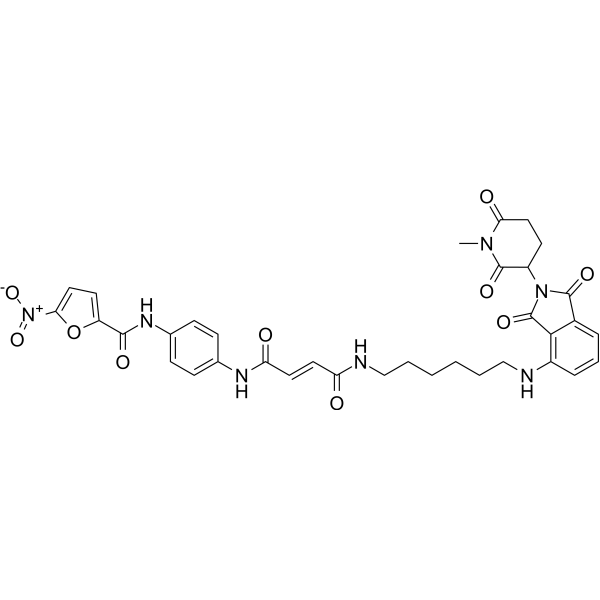
PROTAC STING Degrader-1 control serves as the negative control for PROTAC STING Degrader-1 (HY-150608). PROTAC STING Degrader-1 is a PROTAC degrader targeting the STING pathway .
loading...
    loading...
Cat. No.: HY-174136
Target:  

STING IFNAR

Research Areas:  

Inflammation/Immunology

STING Degrader-2 is an orally active STING degrader that promotes proteasome-independent degradation of STING. STING Degrader-2 inhibits cGAMP-induced STING activation, suppresses STING oligomerization, and inhibits phosphorylation of STING and interferon regulatory factor 3 (IRF3). STING Degrader-2 reduces serum IFN-β and CXCL-10 levels in a cGAMP-induced autoimmune disease mouse model. STING Degrader-2 can be used for the research of autoimmune diseases .
loading...
    loading...
Cat. No.: HY-158036
CAS No.: 3023095-61-3
Target:  

PROTACs STING IKK IFNAR CXCR

Research Areas:  

Inflammation/Immunology

PROTAC STING Degrader-2 is a STING PROTAC degrader with a DC50 of 0.53 μM. PROTAC STING Degrader-2 reduces the phosphorylation levels of TBK1 and IRF3. PROTAC STING Degrader-2 decreases the mRNA expression levels of IFN-β, CXCL10 and TNF-α, and blocks luciferase secretion. PROTAC STING Degrader-2 can be used in the research of autoimmune diseases .
loading...
    loading...
Cat. No.: HY-162331
Target:  

Molecular Glues STING

Research Areas:  

Inflammation/Immunology Cancer

STING Degrader-1 (compound 2), a molecular glue, is a potent STING degrader that covalently binds to STING and E3 ligase. STING Degrader-1 exhibits a "hook effect", that degrades 75% STING protein at 10 μM, and degrades ca. 30% STING protein at 30 μM .
loading...
    loading...
Cat. No.: HY-158046
CAS No.: 3094059-37-4
Target:  

PROTACs STING

Research Areas:  

Infection

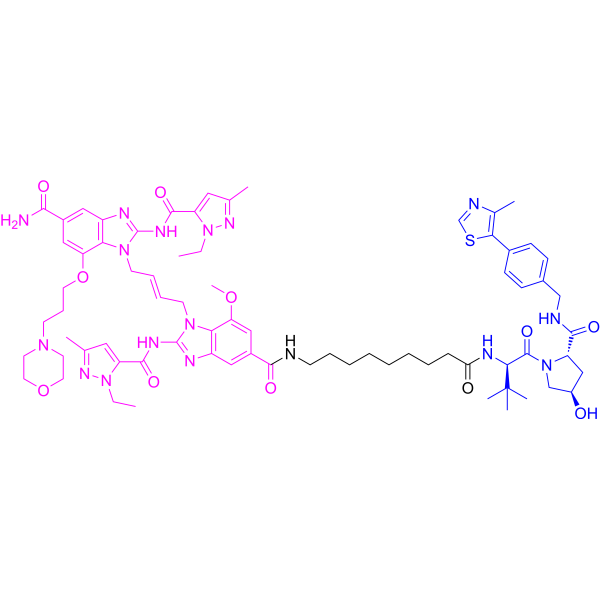
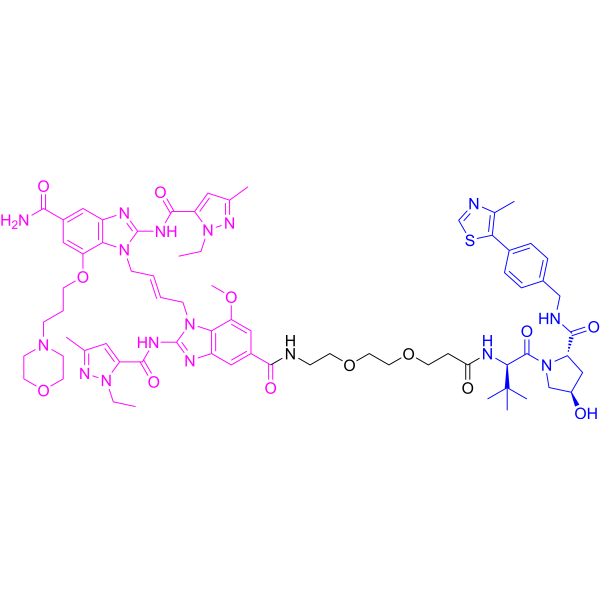
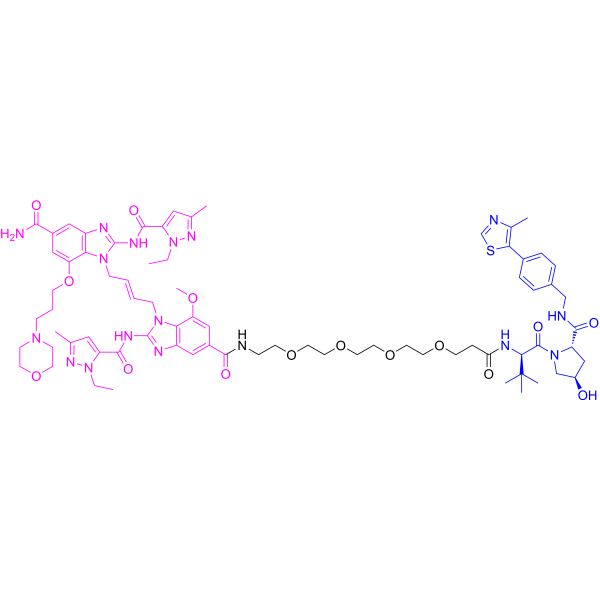
UNC8899 is a VHL-recruiting STING PROTAC degrader (DC50: 0.0.924 μM). UNC8899 can be used for viral or bacterial infection research (Blue: VHL ligand, Black: linker; Pink: STING inhibitor) .
loading...
    loading...
Cat. No.: HY-176180
Target:  

PROTACs STING IKK NF-κB

Research Areas:  

Inflammation/Immunology

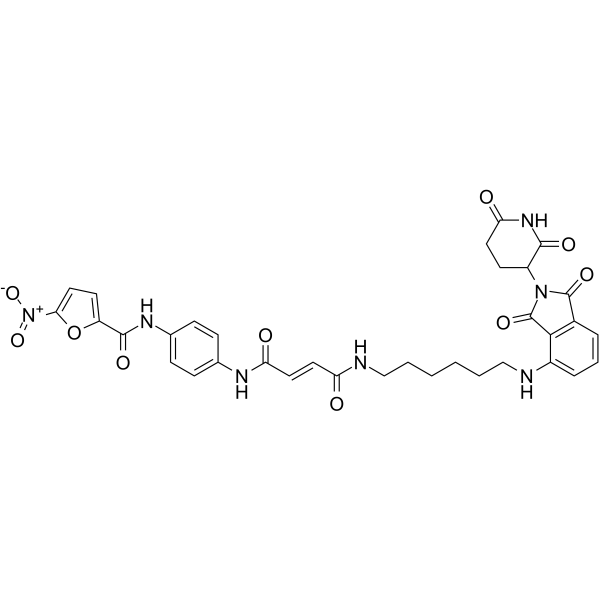
PROTAC STING degrader-4 is a nitro-free covalent STING PROTAC degrader with a DC50 of 3.23 μM. PROTAC STING degrader-4 effectively inhibits STING as well as its downstream signaling, such as p-TBK1 and p-NF-κB (p-P65), and immune-inflammatory cytokines. PROTAC STING degrader-4 mitigates kidney and blood inflammation in Cisplatin (HY-17394)-induced acute kidney injury (AKI) mice model .
loading...
    loading...
Cat. No.: HY-168554
STING Degrader-3 is a PROTAC-like STING degrader with a DC50 of 2.58 μM in THP-1 cells. STING Degrader-3 degrades STING protein via the lysosomal pathway. STING Degrader-3 functions as a non-degradative inhibitor in macrophages. STING Degrader-3 reduces the phosphorylation levels of TBK1 and IRF3, and downregulates the expression of IFN-β, CXCL10, IL-6, TNFα, IL-1β, ISG15 and ISG56. STING Degrader-3 exhibits renoprotective properties in a cisplatin-induced acute kidney injury model. STING Degrader-3 can be used in studies related to acute kidney injury. ((Pink: STING ligand (HY-168676); Blue: CRBN ligand (HY-126457); Black: linker (HY-W123015); CRBN ligand + linker: (HY-168677)) .
loading...
    loading...
Cat. No.: HY-176183
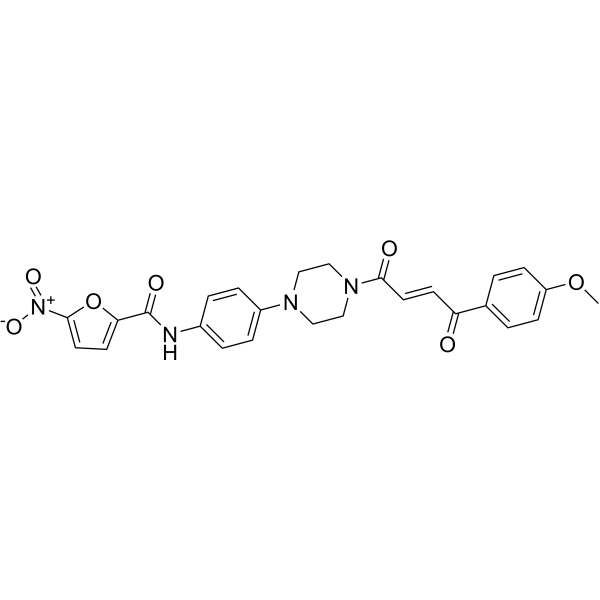
STING ligand-4 (Compound 2) is a nitro-free covalent STING inhibitor with an IC50 < 0.2 μM. STING ligand-4 can be used for synthesis of PROTAC STING degrader-4 (HY-176180) .
loading...
    loading...
Cat. No.: HY-158047
CAS No.: 3094059-45-4
Target:  

PROTACs STING

Research Areas:  

Infection

UNC8900 is a VHL recruiting STING PROTAC degrader (DC50: 0.0.924 μM). UNC8900 can be used for research of viral or bacterial infection. (Blue: VHL ligand, black: linker; Pink: STING inhibitor) .
loading...
    loading...
Cat. No.: HY-173415
Research Areas:  

Cancer

E3 Ligase Ligand-linker Conjugate 177 is an E3 ligase ligand-linker conjugate. E3 Ligase Ligand-linker Conjugate 177 can be used to synthesize STING PROTAC degrader ST9 .
loading...
    loading...
Cat. No.: HY-168676
CAS No.: 1307526-16-4
Research Areas:  

Cancer

STING ligand-2 is the ligand for STING, that can be used as target protein ligand in synthesis of PROTAC degrader STING-IN-10 (HY-168554) .
loading...
    loading...
Cat. No.: HY-176182
CAS No.: 2757925-36-1
Target:  

PROTAC Linkers

Research Areas:  

Inflammation/Immunology

Br-C2-PEG3-OTs is a PEG-based PROTAC linker that can be used in the synthesis of PROTACs, such as PROTAC STING degrader-4 (HY-176180) .
loading...
    loading...
Cat. No.: HY-164043
CAS No.: 2365173-01-7
Target:  

Ligands for E3 Ligase

Research Areas:  

Cancer

(S,R,S)-AHPC(Me)-amido-C2-acid is an VHL (E3 ligase) ligand, and can be used for synthesis of PROTACs, such as PROTAC STING Degrader-2 (HY-158036) .
loading...
    loading...
Cat. No.: HY-176181
CAS No.: 3023389-80-9
Thalidomide-4-OH-PEG4-OTs is an E3 ligase ligand-linker conjugate that incorporates the Thalidomide (HY-14658) based CRBN ligand (HY-103596) and 4-unit PEG linker (HY-176182). Thalidomide-4-OH-PEG4-OTs can be used for synthesis of PROTAC STING degrader-4 (HY-176180) .
loading...
    loading...
Cat. No.: HY-168491
CAS No.: 3067908-20-4
Research Areas:  

Cancer

Enpp-1-IN-25 (Compound 30) is an ENPP1 inhibitor with an IC50 of 8.05 nM and low oral bioavailability. Enpp-1-IN-25 can effectively activate the intracellular STING pathway by inhibiting cGAMP degradation. Enpp-1-IN-25 can enhance immune cell infiltration in the tumor microenvironment and type I interferon responses, and potentiate the antitumor efficacy of the anti-PD-L1 antibody. Enpp-1-IN-25 can be used in the research of cancer immunotherapy .
loading...
    loading...

