4 Results for "

Thiamiprine

" in MedChemExpress (MCE) Product Catalog:
Products (4)

4 Results for "Thiamiprine" in MCE Product Catalog:

Cat. No.: HY-119530
CAS No.: 5581-52-2
Synonyms: BW 57-323
Research Areas:  

Others

Thiamiprine (BW 57-323) is a compound related to azathioprine. Its nucleoside forms are similar to the parent compound in terms of cytotoxicity in vitro (except for the arabinoside). In the rat adjuvant arthritis model in vivo, its riboside and 2'-deoxyriboside are less active than the parent compound. The arabinoside is inactive and nontoxic. It has similar potency to the other parent compounds tested, but has a different safety profile.
loading...
    loading...
13
13 Cited Publications
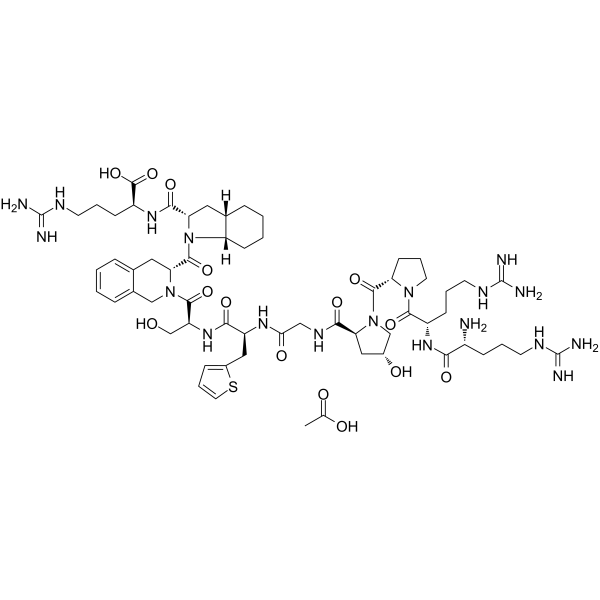
Cat. No.: HY-108896
CAS No.: 138614-30-9
Purity:  99.85%
Synonyms: HOE 140 acetate
Target:  

Bradykinin Receptor

Research Areas:  

Inflammation/Immunology

Icatibant acetate (HOE-140 acetate) is a potent and specific peptide antagonist of bradykinin B2 receptor with an IC50 and Ki of 1.07 nM and 0.798 nM respectively .
loading...
    loading...
Cat. No.: HY-119530R
CAS No.: 5581-52-2
Synonyms: BW 57-323 (Standard)
Thiamiprine (Standard) is the analytical standard of Thiamiprine. This product is intended for research and analytical applications. Thiamiprine (BW 57-323) is a compound related to azathioprine. Its nucleoside forms are similar to the parent compound in terms of cytotoxicity in vitro (except for the arabinoside). In the rat adjuvant arthritis model in vivo, its riboside and 2'-deoxyriboside are less active than the parent compound. The arabinoside is inactive and nontoxic. It has similar potency to the other parent compounds tested, but has a different safety profile.
loading...
    loading...
Cat. No.: HY-119821R
CAS No.: 52452-60-5
Thiamiprine (Standard) is the analytical standard of Thiamiprine. This product is intended for research and analytical applications. Thiamiprine (BW 57-323) is a compound related to azathioprine. Its nucleoside forms are similar to the parent compound in terms of cytotoxicity in vitro (except for the arabinoside). In the rat adjuvant arthritis model in vivo, its riboside and 2'-deoxyriboside are less active than the parent compound. The arabinoside is inactive and nontoxic. It has similar potency to the other parent compounds tested, but has a different safety profile.
loading...
    loading...

