12 Results for "

Vemurafenib

" in MedChemExpress (MCE) Product Catalog:
Products (12)

12 Results for "Vemurafenib" in MCE Product Catalog:

104
104 Cited Publications
Cat. No.: HY-12057
CAS No.: 918504-65-1
Purity:  99.85%
Synonyms: PLX4032; RG7204; RO5185426
Target:  

Raf Autophagy

Research Areas:  

Cancer

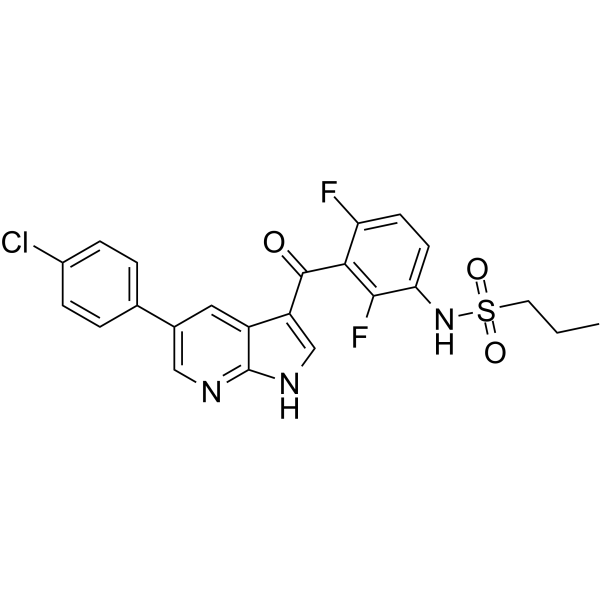
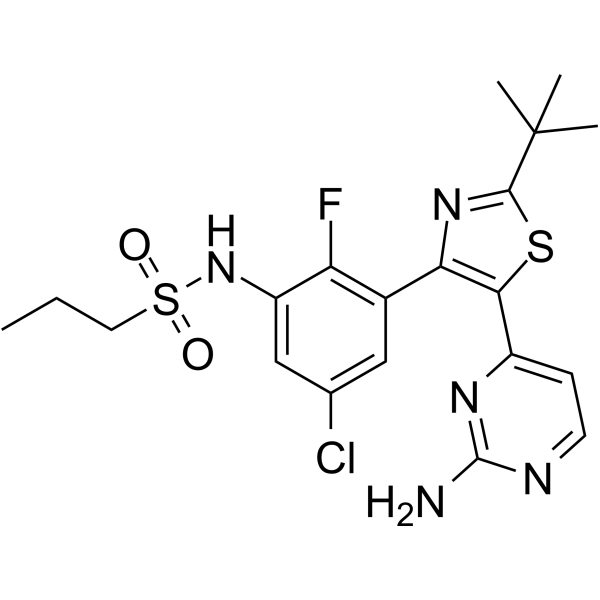
Vemurafenib (PLX4032) is a first-in-class, selective, potent inhibitor of B-RAF kinase, with IC50s of 31 and 48 nM for RAF V600E and c-RAF-1, respectively . Vemurafenib induces cell autophagy .
loading...
    loading...
6
6 Cited Publications
Cat. No.: HY-13313
CAS No.: 1149705-71-4
Purity:  99.41%
Target:  

HSP Apoptosis

Research Areas:  

Cancer

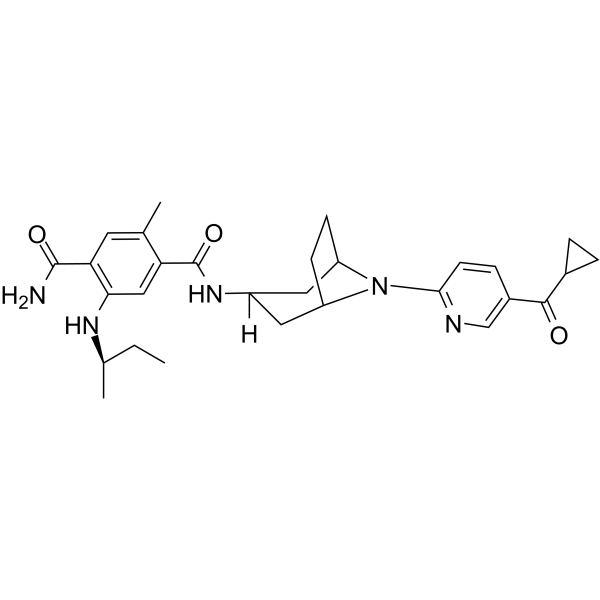
XL888 is a potent and orally active HSP90 inhibitor with an IC50 value of 24 nM. XL888 shows anti-proliferation activity and induces Apoptosis. XL888 shows anti-tumor activity .
loading...
    loading...
Cat. No.: HY-149380
CAS No.: 3057544-65-4
Target:  

Raf

Research Areas:  

Cancer

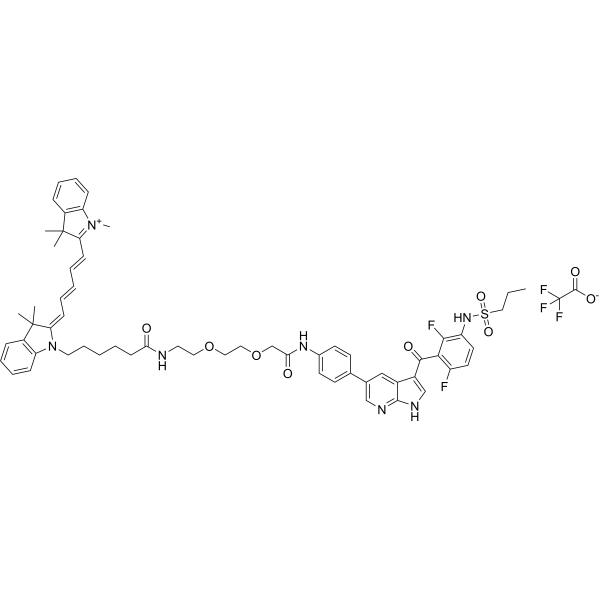
Vem-L-Cy5 (compound 3),modified with the NIR fluorophore cyanine-5 (Cy5),is a Vemurafenib (HY-12057)-based inhibitor of BRAF. Vem-L-Cy5 targets to BRAF V600E,and also inhibits MEK phosphorylation. Vem-L-Cy5 has cell permeability,and inhibits cell growth of many types of cancer .
loading...
    loading...
Cat. No.: HY-W674149
CAS No.: 1253697-93-6
Target:  

Microtubule/Tubulin

Research Areas:  

Cancer

ABI-274 is a tubulin and colchicine binding site inhibitor. ABI-274 significantly promotes cancer cell apoptosis in vitro when combined with vemurafenib (HY-12057). ABI-274 exhibits potent synergistic efficacy in the vemurafenib-resistant xenograft model in nude mice. ABI-274 can be studied in research on melanoma .
loading...
    loading...
Cat. No.: HY-12057S
CAS No.: 1365986-90-8
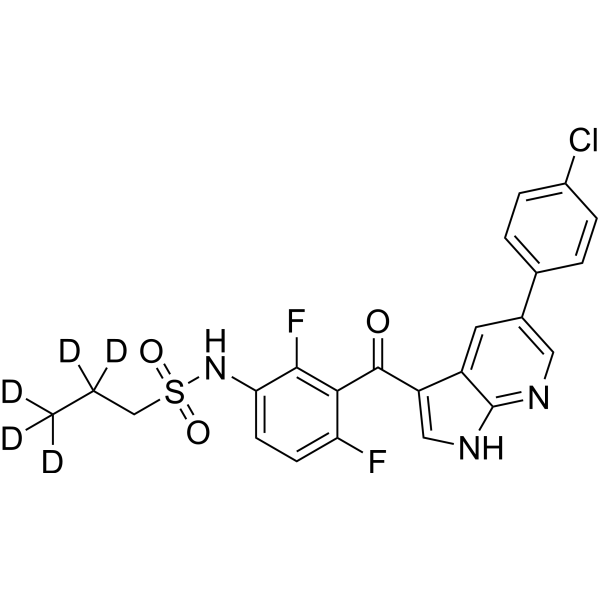
Vemurafenib-d5 is the deuterium labeled Vemurafenib. Vemurafenib (PLX4032) is a first-in-class, selective, potent inhibitor of B-RAF kinase, with IC50s of 31 and 48 nM for RAFV600E and c-RAF-1, respectively . Vemurafenib induces cell autophagy .
loading...
    loading...
Cat. No.: HY-150639
CAS No.: 2923700-82-5
Target:  

Raf

Research Areas:  

Cancer

Everafenib is a potent and blood-brain barrier (BBB) penetrant BRAF inhibitor, also inhibits MAPK signaling. Everafenib has inhibitory activity against a panel of V600EBRAF melanoma cell lines with IC50 values of 2-10 nM, which is better than Dabrafenib (HY-14660) and Vemurafenib (HY-12057). Everafenib has efficacy in an intracranial mouse model of metastatic melanoma .
loading...
    loading...
Cat. No.: HY-12057R
CAS No.: 918504-65-1
Synonyms: PLX4032 (Standard); RG7204 (Standard); RO5185426 (Standard)
Research Areas:  

Cancer

Vemurafenib (Standard) is the analytical standard of Vemurafenib. This product is intended for research and analytical applications. Vemurafenib (PLX4032) is a first-in-class, selective, potent inhibitor of B-RAF kinase, with IC50s of 31 and 48 nM for RAF V600E and c-RAF-1, respectively . Vemurafenib induces cell autophagy .
loading...
    loading...
Cat. No.: HY-179012
Target:  

APC CDK Raf Akt HSP

Research Areas:  

Cancer

CDC20/HSP90-IN-1 (Compound 2b) is a Cdc20/Hsp90 inhibitor with a Kd of 16.2 μM for Cdc20 and a Kd of 0.241 μM for Hsp90α. CDC20/HSP90-IN-1 exerts potent antitumor activity through reducing p53-mediated Cdc20, upregulating Bim, downregulating Cyclin B1 expression, and disturbing B-Raf and AKT pathways via destroying Hsp90 chaperone function. CDC20/HSP90-IN-1 overcomes Vemurafenib (HY-12057)-induced resistant melanoma .
loading...
    loading...
Cat. No.: HY-12057S1
CAS No.: 1365986-73-7
Synonyms: PLX4032-d7; RG7204-d7; RO5185426-d7
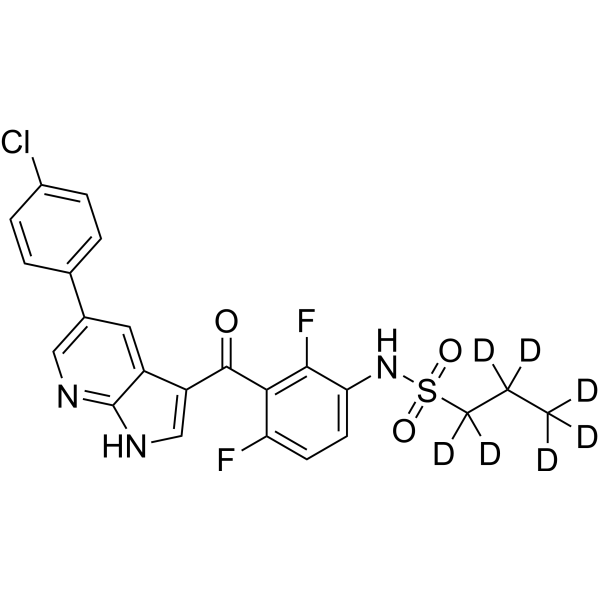
Vemurafenib-d7 is deuterium labeled Vemurafenib. Vemurafenib (PLX4032) is a first-in-class, selective, potent inhibitor of B-RAF kinase, with IC50s of 31 and 48 nM for RAFV600E and c-RAF-1, respectively . Vemurafenib induces cell autophagy .
loading...
    loading...
Cat. No.: HY-164473
CAS No.: 1836209-98-3
Target:  

ERK Akt STAT Apoptosis

Research Areas:  

Cancer

DETD-35 is an inhibitor of the MEK-ERK, Akt, and STAT3 signaling pathways, which promotes cancer cell apoptosis (Apoptosis) and reduces cancer cell resistance to Vemurafenib (HY-12057). The IC50 values of DETD-35 against wild-type and mutant melanoma cell lines B16-F10, MeWo, SK-MEL-2, A2058c, and A375c are 2.7, 6.0, 3.9, 3.1, and 2.5 μM, respectively. DETD-35 holds promise for research in the field of anti-melanoma therapy .
loading...
    loading...
Cat. No.: HY-L187
2,193 compounds

Fragment-based drug development (FBDD) is a strategy for drug discovery that can be applied both academically and commercially to enhance the identification of some non-drug targets. Fragment-based drug development has identified low molecular weight molecules (<300 Da) capable of binding to related macromolecules. These fragments can cover a wide chemical space and are easy to optimize later. Currently, several fragment-based drugs have entered clinical trials, of which two drugs, Vemurafenib and Venetoclax, have been approved for marketing.

Based on Tanimoto coefficient, MCE uses similarity algorithm to carefully select 2,193 high-structurally diverse 'RO3' compliant fragment molecules from large-scale fragment molecules, which can be applied to fragment based drug development.

Cat. No.: HY-L032
41,368 compounds

Fragment-based drug discovery (FBDD) is well suited for discovering both drug leads and chemical probes of protein function; it can cover broad swaths of chemical space and allows the use of creative chemistry. Fragment-based drug discovery is well-established in industry and has resulted in a variety of drugs entering clinical trials, with two, vemurafenib and venetoclax, already approved. FBDD also has key attractions for academia. Notably, it is able to tackle difficult or novel targets for which no chemical matter may be found in existing HTS collections.

MCE designs a unique collection of 41,368 fragment compounds, all of which obey a heuristic rule called the “Rule of Three (RO3) ”, in which molecular weight ≤300 Da, the number of hydrogen bond donors (H-donors) ≤3, the number of hydrogen bond acceptors (H-acceptors) is ≤3 and cLogP is ≤3. This library is an important source of lead-like drugs.

  • 1

