6 Results for "

behavioral recovery

" in MedChemExpress (MCE) Product Catalog:
Products (6)

6 Results for "behavioral recovery" in MCE Product Catalog:

4
4 Cited Publications
Cat. No.: HY-B1752
CAS No.: 80373-22-4
Synonyms: LY 171555; (-)-LY 141865
Quinpirole (LY 171555; (-)-LY 141865) is a D2/D3 dopamine receptor agonist and a CaV1.3 calcium channel modulator. Quinpirole normalizes dendritic spine density in dopamine-depleted striatum, upregulates the protein expression of BCL2 and GluR2, downregulates the protein expression of BAX, and delays the onset of seizures. Quinpirole enhances learning and memory, inhibits neuronal apoptosis (apoptosis), and induces anxiety-like, stereotyped, and compulsive behaviors. Quinpirole disrupts prepulse inhibition in rhesus monkeys, enhances the activity of paraventricular thalamic neurons to promote recovery from Isoflurane anesthesia, and alters the composition of the gut microbiota in rats. Quinpirole can be used in research related to dyskinesia, pain, epilepsy, and neurological disorders including anxiety disorder, obsessive-compulsive disorder, and schizophrenia .
loading...
    loading...
Cat. No.: HY-13999
CAS No.: 1270138-40-3
Purity:  99.57%
Synonyms: NSI-189
Target:  

Trk Receptor

Research Areas:  

Neurological Disease

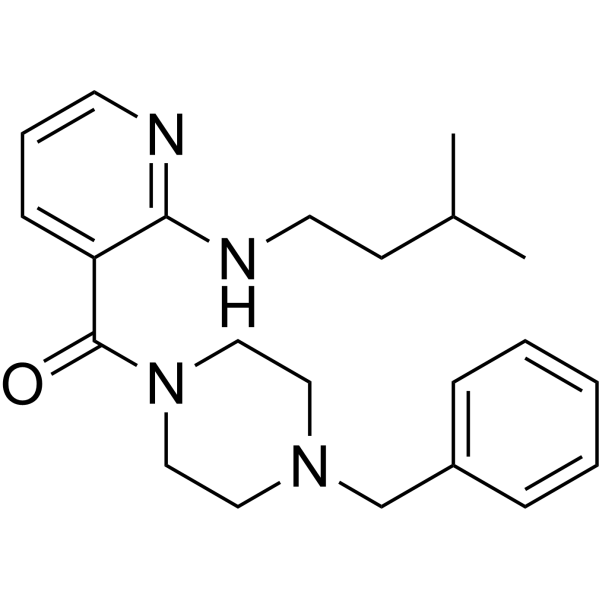
Amdiglurax (NSI-189) is an orally active chemical entity with enhanced neurogenic activity. Amdiglurax up-regulates neurogenic factors such as BDNF (brain derived-neurotrophic factor) and SCF. Amdiglurax exhibits anti-depressant effect. Amdiglurax enhances synaptic plasticity and reduces cognitive dysfunction. Amdiglurax holds potential for psychiatric disorder research .
loading...
    loading...
Cat. No.: HY-111178
CAS No.: 90280-13-0
Purity:  99.18%
Synonyms: BisfluoroModafinil; CRL-40940; NLS-4
Target:  

Dopamine Transporter

Research Areas:  

Neurological Disease

Lauflumide (BisfluoroModafinil) is a selective dopamine reuptake inhibitor and wake-promoting agent. Lauflumide inhibits the dopamine transporter (DAT). Lauflumide induces sustained wakefulness without eliciting hyperlocomotion, stereotypy or abnormal behaviors in Mus musculus (house mice). Lauflumide reduces non-rapid eye movement (NREM) sleep rebound in rats, modulates electroencephalogram (EEG) spectral composition, and produces anti-aggressive effects. Lauflumide alleviates circadian rhythm disturbances in rats, increases spontaneous activity in fatigued rats, and facilitates their recovery from severe fatigue. Lauflumide can be used in research related to excessive daytime sleepiness as well as chronic severe fatigue/chronic fatigue syndrome (CFS) .
loading...
    loading...
Cat. No.: HY-P3801
CAS No.: 77128-69-9
Synonyms: DiMe-C7
[Glp5,(Me)Phe8,Sar9] Substance P (5-11) (DiMe-C7) is a Substance P (HY-P0201) analogue that has approximately the same effects as Substance P (HY-P0201) on neurokinin 1 receptor (NK1R) in rat brain, but with a much longer duration of action. [Glp5,(Me)Phe8,Sar9] Substance P (5-11) selectively activates dopamine metabolism in the mesencephalon and midbrain cortex of the rat brain. [Glp5,(Me)Phe8,Sar9] Substance P (5-11) also increases motor activity and induces recovery of addictive agent-seeking behavior in rats .
loading...
    loading...
Cat. No.: HY-13999A1
CAS No.: 1270138-41-4
Purity:  99.75%
Synonyms: NSI-189 phosphate
Target:  

Trk Receptor

Research Areas:  

Neurological Disease

Amdiglurax (NSI-189) phosphate is an orally active chemical entity with enhanced neurogenic activity. Amdiglurax phosphate up-regulates neurogenic factors such as BDNF (brain derived-neurotrophic factor) and SCF. Amdiglurax phosphate exhibits anti-depressant effect. Amdiglurax enhances synaptic plasticity and reduces cognitive dysfunction. Amdiglurax phosphate holds potential for psychiatric disorder research .
loading...
    loading...
Cat. No.: HY-177797
CAS No.: 30439-19-1
Research Areas:  

Neurological Disease

5-Methoxytryptoline acts as a modulator of the Serotonin transporter complex, as well as a ligand for the 5-HT2A and 5-HT2C receptors, with Ki values of 130 nM and 140 nM for the 5-HT2A and 5-HT2C receptors, respectively. 5-Methoxytryptoline inhibits the active uptake of Serotonin (HY-B1473A) and Tryptamine (HY-B2132) in platelets. 5-Methoxytryptoline induces behavioral excitation, cortical electroencephalographic desynchronization, and dose-dependent elevation of plasma prolactin, followed by behavioral sedation and partial recovery of cortical electroencephalographic voltage. 5-Methoxytryptoline antagonizes Reserpine (HY-N0480)-induced sedation, reduced locomotor activity, and hypothermia. 5-Methoxytryptoline exerts dose-dependent effects on behavior and cortical electroencephalographic activity in freely moving rats. 5-Methoxytryptoline can be used in depression-related research .
loading...
    loading...

