1. Search Result
Search Result
Results for "

extracellular polysaccharides

" in MedChemExpress (MCE) Product Catalog:

11

Inhibitors & Agonists

1

Fluorescent Dyes

1

Biochemical Assay Reagents

4

Natural
Products

Targets Recommended:
Cat. No. Product Name Target Research Areas Chemical Structure
  • HY-101916
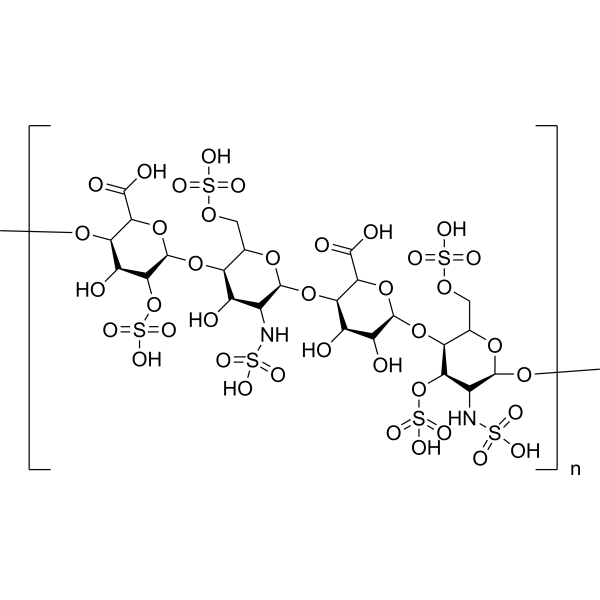
    Heparan Sulfate
    Maximum Cited Publications
    20 Publications Verification

    FGFR Wnt Endogenous Metabolite Neurological Disease Inflammation/Immunology Cancer
    Heparan sulfate, a complex and linear polysaccharide, exists as part of glycoproteins named heparan sulfate proteoglycans, which are expressed abundantly on the cell surface and in the extracellular matrix.
    Heparan Sulfate
  • HY-N11287A
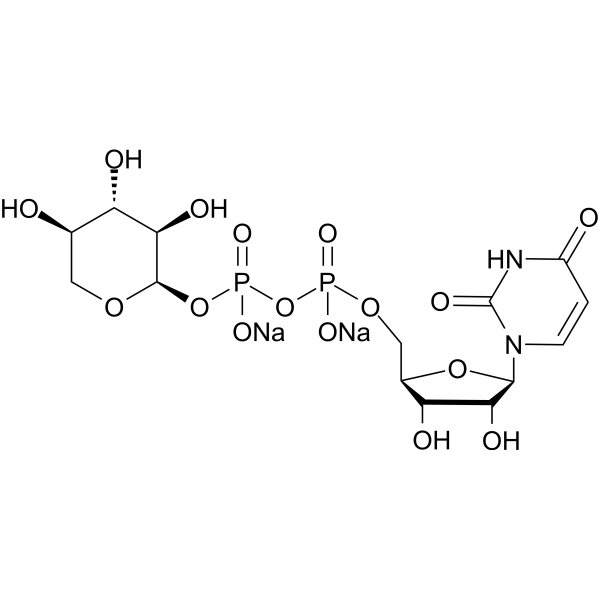
    UDP-xylose disodium
    2 Publications Verification

    Endogenous Metabolite Others
    UDP-xylose disodium is an endogenous sugar nucleotide and a catalytic substrate of UDP-xylose disodium synthase (UXS). UDP-xylose disodium is a sugar donor for the synthesis of glycoproteins, polysaccharides, various metabolites and oligosaccharides in plants, vertebrates and fungi, and participates in the synthesis of proteoglycans as a glycosyl donor. UDP-xylose disodium participates in the regulation of the synthesis of extracellular matrix components and can be used to study the mechanism of proteoglycan biosynthesis in glycobiology and related diseases (such as connective tissue diseases)[1][2].
    UDP-xylose disodium
  • HY-N13022
    Humic acid
    1 Publications Verification

    Environmental Pollutants Bacterial SOD Inflammation/Immunology Cancer
    Humic acid is an important component of organic matter in soil and water, and serves as a plant regulator. Humic acid has multiple reactive activities such as surface adsorption, ion exchange, and complexation. Humic acid can enhance pyrene degradation by Mycobacterium NJS-1. Humic acid can inhibit the activity of superoxide dismutase and scavenge hydroxyl radicals. Humic acid is also toxic to CEM cells .
    Humic acid
  • HY-N11287

    Endogenous Metabolite Others
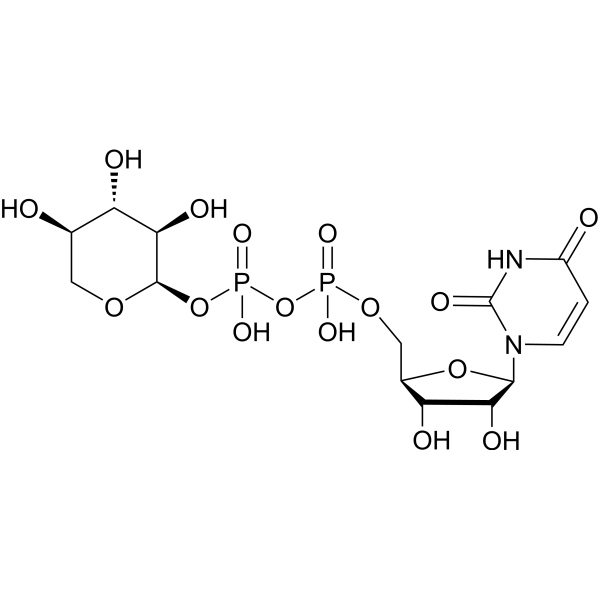
    UDP-xylose is an endogenous sugar nucleotide and a catalytic substrate of UDP-xylose synthase (UXS). UDP-xylose is a sugar donor for the synthesis of glycoproteins, polysaccharides, various metabolites and oligosaccharides in plants, vertebrates and fungi, and participates in the synthesis of proteoglycans as a glycosyl donor. UDP-xylose participates in the regulation of the synthesis of extracellular matrix components and can be used to study the mechanism of proteoglycan biosynthesis in glycobiology and related diseases (such as connective tissue diseases)[1][2].
    UDP-xylose
  • HY-W540661

    Biochemical Assay Reagents Others
    Hyaluronic acid tetrasaccharide, 98% is a naturally occurring polysaccharide found in the extracellular matrix of connective tissues. Hyaluronic acid tetrasaccharide can be used as a substrate for enzyme assays to characterize hyaluronidases and other hyaluronic acid-degrading enzymes.
    Hyaluronic acid tetrasaccharide, 98%
  • HY-179389

    Bacterial Glutathione S-transferase Elastase Infection
    XDS-23 is a selective biofilm inhibitor with an IC50 of 1.26 µM against Pseudomonas aeruginosa. XDS-23 exerts a dual inhibitory effect on the LasI/LasR System (las) and Pseudomonas Quinolone Signal System (pqs). XDS-23 suppress the production of key virulence factors including elastase, pyocyanin, and extracellular polysaccharides. XDS-23 exhibits synergistic antibacterial activity and can enhance the efficacy of multiple antibiotics in both in vitro and in vivo models, while maintaining a favorable safety profile. XDS-23 can be employed for research in combating biofilm-mediated drug-resistant P. aeruginosa infections .
    XDS-23
  • HY-155716

    Bacterial Glucosylceramide Synthase (GCS) Infection
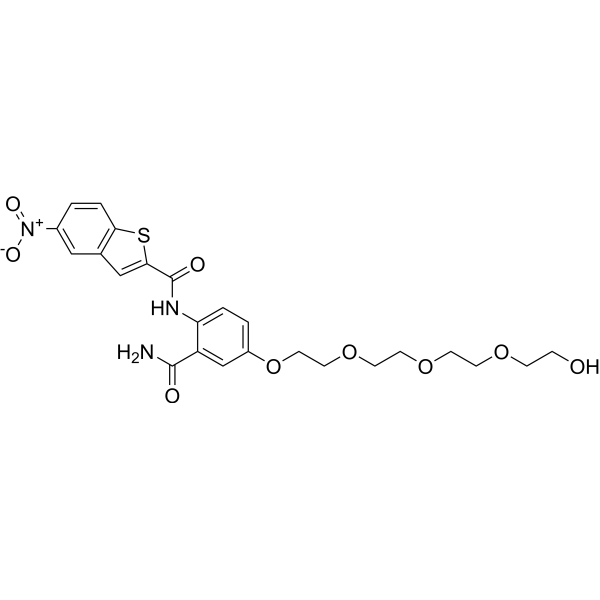
    G43-C3-TEG is a glycosyl-transferase inhibitor. G43-C3-TEG reduces the biofilm formation by decreasing the production of EPS (extracellular polysaccharides) .
    G43-C3-TEG
  • HY-162624

    Bacterial Infection
    Quorum sensing-IN-5 is a RpfF-targeted quorum-sensing inhibitor. Quorum sensing-IN-5 inhibits Xanthomonas oryzae pv oryzae (Xoo) and Xanthomonas axonopodis pv. citri (Xac) with EC50 values of 9.91 μg/mL and 7.04 μg/mL. Quorum sensing-IN-5 has antimicrobial activity .
    Quorum sensing-IN-5
  • HY-178212

    Bacterial Reactive Oxygen Species (ROS) Apoptosis Infection
    Antibacterial agent 292 is a 3-pyrazolylindole derivative. Antibacterial agent 292 is an anti-bacterial agent. Antibacterial agent 292 shows potent inhibitory activity against Xanthomonas oryzae pv oryzae (Xoo) and Xanthomonas axonopodis pv citri (Xac), with EC50 values of 2.54 and 3.49 μg/mL. Antibacterial agent 292 can suppress biofilm formation, bacterial motility, and extracellular polysaccharide production, induce morphological alterations and promote ROS accumulation, ultimately triggers bacterial apoptosis. Antibacterial agent 292 down-regulates the expression of genes associated with the type VI secretion system (T6SS). Antibacterial agent 292 can be used in rice bacterial blight and citrus canker .
    Antibacterial agent 292
  • HY-D3194

    Fluorescent Dye Infection
    CDy14 is a fluorescent probe targeting the extracellular polysaccharide Psl. CDy14 enables the detection of biofilms. CDy14 can be used for research on chronic bacterial infections .
    CDy14
  • HY-178800

    Bacterial Infection
    Antibacterial agent 296 (Compound Q24) is an antibacterial agent. Antibacterial agent 296 inhibits biofilm formation, reduces extracellular polysaccharides. Antibacterial agent 296 shows inhibitory activity against Xanthomonas axonopodis pv. citri (Xac), with an EC50 of 5.13 μg/mL .
    Antibacterial agent 296

Inquiry Online

Your information is safe with us. * Required Fields.

Salutation


Country or Region *

Applicant Name *


Organization Name *

Department *


Email Address *


Product Name *

Cat. No.


Requested quantity *

Phone Number *


Remarks

Inquiry Online

Inquiry Information

Product Name:
Cat. No.:
Quantity:
MCE Japan Authorized Agent:

