24 Results for "

lysine side chains

" in MedChemExpress (MCE) Product Catalog:
Products (24)

24 Results for "lysine side chains" in MCE Product Catalog:

1
1 Cited Publications
Cat. No.: HY-48999A
CAS No.: 3033987-42-4
Target:  

EGFR

Research Areas:  

Cancer

FSK hydrochloride is fluorosulfonyloxybenzoyl-L-lysine, which features a long, flexible aryl fluorosulfate-containing side chain that can reach protein sites inaccessible to covalent conjugation. FSK hydrochloride modifies nanomolecules to target epidermal growth factor receptor (EGFR), resulting in irreversibly bound covalent interactions. Through genetically encoded chemical crosslinking, FSK hydrochloride captures unknown enzyme-substrate interactions in living cells, targets residues other than Cys, and mediates crosslinking at the binding periphery. FSK hydrochloride enables the construction of a bioreactive SuFEx system for generating covalent bonds in various proteins both in vitro and in vivo .
loading...
    loading...
Cat. No.: HY-151835
CAS No.: 2765066-38-2
Purity:  95.25%
Target:  

ADC Linkers

Research Areas:  

Others

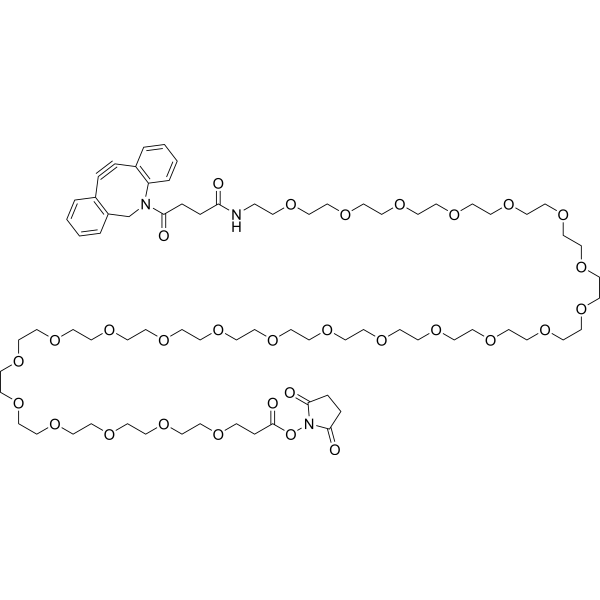
DBCO-PEG24-NHS ester is a click chemistry reagent. DBCO-PEG24-NHS ester is a click chemistry PEG reagent containing NHS ester that is able to react specifically and efficiently with primary amines (e.g. the side chain of lysine residues or aminosilane-coated surfaces) at neutral or slightly basic condition to form a covalent bond. The hydrophilic PEG spacer arm improves water solubility and provides a long and flexible connection that minimizes steric hindrance involved with ligation. DBCO is commonly used for copper-free Click Chemistry reactions. Reagent grade, for research use only .
loading...
    loading...
Cat. No.: HY-141600
CAS No.: 1708947-48-1
Purity:  98.99%
Synonyms: BAY 1187982
Aprutumab ixadotin (BAY 1187982) is the first antibody-drug conjugate (ADC) to target FGFR2 and the first to use Auristatin-based payload. Aprutumab ixadotin contains a fully human anti-FGFR2 monoclonal antibody (Aprutumab) (HY-P99007) conjugated by lysine side chains to a non-cleavable linker and via this an innovative Auristatin W derivative. Aprutumab ixadotin can be used for the study of advanced solid tumors, such as FGFR2-positive gastric cancer and triple-negative breast cancer .
loading...
    loading...
Cat. No.: HY-151827
CAS No.: 2585653-12-7
Purity:  ≥98.0%
Target:  

ADC Linkers

Research Areas:  

Others

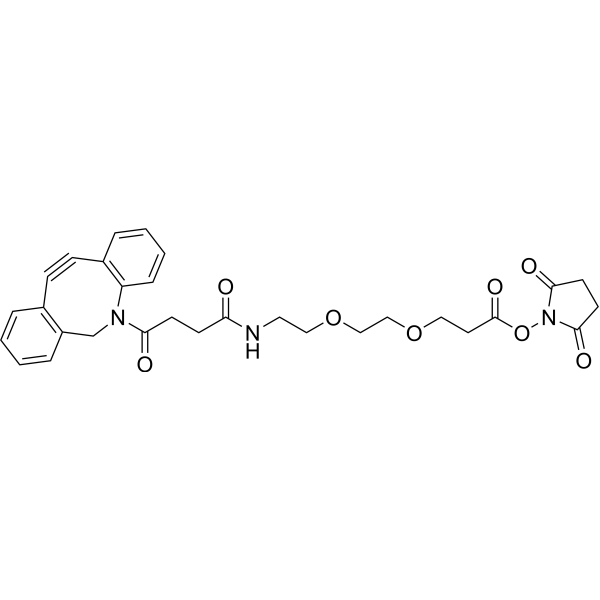
DBCO-PEG2-NHS ester is a click chemistry reagent containing an azide group. DBCO-PEG2-NHS ester is a click chemistry PEG reagent containing NHS ester that is able to react specifically and efficiently with primary amines (e.g. the side chain of lysine residues or aminosilane-coated surfaces) at neutral or slightly basic condition to form a covalent bond. The hydrophilic PEG spacer arm improves water solubility and provides a long and flexible connection that minimizes steric hindrance involved with ligation. DBCO is commonly used for copper-free Click Chemistry reactions. Reagent grade, for research use only .
loading...
    loading...
Cat. No.: HY-160773
Research Areas:  

Others

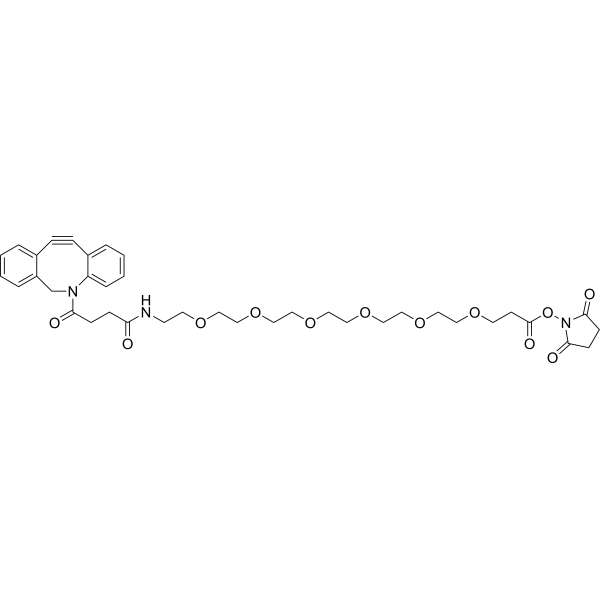
DBCO-PEG6-NHS ester is a click chemistry PEG reagent containing an NHS ester that reacts specifically with primary amines, such as side chains of lysine residues or aminosilane-coated surfaces, under neutral or slightly alkaline conditions. , efficient reaction to form covalent bonds. DBCO-PEG6-NHS ester also contains a DBCO group that can undergo strain-promoted alkyne-azide cycloaddition (SPAAC) with molecules containing Azide groups .
loading...
    loading...
Cat. No.: HY-W012166
CAS No.: 42014-51-7
Synonyms: NHS-Bromoacetate
Research Areas:  

Infection

N-Succinimidyl bromoacetate (NHS-Bromoacetate) is a heterobifunctional crosslinking reagent, mainly used to modify the ɛ-amino group of lysine side chains. By covalently linking its bromoacetyl moiety to the ɛ-amino group of lysine in peptidomimetics, N-Succinimidyl bromoacetate enables their conjugation with thiol-modified nanoparticles via thioether bonds. N-Succinimidyl bromoacetate also performs bromoacetylation modification on carrier proteins, which then forms stable thioether bonds with the thiol groups of cysteine in peptides, thus efficiently preparing soluble peptide-protein conjugates with high substitution ratios. N-Succinimidyl bromoacetate can be used to prepare activated Sepharose derivatives for affinity chromatography, protein affinity labeling reagents, and peptide-protein immunogen conjugates with non-immunogenic linkages. N-Succinimidyl bromoacetate is applicable to studies related to HIV-1 infection and glioblastoma multiforme .
loading...
    loading...
Cat. No.: HY-120128
CAS No.: 16599-33-0
Purity:  97.90%
Research Areas:  

Neurological Disease

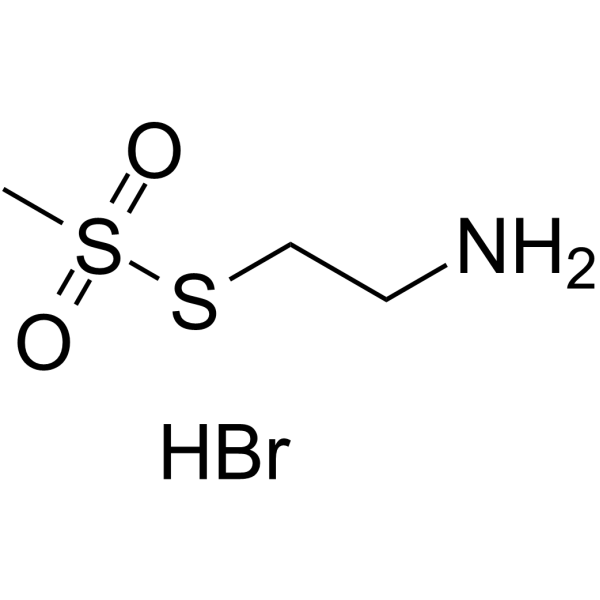
MTSEA hydrobromide is a sulfhydryl-reactive compound that modifies free cysteine residues to produce a positively charged side chain approximately the size of lysine .
loading...
    loading...
Cat. No.: HY-W848699
CAS No.: 890090-41-2
FAM NHS ester, 6-isomer is a hydrophilic fluorophore. The NHS ester can react specifically and efficiently with primary amines such as the side chain of lysine residue or aminosilane-coated surfaces at neutral or slight basic conditions to form a covalent bond.
loading...
    loading...
Cat. No.: HY-W591479
CAS No.: 1895916-22-9
Target:  

ADC Linkers

Research Areas:  

Cancer

MC-Val-Ala-NHS ester is a cleavable ADC linker with a malimide group and an NHS ester group. The Val-Ala linkers can be cleaved by Cathepsin B. Maleimide group is reactive toward thiol groups. MC is reactive with thiol moieties. The NHS ester is able to react specifically and efficiently with amines (e.g. the side chain of lysine residues or aminosilane-coated surfaces) at neutral or slightly basic condition to form a covalent bond.
loading...
    loading...
Cat. No.: HY-118112
CAS No.: 64191-06-6
Research Areas:  

Others

4-N-Maleimidobenzoicacid-NHS is a PEG linker that finds utility in bioconjugation endeavors and protein labeling ventures. Specifically designed for selective reaction with thiol groups, the maleimide group establishes covalent linkages, thereby facilitating the coupling of proteins, peptides, or diverse molecules to thiol-bearing biomolecules. The NHS ester is able to react specifically and efficiently with primary amines (e.g. the side chain of lysine residues or aminosilane-coated surfaces) at neutral or slightly basic conditions to form a covalent bond.
loading...
    loading...
Cat. No.: HY-123564
CAS No.: 2012563-34-5
Target:  

Bcl-2 Family

Research Areas:  

Others

Mcl1-IN-7 (compound 11) is a reversible covalent inhibitor of Mcl-1 with the activity of inhibiting Mcl-1. By covalently targeting the non-catalytic lysine side chain of Mcl-1, it has higher potency than non-covalent counterparts and can be used to develop Mcl-1 inhibitory compounds and study related biological phenomena.
loading...
    loading...
Cat. No.: HY-W739603
CAS No.: 252255-42-8
Cy5-bifunctional dye potassium is a water soluble bifunctional dye possessing two terminal NHS ester functions. The NHS esters can react specifically and efficiently with primary amines such as the side chain of lysine residue or aminosilane-coated surfaces at neutral or slight basic conditions to form a covalent bond. The dye is useful for the cross-conjugation of amines, and for other advanced labeling applications.
loading...
    loading...
Cat. No.: HY-116220
CAS No.: 2012563-29-8
Target:  

Others

Research Areas:  

Others

Mcl1-IN-14 (compound 5) is a reversible covalent inhibitor of Mcl-1 with the activity of inhibiting Mcl-1. Mcl1-IN-14 covalently targets the non-catalytic lysine side chain of Mcl-1 and has higher potency than non-covalent counterparts, which can be used to develop Mcl-1 inhibitory compounds and study related biological phenomena.
loading...
    loading...
Cat. No.: HY-160773A
Research Areas:  

Others

DBCO-C3-amide-PEG6-NHS ester is a click chemistry PEG reagent containing an NHS ester that reacts specifically with primary amines, such as side chains of lysine residues or aminosilane-coated surfaces, under neutral or slightly alkaline conditions. , efficient reaction to form covalent bonds. DBCO-C3-amide-PEG6-NHS ester also contains a DBCO group that can undergo strain-promoted alkyne-azide cycloaddition (SPAAC) with molecules containing Azide groups .
loading...
    loading...
Cat. No.: HY-136112
CAS No.: 14464-29-0
Synonyms: Succinimidyl acetate; Ac-OSu
Research Areas:  

Others

N-Succinimidyl acetate (Succinimidyl acetate; Ac-OSu) is a bioconjugation and peptide synthesis reagent. N-Succinimidyl acetate performs acetylation modification on the N-terminus and lysine side chains of proteins. N-Succinimidyl acetate is applicable to research fields including protein labeling, vaccine development and targeted drug delivery .
loading...
    loading...
Cat. No.: HY-E71022
Target:  

Endogenous Metabolite

Research Areas:  

Metabolic Disease

Trypsin Acetylated, Bovine (EC 3.4.21.4) is a serine protease from the PA clan superfamily, found in the digestive system of many vertebrates, where it hydrolyses proteins. Trypsin is produced in the pancreas as the inactive protease trypsinogen. Trypsin cleaves peptide chains mainly at the carboxyl side of the amino acids lysine or arginine, except when either is followed by proline.
loading...
    loading...
Cat. No.: HY-W190948
CAS No.: 905735-81-1
Research Areas:  

Others

10-(tert-Butoxy)-10-oxodecanoic NHS ester has a t-butyl ester group and an NHS ester moiety. The t-butyl group can be deprotected under acidic conditions. NHS ester can react specifically and efficiently with primary amines such as the side chain of lysine residues or aminosilane-coated surfaces at neutral or slightly basic condition to form a covalent bond.
loading...
    loading...
Cat. No.: HY-W190906
CAS No.: 402958-62-7
Research Areas:  

Others

6-(tert-Butoxy)-6-oxohexanoic NHS ester has a t-butyl ester group and an NHS ester moiety. The t-butyl group can be deprotected under acidic conditions. NHS ester can react specifically and efficiently with primary amines such as the side chain of lysine residues or aminosilane-coated surfaces at neutral or slightly basic condition to form a covalent bond.
loading...
    loading...
Cat. No.: HY-L913
105 compounds

Recently, significant advancements in tyrosine-targeting electrophiles have primarily occurred in the field of protein-protein interactions (PPIs), where cysteine residues are often underrepresented and novel chemistries are needed to address these interfaces. In this context, tyrosines are frequently more accessible compared to more buried binding sites. Moreover, they are commonly found at "hot spots," which are functional epitopes of PPIs, with 12.3% of the residues consisting of tyrosines. This prevalence is likely due to the hydrophobic nature of tyrosine, its ability to participate in aromatic π-interactions, and its capacity for hydrogen bonding. Beyond PPIs, some progress has also been made in covalent tyrosine targeting in other areas where more commonly addressed side chains are lacking. Even though tyrosine has a slightly lower pKa value compared to the protonated lysine side chain (approximately 10 vs. 10.5 for the unprotected amino acid side chains), significantly less progress has been made in the development of tyrosine-targeted covalent ligands compared to lysine. This is likely due to the reduced flexibility of the tyrosine side chain and the greater steric hindrance of its hydroxy group, which makes it more challenging to adopt suitable reaction geometries.

Through careful selection, we constructed a structural filter containing over 110 electrophilic groups. By analyzing the electrophilic fragments selected by the structural filter, we removed any molecules with trivial or undesirable structural features. Ultimately, we obtained 124 fragment molecules which can target tyrosine residue and can be used for fragment-based covalent drug discovery.

Cat. No.: HY-W190920
CAS No.: 2411681-93-9
Research Areas:  

Others

t-Butoxycarbonyl-PEG2-NHS ester has a t-Boc protecting group and an NHS ester moiety. The t-butyl group can be deprotected under acidic conditions. NHS ester can react specifically and efficiently with primary amines such as the side chain of lysine residues or aminosilane-coated surfaces at neutral or slightly basic condition to form a covalent bond. The hydrophilic PEG linker increases the water solubility of the compound in aqueous media.
loading...
    loading...

