
Search Result
Results for "
mimicking
" in MedChemExpress (MCE) Product Catalog:
102
Biochemical Assay Reagents
2
Isotope-Labeled Compounds
| Cat. No. |
Product Name |
Target |
Research Areas |
Chemical Structure |
-
- HY-17551
-
-
-
- HY-112416
-
AZD4320
5 Publications Verification
|
Bcl-2 Family
|
Cancer
|
|
AZD4320 is a novel BH3-mimicking dual BCL2/BCLxL inhibitor with IC50s of 26 nM, 17 nM, and 170 nM for KPUM-MS3, KPUM-UH1, and STR-428 cells, respectively.
|
-
-
- HY-N11420
-
|
|
Bacterial
Phytohormone
|
Others
|
|
Coronatine is a plant growth regulator that mimicks the jasmonic acid-isoleucine conjugate (JA-Ile), targets the jasmonic acid receptor COI1, activates the jasmonic acid signaling pathway, thereby inhibiting salicylic acid (SA)-dependent defense responses. Coronatine antagonizes the stomatal closure, induces plant cell necrosis and chlorosis, interfers with plant hormone balance, thereby promoting pathogen infection .
|
-
-
- HY-P1416
-
Foxy-5
Maximum Cited Publications
7 Publications Verification
|
Wnt
|
Cancer
|
|
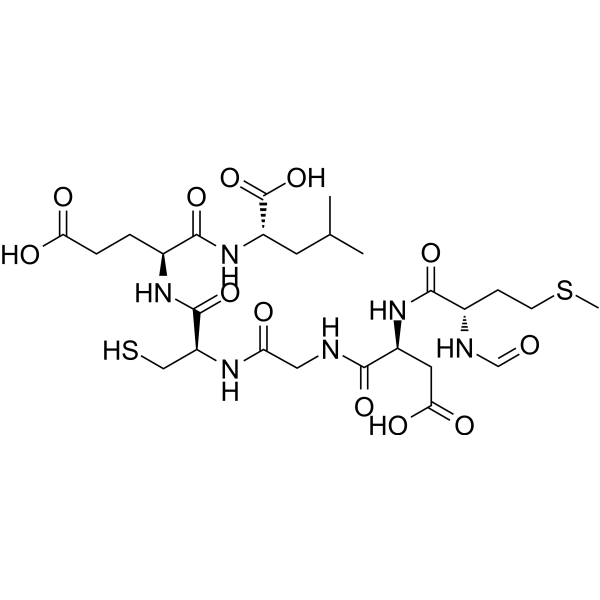
Foxy-5, a WNT5A agonist, is a mimicking peptide of WNT5A which is a non-canonical member of the Wnt family. Foxy-5 triggers cytosolic free calcium signaling without affecting β-catenin activation and it impairs the migration and invasion of epithelial cancer cells. Foxy-5 effectively reduces the metastatic spread of WNT5A-low prostate cancer cells in an orthotopic mouse model .
|
-
-
- HY-P0102
-
|
|
nAChR
|
Neurological Disease
Metabolic Disease
|
|
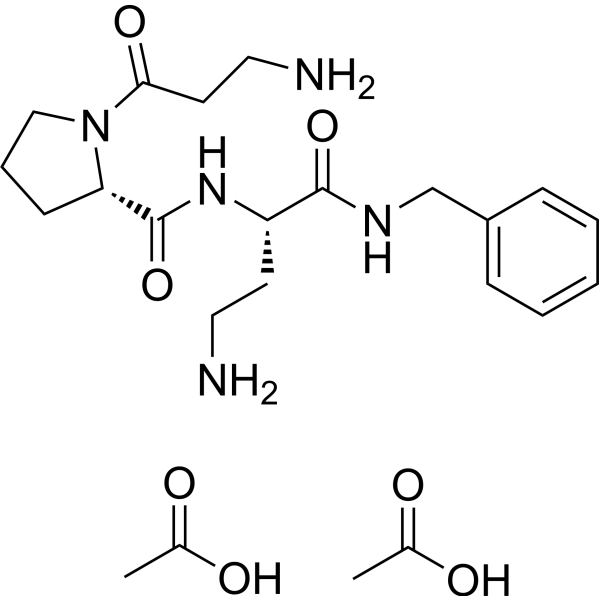
Dipeptide diaminobutyroyl benzylamide diacetate, a Wagerlin-1-mimicking peptide, is a nAChR antagonist. Dipeptide diaminobutyroyl benzylamide diacetate mimics Waglerin-1 to block neuromuscular junction nicotinic acetylcholine receptors, partially inhibits neuronal signal transduction, and relaxes muscles. Dipeptide diaminobutyroyl benzylamide diacetate reduces appearance of facial wrinkles linked to repeated muscle movement.Dipeptide diaminobutyroyl benzylamide diacetate can be used for the research of mild-to-moderate fine and coarse periocular and perioral wrinkles and periorbital ageing .
|
-
-
- HY-P5558
-
|
|
VEGFR
|
Neurological Disease
|
|
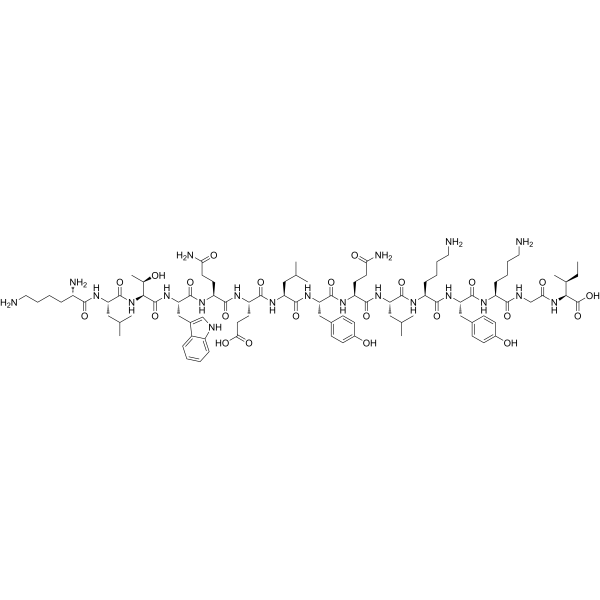
KLTWQELYQLKYKGI is a VEGF mimetic peptide designed based on the VEGF helix sequence 17-25, with the ability to activate VEGF receptors and exert pro-angiogenic biological activity. KLTWQELYQLKYKGI effectively promotes the attachment, spreading and proliferation of human umbilical vein endothelial cells. KLTWQELYQLKYKGI enhances the proliferation, migration and osteogenic differentiation of bone marrow stromal cells (BMSCs). KLTWQELYQLKYKGI synergistically accelerates angiogenesis and bone regeneration in rat cranial defect models. KLTWQELYQLKYKGI can be used for the research of brain tissue engineering and traumatic brain injury repair and biomaterials for bone tissue engineering and bone repair .
|
-
-
- HY-P10026
-
|
LY-3457263
|
Neuropeptide Y Receptor
|
Metabolic Disease
|
|
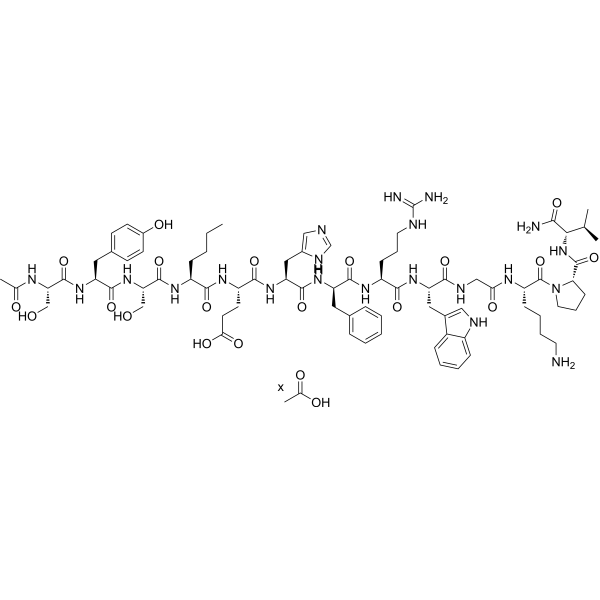
Nisotirotide (LY-3457263) is a subcutaneous injectable NPY2 receptor agonist. By mimicking peptide YY (PYY), Nisotirotide inhibits appetite and can be used in the research of diseases such as obesity and diabetes .
|
-
-
- HY-P1416A
-
Foxy-5 TFA
Maximum Cited Publications
7 Publications Verification
|
Wnt
|
Cancer
|
|
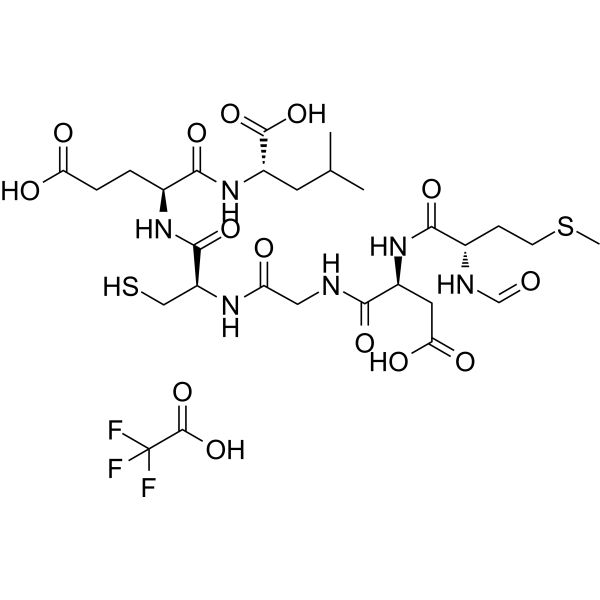
Foxy-5 TFA, a WNT5A agonist, is a mimicking peptide of WNT5A which is a non-canonical member of the Wnt family. Foxy-5 TFA triggers cytosolic free calcium signaling without affecting β-catenin activation and it impairs the migration and invasion of epithelial cancer cells. Foxy-5 TFA effectively reduces the metastatic spread of WNT5A-low prostate cancer cells in an orthotopic mouse model .
|
-
-
- HY-W250145
-
|
Nigrosine
|
Biochemical Assay Reagents
|
Others
|
|
Acid Black 2 (Nigrosine) is an alcohol-soluble absorber used to mimic skin pigmentation in tissue-mimicking phantoms. Acid Black 2 acts as an absorber in silicone-based thin tissue phantoms to simulate varying melanosome volume fractions in skin .
|
-
-
- HY-158482
-
|
Mannose-3 N-linked oligosaccharide; Oligomannose 3 glycan
|
Biochemical Assay Reagents
|
Others
|
|
M3 glycan (Man3) (Mannose-3 N-linked oligosaccharide; Oligomannose 3 glycan) is a N-polysaccharide protein and a multifunctional fluorescent linker. The resulting conjugates exhibit high sensitivity and specificity by mimicking the antennal elements of N-glycans .
|
-
-
- HY-W142596
-
|
|
Liposome
|
Others
|
|
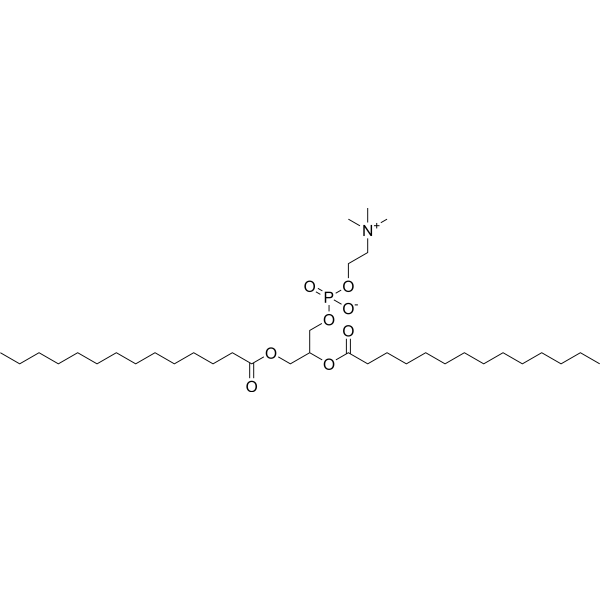
1,2-DImyristoyl-rac-glycero-3-phosphocholine (DMPC), a zwitterionic phospholipid, is chosen as a simple eukaryotic cell membrane, mimicking the neutral charge of the surface membrane of eukaryotic plasma membranes .
|
-
-
- HY-162467
-
|
|
Proton Pump
|
Others
|
|
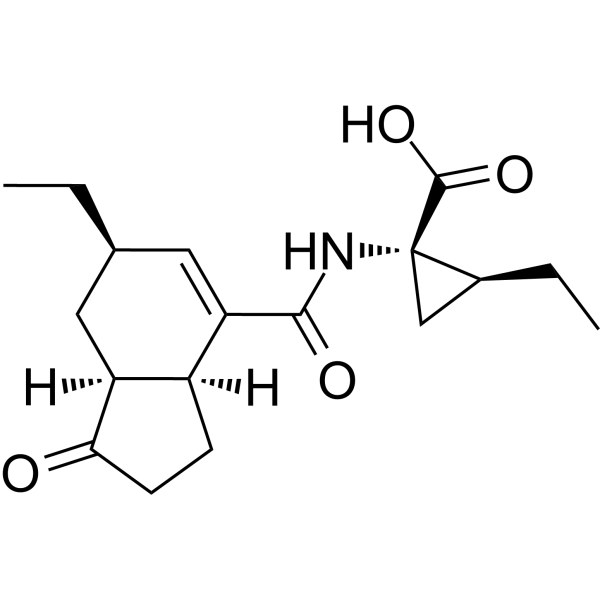
Opabactin is an agonist for abscisic acid (ABA) receptor, which regulates the water use of plants by mimicking the effects of ABA with an IC50 of 7 nM. Opabactin inhibits the seed germination of Arabidopsis with an IC50 of 62 nM. Opabactin induces anti-transpiration response in plant tissue, and improves crop drought tolerance .
|
-
-
- HY-D2361
-
|
|
Nucleoside Antimetabolite/Analog
|
Others
|
|
Adenosine 2'-PEG-Biotin is a biochemical reagent derived from adenosine. Adenosine 2'-PEG-Biotin regulates cell signaling pathways by mimicking the effects of endogenous adenosine and binding to its receptors. Adenosine 2'-PEG-Biotin can be used in the research of bioprobes, biosensors and diagnostic reagents .
|
-
-
- HY-P11430
-
|
|
Biochemical Assay Reagents
|
Infection
|
|
UBI (31-38) is a Ubiquicidin-derived octapeptide and anti-bacterial agent. UBI (31-38) selectively interacts with anionic phospholipid membranes and restricts lipid lateral motion. UBI (31-38) induces anionic vesicle aggregation via electrostatic repulsion screening, and undergoes conformational changes in membrane-mimicking environments. UBI (31-38) can be used for the research of infection imaging probes .
|
-
-
- HY-125382
-
|
|
Somatostatin Receptor
|
Metabolic Disease
|
|
L-797591 is a selective sst1 agonist. L-797591 mimicks the effects of SRIF-14 and SRIF-28 by potently inhibiting either Forskolin (HY-15371)-stimulated or CRH-stimulated cAMP accumulation .
|
-
-
- HY-P10428
-
|
|
HPV
|
Infection
|
|
E6AP-mimicking peptide (compound 13) is a high-affinity, selective, irreversible and potent peptide-based covalent HPV16 E6 inhibitor targeting the 16E6 oncoprotein using a cysteine-reactive acrylamide warhead. E6AP-mimicking peptide has a Ki of 17 nM. E6AP-mimicking peptide targets all residues appearing in the binding pocket of E6 to disrupt the binding interface of 16E6 and E6AP. E6AP-mimicking peptide selectively binds and crosslinks to MBP-16E6 in PBS or a protein mixture .
|
-
-
- HY-P5171
-
|
|
Wnt
|
Cancer
|
|
MDGCEL is a WNT5A peptide, that acts as a WNT5A mimicks and exhibits WNT5A antagonistic activity .
|
-
-
- HY-125382A
-
|
|
Somatostatin Receptor
|
Neurological Disease
|
|
L-797591 hydrochloride is a selective sst1 agonist. L-797591 hydrochloride mimicks the effects of SRIF-14 and SRIF-28 by potently inhibiting either Forskolin (HY-15371)-stimulated or CRH-stimulated cAMP accumulation .
|
-
-
- HY-158485
-
|
Mannose-5 N-linked oligosaccharide; Oligomannose 5 glycan
|
Biochemical Assay Reagents
|
Others
|
|
M5 glycan (Man5) (Mannose-5 N-linked oligosaccharide; Oligomannose 5 glycan) is a N-polysaccharide protein and a multifunctional fluorescent linker. The resulting conjugates exhibit high sensitivity and specificity by mimicking the antennal elements of N-glycans .
|
-
-
- HY-158543
-
|
Mannose-9 N-linked oligosaccharide; Oligomannose 9 glycan
|
Biochemical Assay Reagents
|
Others
|
|
M9 glycan (Man9) (Mannose-9 N-linked oligosaccharide; Oligomannose 9 glycan) is a N-polysaccharide protein and a multifunctional fluorescent linker. The resulting conjugates exhibit high sensitivity and specificity by mimicking the antennal elements of N-glycans .
|
-
-
- HY-158452
-
|
A3G3 N-linked oligosaccharide; A3G(4)3 glycan
|
Biochemical Assay Reagents
|
Others
|
|
A3G3 glycan (G3) (A3G3 N-linked oligosaccharide; A3G(4)3 glycan) is a N-polysaccharide protein and a multifunctional fluorescent linker. The resulting conjugates exhibit high sensitivity and specificity by mimicking the antennal elements of N-glycans .
|
-
-
- HY-158442
-
|
A2G2 N-linked oligosaccharide; A2G(4)2 glycan
|
Biochemical Assay Reagents
|
Others
|
|
A2G2 glycan (G2) (A2G2 N-linked oligosaccharide; A2G(4)2 glycan) is a N-polysaccharide protein and a multifunctional fluorescent linker. The resulting conjugates exhibit high sensitivity and specificity by mimicking the antennal elements of N-glycans .
|
-
-
- HY-158448
-
|
FA2G2 N-linked oligosaccharide; F(6)A2G2
|
Biochemical Assay Reagents
|
Others
|
|
FA2G2 glycan (G2F) (FA2G2 N-linked oligosaccharide; F(6)A2G2) is a N-polysaccharide protein and a multifunctional fluorescent linker. The resulting conjugates exhibit high sensitivity and specificity by mimicking the antennal elements of N-glycans .
|
-
-
- HY-P11204
-
|
|
Peptide-Drug Conjugates (PDCs)
|
Others
|
|
DDDEEKC is a bioinspired peptide sequence that can selectively adsorb onto the enamel surface (mimicking the role of salivary acquired pellicle protein statherin), acting as a "target - guiding agent" for tooth enamel remineralization. DDDEEKC enhances the regeneration of hydroxyapatite (HAP). DDDEEKC is promising for research of in-situ remineralization repair of enamel demineralization damage (such as dental caries) .
|
-
-
- HY-134263
-
|
|
PKA
Ras
|
Cardiovascular Disease
|
|
8-Br-cAMP-AM is a cyclic adenosine monophosphate (cAMP) analog that activates two major signal transduction pathways in the heart by mimicking the effects of cAMP: protein kinase A (PKA) and guanosine nucleotide exchange factor (Epac), which is directly activated by cAMP. 8-Br-cAMP-AM can be used to study cardiac ischemia and reperfusion injury .
|
-
-
- HY-P10356
-
|
|
TRP Channel
|
Others
|
|
T100-Mut is a cell-permeable peptide whose N-terminus is conjugated with a myristoylated group to enable T100-Mut to penetrate and localize to the inner side of the plasma membrane, thus mimicking the topology of Tmem100-3Q. T100-Mut can alleviate TRPA1-mediated pain .
|
-
-
- HY-167815
-
|
|
Biochemical Assay Reagents
|
|
|
Myo-Inositol hexasulfate hexapotassium is a sulfated derivative of inositol that has the activity of mimicking highly sulfated polysaccharides such as heparin, affecting many cell signaling pathways.
|
-
-
- HY-158464
-
|
|
Biochemical Assay Reagents
|
Others
|
|
Fetuin glycoprotein is a N-polysaccharide protein and a multifunctional fluorescent linker. The resulting conjugates exhibit high sensitivity and specificity by mimicking the antennal elements of N-glycans .
|
-
-
- HY-158466
-
|
|
Biochemical Assay Reagents
|
Others
|
|
Human IgG Glycoprotein is a N-polysaccharide protein and a multifunctional fluorescent linker. The resulting conjugates exhibit high sensitivity and specificity by mimicking the antennal elements of N-glycans .
|
-
-
- HY-158532
-
|
A4 N-linked oligosaccharide
|
Biochemical Assay Reagents
|
Others
|
|
A4 glycan (A4 N-linked oligosaccharide) is a N-polysaccharide protein and a multifunctional fluorescent linker. The resulting conjugates exhibit high sensitivity and specificity by mimicking the antennal elements of N-glycans .
|
-
-
- HY-158528
-
|
A3 N-linked oligosaccharide
|
Biochemical Assay Reagents
|
Others
|
|
A3 glycan (A3 N-linked oligosaccharide) is a N-polysaccharide protein and a multifunctional fluorescent linker. The resulting conjugates exhibit high sensitivity and specificity by mimicking the antennal elements of N-glycans .
|
-
-
- HY-158460
-
|
Galactose-alpha-1,3-galactose
|
Biochemical Assay Reagents
|
Others
|
|
Alpha-Gal (Galactose-alpha-1,3-galactose) is a N-polysaccharide protein and a multifunctional fluorescent linker. The resulting conjugates exhibit high sensitivity and specificity by mimicking the antennal elements of N-glycans .
|
-
-
- HY-158490
-
|
A4G4 N-linked oligosaccharide
|
Biochemical Assay Reagents
|
Others
|
|
A4G4 glycan (A4G4 N-linked oligosaccharide) is a N-polysaccharide protein and a multifunctional fluorescent linker. The resulting conjugates exhibit high sensitivity and specificity by mimicking the antennal elements of N-glycans .
|
-
-
- HY-158531
-
|
A3 N-linked oligosaccharide, procainamide labelled
|
Fluorescent Dye
Biochemical Assay Reagents
|
Others
|
|
A3 glycan, procainamide labelled (A3 N-linked oligosaccharide, procainamide labelled) is a N-polysaccharide protein and a multifunctional fluorescent linker. The resulting conjugates exhibit high sensitivity and specificity by mimicking the antennal elements of N-glycans .
|
-
-
- HY-158472
-
|
|
Biochemical Assay Reagents
|
Others
|
|
Sialylated Core 1 O-glycan (C1S(3)1) () is a N-polysaccharide protein and a multifunctional fluorescent linker. The resulting conjugates exhibit high sensitivity and specificity by mimicking the antennal elements of N-glycans .
|
-
-
- HY-158463
-
|
|
Biochemical Assay Reagents
|
Others
|
|
A2G2S2-KVANKT glycopeptide is a N-polysaccharide protein and a multifunctional fluorescent linker. The resulting conjugates exhibit high sensitivity and specificity by mimicking the antennal elements of N-glycans .
|
-
-
- HY-158534
-
|
Mannose-8 N-linked oligosaccharide; Oligomannose 8 glycan
|
Biochemical Assay Reagents
|
Others
|
|
M8 glycan (Man8) (Mannose-8 N-linked oligosaccharide; Oligomannose 8 glycan) is a N-polysaccharide protein and a multifunctional fluorescent linker. The resulting conjugates exhibit high sensitivity and specificity by mimicking the antennal elements of N-glycans .
|
-
-
- HY-158519
-
|
Mannose-7 N-linked oligosaccharide; Oligomannose 7 glycan
|
Biochemical Assay Reagents
|
Others
|
|
M7 glycan (Man7) (Mannose-7 N-linked oligosaccharide; Oligomannose 7 glycan) is a N-polysaccharide protein and a multifunctional fluorescent linker. The resulting conjugates exhibit high sensitivity and specificity by mimicking the antennal elements of N-glycans .
|
-
-
- HY-158509
-
|
Mannose-6 N-linked oligosaccharide; Oligomannose 6 glycan
|
Biochemical Assay Reagents
|
Others
|
|
M6 glycan (Man6) (Mannose-6 N-linked oligosaccharide; Oligomannose 6 glycan) is a N-polysaccharide protein and a multifunctional fluorescent linker. The resulting conjugates exhibit high sensitivity and specificity by mimicking the antennal elements of N-glycans .
|
-
-
- HY-119274
-
|
|
COX
Sodium Channel
|
Neurological Disease
|
|
BN-82451 dihydrochloride, an orally active and CNS-penetrated antioxidant and a multitargeting neuroprotective agent, exert a significant protection in experimental animal models mimicking aspects of cerebral ischemia, Parkinson disease, Huntington disease, and more particularly amyotrophic lateral sclerosis .
|
-
-
- HY-158541
-
|
A4 N-linked oligosaccharide, 2-AB labelled
|
Fluorescent Dye
Biochemical Assay Reagents
|
Others
|
|
A4 glycan, 2-AB labelled (A4 N-linked oligosaccharide, 2-AB labelled) is a N-polysaccharide protein and a multifunctional fluorescent linker. The resulting conjugates exhibit high sensitivity and specificity by mimicking the antennal elements of N-glycans .
|
-
-
- HY-158540
-
|
A4 N-linked oligosaccharide, 2-AA labelled
|
Biochemical Assay Reagents
|
Others
|
|
A4 glycan, 2-AA labelled (A4 N-linked oligosaccharide, 2-AA labelled) is a N-polysaccharide protein and a multifunctional fluorescent linker. The resulting conjugates exhibit high sensitivity and specificity by mimicking the antennal elements of N-glycans .
|
-
-
- HY-158468
-
|
|
Biochemical Assay Reagents
|
Others
|
|
Sialylated Core 1 O-glycan (C1S(3)1), 2AB labelled () is a N-polysaccharide protein and a multifunctional fluorescent linker. The resulting conjugates exhibit high sensitivity and specificity by mimicking the antennal elements of N-glycans .
|
-
-
- HY-158496
-
|
A2 N-linked oligosaccharide, 2-AB labelled
|
Biochemical Assay Reagents
|
Others
|
|
A2 glycan (G0), 2-AB labelled (A2 N-linked oligosaccharide, 2-AB labelled) is a N-polysaccharide protein and a multifunctional fluorescent linker. The resulting conjugates exhibit high sensitivity and specificity by mimicking the antennal elements of N-glycans .
|
-
-
- HY-158446
-
|
A2G2 N-linked oligosaccharide, APTS labelled
|
Biochemical Assay Reagents
|
Others
|
|
A2G2 glycan (G2), APTS labelled (A2G2 N-linked oligosaccharide, APTS labelled) is a N-polysaccharide protein and a multifunctional fluorescent linker. The resulting conjugates exhibit high sensitivity and specificity by mimicking the antennal elements of N-glycans .
|
-
-
- HY-158461
-
|
Galactose-alpha-1,3-galactose, 2-AA labelled
|
Biochemical Assay Reagents
|
Others
|
|
Alpha-Gal standard, 2-AA labelled (Galactose-alpha-1,3-galactose, 2-AA labelled) is a N-polysaccharide protein and a multifunctional fluorescent linker. The resulting conjugates exhibit high sensitivity and specificity by mimicking the antennal elements of N-glycans .
|
-
-
- HY-158462
-
|
Galactose-alpha-1,3-galactose, 2-AB labelled
|
Biochemical Assay Reagents
|
Others
|
|
Alpha-Gal standard, 2-AB labelled (Galactose-alpha-1,3-galactose, 2-AB labelled) is a N-polysaccharide protein and a multifunctional fluorescent linker. The resulting conjugates exhibit high sensitivity and specificity by mimicking the antennal elements of N-glycans .
|
-
-
- HY-158492
-
|
A4G4 N-linked oligosaccharide, 2-AB labelled
|
Biochemical Assay Reagents
|
Others
|
|
A4G4 glycan, 2-AB labelled (A4G4 N-linked oligosaccharide, 2-AB labelled) is a N-polysaccharide protein and a multifunctional fluorescent linker. The resulting conjugates exhibit high sensitivity and specificity by mimicking the antennal elements of N-glycans .
|
-
-
- HY-158537
-
|
A3G3S3 N-linked oligosaccharide, procainamide labelled
|
Biochemical Assay Reagents
|
Others
|
|
A3G3S3 glycan, procainamide labelled (A3G3S3 N-linked oligosaccharide, procainamide labelled) is a N-polysaccharide protein and a multifunctional fluorescent linker. The resulting conjugates exhibit high sensitivity and specificity by mimicking the antennal elements of N-glycans .
|
-
-
- HY-158507
-
|
Mannose-5 N-linked oligosaccharide, procainamide labelled; Oligomannose 5 glycan, procainamide labelled
|
Biochemical Assay Reagents
|
Others
|
|
M5 glycan (Man5), procainamide labelled (Mannose-5 N-linked oligosaccharide, procainamide labelled; Oligomannose 5 glycan, procainamide labelled) is a N-polysaccharide protein and a multifunctional fluorescent linker. The resulting conjugates exhibit high sensitivity and specificity by mimicking the antennal elements of N-glycans .
|
-
- HY-158465
-
|
F(3)A2 glycan-KVANKT & F(6)A2 glycan-KVANKT
|
Biochemical Assay Reagents
|
Others
|
|
GPEP FA2-KVANKT glycopeptide (F(3)A2 glycan-KVANKT & F(6)A2 glycan-KVANKT) is a N-polysaccharide protein and a multifunctional fluorescent linker. The resulting conjugates exhibit high sensitivity and specificity by mimicking the antennal elements of N-glycans .
|
-
- HY-158488
-
|
A3G3 N-linked oligosaccharide, 2-AB labelled
|
Biochemical Assay Reagents
|
Others
|
|
A3G3 glycan (G3), 2-AB labelled (A3G3 N-linked oligosaccharide, 2-AB labelled) is a N-polysaccharide protein and a multifunctional fluorescent linker. The resulting conjugates exhibit high sensitivity and specificity by mimicking the antennal elements of N-glycans .
|
-
- HY-158445
-
|
A2G2 N-linked oligosaccharide, 2-AB labelled
|
Biochemical Assay Reagents
|
Others
|
|
A2G2 glycan (G2), 2-AB labelled (A2G2 N-linked oligosaccharide, 2-AB labelled) is a N-polysaccharide protein and a multifunctional fluorescent linker. The resulting conjugates exhibit high sensitivity and specificity by mimicking the antennal elements of N-glycans .
|
-
- HY-P5371
-
|
|
Thrombin
|
Others
|
|
TFLLRNPNDK-NH2 is a biological active peptide. (This peptide is a thrombin receptor activating peptide. This PAR-1 agonist peptide reversibly binds to PAR-1 mimicking the 'tethered ligand' that thrombin makes available through proteolytic cleavage of substrate. It is also known to cause increase in liquid and protein permeability much like thrombin.)
|
-
- HY-158514
-
|
Mannose-6 N-linked oligosaccharide, 2-AB labelled; Oligomannose 6 glycan, 2-AB labelled
|
Biochemical Assay Reagents
|
Others
|
|
M6 glycan (Man6), 2-AB labelled (Mannose-6 N-linked oligosaccharide, 2-AB labelled; Oligomannose 6 glycan, 2-AB labelled) is a N-polysaccharide protein and a multifunctional fluorescent linker. The resulting conjugates exhibit high sensitivity and specificity by mimicking the antennal elements of N-glycans .
|
-
- HY-158503
-
|
Mannose-5 N-linked oligosaccharide, 2-AB labelled; Oligomannose 5 glycan, 2-AB labelled
|
Biochemical Assay Reagents
|
Others
|
|
M5 glycan (Man5), 2-AB labelled (Mannose-5 N-linked oligosaccharide, 2-AB labelled; Oligomannose 5 glycan, 2-AB labelled) is a N-polysaccharide protein and a multifunctional fluorescent linker. The resulting conjugates exhibit high sensitivity and specificity by mimicking the antennal elements of N-glycans .
|
-
- HY-158536
-
|
Mannose-8 N-linked oligosaccharide, 2-AA labelled; Oligomannose 8 glycan, 2-AA labelled
|
Biochemical Assay Reagents
|
Others
|
|
M8 glycan (Man8), 2-AA labelled (Mannose-8 N-linked oligosaccharide, 2-AA labelled; Oligomannose 8 glycan, 2-AA labelled) is a N-polysaccharide protein and a multifunctional fluorescent linker. The resulting conjugates exhibit high sensitivity and specificity by mimicking the antennal elements of N-glycans .
|
-
- HY-126039
-
|
|
Integrin
|
Cardiovascular Disease
|
|
L-739758 is an antagonist for αIIbβ3 integrin (platelet glycoprotein IIb/IIIa). L-739758 acts as a peptidomimetic, binds to αIIbβ3 integrin by mimicking the interaction of the RGD (arginine-glycine-aspartic acid) motif, and is involved in the blood coagulation process. L-739758 inhibits platelet aggregation, and is used for thrombosis research .
|
-
- HY-158502
-
|
FA2G2S1 N-linked oligosaccharide, 2-AB labelled
|
Biochemical Assay Reagents
|
Others
|
|
FA2G2S1 glycan (G2FS1), 2-AB labelled (FA2G2S1 N-linked oligosaccharide, 2-AB labelled) is a N-polysaccharide protein and a multifunctional fluorescent linker. The resulting conjugates exhibit high sensitivity and specificity by mimicking the antennal elements of N-glycans .
|
-
- HY-158486
-
|
FA2G2S1 N-linked oligosaccharide, 2-AA labelled
|
Biochemical Assay Reagents
|
Others
|
|
FA2G2S1 glycan (G2FS1), 2-AA labelled (FA2G2S1 N-linked oligosaccharide, 2-AA labelled) is a N-polysaccharide protein and a multifunctional fluorescent linker. The resulting conjugates exhibit high sensitivity and specificity by mimicking the antennal elements of N-glycans .
|
-
- HY-158443
-
|
A2G2S1 N-linked oligosaccharide, 2-AB labelled
|
Biochemical Assay Reagents
|
Others
|
|
A2G2S1 glycan (G2S1), 2-AB labelled (A2G2S1 N-linked oligosaccharide, 2-AB labelled) is a N-polysaccharide protein and a multifunctional fluorescent linker. The resulting conjugates exhibit high sensitivity and specificity by mimicking the antennal elements of N-glycans .
|
-
- HY-158489
-
|
A3G3 N-linked oligosaccharide, procainamide labelled; A3G(4)3 glycan, procainamide labelled
|
Biochemical Assay Reagents
|
Others
|
|
A3G3 glycan (G3), procainamide labelled (A3G3 N-linked oligosaccharide, procainamide labelled; A3G(4)3 glycan, procainamide labelled) is a N-polysaccharide protein and a multifunctional fluorescent linker. The resulting conjugates exhibit high sensitivity and specificity by mimicking the antennal elements of N-glycans .
|
-
- HY-158499
-
|
FA2 N-linked oligosaccharide, 2-AA labelled; F(6)A2 glycan, 2-AA labelled
|
Biochemical Assay Reagents
|
Others
|
|
FA2 glycan (G0F), 2-AA labelled (FA2 N-linked oligosaccharide, 2-AA labelled; F(6)A2 glycan, 2-AA labelled) is a N-polysaccharide protein and a multifunctional fluorescent linker. The resulting conjugates exhibit high sensitivity and specificity by mimicking the antennal elements of N-glycans .
|
-
- HY-158500
-
|
FA2 N-linked oligosaccharide, 2-AB labelled; F(6)A2 glycan, 2-AB labelled
|
Biochemical Assay Reagents
|
Others
|
|
FA2 glycan (G0F), 2-AB labelled (FA2 N-linked oligosaccharide, 2-AB labelled; F(6)A2 glycan, 2-AB labelled) is a N-polysaccharide protein and a multifunctional fluorescent linker. The resulting conjugates exhibit high sensitivity and specificity by mimicking the antennal elements of N-glycans .
|
-
- HY-W714973
-
|
|
Herbicide
|
Others
|
|
Halauxifen-methyl is a 6-arylpicolinic acid herbicide. As a synthetic auxin, Halauxifen-methyl interferes with the normal growth and development of sensitive weeds by mimicking the action of endogenous plant auxins, causing malformation, uncontrolled growth and eventual death .
|
-
- HY-158542
-
|
A4 N-linked oligosaccharide, procainamide labelled
|
Biochemical Assay Reagents
|
Others
|
|
A4 glycan, procainamide labelled (A4 N-linked oligosaccharide, procainamide labelled) is a N-polysaccharide protein and a multifunctional fluorescent linker. The resulting conjugates exhibit high sensitivity and specificity by mimicking the antennal elements of N-glycans .
|
-
- HY-158493
-
|
A2 N-linked oligosaccharide, procainamide labelled
|
Biochemical Assay Reagents
|
Others
|
|
A2 glycan (G0), procainamide labelled (A2 N-linked oligosaccharide, procainamide labelled) is a N-polysaccharide protein and a multifunctional fluorescent linker. The resulting conjugates exhibit high sensitivity and specificity by mimicking the antennal elements of N-glycans .
|
-
- HY-158497
-
|
A2 N-linked oligosaccharide, APTS labelled
|
Biochemical Assay Reagents
|
Others
|
|
A2 glycan (G0), APTS labelled (A2 N-linked oligosaccharide, APTS labelled) is a N-polysaccharide protein and a multifunctional fluorescent linker. The resulting conjugates exhibit high sensitivity and specificity by mimicking the antennal elements of N-glycans .
|
-
- HY-180538
-
|
|
Molecular Glues
E1/E2/E3 Enzyme
|
Others
|
|
MRT-31619 is a molecular gel degrader (MGD) targeting CRBN. MRT-31619 drives the self-dimerization of the E3 ligase by mimicking the degradation subunit, and promotes its rapid, effective and selective degradation through the ubiquitin-proteasome system .
|
-
- HY-158516
-
|
Mannose-6 N-linked oligosaccharide, procainamide labelled; Oligomannose 6 glycan, procainamide labelled
|
Biochemical Assay Reagents
|
Others
|
|
M6 glycan (Man6), procainamide labelled (Mannose-6 N-linked oligosaccharide, procainamide labelled) is a N-polysaccharide protein and a multifunctional fluorescent linker. The resulting conjugates exhibit high sensitivity and specificity by mimicking the antennal elements of N-glycans .
|
-
- HY-158529
-
|
A3 N-linked oligosaccharide, 2-AA labelled
|
Biochemical Assay Reagents
|
Others
|
|
A3 glycan, 2-AA labelled (A3 N-linked oligosaccharide, 2-AA labelled) is a N-polysaccharide protein and a multifunctional fluorescent linker. The resulting conjugates exhibit high sensitivity and specificity by mimicking the antennal elements of N-glycans .
|
-
- HY-158530
-
|
A3 N-linked oligosaccharide, 2-AB labelled
|
Biochemical Assay Reagents
|
Others
|
|
A3 glycan, 2-AB labelled (A3 N-linked oligosaccharide, 2-AB labelled) is a N-polysaccharide protein and a multifunctional fluorescent linker. The resulting conjugates exhibit high sensitivity and specificity by mimicking the antennal elements of N-glycans .
|
-
- HY-76737
-
|
4-CDE
|
Estrogen Receptor/ERR
|
Endocrinology
|
|
4-Chlorodiphenyl ether (4-CDE) is an estrogen-mimicking active compound. 4-Chlorodiphenyl ether maintains the survival of endometriotic cysts and exhibits estrogenic activity associated with the growth of endometriotic implants. 4-Chlorodiphenyl ether can be used in research related to endometriosis .
|
-
- HY-158539
-
|
Mannose-8 N-linked oligosaccharide, procainamide labelled; Oligomannose 8 glycan, procainamide labelled
|
Biochemical Assay Reagents
|
Others
|
|
M8 glycan (Man8), procainamide labelled (Mannose-8 N-linked oligosaccharide, procainamide labelled; Oligomannose 8 glycan, procainamide labelled) is a N-polysaccharide protein and a multifunctional fluorescent linker. The resulting conjugates exhibit high sensitivity and specificity by mimicking the antennal elements of N-glycans .
|
-
- HY-158546
-
|
Mannose-9 N-linked oligosaccharide, procainamide labelled; Oligomannose 9 glycan, procainamide labelled
|
Biochemical Assay Reagents
|
Others
|
|
M9 glycan (Man9), procainamide labelled (Mannose-9 N-linked oligosaccharide, procainamide labelled; Oligomannose 9 glycan, procainamide labelled) is a N-polysaccharide protein and a multifunctional fluorescent linker. The resulting conjugates exhibit high sensitivity and specificity by mimicking the antennal elements of N-glycans .
|
-
- HY-158505
-
|
Mannose-5 N-linked oligosaccharide, APTS labelled; Oligomannose 5 glycan, APTS labelled
|
Biochemical Assay Reagents
|
Others
|
|
M5 glycan (Man5), APTS labelled (Mannose-5 N-linked oligosaccharide, APTS labelled; Oligomannose 5 glycan, APTS labelled) is a N-polysaccharide protein and a multifunctional fluorescent linker. The resulting conjugates exhibit high sensitivity and specificity by mimicking the antennal elements of N-glycans .
|
-
- HY-158526
-
|
Mannose-7 N-linked oligosaccharide, procainamide labelled; Oligomannose 7 glycan, procainamide labelled
|
Biochemical Assay Reagents
|
Others
|
|
M7 glycan (Man7), procainamide labelled (Mannose-7 N-linked oligosaccharide, procainamide labelled; Oligomannose 7 glycan, procainamide labelled) is a N-polysaccharide protein and a multifunctional fluorescent linker. The resulting conjugates exhibit high sensitivity and specificity by mimicking the antennal elements of N-glycans .
|
-
- HY-158491
-
|
A4G4 N-linked oligosaccharide, 2-AA labelled
|
Biochemical Assay Reagents
|
Others
|
|
A4G4 glycan, 2-AA labelled (A4G4 N-linked oligosaccharide, 2-AA labelled) is a N-polysaccharide protein and a multifunctional fluorescent linker. The resulting conjugates exhibit high sensitivity and specificity by mimicking the antennal elements of N-glycans .
|
-
- HY-158487
-
|
A3G3 N-linked oligosaccharide, 2-AA labelled
|
Biochemical Assay Reagents
|
Others
|
|
A3G3 glycan (G3), 2-AA labelled (A3G3 N-linked oligosaccharide, 2-AA labelled) is a N-polysaccharide protein and a multifunctional fluorescent linker. The resulting conjugates exhibit high sensitivity and specificity by mimicking the antennal elements of N-glycans .
|
-
- HY-158474
-
|
A2G2S1 N-linked oligosaccharide, APTS labelled
|
Biochemical Assay Reagents
|
Others
|
|
A2G2S1 glycan (G2S1), APTS labelled (A2G2S1 N-linked oligosaccharide, APTS labelled) is a N-polysaccharide protein and a multifunctional fluorescent linker. The resulting conjugates exhibit high sensitivity and specificity by mimicking the antennal elements of N-glycans .
|
-
- HY-158504
-
|
FA2G2S1 N-linked oligosaccharide, APTS labelled
|
Biochemical Assay Reagents
|
Others
|
|
FA2G2S1 glycan (G2FS1), APTS labelled (FA2G2S1 N-linked oligosaccharide, APTS labelled) is a N-polysaccharide protein and a multifunctional fluorescent linker. The resulting conjugates exhibit high sensitivity and specificity by mimicking the antennal elements of N-glycans .
|
-
- HY-158533
-
|
A3G3S3 N-linked oligosaccharide, 2-AA labelled
|
Biochemical Assay Reagents
|
Others
|
|
A3G3S3 glycan, 2-AA labelled (A3G3S3 N-linked oligosaccharide, 2-AA labelled) is a N-polysaccharide protein and a multifunctional fluorescent linker. The resulting conjugates exhibit high sensitivity and specificity by mimicking the antennal elements of N-glycans .
|
-
- HY-158527
-
|
FA2 N-linked oligosaccharide, APTS labelled; F(6)A2 glycan, APTS labelled
|
Biochemical Assay Reagents
|
Others
|
|
FA2 glycan (G0F), APTS labelled (FA2 N-linked oligosaccharide, APTS labelled; F(6)A2 glycan, APTS labelled) is a N-polysaccharide protein and a multifunctional fluorescent linker. The resulting conjugates exhibit high sensitivity and specificity by mimicking the antennal elements of N-glycans .
|
-
- HY-158535
-
|
A3G3S3 N-linked oligosaccharide, 2-AB labelled
|
Biochemical Assay Reagents
|
Others
|
|
A3G3S3 glycan, 2-AB labelled (A3G3S3 N-linked oligosaccharide, 2-AB labelled) is a N-polysaccharide protein and a multifunctional fluorescent linker. The resulting conjugates exhibit high sensitivity and specificity by mimicking the antennal elements of N-glycans .
|
-
- HY-158483
-
|
Mannose-3 N-linked oligosaccharide, 2-AA labelled; Oligomannose 3 glycan, 2-AA labelled
|
Biochemical Assay Reagents
|
Others
|
|
M3 glycan (Man3), 2-AA labelled (Mannose-3 N-linked oligosaccharide, 2-AA labelled; Oligomannose 3 glycan, 2-AA labelled) is a N-polysaccharide protein and a multifunctional fluorescent linker. The resulting conjugates exhibit high sensitivity and specificity by mimicking the antennal elements of N-glycans .
|
-
- HY-158511
-
|
Mannose-6 N-linked oligosaccharide, 2-AA labelled; Oligomannose 6 glycan, 2-AA labelled
|
Biochemical Assay Reagents
|
Others
|
|
M6 glycan (Man6), 2-AA labelled (Mannose-6 N-linked oligosaccharide, 2-AA labelled; Oligomannose 6 glycan, 2-AA labelled) is a N-polysaccharide protein and a multifunctional fluorescent linker. The resulting conjugates exhibit high sensitivity and specificity by mimicking the antennal elements of N-glycans .
|
-
- HY-158521
-
|
Mannose-7 N-linked oligosaccharide, 2-AA labelled; Oligomannose 7 glycan, 2-AA labelled
|
Biochemical Assay Reagents
|
Others
|
|
M7 glycan (Man7), 2-AA labelled (Mannose-7 N-linked oligosaccharide, 2-AA labelled; Oligomannose 7 glycan, 2-AA labelled) is a N-polysaccharide protein and a multifunctional fluorescent linker. The resulting conjugates exhibit high sensitivity and specificity by mimicking the antennal elements of N-glycans .
|
-
- HY-158524
-
|
Mannose-7 N-linked oligosaccharide, 2-AB labelled; Oligomannose 7 glycan, 2-AB labelled
|
Biochemical Assay Reagents
|
Others
|
|
M7 glycan (Man7), 2-AB labelled (Mannose-7 N-linked oligosaccharide, 2-AB labelled; Oligomannose 7 glycan, 2-AB labelled) is a N-polysaccharide protein and a multifunctional fluorescent linker. The resulting conjugates exhibit high sensitivity and specificity by mimicking the antennal elements of N-glycans .
|
-
- HY-158545
-
|
Mannose-9 N-linked oligosaccharide, 2-AB labelled; Oligomannose 9 glycan, 2-AB labelled
|
Biochemical Assay Reagents
|
Others
|
|
M9 glycan (Man9), 2-AB labelled (Mannose-9 N-linked oligosaccharide, 2-AB labelled; Oligomannose 9 glycan, 2-AB labelled) is a N-polysaccharide protein and a multifunctional fluorescent linker. The resulting conjugates exhibit high sensitivity and specificity by mimicking the antennal elements of N-glycans .
|
-
- HY-158544
-
|
Mannose-9 N-linked oligosaccharide, 2-AA labelled; Oligomannose 9 glycan, 2-AA labelled
|
Biochemical Assay Reagents
|
Others
|
|
M9 glycan (Man9), 2-AA labelled (Mannose-9 N-linked oligosaccharide, 2-AA labelled; Oligomannose 9 glycan, 2-AA labelled) is a N-polysaccharide protein and a multifunctional fluorescent linker. The resulting conjugates exhibit high sensitivity and specificity by mimicking the antennal elements of N-glycans .
|
-
- HY-158484
-
|
Mannose-3 N-linked oligosaccharide, 2-AB labelled; Oligomannose 3 glycan, 2-AB labelled
|
Biochemical Assay Reagents
|
Others
|
|
M3 glycan (Man3), 2-AB labelled (Mannose-3 N-linked oligosaccharide, 2-AB labelled; Oligomannose 3 glycan, 2-AB labelled) is a N-polysaccharide protein and a multifunctional fluorescent linker. The resulting conjugates exhibit high sensitivity and specificity by mimicking the antennal elements of N-glycans .
|
-
- HY-158501
-
|
Mannose-5 N-linked oligosaccharide, 2-AA labelled; Oligomannose 5 glycan, 2-AA labelled
|
Biochemical Assay Reagents
|
Others
|
|
M5 glycan (Man5), 2-AA labelled (Mannose-5 N-linked oligosaccharide, 2-AA labelled; Oligomannose 5 glycan, 2-AA labelled) is a N-polysaccharide protein and a multifunctional fluorescent linker. The resulting conjugates exhibit high sensitivity and specificity by mimicking the antennal elements of N-glycans .
|
-
- HY-158538
-
|
Mannose-8 N-linked oligosaccharide, 2-AB labelled; Oligomannose 8 glycan, 2-AB labelled
|
Biochemical Assay Reagents
|
Others
|
|
M8 glycan (Man8), 2-AB labelled (Mannose-8 N-linked oligosaccharide, 2-AB labelled; Oligomannose 8 glycan, 2-AB labelled) is a N-polysaccharide protein and a multifunctional fluorescent linker. The resulting conjugates exhibit high sensitivity and specificity by mimicking the antennal elements of N-glycans .
|
-
- HY-158441
-
|
A2G2S1 N-linked oligosaccharide, 2-AA labelled
|
Biochemical Assay Reagents
|
Others
|
|
A2G2S1 glycan (G2S1), 2-AA labelled (A2G2S1 N-linked oligosaccharide, 2-AA labelled) is a N-polysaccharide protein and a multifunctional fluorescent linker. The resulting conjugates exhibit high sensitivity and specificity by mimicking the antennal elements of N-glycans .
|
-
- HY-158447
-
|
A2G2 N-linked oligosaccharide, procainamide labelled; A2G(4)2 glycan, procainamide labelled
|
Biochemical Assay Reagents
|
Others
|
|
A2G2 glycan (G2), procainamide labelled (A2G2 N-linked oligosaccharide, procainamide labelled; A2G(4)2 glycan, procainamide labelled) is a N-polysaccharide protein and a multifunctional fluorescent linker. The resulting conjugates exhibit high sensitivity and specificity by mimicking the antennal elements of N-glycans .
|
-
- HY-182097A
-
|
|
Liposome
|
Inflammation/Immunology
|
|
DSPE-PEG3400-GNYTCEVTELTREGETIIELK is a PEG compound which composed of DSPE and a peptide mimicking the function of CD47 (GNYTCEVTELSREGKTVIELK). Modifying the surface of LNPs with GNYTCEVTELSREGKTVIELK significantly reduced the recognition and clearance of LNPs by the mononuclear phagocytic system (MPS), and decreased their accumulation in non-target tissues such as the liver and spleen. DSPE-PEG3400-GNYTCEVTELTREGETIIELK can be used for drug delivery .
|
-
- HY-182097
-
|
|
Liposome
|
Inflammation/Immunology
|
|
DSPE-PEG1000-GNYTCEVTELTREGETIIELK is a PEG compound which composed of DSPE and a peptide mimicking the function of CD47 (GNYTCEVTELSREGKTVIELK). Modifying the surface of LNPs with GNYTCEVTELSREGKTVIELK significantly reduced the recognition and clearance of LNPs by the mononuclear phagocytic system (MPS), and decreased their accumulation in non-target tissues such as the liver and spleen. DSPE-PEG1000-GNYTCEVTELTREGETIIELK can be used for drug delivery .
|
-
- HY-158453
-
|
FA2B N-linked oligosaccharide, 2-AA labelled; G0F with bisecting GlcNAc, 2-AA labelled
|
Biochemical Assay Reagents
|
Others
|
|
FA2B glycan (G0B), 2-AA labelled (FA2B N-linked oligosaccharide, 2-AA labelled; G0F with bisecting GlcNAc, 2-AA labelled) is a N-polysaccharide protein and a multifunctional fluorescent linker. The resulting conjugates exhibit high sensitivity and specificity by mimicking the antennal elements of N-glycans .
|
-
- HY-182097B
-
|
|
Liposome
|
Inflammation/Immunology
|
|
DSPE-PEG5000-GNYTCEVTELTREGETIIELK is a PEG compound which composed of DSPE and a peptide mimicking the function of CD47 (GNYTCEVTELSREGKTVIELK). Modifying the surface of LNPs with GNYTCEVTELSREGKTVIELK significantly reduced the recognition and clearance of LNPs by the mononuclear phagocytic system (MPS), and decreased their accumulation in non-target tissues such as the liver and spleen. DSPE-PEG5000-GNYTCEVTELTREGETIIELK can be used for drug delivery .
|
-
- HY-158451
-
|
FA2G2 N-linked oligosaccharide, APTS labelled; F(6)A2G2, APTS labelled
|
Biochemical Assay Reagents
|
Others
|
|
FA2G2 glycan (G2F), APTS labelled (FA2G2 N-linked oligosaccharide, APTS labelled; F(6)A2G2, APTS labelled) is a N-polysaccharide protein and a multifunctional fluorescent linker. The resulting conjugates exhibit high sensitivity and specificity by mimicking the antennal elements of N-glycans .
|
-
- HY-76737S
-
|
4-CDE-d5
|
Isotope-Labeled Compounds
Estrogen Receptor/ERR
|
Endocrinology
|
|
4-Chlorodiphenyl ether-d5 (4-CDE-d5) is the deuterium labeled 4-Chlorodiphenyl ether. 4-Chlorodiphenyl ether is an estrogen-mimicking active compound. 4-Chlorodiphenyl ether maintains the survival of endometriotic cysts and exhibits estrogenic activity associated with the growth of endometriotic implants. 4-Chlorodiphenyl ether can be used in research related to endometriosis.
|
-
- HY-158506
-
|
A2G2S2 N-linked oligosaccharide; A2G(4)2S(6)2 glycan
|
Biochemical Assay Reagents
|
Others
|
|
A2G2S2 glycan (G2S2) (A2G2S2 N-linked oligosaccharide; A2G(4)2S(6)2 glycan) is a N-polysaccharide protein and a multifunctional fluorescent linker. The resulting conjugates exhibit high sensitivity and specificity by mimicking the antennal elements of N-glycans .
|
-
- HY-N2466A
-
|
MT-I acetate; [Nle4,D-Phe7]-α-MSH acetate
|
Melanocortin Receptor
|
Cancer
|
|
Melanotan I acetate is a potent non-selective melanocortin receptor (MCR) agonist. Melanotan I acetate is a synthetic analogue of α-melanocyte stimulating hormone (α-MSH) that stimulates melanogenesis. Melanotan I acetate can induce skin tanning by mimicking the actions of a-MSH on the melanocortin type 1 receptors (MC1R) of melanocytes. Melanotan I acetate can be used for sunlight-induced skin cancers research .
|
-
- HY-158475
-
|
A2G2S1 N-linked oligosaccharide; A2G(4)2S(6)1 glycan
|
Biochemical Assay Reagents
|
Others
|
|
A2G2S1 glycan (G2S1) (A2G2S1 N-linked oligosaccharide; A2G(4)2S(6)1 glycan) is a N-polysaccharide protein and a multifunctional fluorescent linker. The resulting conjugates exhibit high sensitivity and specificity by mimicking the antennal elements of N-glycans .
|
-
- HY-W015752R
-
|
|
Reference Standards
Drug Intermediate
|
Others
|
|
5-Methoxyresorcinol (Standard) is an analytical standard for 5-Methoxyresorcinol (HY-W015752). This product is intended for research and analytical applications. 5-Methoxyresorcinol is a model molecule for the A ring of flavonoids, specifically mimicking the chemical behavior of the resorcinol-type A ring in catechins. 5-Methoxyresorcinol exhibits very low tocopherol regeneration activity. 5-Methoxyresorcinol shows little inhibition of cholesteryl ester transfer protein (CETP).
|
-
- HY-116535B
-
|
|
Parasite
|
Infection
|
|
DL-threo-PPMP is an inhibitor of sphingosine synthetase in Plasmodium falciparum. DL-threo-PPMP inhibits the activity of sphingosine synthetase by mimicking the substrate sphingosine. This inhibition leads to a rapid decrease in the activity of sensitive sphingosine synthetase, selectively destroying the interconnected tubular network of TVMs in the host cell cytoplasm, and this inhibition also blocks the proliferation of Plasmodium falciparum. DL-threo-PPMP can be used for the study of Plasmodium biology and the search for new antimalarial strategies .
|
-
- HY-158513
-
|
FA2G2S2 N-linked oligosaccharide; F(6)A2G(4)2S(6)2 glycan
|
Biochemical Assay Reagents
|
Others
|
|
FA2G2S2 glycan (G2FS2) (FA2G2S2 N-linked oligosaccharide; F(6)A2G(4)2S(6)2 glycan) is a N-polysaccharide protein and a multifunctional fluorescent linker. The resulting conjugates exhibit high sensitivity and specificity by mimicking the antennal elements of N-glycans .
|
-
- HY-P3431
-
|
|
iGluR
|
Neurological Disease
|
|
VSGLNPSLWSIFGLQFILLWLVSGSRHYLW is a 30-amino-acid peptide mimicking the C-terminal domain of α2δ-1, termed as α2δ-1Tat peptide. VSGLNPSLWSIFGLQFILLWLVSGSRHYLW can effectively interrupt the α2δ-1 - NMDAR interaction in vitro and in vivo. VSGLNPSLWSIFGLQFILLWLVSGSRHYLW can be used for researching neuropathic pain .
|
-
- HY-129242
-
|
4-Oxo-Tempo
|
SOD
|
Others
|
|
Tempone (4-Oxo-Tempo) is a stable water-soluble nitro radical. Tempone is widely used as a contrast agent for metabolic activity and hypoxic sensitivity in electron spin resonance spectroscopy, magnetic resonance imaging and dynamic nuclear polarization. Tempone reduces superoxide radicals by mimicking the activity of superoxide dismutase (SOD), thereby reducing the formation of hydroxyl radicals and peroxynitrites. Tempone can be used in the study of ischemia-reperfusion injury and acute renal failure .
|
-
- HY-158450
-
|
FA2G2 N-linked oligosaccharide, 2-AB labelled; F(6)A2G2, 2-AB labelled
|
Biochemical Assay Reagents
|
Others
|
|
FA2G2 glycan (G2F), 2-AB labelled (FA2G2 N-linked oligosaccharide, 2-AB labelled; F(6)A2G2, 2-AB labelled) is a N-polysaccharide protein and a multifunctional fluorescent linker. The resulting conjugates exhibit high sensitivity and specificity by mimicking the antennal elements of N-glycans .
|
-
- HY-133813AR
-
|
|
Reference Standards
Drug Metabolite
|
Neurological Disease
|
|
2,4-D Butyl ester (Standard) is the analytical standard of 2,4-D Butyl ester. This product is intended for research and analytical applications. 2,4-D Butyl ester is an organic phenoxy herbicide and used to control woody broad-leaf weeds. 2,4-D butyl ester produces its herbicidal effect by mimicking natural plant growth hormones causing plants to grow too rapidly to survive .
|
-
- HY-P991069
-
|
|
HIV
|
Infection
|
|
VRC-01 is a broadly neutralizing IgG1 monoclonal antibody that targets HIV-1 envelope glycoprotein gp120 Protein. VRC-01 blocks HIV-1 viral entry by mimicking CD4 receptor interaction with HIV-1 gp120 and neutralizes broad HIV-1 clades. VRC-01 can be used for the research of HIV-1 infection .
|
-
- HY-N2466
-
|
MT-I; [Nle4,D-Phe7]-α-MSH
|
Melanocortin Receptor
|
Neurological Disease
Cancer
|
|
Melanotan I is a potent non-selective melanocortin receptor (MCR) agonist. Melanotan I is a synthetic analogue of α-melanocyte stimulating hormone (α-MSH) that stimulates melanogenesis. Melanotan I can induce skin tanning by mimicking the actions of a-MSH on the melanocortin type 1 receptors (MC1R) of melanocytes. Melanotan I can be used for the research of sun-induced skin cancer, melanoma, inflammation and male erectile dysfunction .
|
-
- HY-116945
-
|
|
Endogenous Metabolite
|
Others
|
|
Diphenamid is a chemical compound that exhibits herbicide activity. Diphenamid acts by inhibiting the enzyme acetyl-CoA carboxylase. Diphenamid has shown resistance as a model for mimicking organic pollutants in wastewater treatment processes, especially in the presence of multiple anions. The degradation of diphenamid is significantly affected by certain inorganic ions, such as chromium (VI) and nitrogen oxides. Diphenamid shows changes in toxicity with longer treatment times, and the results of toxicity tests on selected algae indicate higher toxicity at 240 minutes of treatment .
|
-
- HY-158510
-
|
A2G2S2 N-linked oligosaccharide, APTS labelled; A2G(4)2S(6)2 glycan, APTS labelled
|
Biochemical Assay Reagents
|
Others
|
|
A2G2S2 glycan (G2S2), APTS labelled (A2G2S2 N-linked oligosaccharide, APTS labelled; A2G(4)2S(6)2 glycan, APTS labelled) is a N-polysaccharide protein and a multifunctional fluorescent linker. The resulting conjugates exhibit high sensitivity and specificity by mimicking the antennal elements of N-glycans .
|
-
- HY-158473
-
|
FA2[3]G1 & FA2[6]G1 N-linked oligosaccharide
|
Biochemical Assay Reagents
|
Others
|
|
FA2[3]G1 & FA2[6]G1 glycan (G1F) (FA2[3]G1 & FA2[6]G1 N-linked oligosaccharide) is a N-polysaccharide protein and a multifunctional fluorescent linker. The resulting conjugates exhibit high sensitivity and specificity by mimicking the antennal elements of N-glycans .
|
-
- HY-P3431A
-
|
|
iGluR
|
Neurological Disease
|
|
VSGLNPSLWSIFGLQFILLWLVSGSRHYLW (TFA) is a 30-amino-acid peptide mimicking the C-terminal domain of α2δ-1, termed as α2δ-1Tat peptide. VSGLNPSLWSIFGLQFILLWLVSGSRHYLW can effectively interrupt the α2δ-1 - NMDAR interaction in vitro and in vivo. VSGLNPSLWSIFGLQFILLWLVSGSRHYLW can be used for researching neuropathic pain .
|
-
- HY-158523
-
|
A2[3]G1 & A2[6]G1 N-linked oligosaccharide
|
Biochemical Assay Reagents
|
Others
|
|
A2[3]G1 & A2[6]G1 glycan (G1) (A2[3]G1 & A2[6]G1 N-linked oligosaccharide) is a N-polysaccharide protein and a multifunctional fluorescent linker. The resulting conjugates exhibit high sensitivity and specificity by mimicking the antennal elements of N-glycans .
|
-
- HY-158517
-
|
FA2G2S2 N-linked oligosaccharide, APTS labelled; F(6)A2G(4)2S(6)2 glycan, APTS labelled
|
Biochemical Assay Reagents
|
Others
|
|
FA2G2S2 glycan (G2FS2), APTS labelled (FA2G2S2 N-linked oligosaccharide, APTS labelled; F(6)A2G(4)2S(6)2 glycan, APTS labelled) is a N-polysaccharide protein and a multifunctional fluorescent linker. The resulting conjugates exhibit high sensitivity and specificity by mimicking the antennal elements of N-glycans .
|
-
- HY-158480
-
|
FA2[3]G1 & FA2[6]G1 N-linked oligosaccharide, procainamide labelled
|
Biochemical Assay Reagents
|
Others
|
|
FA2[3]G1 & FA2[6]G1 glycan (G1F), procainamide labelled (FA2[3]G1 & FA2[6]G1 N-linked oligosaccharide, procainamide labelled) is a N-polysaccharide protein and a multifunctional fluorescent linker. The resulting conjugates exhibit high sensitivity and specificity by mimicking the antennal elements of N-glycans .
|
-
- HY-158479
-
|
FA2[3]G1 & FA2[6]G1 N-linked oligosaccharide, APTS labelled
|
Biochemical Assay Reagents
|
Others
|
|
FA2[3]G1 & FA2[6]G1 glycan (G1F), APTS labelled (FA2[3]G1 & FA2[6]G1 N-linked oligosaccharide, APTS labelled) is a N-polysaccharide protein and a multifunctional fluorescent linker. The resulting conjugates exhibit high sensitivity and specificity by mimicking the antennal elements of N-glycans .
|
-
- HY-182021
-
|
|
Amine N-methyltransferase
|
Endocrinology
|
|
NNMT-IN-8 is a non-SAM-mimicking bisubstrate inhibitor and a selective methyltransferase NNMT inhibitor, with IC50 values of 0.0084 μM and 0.0085 μM against human NNMT, and an IC50 of 0.0072 μM against mouse NNMT. NNMT-IN-8 exhibits prominent renal distribution characteristics and moderate bioavailability in rodents. NNMT-IN-8 dose-dependently inhibits renal NNMT in renal fibrosis models, thereby exerting antifibrotic effects. NNMT-IN-8 can be used to investigate the mechanisms of renal fibrosis .
|
-
- HY-142991
-
|
POPG
|
Liposome
|
Others
|
|
1-Palmitoyl-2-oleoyl-sn-glycero-3-phosphatidylglycerol (POPG) is an anionic phosphatidylglycerol that often serves as a key component to co-construct model phospholipid bilayers with phosphatidylcholine (e.g., at a 3:1 POPC:POPG ratio) for investigating the structure and dynamics of transmembrane proteins. 1-Palmitoyl-2-oleoyl-sn-glycero-3-phosphatidylglycerol acts as a fundamental material for mimicking the physicochemical properties of biological membranes and enables the elucidation of membrane protein interaction mechanisms .
|
-
- HY-158508
-
|
A2G2S2 N-linked oligosaccharide, 2-AA labelled; A2G(4)2S(6)2 glycan, 2-AA labelled
|
Biochemical Assay Reagents
|
Others
|
|
A2G2S2 glycan (G2S2), 2-AA labelled (A2G2S2 N-linked oligosaccharide, 2-AA labelled; A2G(4)2S(6)2 glycan, 2-AA labelled) is a N-polysaccharide protein and a multifunctional fluorescent linker. The resulting conjugates exhibit high sensitivity and specificity by mimicking the antennal elements of N-glycans .
|
-
- HY-158481
-
|
FA2[3]G1 & FA2[6]G1 N-linked oligosaccharide, 2-AA labelled
|
Biochemical Assay Reagents
|
Others
|
|
FA2[3]G1 & FA2[6]G1 glycan (G1F), 2-AA labelled (FA2[3]G1 & FA2[6]G1 N-linked oligosaccharide, 2-AA labelled) is a N-polysaccharide protein and a multifunctional fluorescent linker. The resulting conjugates exhibit high sensitivity and specificity by mimicking the antennal elements of N-glycans .
|
-
- HY-158520
-
|
A2[3]G1 & A2[6]G1 N-linked oligosaccharide, 2-AA labelled
|
Biochemical Assay Reagents
|
Others
|
|
A2[3]G1 & A2[6]G1 glycan (G1), 2-AA labelled (A2[3]G1 & A2[6]G1 N-linked oligosaccharide, 2-AA labelled) is a N-polysaccharide protein and a multifunctional fluorescent linker. The resulting conjugates exhibit high sensitivity and specificity by mimicking the antennal elements of N-glycans .
|
-
- HY-158512
-
|
A2G2S2 N-linked oligosaccharide, 2-AB labelled; A2G(4)2S(6)2 glycan, 2-AB labelled
|
Biochemical Assay Reagents
|
Others
|
|
A2G2S2 glycan (G2S2), 2-AB labelled (A2G2S2 N-linked oligosaccharide, 2-AB labelled; A2G(4)2S(6)2 glycan, 2-AB labelled) is a N-polysaccharide protein and a multifunctional fluorescent linker. The resulting conjugates exhibit high sensitivity and specificity by mimicking the antennal elements of N-glycans .
|
-
- HY-174146
-
|
|
5-HT Receptor
|
Neurological Disease
|
|
5-HT1A agonist 1 (Compound Ex.37) is a highly selective 5-HT1a receptor agonist (EC50=0.18 nM). 5-HT1A agonist 1 mimicks serotonin binding to the receptor, promotes postsynaptic membrane hyperpolarization, inhibits neuronal hyperexcitability, and reduces the release of anxiety-related neurotransmitters. 5-HT1A agonist 1 is promising for research of neuropsychiatric diseases .
|
-
- HY-158478
-
|
FA2[3]G1 & FA2[6]G1 N-linked oligosaccharide, 2-AB labelled
|
Biochemical Assay Reagents
|
Others
|
|
FA2[3]G1 & FA2[6]G1 glycan (G1F), 2-AB labelled (FA2[3]G1 & FA2[6]G1 N-linked oligosaccharide, 2-AB labelled) is a N-polysaccharide protein and a multifunctional fluorescent linker. The resulting conjugates exhibit high sensitivity and specificity by mimicking the antennal elements of N-glycans .
|
-
- HY-158515
-
|
FA2G2S2 N-linked oligosaccharide, 2-AB labelled; F(6)A2G(4)2S(6)2 glycan, 2-AB labelled
|
Biochemical Assay Reagents
|
Others
|
|
FA2G2S2 glycan (G2FS2), 2-AB labelled (FA2G2S2 N-linked oligosaccharide, 2-AB labelled; F(6)A2G(4)2S(6)2 glycan, 2-AB labelled) is a N-polysaccharide protein and a multifunctional fluorescent linker. The resulting conjugates exhibit high sensitivity and specificity by mimicking the antennal elements of N-glycans .
|
-
- HY-158518
-
|
FA2G2S2 N-linked oligosaccharide, 2-AA labelled; F(6)A2G(4)2S(6)2 glycan, 2-AA labelled
|
Biochemical Assay Reagents
|
Others
|
|
FA2G2S2 glycan (G2FS2), 2-AA labelled (FA2G2S2 N-linked oligosaccharide, 2-AA labelled; F(6)A2G(4)2S(6)2 glycan, 2-AA labelled) is a N-polysaccharide protein and a multifunctional fluorescent linker. The resulting conjugates exhibit high sensitivity and specificity by mimicking the antennal elements of N-glycans .
|
-
- HY-130495
-
|
CDDO-Trifluoethyl amide; RTA 404; TP-500
|
Keap1-Nrf2
Apoptosis
|
Cancer
|
|
CDDO-TFEA (RTA 404; TP-500) is a trifluoroacetamide derivative of CDDO with enhanced ability to cross the blood-brain barrier. CDDO is an Nrf2 activator that inhibits proliferation and induces differentiation and apoptosis in various cancer cells. CDDO-TFEA can enhance Nrf2 expression and signaling in various neurodegenerative disease models, including those mimicking multiple sclerosis, amyotrophic lateral sclerosis, and Huntington's disease. CDDO-TFEA induces apoptosis and blocks colony formation in Ewing's sarcoma and neuroblastoma cell lines with IC50 values ranging from 85-170 nM.
|
-
- HY-19487
-
|
|
Bacterial
|
Infection
|
|
Ribocil is a selective inhibitor targeting the bacterial FMN riboswitch, regulating the bacterial riboflavin riboswitch. Ribocil competitively binds to the FMN binding site, mimicking the natural ligand FMN to induce conformational changes in the riboswitch, inhibiting ribB gene expression, reducing riboflavin synthesis, and thus inhibiting bacterial growth. Ribocil strongly inhibits GFP expression (EC50=0.3 μM). Ribocil exhibits in vivo antibacterial activity in a mouse model and can be used to study antibacterial drugs related to drug-resistant bacterial infections and bacterial riboflavin metabolic pathways[1][2].
|
-
- HY-175232
-
|
|
Nuclear Factor of activated T Cells (NFAT)
Endogenous Metabolite
|
Endocrinology
|
|
GL64 is a selective agonist of ADGRD1 (EC50 = 3.98 μM). GL64 has low selectivity for ADGRD2, ADGRG5, ADGRG6, CELSR1, CELSR2, CELSR3, and ADGRG4 isoforms. GL64 activates ADGRD1 by mimicking the satchel sequence. GL64 regulates osteoclast maturation through the cAMP-PKA-NFATC1 pathway. GL64 effectively inhibits osteoclastogenesis and prevents bone loss both in vitro and in vivo. GL64 is useful in the study of osteoclast-related diseases .
|
-
- HY-P10302
-
|
|
GLP Receptor
Insulin Receptor
|
Metabolic Disease
|
|
GLP-1R/GIPR AgonIST-1 is a double-receptor agonist for GLP-1 (glucagon-like peptide-1) and GIP (glucose-dependent insulin releasing peptide). GLP-1R/GIPR agonist-1 lowers blood sugar by mimicking the action of endogenous hormones GLP-1 and GIP, enhancing insulin secretion while inhibiting glucagon secretion. GLP-1R/GIPR agonist-1 can be used in the study of metabolic diseases such as diabetes, obesity, and non-alcoholic steatohepatitis (NASH) .
|
-
- HY-158456
-
|
FA2[3]BG1 & FA2[6]BG1 glycan N-linked oligosaccharide, 2-AB labelled; G1F with bisecting GlcNAc, 2-AB labelled
|
Biochemical Assay Reagents
|
Others
|
|
FA2[3]BG1 & FA2[6]BG1 glycan (G1B), 2-AB labelled (FA2[3]BG1 & FA2[6]BG1 glycan N-linked oligosaccharide, 2-AB labelled; G1F with bisecting GlcNAc, 2-AB labelled) is a N-polysaccharide protein and a multifunctional fluorescent linker. The resulting conjugates exhibit high sensitivity and specificity by mimicking the antennal elements of N-glycans .
|
-
- HY-P4198
-
|
Fmoc-Sar10
|
Biochemical Assay Reagents
|
Others
|
|
Fmoc-N(Me)-Sar10 (Fmoc-Sar10) is an Fmoc-protected derivative of a methylated sarcosine decamer, which supports cell adhesion, proliferation, and maintenance of cell phenotype. Fmoc-N(Me)-Sar10 is primarily used in peptide synthesis to introduce enzymatically stable spacer sequences. By mimicking the extracellular matrix (ECM), Fmoc-N(Me)-Sar10 provides a 3D growth microenvironment for cells and is mainly used in tissue engineering and 3D cell culture, particularly suitable for in vitro culture studies of cells such as chondrocytes .
|
-
- HY-158455
-
|
FA2[3]BG1 & FA2[6]BG1 glycan N-linked oligosaccharide, 2-AA labelled; G1F with bisecting GlcNAc, 2-AA labelled
|
Biochemical Assay Reagents
|
Others
|
|
FA2[3]BG1 & FA2[6]BG1 glycan (G1B), 2-AA labelled (FA2[3]BG1 & FA2[6]BG1 glycan N-linked oligosaccharide, 2-AA labelled; G1F with bisecting GlcNAc, 2-AA labelled) is a N-polysaccharide protein and a multifunctional fluorescent linker. The resulting conjugates exhibit high sensitivity and specificity by mimicking the antennal elements of N-glycans .
|
-
- HY-158477
-
|
FA2G2S1 N-linked oligosaccharide; α(2,6)/FA2G2S(6)1 glycan; F(6)A2G(4)2S(6)1 glycan
|
Biochemical Assay Reagents
|
Others
|
|
FA2G2S1 glycan (G2FS1) (FA2G2S1 N-linked oligosaccharide; α(2,6)/FA2G2S(6)1 glycan; F(6)A2G(4)2S(6)1 glycan) is a N-polysaccharide protein and a multifunctional fluorescent linker. The resulting conjugates exhibit high sensitivity and specificity by mimicking the antennal elements of N-glycans .
|
-
- HY-131614
-
|
|
Calcium Channel
|
Others
|
|
TPC2-A1-N is a powerful and Ca 2+-permeable agonist of two pore channel 2 (TPC2), which plays its role by mimicking the physiological actions of NAADP. TPC2-A1-P reproducibly evokes significant Ca 2+ responses from TPC2 (EC50=7.8 μM), and the effect can be blocked by several TPC blockers. TPC2-A1-N can be used to probe different functions of TPC2 channels in intact cells .
|
-
- HY-158476
-
|
FA2G2S1 N-linked oligosaccharide, procainamide labelled; α(2,6)/FA2G2S(6)1 glycan, procainamide labelled; F(6)A2G(4)2S(6)1 glycan, procainamide labelled
|
Biochemical Assay Reagents
|
Others
|
|
FA2G2S1 glycan (G2FS1), procainamide labelled (FA2G2S1 N-linked oligosaccharide, procainamide labelled; α(2,6)/FA2G2S(6)1 glycan, procainamide labelled; F(6)A2G(4)2S(6)1 glycan, procainamide labelled) is a N-polysaccharide protein and a multifunctional fluorescent linker. The resulting conjugates exhibit high sensitivity and specificity by mimicking the antennal elements of N-glycans .
|
-
- HY-116392E
-
|
|
Glucosylceramide Synthase (GCS)
Apoptosis
|
Neurological Disease
Metabolic Disease
Cancer
|
|
D-threo-PDMP is a potent glucoceramide synthase (GCS) inhibitor, which reduces the glycosphingolipids (such as GM3 and GD3) on the cell surface by inhibiting glycosylation, reduces the total length of the axon plexus and the number of axon branch points, and inhibits neurite growth. D-threo-PDMP inhibits the synthesis of GM3, thereby reducing the adhesion ability of B16 melanoma cells and mimicking the pathological effects of hyperglycemia/TGF-β1. D-threo-PDMP inhibits the synthesis of GD3, thereby protecting liver cells from apoptosis induced by TNF-α. D-threo-PDMP can be used to study diseases related to targeted glycosphingolipid metabolism .
|
-
- HY-116392F
-
|
|
Glucosylceramide Synthase (GCS)
|
Neurological Disease
Metabolic Disease
Cancer
|
|
D-threo-PDMP hydrochloride is a potent glucoceramide synthase (GCS) inhibitor, which reduces the glycosphingolipids (such as GM3 and GD3) on the cell surface by inhibiting glycosylation, reduces the total length of the axon plexus and the number of axon branch points, and inhibits neurite growth. D-threo-PDMP hydrochloride inhibits the synthesis of GM3, thereby reducing the adhesion ability of B16 melanoma cells and mimicking the pathological effects of hyperglycemia/TGF-β1. D-threo-PDMP hydrochloride inhibits the synthesis of GD3, thereby protecting liver cells from apoptosis induced by TNF-α. D-threo-PDMP hydrochloride can be used to study diseases related to targeted glycosphingolipid metabolism .
|
-
- HY-150097
-
|
|
Biochemical Assay Reagents
|
Metabolic Disease
Inflammation/Immunology
Cancer
|
|
Recombinant Human Serum Albumin (rHSA) is a non-glycosylated monomeric plasma protein that acts as a core factor for maintaining plasma colloid osmotic pressure. Recombinant Human Serum Albumin (rHSA) possesses multiple physiological functions including carrier, metabolic regulation, detoxification, antioxidation and enzyme mimicking. Recombinant Human Serum Albumin (rHSA) not only scavenges reactive oxygen and nitrogen species via specific residues and binds a variety of endogenous and exogenous compounds to maintain redox homeostasis, but also serves as a biomarker for multiple diseases such as cancer and inflammation. Recombinant Human Serum Albumin (rHSA) broadly supports the development of implantable materials, surgical adhesives and ligand capture, and can be used for research on critical illnesses including hypovolemia, liver failure, severe sepsis and various types of trauma resuscitation .
|
-
- HY-116748
-
|
|
PDI
Phosphatase
|
|
|
(±)-trans-1,2-Bis(2-mercaptoacetamido)cyclohexane is a small-molecule dithiol catalyst with a low thiol pKa value (8.3) and high reduction potential (-0.24 V), capable of mimicking PDI activity. It catalyzes the activation of scrambled ribonuclease A (scrambled ribonuclease A) and promotes the formation of native disulfide bonds, thereby significantly enhancing protein folding efficiency. Adding (±)-trans-1,2-Bis(2-mercaptoacetamido)cyclohexane to the culture medium of Saccharomyces cerevisiae can increase the secretion of exogenously expressed Schizosaccharomyces pombe acid phosphatase by more than threefold. (±)-trans-1,2-Bis(2-mercaptoacetamido)cyclohexane holds great potential for applications in protein production and secretion research .
|
-
- HY-N3021R
-
|
|
Reference Standards
Endogenous Metabolite
NF-κB
TNF Receptor
FOXO
Microtubule/Tubulin
|
Metabolic Disease
|
|
D-chiro-Inositol is a stereoisomer of inositol that exhibits activities such as improving glucose metabolism, anti-tumor effects, anti-inflammatory properties, and antioxidant activity. D-chiro-Inositol effectively alleviates cholestasis by enhancing bile acid secretion and reducing oxidative stress. D-chiro-Inositol improves insulin resistance, lowers hyperglycemia and circulating insulin levels, reduces serum androgen levels, and ameliorates some metabolic abnormalities associated with X syndrome by mimicking the action of insulin. Additionally, D-chiro-Inositol can induce a reduction in pro-inflammatory factors (such as Nf-κB) and cytokines (such as TNF-α), thereby exerting anti-inflammatory effects. D-chiro-Inositol may be used in the study of liver cirrhosis, breast cancer, type 2 diabetes, and polycystic ovary syndrome .
|
-
- HY-131615
-
|
|
Sodium Channel
|
Others
|
|
TPC2-A1-P is a powerful and membrane permeable agonist of two pore channel 2 (TPC2) with an EC50 of 10.5 μM. TPC2-A1-P plays its role by mimicking the physiological actions of PI(3,5)P2. TPC2-A1-P also shows higher potency to induce Na 2+ mobilisation from TPC2 than TPC-A1-N (HY-131614). TPC2-A1-P can be used to probe different functions of TPC2 channels in intact cells .
|
-
- HY-P11590
-
|
|
EGFR
|
Cancer
|
|
WGYRGFYC (WC8) is a selective HER2-targeting peptide that binds specifically to HER2 by mimicking the antigen-binding site of trastuzumab. The DOTA precursor of WGYRGFYC has a KD of 61.20 nM for HER2. WGYRGFYC enables specific and highly sensitive detection of HER2 expression in HER2-positive breast cancer cells and tumor tissues, and monitors the dynamic downregulation of HER2 expression. WGYRGFYC rapidly distributes to target tissues and is efficiently cleared from non-target tissues via the kidneys, generating an ideal tumor-to-background ratio in imaging; it is a component of the PET radiotracer Ga-DOTA-WC8. WGYRGFYC exhibits no significant cytotoxicity in breast cancer cells, and can be used for non-invasive imaging diagnosis and therapeutic efficacy evaluation of HER2-positive breast cancer .
|
-
- HY-W020012
-
|
22-NBD Cholesterol
|
Fluorescent Dye
|
Metabolic Disease
|
|
Fluoresterol (22-NBD Cholesterol) is a cholesterol-specific fluorescent probe with cholesterol-mimicking binding properties. Fluoresterol is ineffective orally and does not cross the blood-brain barrier. Fluoresterol specifically binds to cholesterol transport-related proteins (such as ABCA1 and ABCG1) and is primarily used in cholesterol metabolism research, particularly for the visualization and quantitative analysis of cholesterol absorption, efflux, intracellular transport efficiency, and reverse cholesterol transport (RCT) processes. The commonly used concentration of Fluoresterol in in vitro experiments is 0.1-10 μM, and the commonly used dose in in vivo experiments is 5-20 mg/kg (gavage or intraperitoneal injection), with excitation/emission wavelengths of 472/540 nm. Fluoresterol can be applied to the study of cholesterol metabolism mechanisms related to hyperlipidemia, atherosclerosis, and non-alcoholic fatty liver disease (NAFLD) .
|
-
- HY-N3021
-
|
|
Endogenous Metabolite
NF-κB
TNF Receptor
FOXO
Microtubule/Tubulin
|
Metabolic Disease
|
|
D-chiro-Inositol is a stereoisomer of inositol that exhibits activities such as improving glucose metabolism, anti-tumor effects, anti-inflammatory properties, and antioxidant activity. D-chiro-Inositol effectively alleviates cholestasis by enhancing bile acid secretion and reducing oxidative stress. D-chiro-Inositol improves insulin resistance, lowers hyperglycemia and circulating insulin levels, reduces serum androgen levels, and ameliorates some metabolic abnormalities associated with X syndrome by mimicking the action of insulin. Additionally, D-chiro-Inositol can induce a reduction in pro-inflammatory factors (such as Nf-κB) and cytokines (such as TNF-α), thereby exerting anti-inflammatory effects. D-chiro-Inositol may be used in the study of liver cirrhosis, breast cancer, type 2 diabetes, and polycystic ovary syndrome .
|
-
- HY-B1306
-
|
p-Aminohippuric acid
|
Others
|
Neurological Disease
Metabolic Disease
|
|
4-Aminohippuric acid (p-Aminohippuric acid) is a coordination ligand for metal ions (such as Cu 2+, Fe 3+, Hg 2+) and a functionalization reagent for nanomaterials. 4-Aminohippuric acid can coordinate with metal ions or modify the surface of materials such as carbon nanotubes and gold nanoparticles through amino and carboxyl groups. 4-Aminohippuric acid can form stable complexes with metal ions or participate in the synthesis of nanomaterials as a reducing agent/stabilizer, enriching metal ions or giving nanoparticles peroxidase-mimicking activity. 4-Aminohippuric acid can be used to construct highly sensitive electrochemical sensors or colorimetric sensors to detect and quantitatively analyze heavy metal ions such as copper, iron, and mercury in environmental water samples and biological samples. 4-Aminohippuric acid may also be a biomarker for attention-deficit/hyperactivity disorder (ADHD) .
|
-
- HY-P4863
-
|
|
CGRP Receptor
|
Neurological Disease
Metabolic Disease
|
|
Biotinyl-Amylin (human) is a biotin-labeled derivative of Amylin, amide, human (HY-P1070). Biotinyl-Amylin (human) acts as a competitive agonist for the Calcitonin Receptor (CTR) and for the Amylin receptors (AMY1, AMY2, and AMY3) formed by the association of CTR with RAMP1/2/3. By mimicking endogenous human amylin, Biotinyl-Amylin (human) binds to and activates CTR and AMY receptors, thereby initiating downstream signaling pathways involving cAMP, CREB, and ERK1/2, while retaining high-affinity receptor binding and activation capabilities. Biotinyl-Amylin (human) is primarily utilized in studies investigating the metabolic regulatory mechanisms underlying obesity and diabetes; it is also applicable to pharmacological research, receptor localization studies, and ligand-binding assays related to Amylin receptors in the context of Alzheimer's disease .
|
-
- HY-10199A
-
|
MK-677 free base; MK-0677 free base
|
GHSR
Insulin Receptor
|
Neurological Disease
Metabolic Disease
|
|
Ibutamoren (MK-677 free base; MK-0677 free base) is an orally active non-peptide growth hormone secretagogue receptor agonist. Ibutamoren activates signal cascades by mimicking endogenous ligands, triggers pulsatile release of growth hormone from the pituitary gland, and increases serum levels of IGF-1 and insulin-like growth factor-binding protein 3. Ibutamoren not only increases the frequency of growth hormone pulses in male individuals, but also promotes elevated bone formation markers in female individuals with postmenopausal osteoporosis. The combination of Ibutamoren with Alendronate sodium hydrate (HY-11101) significantly increases bone mineral density at the femoral neck. However, Ibutamoren may cause mild, reversible adverse reactions such as increased appetite, fluid retention, and elevated fasting blood glucose. Ibutamoren has been widely used in studies related to idiopathic growth hormone deficiency, sarcopenia, Alzheimer's disease, and osteoporosis .
|
-
- HY-B1306R
-
|
p-Aminohippuric acid (Standard)
|
Reference Standards
Biochemical Assay Reagents
|
Neurological Disease
Metabolic Disease
|
|
4-Aminohippuric acid (p-Aminohippuric acid) (Standard) is the analytical standard of 4-Aminohippuric acid (HY-B1306). This product is intended for research and analytical applications. 4-Aminohippuric acid (p-Aminohippuric acid) is a coordination ligand for metal ions (such as Cu 2+, Fe 3+, Hg 2+) and a functionalization reagent for nanomaterials. 4-Aminohippuric acid can coordinate with metal ions or modify the surface of materials such as carbon nanotubes and gold nanoparticles through amino and carboxyl groups. 4-Aminohippuric acid can form stable complexes with metal ions or participate in the synthesis of nanomaterials as a reducing agent/stabilizer, enriching metal ions or giving nanoparticles peroxidase-mimicking activity. 4-Aminohippuric acid can be used to construct highly sensitive electrochemical sensors or colorimetric sensors to detect and quantitatively analyze heavy metal ions such as copper, iron, and mercury in environmental water samples and biological samples. 4-Aminohippuric acid may also be a biomarker for attention-deficit/hyperactivity disorder (ADHD) .
|
-
- HY-B1306S
-
|
p-Aminohippuric acid-d4
|
Biochemical Assay Reagents
|
Neurological Disease
Metabolic Disease
|
|
4-Aminohippuric acid-d4 (p-Aminohippuric acid-d4) is the deuterium labeled 4-Aminohippuric acid (HY-B1306). 4-Aminohippuric acid (p-Aminohippuric acid) is a coordination ligand for metal ions (such as Cu 2+, Fe 3+, Hg 2+) and a functionalization reagent for nanomaterials. 4-Aminohippuric acid can coordinate with metal ions or modify the surface of materials such as carbon nanotubes and gold nanoparticles through amino and carboxyl groups. 4-Aminohippuric acid can form stable complexes with metal ions or participate in the synthesis of nanomaterials as a reducing agent/stabilizer, enriching metal ions or giving nanoparticles peroxidase-mimicking activity. 4-Aminohippuric acid can be used to construct highly sensitive electrochemical sensors or colorimetric sensors to detect and quantitatively analyze heavy metal ions such as copper, iron, and mercury in environmental water samples and biological samples. 4-Aminohippuric acid may also be a biomarker for attention-deficit/hyperactivity disorder (ADHD) .
|
-
- HY-112624K
-
|
Dextran 5; Dextran D5; Dextran T5(MW 4500-5500)
|
Apoptosis
Autophagy
|
Others
|
|
Dextran T5 (MW 5,000) is a sulfated polysaccharide anti-apoptotic and autophagic agent. Dextran T5 (MW 5,000) has sulfated groups and interacts with cell membranes by mimicking endogenous glycosaminoglycans, inhibiting the mitochondrial apoptotic pathway and delaying DNA fragmentation to exert anti-apoptotic activity. Dextran T5 (MW 5,000) also promotes the conversion of LC3-I to LC3-II and the formation of autophagosomes to activate the autophagic pathway. Dextran T5 (MW 5,000) can prolong the survival cycle of CHO cells and increase the production of recombinant erythropoietin (EPO). The Dextran series of compounds are also natural polysaccharide drug carriers that can be connected to drugs through covalent bonding methods such as ester bonds, amide bonds or click chemistry, or self-assembled to form carriers such as nanoparticles and hydrogels. Dextran is biodegradable and biocompatible, and can achieve targeted delivery and controlled release of drugs. Dextran derivatives can prolong drug half-life, increase local concentration and reduce immune clearance activity. The Dextran series of compounds are also natural polysaccharide drug carriers that can be connected to drugs through covalent bonding methods such as ester bonds, amide bonds or click chemistry, or self-assembled to form carriers such as nanoparticles and hydrogels. Dextran is biodegradable and biocompatible, and can achieve targeted delivery and controlled release of drugs. Dextran derivatives can prolong the half-life of drugs, increase local concentrations, and reduce the activity of immune clearance .
|
-
| Cat. No. |
Product Name |
Type |
-
- HY-W250145
-
|
Nigrosine
|
Fluorescent Dyes
|
|
Acid Black 2 (Nigrosine) is an alcohol-soluble absorber used to mimic skin pigmentation in tissue-mimicking phantoms. Acid Black 2 acts as an absorber in silicone-based thin tissue phantoms to simulate varying melanosome volume fractions in skin .
|
-
- HY-D2361
-
|
|
Fluorescent Dyes
|
|
Adenosine 2'-PEG-Biotin is a biochemical reagent derived from adenosine. Adenosine 2'-PEG-Biotin regulates cell signaling pathways by mimicking the effects of endogenous adenosine and binding to its receptors. Adenosine 2'-PEG-Biotin can be used in the research of bioprobes, biosensors and diagnostic reagents .
|
| Cat. No. |
Product Name |
Type |
-
- HY-158482
-
|
Mannose-3 N-linked oligosaccharide; Oligomannose 3 glycan
|
Biochemical Assay Reagents
|
|
M3 glycan (Man3) (Mannose-3 N-linked oligosaccharide; Oligomannose 3 glycan) is a N-polysaccharide protein and a multifunctional fluorescent linker. The resulting conjugates exhibit high sensitivity and specificity by mimicking the antennal elements of N-glycans .
|
-
- HY-142991
-
|
POPG
|
Biochemical Assay Reagents
|
|
1-Palmitoyl-2-oleoyl-sn-glycero-3-phosphatidylglycerol (POPG) is an anionic phosphatidylglycerol that often serves as a key component to co-construct model phospholipid bilayers with phosphatidylcholine (e.g., at a 3:1 POPC:POPG ratio) for investigating the structure and dynamics of transmembrane proteins. 1-Palmitoyl-2-oleoyl-sn-glycero-3-phosphatidylglycerol acts as a fundamental material for mimicking the physicochemical properties of biological membranes and enables the elucidation of membrane protein interaction mechanisms .
|
-
- HY-W142596
-
|
|
Biochemical Assay Reagents
|
|
1,2-DImyristoyl-rac-glycero-3-phosphocholine (DMPC), a zwitterionic phospholipid, is chosen as a simple eukaryotic cell membrane, mimicking the neutral charge of the surface membrane of eukaryotic plasma membranes .
|
-
- HY-158485
-
|
Mannose-5 N-linked oligosaccharide; Oligomannose 5 glycan
|
Biochemical Assay Reagents
|
|
M5 glycan (Man5) (Mannose-5 N-linked oligosaccharide; Oligomannose 5 glycan) is a N-polysaccharide protein and a multifunctional fluorescent linker. The resulting conjugates exhibit high sensitivity and specificity by mimicking the antennal elements of N-glycans .
|
-
- HY-158543
-
|
Mannose-9 N-linked oligosaccharide; Oligomannose 9 glycan
|
Biochemical Assay Reagents
|
|
M9 glycan (Man9) (Mannose-9 N-linked oligosaccharide; Oligomannose 9 glycan) is a N-polysaccharide protein and a multifunctional fluorescent linker. The resulting conjugates exhibit high sensitivity and specificity by mimicking the antennal elements of N-glycans .
|
-
- HY-158452
-
|
A3G3 N-linked oligosaccharide; A3G(4)3 glycan
|
Biochemical Assay Reagents
|
|
A3G3 glycan (G3) (A3G3 N-linked oligosaccharide; A3G(4)3 glycan) is a N-polysaccharide protein and a multifunctional fluorescent linker. The resulting conjugates exhibit high sensitivity and specificity by mimicking the antennal elements of N-glycans .
|
-
- HY-158442
-
|
A2G2 N-linked oligosaccharide; A2G(4)2 glycan
|
Biochemical Assay Reagents
|
|
A2G2 glycan (G2) (A2G2 N-linked oligosaccharide; A2G(4)2 glycan) is a N-polysaccharide protein and a multifunctional fluorescent linker. The resulting conjugates exhibit high sensitivity and specificity by mimicking the antennal elements of N-glycans .
|
-
- HY-158448
-
|
FA2G2 N-linked oligosaccharide; F(6)A2G2
|
Biochemical Assay Reagents
|
|
FA2G2 glycan (G2F) (FA2G2 N-linked oligosaccharide; F(6)A2G2) is a N-polysaccharide protein and a multifunctional fluorescent linker. The resulting conjugates exhibit high sensitivity and specificity by mimicking the antennal elements of N-glycans .
|
-
- HY-158506
-
|
A2G2S2 N-linked oligosaccharide; A2G(4)2S(6)2 glycan
|
Biochemical Assay Reagents
|
|
A2G2S2 glycan (G2S2) (A2G2S2 N-linked oligosaccharide; A2G(4)2S(6)2 glycan) is a N-polysaccharide protein and a multifunctional fluorescent linker. The resulting conjugates exhibit high sensitivity and specificity by mimicking the antennal elements of N-glycans .
|
-
- HY-158513
-
|
FA2G2S2 N-linked oligosaccharide; F(6)A2G(4)2S(6)2 glycan
|
Biochemical Assay Reagents
|
|
FA2G2S2 glycan (G2FS2) (FA2G2S2 N-linked oligosaccharide; F(6)A2G(4)2S(6)2 glycan) is a N-polysaccharide protein and a multifunctional fluorescent linker. The resulting conjugates exhibit high sensitivity and specificity by mimicking the antennal elements of N-glycans .
|
-
- HY-158473
-
|
FA2[3]G1 & FA2[6]G1 N-linked oligosaccharide
|
Biochemical Assay Reagents
|
|
FA2[3]G1 & FA2[6]G1 glycan (G1F) (FA2[3]G1 & FA2[6]G1 N-linked oligosaccharide) is a N-polysaccharide protein and a multifunctional fluorescent linker. The resulting conjugates exhibit high sensitivity and specificity by mimicking the antennal elements of N-glycans .
|
-
- HY-167815
-
|
|
Biochemical Assay Reagents
|
|
Myo-Inositol hexasulfate hexapotassium is a sulfated derivative of inositol that has the activity of mimicking highly sulfated polysaccharides such as heparin, affecting many cell signaling pathways.
|
-
- HY-158464
-
|
|
Biochemical Assay Reagents
|
|
Fetuin glycoprotein is a N-polysaccharide protein and a multifunctional fluorescent linker. The resulting conjugates exhibit high sensitivity and specificity by mimicking the antennal elements of N-glycans .
|
-
- HY-158466
-
|
|
Biochemical Assay Reagents
|
|
Human IgG Glycoprotein is a N-polysaccharide protein and a multifunctional fluorescent linker. The resulting conjugates exhibit high sensitivity and specificity by mimicking the antennal elements of N-glycans .
|
-
- HY-158532
-
|
A4 N-linked oligosaccharide
|
Biochemical Assay Reagents
|
|
A4 glycan (A4 N-linked oligosaccharide) is a N-polysaccharide protein and a multifunctional fluorescent linker. The resulting conjugates exhibit high sensitivity and specificity by mimicking the antennal elements of N-glycans .
|
-
- HY-158528
-
|
A3 N-linked oligosaccharide
|
Biochemical Assay Reagents
|
|
A3 glycan (A3 N-linked oligosaccharide) is a N-polysaccharide protein and a multifunctional fluorescent linker. The resulting conjugates exhibit high sensitivity and specificity by mimicking the antennal elements of N-glycans .
|
-
- HY-158460
-
|
Galactose-alpha-1,3-galactose
|
Biochemical Assay Reagents
|
|
Alpha-Gal (Galactose-alpha-1,3-galactose) is a N-polysaccharide protein and a multifunctional fluorescent linker. The resulting conjugates exhibit high sensitivity and specificity by mimicking the antennal elements of N-glycans .
|
-
- HY-158490
-
|
A4G4 N-linked oligosaccharide
|
Biochemical Assay Reagents
|
|
A4G4 glycan (A4G4 N-linked oligosaccharide) is a N-polysaccharide protein and a multifunctional fluorescent linker. The resulting conjugates exhibit high sensitivity and specificity by mimicking the antennal elements of N-glycans .
|
-
- HY-158531
-
|
A3 N-linked oligosaccharide, procainamide labelled
|
Biochemical Assay Reagents
|
|
A3 glycan, procainamide labelled (A3 N-linked oligosaccharide, procainamide labelled) is a N-polysaccharide protein and a multifunctional fluorescent linker. The resulting conjugates exhibit high sensitivity and specificity by mimicking the antennal elements of N-glycans .
|
-
- HY-158472
-
|
|
Biochemical Assay Reagents
|
|
Sialylated Core 1 O-glycan (C1S(3)1) () is a N-polysaccharide protein and a multifunctional fluorescent linker. The resulting conjugates exhibit high sensitivity and specificity by mimicking the antennal elements of N-glycans .
|
-
- HY-158463
-
|
|
Biochemical Assay Reagents
|
|
A2G2S2-KVANKT glycopeptide is a N-polysaccharide protein and a multifunctional fluorescent linker. The resulting conjugates exhibit high sensitivity and specificity by mimicking the antennal elements of N-glycans .
|
-
- HY-158534
-
|
Mannose-8 N-linked oligosaccharide; Oligomannose 8 glycan
|
Biochemical Assay Reagents
|
|
M8 glycan (Man8) (Mannose-8 N-linked oligosaccharide; Oligomannose 8 glycan) is a N-polysaccharide protein and a multifunctional fluorescent linker. The resulting conjugates exhibit high sensitivity and specificity by mimicking the antennal elements of N-glycans .
|
-
- HY-158519
-
|
Mannose-7 N-linked oligosaccharide; Oligomannose 7 glycan
|
Biochemical Assay Reagents
|
|
M7 glycan (Man7) (Mannose-7 N-linked oligosaccharide; Oligomannose 7 glycan) is a N-polysaccharide protein and a multifunctional fluorescent linker. The resulting conjugates exhibit high sensitivity and specificity by mimicking the antennal elements of N-glycans .
|
-
- HY-158509
-
|
Mannose-6 N-linked oligosaccharide; Oligomannose 6 glycan
|
Biochemical Assay Reagents
|
|
M6 glycan (Man6) (Mannose-6 N-linked oligosaccharide; Oligomannose 6 glycan) is a N-polysaccharide protein and a multifunctional fluorescent linker. The resulting conjugates exhibit high sensitivity and specificity by mimicking the antennal elements of N-glycans .
|
-
- HY-158541
-
|
A4 N-linked oligosaccharide, 2-AB labelled
|
Biochemical Assay Reagents
|
|
A4 glycan, 2-AB labelled (A4 N-linked oligosaccharide, 2-AB labelled) is a N-polysaccharide protein and a multifunctional fluorescent linker. The resulting conjugates exhibit high sensitivity and specificity by mimicking the antennal elements of N-glycans .
|
-
- HY-158540
-
|
A4 N-linked oligosaccharide, 2-AA labelled
|
Biochemical Assay Reagents
|
|
A4 glycan, 2-AA labelled (A4 N-linked oligosaccharide, 2-AA labelled) is a N-polysaccharide protein and a multifunctional fluorescent linker. The resulting conjugates exhibit high sensitivity and specificity by mimicking the antennal elements of N-glycans .
|
-
- HY-158468
-
|
|
Biochemical Assay Reagents
|
|
Sialylated Core 1 O-glycan (C1S(3)1), 2AB labelled () is a N-polysaccharide protein and a multifunctional fluorescent linker. The resulting conjugates exhibit high sensitivity and specificity by mimicking the antennal elements of N-glycans .
|
-
- HY-158496
-
|
A2 N-linked oligosaccharide, 2-AB labelled
|
Biochemical Assay Reagents
|
|
A2 glycan (G0), 2-AB labelled (A2 N-linked oligosaccharide, 2-AB labelled) is a N-polysaccharide protein and a multifunctional fluorescent linker. The resulting conjugates exhibit high sensitivity and specificity by mimicking the antennal elements of N-glycans .
|
-
- HY-158446
-
|
A2G2 N-linked oligosaccharide, APTS labelled
|
Biochemical Assay Reagents
|
|
A2G2 glycan (G2), APTS labelled (A2G2 N-linked oligosaccharide, APTS labelled) is a N-polysaccharide protein and a multifunctional fluorescent linker. The resulting conjugates exhibit high sensitivity and specificity by mimicking the antennal elements of N-glycans .
|
-
- HY-158461
-
|
Galactose-alpha-1,3-galactose, 2-AA labelled
|
Biochemical Assay Reagents
|
|
Alpha-Gal standard, 2-AA labelled (Galactose-alpha-1,3-galactose, 2-AA labelled) is a N-polysaccharide protein and a multifunctional fluorescent linker. The resulting conjugates exhibit high sensitivity and specificity by mimicking the antennal elements of N-glycans .
|
-
- HY-158462
-
|
Galactose-alpha-1,3-galactose, 2-AB labelled
|
Biochemical Assay Reagents
|
|
Alpha-Gal standard, 2-AB labelled (Galactose-alpha-1,3-galactose, 2-AB labelled) is a N-polysaccharide protein and a multifunctional fluorescent linker. The resulting conjugates exhibit high sensitivity and specificity by mimicking the antennal elements of N-glycans .
|
-
- HY-158492
-
|
A4G4 N-linked oligosaccharide, 2-AB labelled
|
Biochemical Assay Reagents
|
|
A4G4 glycan, 2-AB labelled (A4G4 N-linked oligosaccharide, 2-AB labelled) is a N-polysaccharide protein and a multifunctional fluorescent linker. The resulting conjugates exhibit high sensitivity and specificity by mimicking the antennal elements of N-glycans .
|
-
- HY-158537
-
|
A3G3S3 N-linked oligosaccharide, procainamide labelled
|
Biochemical Assay Reagents
|
|
A3G3S3 glycan, procainamide labelled (A3G3S3 N-linked oligosaccharide, procainamide labelled) is a N-polysaccharide protein and a multifunctional fluorescent linker. The resulting conjugates exhibit high sensitivity and specificity by mimicking the antennal elements of N-glycans .
|
-
- HY-158507
-
|
Mannose-5 N-linked oligosaccharide, procainamide labelled; Oligomannose 5 glycan, procainamide labelled
|
Biochemical Assay Reagents
|
|
M5 glycan (Man5), procainamide labelled (Mannose-5 N-linked oligosaccharide, procainamide labelled; Oligomannose 5 glycan, procainamide labelled) is a N-polysaccharide protein and a multifunctional fluorescent linker. The resulting conjugates exhibit high sensitivity and specificity by mimicking the antennal elements of N-glycans .
|
-
- HY-158465
-
|
F(3)A2 glycan-KVANKT & F(6)A2 glycan-KVANKT
|
Biochemical Assay Reagents
|
|
GPEP FA2-KVANKT glycopeptide (F(3)A2 glycan-KVANKT & F(6)A2 glycan-KVANKT) is a N-polysaccharide protein and a multifunctional fluorescent linker. The resulting conjugates exhibit high sensitivity and specificity by mimicking the antennal elements of N-glycans .
|
-
- HY-158488
-
|
A3G3 N-linked oligosaccharide, 2-AB labelled
|
Biochemical Assay Reagents
|
|
A3G3 glycan (G3), 2-AB labelled (A3G3 N-linked oligosaccharide, 2-AB labelled) is a N-polysaccharide protein and a multifunctional fluorescent linker. The resulting conjugates exhibit high sensitivity and specificity by mimicking the antennal elements of N-glycans .
|
-
- HY-158445
-
|
A2G2 N-linked oligosaccharide, 2-AB labelled
|
Biochemical Assay Reagents
|
|
A2G2 glycan (G2), 2-AB labelled (A2G2 N-linked oligosaccharide, 2-AB labelled) is a N-polysaccharide protein and a multifunctional fluorescent linker. The resulting conjugates exhibit high sensitivity and specificity by mimicking the antennal elements of N-glycans .
|
-
- HY-158514
-
|
Mannose-6 N-linked oligosaccharide, 2-AB labelled; Oligomannose 6 glycan, 2-AB labelled
|
Biochemical Assay Reagents
|
|
M6 glycan (Man6), 2-AB labelled (Mannose-6 N-linked oligosaccharide, 2-AB labelled; Oligomannose 6 glycan, 2-AB labelled) is a N-polysaccharide protein and a multifunctional fluorescent linker. The resulting conjugates exhibit high sensitivity and specificity by mimicking the antennal elements of N-glycans .
|
-
- HY-158503
-
|
Mannose-5 N-linked oligosaccharide, 2-AB labelled; Oligomannose 5 glycan, 2-AB labelled
|
Biochemical Assay Reagents
|
|
M5 glycan (Man5), 2-AB labelled (Mannose-5 N-linked oligosaccharide, 2-AB labelled; Oligomannose 5 glycan, 2-AB labelled) is a N-polysaccharide protein and a multifunctional fluorescent linker. The resulting conjugates exhibit high sensitivity and specificity by mimicking the antennal elements of N-glycans .
|
-
- HY-158536
-
|
Mannose-8 N-linked oligosaccharide, 2-AA labelled; Oligomannose 8 glycan, 2-AA labelled
|
Biochemical Assay Reagents
|
|
M8 glycan (Man8), 2-AA labelled (Mannose-8 N-linked oligosaccharide, 2-AA labelled; Oligomannose 8 glycan, 2-AA labelled) is a N-polysaccharide protein and a multifunctional fluorescent linker. The resulting conjugates exhibit high sensitivity and specificity by mimicking the antennal elements of N-glycans .
|
-
- HY-158502
-
|
FA2G2S1 N-linked oligosaccharide, 2-AB labelled
|
Biochemical Assay Reagents
|
|
FA2G2S1 glycan (G2FS1), 2-AB labelled (FA2G2S1 N-linked oligosaccharide, 2-AB labelled) is a N-polysaccharide protein and a multifunctional fluorescent linker. The resulting conjugates exhibit high sensitivity and specificity by mimicking the antennal elements of N-glycans .
|
-
- HY-158486
-
|
FA2G2S1 N-linked oligosaccharide, 2-AA labelled
|
Biochemical Assay Reagents
|
|
FA2G2S1 glycan (G2FS1), 2-AA labelled (FA2G2S1 N-linked oligosaccharide, 2-AA labelled) is a N-polysaccharide protein and a multifunctional fluorescent linker. The resulting conjugates exhibit high sensitivity and specificity by mimicking the antennal elements of N-glycans .
|
-
- HY-158443
-
|
A2G2S1 N-linked oligosaccharide, 2-AB labelled
|
Biochemical Assay Reagents
|
|
A2G2S1 glycan (G2S1), 2-AB labelled (A2G2S1 N-linked oligosaccharide, 2-AB labelled) is a N-polysaccharide protein and a multifunctional fluorescent linker. The resulting conjugates exhibit high sensitivity and specificity by mimicking the antennal elements of N-glycans .
|
-
- HY-158489
-
|
A3G3 N-linked oligosaccharide, procainamide labelled; A3G(4)3 glycan, procainamide labelled
|
Biochemical Assay Reagents
|
|
A3G3 glycan (G3), procainamide labelled (A3G3 N-linked oligosaccharide, procainamide labelled; A3G(4)3 glycan, procainamide labelled) is a N-polysaccharide protein and a multifunctional fluorescent linker. The resulting conjugates exhibit high sensitivity and specificity by mimicking the antennal elements of N-glycans .
|
-
- HY-158454
-
|
FA2B N-linked oligosaccharide, 2-AB labelled; G0F with bisecting GlcNAc, 2-AB labelled
|
Biochemical Assay Reagents
|
|
FA2B glycan (G0B), 2-AB labelled (FA2B N-linked oligosaccharide, 2-AB labelled; G0F with bisecting GlcNAc, 2-AB labelled) is a N-polysaccharide protein and a multifunctional fluorescent linker. The resulting conjugates exhibit high sensitivity and specificity by mimicking the antennal elements of N-glycans .
|
-
- HY-158499
-
|
FA2 N-linked oligosaccharide, 2-AA labelled; F(6)A2 glycan, 2-AA labelled
|
Biochemical Assay Reagents
|
|
FA2 glycan (G0F), 2-AA labelled (FA2 N-linked oligosaccharide, 2-AA labelled; F(6)A2 glycan, 2-AA labelled) is a N-polysaccharide protein and a multifunctional fluorescent linker. The resulting conjugates exhibit high sensitivity and specificity by mimicking the antennal elements of N-glycans .
|
-
- HY-158500
-
|
FA2 N-linked oligosaccharide, 2-AB labelled; F(6)A2 glycan, 2-AB labelled
|
Biochemical Assay Reagents
|
|
FA2 glycan (G0F), 2-AB labelled (FA2 N-linked oligosaccharide, 2-AB labelled; F(6)A2 glycan, 2-AB labelled) is a N-polysaccharide protein and a multifunctional fluorescent linker. The resulting conjugates exhibit high sensitivity and specificity by mimicking the antennal elements of N-glycans .
|
-
- HY-158475
-
|
A2G2S1 N-linked oligosaccharide; A2G(4)2S(6)1 glycan
|
Biochemical Assay Reagents
|
|
A2G2S1 glycan (G2S1) (A2G2S1 N-linked oligosaccharide; A2G(4)2S(6)1 glycan) is a N-polysaccharide protein and a multifunctional fluorescent linker. The resulting conjugates exhibit high sensitivity and specificity by mimicking the antennal elements of N-glycans .
|
-
- HY-158450
-
|
FA2G2 N-linked oligosaccharide, 2-AB labelled; F(6)A2G2, 2-AB labelled
|
Biochemical Assay Reagents
|
|
FA2G2 glycan (G2F), 2-AB labelled (FA2G2 N-linked oligosaccharide, 2-AB labelled; F(6)A2G2, 2-AB labelled) is a N-polysaccharide protein and a multifunctional fluorescent linker. The resulting conjugates exhibit high sensitivity and specificity by mimicking the antennal elements of N-glycans .
|
-
- HY-158480
-
|
FA2[3]G1 & FA2[6]G1 N-linked oligosaccharide, procainamide labelled
|
Biochemical Assay Reagents
|
|
FA2[3]G1 & FA2[6]G1 glycan (G1F), procainamide labelled (FA2[3]G1 & FA2[6]G1 N-linked oligosaccharide, procainamide labelled) is a N-polysaccharide protein and a multifunctional fluorescent linker. The resulting conjugates exhibit high sensitivity and specificity by mimicking the antennal elements of N-glycans .
|
- HY-158508
-
|
A2G2S2 N-linked oligosaccharide, 2-AA labelled; A2G(4)2S(6)2 glycan, 2-AA labelled
|
Biochemical Assay Reagents
|
|
A2G2S2 glycan (G2S2), 2-AA labelled (A2G2S2 N-linked oligosaccharide, 2-AA labelled; A2G(4)2S(6)2 glycan, 2-AA labelled) is a N-polysaccharide protein and a multifunctional fluorescent linker. The resulting conjugates exhibit high sensitivity and specificity by mimicking the antennal elements of N-glycans .
|
- HY-158481
-
|
FA2[3]G1 & FA2[6]G1 N-linked oligosaccharide, 2-AA labelled
|
Biochemical Assay Reagents
|
|
FA2[3]G1 & FA2[6]G1 glycan (G1F), 2-AA labelled (FA2[3]G1 & FA2[6]G1 N-linked oligosaccharide, 2-AA labelled) is a N-polysaccharide protein and a multifunctional fluorescent linker. The resulting conjugates exhibit high sensitivity and specificity by mimicking the antennal elements of N-glycans .
|
- HY-158512
-
|
A2G2S2 N-linked oligosaccharide, 2-AB labelled; A2G(4)2S(6)2 glycan, 2-AB labelled
|
Biochemical Assay Reagents
|
|
A2G2S2 glycan (G2S2), 2-AB labelled (A2G2S2 N-linked oligosaccharide, 2-AB labelled; A2G(4)2S(6)2 glycan, 2-AB labelled) is a N-polysaccharide protein and a multifunctional fluorescent linker. The resulting conjugates exhibit high sensitivity and specificity by mimicking the antennal elements of N-glycans .
|
- HY-158478
-
|
FA2[3]G1 & FA2[6]G1 N-linked oligosaccharide, 2-AB labelled
|
Biochemical Assay Reagents
|
|
FA2[3]G1 & FA2[6]G1 glycan (G1F), 2-AB labelled (FA2[3]G1 & FA2[6]G1 N-linked oligosaccharide, 2-AB labelled) is a N-polysaccharide protein and a multifunctional fluorescent linker. The resulting conjugates exhibit high sensitivity and specificity by mimicking the antennal elements of N-glycans .
|
- HY-158455
-
|
FA2[3]BG1 & FA2[6]BG1 glycan N-linked oligosaccharide, 2-AA labelled; G1F with bisecting GlcNAc, 2-AA labelled
|
Biochemical Assay Reagents
|
|
FA2[3]BG1 & FA2[6]BG1 glycan (G1B), 2-AA labelled (FA2[3]BG1 & FA2[6]BG1 glycan N-linked oligosaccharide, 2-AA labelled; G1F with bisecting GlcNAc, 2-AA labelled) is a N-polysaccharide protein and a multifunctional fluorescent linker. The resulting conjugates exhibit high sensitivity and specificity by mimicking the antennal elements of N-glycans .
|
- HY-158477
-
|
FA2G2S1 N-linked oligosaccharide; α(2,6)/FA2G2S(6)1 glycan; F(6)A2G(4)2S(6)1 glycan
|
Biochemical Assay Reagents
|
|
FA2G2S1 glycan (G2FS1) (FA2G2S1 N-linked oligosaccharide; α(2,6)/FA2G2S(6)1 glycan; F(6)A2G(4)2S(6)1 glycan) is a N-polysaccharide protein and a multifunctional fluorescent linker. The resulting conjugates exhibit high sensitivity and specificity by mimicking the antennal elements of N-glycans .
|
- HY-158542
-
|
A4 N-linked oligosaccharide, procainamide labelled
|
Biochemical Assay Reagents
|
|
A4 glycan, procainamide labelled (A4 N-linked oligosaccharide, procainamide labelled) is a N-polysaccharide protein and a multifunctional fluorescent linker. The resulting conjugates exhibit high sensitivity and specificity by mimicking the antennal elements of N-glycans .
|
- HY-158493
-
|
A2 N-linked oligosaccharide, procainamide labelled
|
Biochemical Assay Reagents
|
|
A2 glycan (G0), procainamide labelled (A2 N-linked oligosaccharide, procainamide labelled) is a N-polysaccharide protein and a multifunctional fluorescent linker. The resulting conjugates exhibit high sensitivity and specificity by mimicking the antennal elements of N-glycans .
|
- HY-158497
-
|
A2 N-linked oligosaccharide, APTS labelled
|
Biochemical Assay Reagents
|
|
A2 glycan (G0), APTS labelled (A2 N-linked oligosaccharide, APTS labelled) is a N-polysaccharide protein and a multifunctional fluorescent linker. The resulting conjugates exhibit high sensitivity and specificity by mimicking the antennal elements of N-glycans .
|
- HY-158516
-
|
Mannose-6 N-linked oligosaccharide, procainamide labelled; Oligomannose 6 glycan, procainamide labelled
|
Biochemical Assay Reagents
|
|
M6 glycan (Man6), procainamide labelled (Mannose-6 N-linked oligosaccharide, procainamide labelled) is a N-polysaccharide protein and a multifunctional fluorescent linker. The resulting conjugates exhibit high sensitivity and specificity by mimicking the antennal elements of N-glycans .
|
- HY-158529
-
|
A3 N-linked oligosaccharide, 2-AA labelled
|
Biochemical Assay Reagents
|
|
A3 glycan, 2-AA labelled (A3 N-linked oligosaccharide, 2-AA labelled) is a N-polysaccharide protein and a multifunctional fluorescent linker. The resulting conjugates exhibit high sensitivity and specificity by mimicking the antennal elements of N-glycans .
|
- HY-158530
-
|
A3 N-linked oligosaccharide, 2-AB labelled
|
Biochemical Assay Reagents
|
|
A3 glycan, 2-AB labelled (A3 N-linked oligosaccharide, 2-AB labelled) is a N-polysaccharide protein and a multifunctional fluorescent linker. The resulting conjugates exhibit high sensitivity and specificity by mimicking the antennal elements of N-glycans .
|
- HY-158539
-
|
Mannose-8 N-linked oligosaccharide, procainamide labelled; Oligomannose 8 glycan, procainamide labelled
|
Biochemical Assay Reagents
|
|
M8 glycan (Man8), procainamide labelled (Mannose-8 N-linked oligosaccharide, procainamide labelled; Oligomannose 8 glycan, procainamide labelled) is a N-polysaccharide protein and a multifunctional fluorescent linker. The resulting conjugates exhibit high sensitivity and specificity by mimicking the antennal elements of N-glycans .
|
- HY-158546
-
|
Mannose-9 N-linked oligosaccharide, procainamide labelled; Oligomannose 9 glycan, procainamide labelled
|
Biochemical Assay Reagents
|
|
M9 glycan (Man9), procainamide labelled (Mannose-9 N-linked oligosaccharide, procainamide labelled; Oligomannose 9 glycan, procainamide labelled) is a N-polysaccharide protein and a multifunctional fluorescent linker. The resulting conjugates exhibit high sensitivity and specificity by mimicking the antennal elements of N-glycans .
|
- HY-158505
-
|
Mannose-5 N-linked oligosaccharide, APTS labelled; Oligomannose 5 glycan, APTS labelled
|
Biochemical Assay Reagents
|
|
M5 glycan (Man5), APTS labelled (Mannose-5 N-linked oligosaccharide, APTS labelled; Oligomannose 5 glycan, APTS labelled) is a N-polysaccharide protein and a multifunctional fluorescent linker. The resulting conjugates exhibit high sensitivity and specificity by mimicking the antennal elements of N-glycans .
|
- HY-158526
-
|
Mannose-7 N-linked oligosaccharide, procainamide labelled; Oligomannose 7 glycan, procainamide labelled
|
Biochemical Assay Reagents
|
|
M7 glycan (Man7), procainamide labelled (Mannose-7 N-linked oligosaccharide, procainamide labelled; Oligomannose 7 glycan, procainamide labelled) is a N-polysaccharide protein and a multifunctional fluorescent linker. The resulting conjugates exhibit high sensitivity and specificity by mimicking the antennal elements of N-glycans .
|
- HY-158491
-
|
A4G4 N-linked oligosaccharide, 2-AA labelled
|
Biochemical Assay Reagents
|
|
A4G4 glycan, 2-AA labelled (A4G4 N-linked oligosaccharide, 2-AA labelled) is a N-polysaccharide protein and a multifunctional fluorescent linker. The resulting conjugates exhibit high sensitivity and specificity by mimicking the antennal elements of N-glycans .
|
- HY-158444
-
|
A2G2 N-linked oligosaccharide, 2-AA labelled
|
Biochemical Assay Reagents
|
|
A2G2 glycan (G2), 2-AA labelled (A2G2 N-linked oligosaccharide, 2-AA labelled) is a N-polysaccharide protein and a multifunctional fluorescent linker. The resulting conjugates exhibit high sensitivity and specificity by mimicking the antennal elements of N-glycans .
|
- HY-158487
-
|
A3G3 N-linked oligosaccharide, 2-AA labelled
|
Biochemical Assay Reagents
|
|
A3G3 glycan (G3), 2-AA labelled (A3G3 N-linked oligosaccharide, 2-AA labelled) is a N-polysaccharide protein and a multifunctional fluorescent linker. The resulting conjugates exhibit high sensitivity and specificity by mimicking the antennal elements of N-glycans .
|
- HY-158474
-
|
A2G2S1 N-linked oligosaccharide, APTS labelled
|
Biochemical Assay Reagents
|
|
A2G2S1 glycan (G2S1), APTS labelled (A2G2S1 N-linked oligosaccharide, APTS labelled) is a N-polysaccharide protein and a multifunctional fluorescent linker. The resulting conjugates exhibit high sensitivity and specificity by mimicking the antennal elements of N-glycans .
|
- HY-158504
-
|
FA2G2S1 N-linked oligosaccharide, APTS labelled
|
Biochemical Assay Reagents
|
|
FA2G2S1 glycan (G2FS1), APTS labelled (FA2G2S1 N-linked oligosaccharide, APTS labelled) is a N-polysaccharide protein and a multifunctional fluorescent linker. The resulting conjugates exhibit high sensitivity and specificity by mimicking the antennal elements of N-glycans .
|
- HY-158533
-
|
A3G3S3 N-linked oligosaccharide, 2-AA labelled
|
Biochemical Assay Reagents
|
|
A3G3S3 glycan, 2-AA labelled (A3G3S3 N-linked oligosaccharide, 2-AA labelled) is a N-polysaccharide protein and a multifunctional fluorescent linker. The resulting conjugates exhibit high sensitivity and specificity by mimicking the antennal elements of N-glycans .
|
- HY-158527
-
|
FA2 N-linked oligosaccharide, APTS labelled; F(6)A2 glycan, APTS labelled
|
Biochemical Assay Reagents
|
|
FA2 glycan (G0F), APTS labelled (FA2 N-linked oligosaccharide, APTS labelled; F(6)A2 glycan, APTS labelled) is a N-polysaccharide protein and a multifunctional fluorescent linker. The resulting conjugates exhibit high sensitivity and specificity by mimicking the antennal elements of N-glycans .
|
- HY-158535
-
|
A3G3S3 N-linked oligosaccharide, 2-AB labelled
|
Biochemical Assay Reagents
|
|
A3G3S3 glycan, 2-AB labelled (A3G3S3 N-linked oligosaccharide, 2-AB labelled) is a N-polysaccharide protein and a multifunctional fluorescent linker. The resulting conjugates exhibit high sensitivity and specificity by mimicking the antennal elements of N-glycans .
|
- HY-158483
-
|
Mannose-3 N-linked oligosaccharide, 2-AA labelled; Oligomannose 3 glycan, 2-AA labelled
|
Biochemical Assay Reagents
|
|
M3 glycan (Man3), 2-AA labelled (Mannose-3 N-linked oligosaccharide, 2-AA labelled; Oligomannose 3 glycan, 2-AA labelled) is a N-polysaccharide protein and a multifunctional fluorescent linker. The resulting conjugates exhibit high sensitivity and specificity by mimicking the antennal elements of N-glycans .
|
- HY-158511
-
|
Mannose-6 N-linked oligosaccharide, 2-AA labelled; Oligomannose 6 glycan, 2-AA labelled
|
Biochemical Assay Reagents
|
|
M6 glycan (Man6), 2-AA labelled (Mannose-6 N-linked oligosaccharide, 2-AA labelled; Oligomannose 6 glycan, 2-AA labelled) is a N-polysaccharide protein and a multifunctional fluorescent linker. The resulting conjugates exhibit high sensitivity and specificity by mimicking the antennal elements of N-glycans .
|
- HY-158521
-
|
Mannose-7 N-linked oligosaccharide, 2-AA labelled; Oligomannose 7 glycan, 2-AA labelled
|
Biochemical Assay Reagents
|
|
M7 glycan (Man7), 2-AA labelled (Mannose-7 N-linked oligosaccharide, 2-AA labelled; Oligomannose 7 glycan, 2-AA labelled) is a N-polysaccharide protein and a multifunctional fluorescent linker. The resulting conjugates exhibit high sensitivity and specificity by mimicking the antennal elements of N-glycans .
|
- HY-158524
-
|
Mannose-7 N-linked oligosaccharide, 2-AB labelled; Oligomannose 7 glycan, 2-AB labelled
|
Biochemical Assay Reagents
|
|
M7 glycan (Man7), 2-AB labelled (Mannose-7 N-linked oligosaccharide, 2-AB labelled; Oligomannose 7 glycan, 2-AB labelled) is a N-polysaccharide protein and a multifunctional fluorescent linker. The resulting conjugates exhibit high sensitivity and specificity by mimicking the antennal elements of N-glycans .
|
- HY-158545
-
|
Mannose-9 N-linked oligosaccharide, 2-AB labelled; Oligomannose 9 glycan, 2-AB labelled
|
Biochemical Assay Reagents
|
|
M9 glycan (Man9), 2-AB labelled (Mannose-9 N-linked oligosaccharide, 2-AB labelled; Oligomannose 9 glycan, 2-AB labelled) is a N-polysaccharide protein and a multifunctional fluorescent linker. The resulting conjugates exhibit high sensitivity and specificity by mimicking the antennal elements of N-glycans .
|
- HY-158544
-
|
Mannose-9 N-linked oligosaccharide, 2-AA labelled; Oligomannose 9 glycan, 2-AA labelled
|
Biochemical Assay Reagents
|
|
M9 glycan (Man9), 2-AA labelled (Mannose-9 N-linked oligosaccharide, 2-AA labelled; Oligomannose 9 glycan, 2-AA labelled) is a N-polysaccharide protein and a multifunctional fluorescent linker. The resulting conjugates exhibit high sensitivity and specificity by mimicking the antennal elements of N-glycans .
|
- HY-158484
-
|
Mannose-3 N-linked oligosaccharide, 2-AB labelled; Oligomannose 3 glycan, 2-AB labelled
|
Biochemical Assay Reagents
|
|
M3 glycan (Man3), 2-AB labelled (Mannose-3 N-linked oligosaccharide, 2-AB labelled; Oligomannose 3 glycan, 2-AB labelled) is a N-polysaccharide protein and a multifunctional fluorescent linker. The resulting conjugates exhibit high sensitivity and specificity by mimicking the antennal elements of N-glycans .
|
- HY-158501
-
|
Mannose-5 N-linked oligosaccharide, 2-AA labelled; Oligomannose 5 glycan, 2-AA labelled
|
Biochemical Assay Reagents
|
|
M5 glycan (Man5), 2-AA labelled (Mannose-5 N-linked oligosaccharide, 2-AA labelled; Oligomannose 5 glycan, 2-AA labelled) is a N-polysaccharide protein and a multifunctional fluorescent linker. The resulting conjugates exhibit high sensitivity and specificity by mimicking the antennal elements of N-glycans .
|
- HY-158538
-
|
Mannose-8 N-linked oligosaccharide, 2-AB labelled; Oligomannose 8 glycan, 2-AB labelled
|
Biochemical Assay Reagents
|
|
M8 glycan (Man8), 2-AB labelled (Mannose-8 N-linked oligosaccharide, 2-AB labelled; Oligomannose 8 glycan, 2-AB labelled) is a N-polysaccharide protein and a multifunctional fluorescent linker. The resulting conjugates exhibit high sensitivity and specificity by mimicking the antennal elements of N-glycans .
|
- HY-158441
-
|
A2G2S1 N-linked oligosaccharide, 2-AA labelled
|
Biochemical Assay Reagents
|
|
A2G2S1 glycan (G2S1), 2-AA labelled (A2G2S1 N-linked oligosaccharide, 2-AA labelled) is a N-polysaccharide protein and a multifunctional fluorescent linker. The resulting conjugates exhibit high sensitivity and specificity by mimicking the antennal elements of N-glycans .
|
- HY-158447
-
|
A2G2 N-linked oligosaccharide, procainamide labelled; A2G(4)2 glycan, procainamide labelled
|
Biochemical Assay Reagents
|
|
A2G2 glycan (G2), procainamide labelled (A2G2 N-linked oligosaccharide, procainamide labelled; A2G(4)2 glycan, procainamide labelled) is a N-polysaccharide protein and a multifunctional fluorescent linker. The resulting conjugates exhibit high sensitivity and specificity by mimicking the antennal elements of N-glycans .
|
- HY-182097A
-
|
|
Biochemical Assay Reagents
|
|
DSPE-PEG3400-GNYTCEVTELTREGETIIELK is a PEG compound which composed of DSPE and a peptide mimicking the function of CD47 (GNYTCEVTELSREGKTVIELK). Modifying the surface of LNPs with GNYTCEVTELSREGKTVIELK significantly reduced the recognition and clearance of LNPs by the mononuclear phagocytic system (MPS), and decreased their accumulation in non-target tissues such as the liver and spleen. DSPE-PEG3400-GNYTCEVTELTREGETIIELK can be used for drug delivery .
|
- HY-182097
-
|
|
Biochemical Assay Reagents
|
|
DSPE-PEG1000-GNYTCEVTELTREGETIIELK is a PEG compound which composed of DSPE and a peptide mimicking the function of CD47 (GNYTCEVTELSREGKTVIELK). Modifying the surface of LNPs with GNYTCEVTELSREGKTVIELK significantly reduced the recognition and clearance of LNPs by the mononuclear phagocytic system (MPS), and decreased their accumulation in non-target tissues such as the liver and spleen. DSPE-PEG1000-GNYTCEVTELTREGETIIELK can be used for drug delivery .
|
- HY-158453
-
|
FA2B N-linked oligosaccharide, 2-AA labelled; G0F with bisecting GlcNAc, 2-AA labelled
|
Biochemical Assay Reagents
|
|
FA2B glycan (G0B), 2-AA labelled (FA2B N-linked oligosaccharide, 2-AA labelled; G0F with bisecting GlcNAc, 2-AA labelled) is a N-polysaccharide protein and a multifunctional fluorescent linker. The resulting conjugates exhibit high sensitivity and specificity by mimicking the antennal elements of N-glycans .
|
- HY-182097B
-
|
|
Biochemical Assay Reagents
|
|
DSPE-PEG5000-GNYTCEVTELTREGETIIELK is a PEG compound which composed of DSPE and a peptide mimicking the function of CD47 (GNYTCEVTELSREGKTVIELK). Modifying the surface of LNPs with GNYTCEVTELSREGKTVIELK significantly reduced the recognition and clearance of LNPs by the mononuclear phagocytic system (MPS), and decreased their accumulation in non-target tissues such as the liver and spleen. DSPE-PEG5000-GNYTCEVTELTREGETIIELK can be used for drug delivery .
|
- HY-158451
-
|
FA2G2 N-linked oligosaccharide, APTS labelled; F(6)A2G2, APTS labelled
|
Biochemical Assay Reagents
|
|
FA2G2 glycan (G2F), APTS labelled (FA2G2 N-linked oligosaccharide, APTS labelled; F(6)A2G2, APTS labelled) is a N-polysaccharide protein and a multifunctional fluorescent linker. The resulting conjugates exhibit high sensitivity and specificity by mimicking the antennal elements of N-glycans .
|
- HY-158449
-
|
FA2G2 N-linked oligosaccharide, 2-AA labelled; F(6)A2G2, 2-AA labelled
|
Biochemical Assay Reagents
|
|
FA2G2 glycan (G2F), 2-AA labelled (FA2G2 N-linked oligosaccharide, 2-AA labelled; F(6)A2G2, 2-AA labelled) is a N-polysaccharide protein and a multifunctional fluorescent linker. The resulting conjugates exhibit high sensitivity and specificity by mimicking the antennal elements of N-glycans .
|
- HY-158510
-
|
A2G2S2 N-linked oligosaccharide, APTS labelled; A2G(4)2S(6)2 glycan, APTS labelled
|
Biochemical Assay Reagents
|
|
A2G2S2 glycan (G2S2), APTS labelled (A2G2S2 N-linked oligosaccharide, APTS labelled; A2G(4)2S(6)2 glycan, APTS labelled) is a N-polysaccharide protein and a multifunctional fluorescent linker. The resulting conjugates exhibit high sensitivity and specificity by mimicking the antennal elements of N-glycans .
|
- HY-158523
-
|
A2[3]G1 & A2[6]G1 N-linked oligosaccharide
|
Biochemical Assay Reagents
|
|
A2[3]G1 & A2[6]G1 glycan (G1) (A2[3]G1 & A2[6]G1 N-linked oligosaccharide) is a N-polysaccharide protein and a multifunctional fluorescent linker. The resulting conjugates exhibit high sensitivity and specificity by mimicking the antennal elements of N-glycans .
|
- HY-158517
-
|
FA2G2S2 N-linked oligosaccharide, APTS labelled; F(6)A2G(4)2S(6)2 glycan, APTS labelled
|
Biochemical Assay Reagents
|
|
FA2G2S2 glycan (G2FS2), APTS labelled (FA2G2S2 N-linked oligosaccharide, APTS labelled; F(6)A2G(4)2S(6)2 glycan, APTS labelled) is a N-polysaccharide protein and a multifunctional fluorescent linker. The resulting conjugates exhibit high sensitivity and specificity by mimicking the antennal elements of N-glycans .
|
- HY-158479
-
|
FA2[3]G1 & FA2[6]G1 N-linked oligosaccharide, APTS labelled
|
Biochemical Assay Reagents
|
|
FA2[3]G1 & FA2[6]G1 glycan (G1F), APTS labelled (FA2[3]G1 & FA2[6]G1 N-linked oligosaccharide, APTS labelled) is a N-polysaccharide protein and a multifunctional fluorescent linker. The resulting conjugates exhibit high sensitivity and specificity by mimicking the antennal elements of N-glycans .
|
- HY-158520
-
|
A2[3]G1 & A2[6]G1 N-linked oligosaccharide, 2-AA labelled
|
Biochemical Assay Reagents
|
|
A2[3]G1 & A2[6]G1 glycan (G1), 2-AA labelled (A2[3]G1 & A2[6]G1 N-linked oligosaccharide, 2-AA labelled) is a N-polysaccharide protein and a multifunctional fluorescent linker. The resulting conjugates exhibit high sensitivity and specificity by mimicking the antennal elements of N-glycans .
|
- HY-158515
-
|
FA2G2S2 N-linked oligosaccharide, 2-AB labelled; F(6)A2G(4)2S(6)2 glycan, 2-AB labelled
|
Biochemical Assay Reagents
|
|
FA2G2S2 glycan (G2FS2), 2-AB labelled (FA2G2S2 N-linked oligosaccharide, 2-AB labelled; F(6)A2G(4)2S(6)2 glycan, 2-AB labelled) is a N-polysaccharide protein and a multifunctional fluorescent linker. The resulting conjugates exhibit high sensitivity and specificity by mimicking the antennal elements of N-glycans .
|
- HY-158518
-
|
FA2G2S2 N-linked oligosaccharide, 2-AA labelled; F(6)A2G(4)2S(6)2 glycan, 2-AA labelled
|
Biochemical Assay Reagents
|
|
FA2G2S2 glycan (G2FS2), 2-AA labelled (FA2G2S2 N-linked oligosaccharide, 2-AA labelled; F(6)A2G(4)2S(6)2 glycan, 2-AA labelled) is a N-polysaccharide protein and a multifunctional fluorescent linker. The resulting conjugates exhibit high sensitivity and specificity by mimicking the antennal elements of N-glycans .
|
- HY-158456
-
|
FA2[3]BG1 & FA2[6]BG1 glycan N-linked oligosaccharide, 2-AB labelled; G1F with bisecting GlcNAc, 2-AB labelled
|
Biochemical Assay Reagents
|
|
FA2[3]BG1 & FA2[6]BG1 glycan (G1B), 2-AB labelled (FA2[3]BG1 & FA2[6]BG1 glycan N-linked oligosaccharide, 2-AB labelled; G1F with bisecting GlcNAc, 2-AB labelled) is a N-polysaccharide protein and a multifunctional fluorescent linker. The resulting conjugates exhibit high sensitivity and specificity by mimicking the antennal elements of N-glycans .
|
- HY-158476
-
|
FA2G2S1 N-linked oligosaccharide, procainamide labelled; α(2,6)/FA2G2S(6)1 glycan, procainamide labelled; F(6)A2G(4)2S(6)1 glycan, procainamide labelled
|
Biochemical Assay Reagents
|
|
FA2G2S1 glycan (G2FS1), procainamide labelled (FA2G2S1 N-linked oligosaccharide, procainamide labelled; α(2,6)/FA2G2S(6)1 glycan, procainamide labelled; F(6)A2G(4)2S(6)1 glycan, procainamide labelled) is a N-polysaccharide protein and a multifunctional fluorescent linker. The resulting conjugates exhibit high sensitivity and specificity by mimicking the antennal elements of N-glycans .
|
- HY-150097
-
|
|
Biochemical Assay Reagents
|
|
Recombinant Human Serum Albumin (rHSA) is a non-glycosylated monomeric plasma protein that acts as a core factor for maintaining plasma colloid osmotic pressure. Recombinant Human Serum Albumin (rHSA) possesses multiple physiological functions including carrier, metabolic regulation, detoxification, antioxidation and enzyme mimicking. Recombinant Human Serum Albumin (rHSA) not only scavenges reactive oxygen and nitrogen species via specific residues and binds a variety of endogenous and exogenous compounds to maintain redox homeostasis, but also serves as a biomarker for multiple diseases such as cancer and inflammation. Recombinant Human Serum Albumin (rHSA) broadly supports the development of implantable materials, surgical adhesives and ligand capture, and can be used for research on critical illnesses including hypovolemia, liver failure, severe sepsis and various types of trauma resuscitation .
|
- HY-112624K
-
|
Dextran 5; Dextran D5; Dextran T5(MW 4500-5500)
|
Biochemical Assay Reagents
|
|
Dextran T5 (MW 5,000) is a sulfated polysaccharide anti-apoptotic and autophagic agent. Dextran T5 (MW 5,000) has sulfated groups and interacts with cell membranes by mimicking endogenous glycosaminoglycans, inhibiting the mitochondrial apoptotic pathway and delaying DNA fragmentation to exert anti-apoptotic activity. Dextran T5 (MW 5,000) also promotes the conversion of LC3-I to LC3-II and the formation of autophagosomes to activate the autophagic pathway. Dextran T5 (MW 5,000) can prolong the survival cycle of CHO cells and increase the production of recombinant erythropoietin (EPO). The Dextran series of compounds are also natural polysaccharide drug carriers that can be connected to drugs through covalent bonding methods such as ester bonds, amide bonds or click chemistry, or self-assembled to form carriers such as nanoparticles and hydrogels. Dextran is biodegradable and biocompatible, and can achieve targeted delivery and controlled release of drugs. Dextran derivatives can prolong drug half-life, increase local concentration and reduce immune clearance activity. The Dextran series of compounds are also natural polysaccharide drug carriers that can be connected to drugs through covalent bonding methods such as ester bonds, amide bonds or click chemistry, or self-assembled to form carriers such as nanoparticles and hydrogels. Dextran is biodegradable and biocompatible, and can achieve targeted delivery and controlled release of drugs. Dextran derivatives can prolong the half-life of drugs, increase local concentrations, and reduce the activity of immune clearance .
|
| Cat. No. |
Product Name |
Target |
Research Area |
-
- HY-N2466
-
|
MT-I; [Nle4,D-Phe7]-α-MSH
|
Melanocortin Receptor
|
Neurological Disease
Cancer
|
|
Melanotan I is a potent non-selective melanocortin receptor (MCR) agonist. Melanotan I is a synthetic analogue of α-melanocyte stimulating hormone (α-MSH) that stimulates melanogenesis. Melanotan I can induce skin tanning by mimicking the actions of a-MSH on the melanocortin type 1 receptors (MC1R) of melanocytes. Melanotan I can be used for the research of sun-induced skin cancer, melanoma, inflammation and male erectile dysfunction .
|
-
- HY-P1416
-
Foxy-5
Maximum Cited Publications
7 Publications Verification
|
Wnt
|
Cancer
|
|
Foxy-5, a WNT5A agonist, is a mimicking peptide of WNT5A which is a non-canonical member of the Wnt family. Foxy-5 triggers cytosolic free calcium signaling without affecting β-catenin activation and it impairs the migration and invasion of epithelial cancer cells. Foxy-5 effectively reduces the metastatic spread of WNT5A-low prostate cancer cells in an orthotopic mouse model .
|
-
- HY-P0102
-
|
|
nAChR
|
Neurological Disease
Metabolic Disease
|
|
Dipeptide diaminobutyroyl benzylamide diacetate, a Wagerlin-1-mimicking peptide, is a nAChR antagonist. Dipeptide diaminobutyroyl benzylamide diacetate mimics Waglerin-1 to block neuromuscular junction nicotinic acetylcholine receptors, partially inhibits neuronal signal transduction, and relaxes muscles. Dipeptide diaminobutyroyl benzylamide diacetate reduces appearance of facial wrinkles linked to repeated muscle movement.Dipeptide diaminobutyroyl benzylamide diacetate can be used for the research of mild-to-moderate fine and coarse periocular and perioral wrinkles and periorbital ageing .
|
-
- HY-P4198
-
|
Fmoc-Sar10
|
Biochemical Assay Reagents
|
Others
|
|
Fmoc-N(Me)-Sar10 (Fmoc-Sar10) is an Fmoc-protected derivative of a methylated sarcosine decamer, which supports cell adhesion, proliferation, and maintenance of cell phenotype. Fmoc-N(Me)-Sar10 is primarily used in peptide synthesis to introduce enzymatically stable spacer sequences. By mimicking the extracellular matrix (ECM), Fmoc-N(Me)-Sar10 provides a 3D growth microenvironment for cells and is mainly used in tissue engineering and 3D cell culture, particularly suitable for in vitro culture studies of cells such as chondrocytes .
|
-
- HY-P5558
-
|
|
VEGFR
|
Neurological Disease
|
|
KLTWQELYQLKYKGI is a VEGF mimetic peptide designed based on the VEGF helix sequence 17-25, with the ability to activate VEGF receptors and exert pro-angiogenic biological activity. KLTWQELYQLKYKGI effectively promotes the attachment, spreading and proliferation of human umbilical vein endothelial cells. KLTWQELYQLKYKGI enhances the proliferation, migration and osteogenic differentiation of bone marrow stromal cells (BMSCs). KLTWQELYQLKYKGI synergistically accelerates angiogenesis and bone regeneration in rat cranial defect models. KLTWQELYQLKYKGI can be used for the research of brain tissue engineering and traumatic brain injury repair and biomaterials for bone tissue engineering and bone repair .
|
-
- HY-P10026
-
|
LY-3457263
|
Neuropeptide Y Receptor
|
Metabolic Disease
|
|
Nisotirotide (LY-3457263) is a subcutaneous injectable NPY2 receptor agonist. By mimicking peptide YY (PYY), Nisotirotide inhibits appetite and can be used in the research of diseases such as obesity and diabetes .
|
-
- HY-P10626
-
|
NSPr
|
Peptides
|
Others
|
|
Nanodisc scaffold peptide (NSPr) is an amphipathic double-helical peptide that stabilizes membrane proteins by mimicking their natural environment, allowing them to remain stable and active in detergent-free aqueous solutions. Nanodisc scaffold peptide can be used to construct a universal tool for high-throughput stabilization of membrane proteins, facilitating modern biological research .
|
-
- HY-P1416A
-
Foxy-5 TFA
Maximum Cited Publications
7 Publications Verification
|
Wnt
|
Cancer
|
|
Foxy-5 TFA, a WNT5A agonist, is a mimicking peptide of WNT5A which is a non-canonical member of the Wnt family. Foxy-5 TFA triggers cytosolic free calcium signaling without affecting β-catenin activation and it impairs the migration and invasion of epithelial cancer cells. Foxy-5 TFA effectively reduces the metastatic spread of WNT5A-low prostate cancer cells in an orthotopic mouse model .
|
-
- HY-P11430
-
|
|
Biochemical Assay Reagents
|
Infection
|
|
UBI (31-38) is a Ubiquicidin-derived octapeptide and anti-bacterial agent. UBI (31-38) selectively interacts with anionic phospholipid membranes and restricts lipid lateral motion. UBI (31-38) induces anionic vesicle aggregation via electrostatic repulsion screening, and undergoes conformational changes in membrane-mimicking environments. UBI (31-38) can be used for the research of infection imaging probes .
|
-
- HY-N2466A
-
|
MT-I acetate; [Nle4,D-Phe7]-α-MSH acetate
|
Melanocortin Receptor
|
Cancer
|
|
Melanotan I acetate is a potent non-selective melanocortin receptor (MCR) agonist. Melanotan I acetate is a synthetic analogue of α-melanocyte stimulating hormone (α-MSH) that stimulates melanogenesis. Melanotan I acetate can induce skin tanning by mimicking the actions of a-MSH on the melanocortin type 1 receptors (MC1R) of melanocytes. Melanotan I acetate can be used for sunlight-induced skin cancers research .
|
-
- HY-P10512
-
|
|
Peptides
|
Others
|
|
BDC2.5 mimotope is a potent antigen-mimicking peptide that can activate CD4+ T cell populations that have the same antigen recognition properties as BDC2.5 cells. BDC2.5 mimotope can be used to study the prevention or treatment of type 1 diabetes by targeting specific T cell populations .
|
-
- HY-P10302
-
|
|
GLP Receptor
Insulin Receptor
|
Metabolic Disease
|
|
GLP-1R/GIPR AgonIST-1 is a double-receptor agonist for GLP-1 (glucagon-like peptide-1) and GIP (glucose-dependent insulin releasing peptide). GLP-1R/GIPR agonist-1 lowers blood sugar by mimicking the action of endogenous hormones GLP-1 and GIP, enhancing insulin secretion while inhibiting glucagon secretion. GLP-1R/GIPR agonist-1 can be used in the study of metabolic diseases such as diabetes, obesity, and non-alcoholic steatohepatitis (NASH) .
|
-
- HY-P10428
-
|
|
HPV
|
Infection
|
|
E6AP-mimicking peptide (compound 13) is a high-affinity, selective, irreversible and potent peptide-based covalent HPV16 E6 inhibitor targeting the 16E6 oncoprotein using a cysteine-reactive acrylamide warhead. E6AP-mimicking peptide has a Ki of 17 nM. E6AP-mimicking peptide targets all residues appearing in the binding pocket of E6 to disrupt the binding interface of 16E6 and E6AP. E6AP-mimicking peptide selectively binds and crosslinks to MBP-16E6 in PBS or a protein mixture .
|
-
- HY-P5171
-
|
|
Wnt
|
Cancer
|
|
MDGCEL is a WNT5A peptide, that acts as a WNT5A mimicks and exhibits WNT5A antagonistic activity .
|
-
- HY-P11204
-
|
|
Peptide-Drug Conjugates (PDCs)
|
Others
|
|
DDDEEKC is a bioinspired peptide sequence that can selectively adsorb onto the enamel surface (mimicking the role of salivary acquired pellicle protein statherin), acting as a "target - guiding agent" for tooth enamel remineralization. DDDEEKC enhances the regeneration of hydroxyapatite (HAP). DDDEEKC is promising for research of in-situ remineralization repair of enamel demineralization damage (such as dental caries) .
|
-
- HY-P10356
-
|
|
TRP Channel
|
Others
|
|
T100-Mut is a cell-permeable peptide whose N-terminus is conjugated with a myristoylated group to enable T100-Mut to penetrate and localize to the inner side of the plasma membrane, thus mimicking the topology of Tmem100-3Q. T100-Mut can alleviate TRPA1-mediated pain .
|
-
- HY-P3431
-
|
|
iGluR
|
Neurological Disease
|
|
VSGLNPSLWSIFGLQFILLWLVSGSRHYLW is a 30-amino-acid peptide mimicking the C-terminal domain of α2δ-1, termed as α2δ-1Tat peptide. VSGLNPSLWSIFGLQFILLWLVSGSRHYLW can effectively interrupt the α2δ-1 - NMDAR interaction in vitro and in vivo. VSGLNPSLWSIFGLQFILLWLVSGSRHYLW can be used for researching neuropathic pain .
|
-
- HY-P4863
-
|
|
CGRP Receptor
|
Neurological Disease
Metabolic Disease
|
|
Biotinyl-Amylin (human) is a biotin-labeled derivative of Amylin, amide, human (HY-P1070). Biotinyl-Amylin (human) acts as a competitive agonist for the Calcitonin Receptor (CTR) and for the Amylin receptors (AMY1, AMY2, and AMY3) formed by the association of CTR with RAMP1/2/3. By mimicking endogenous human amylin, Biotinyl-Amylin (human) binds to and activates CTR and AMY receptors, thereby initiating downstream signaling pathways involving cAMP, CREB, and ERK1/2, while retaining high-affinity receptor binding and activation capabilities. Biotinyl-Amylin (human) is primarily utilized in studies investigating the metabolic regulatory mechanisms underlying obesity and diabetes; it is also applicable to pharmacological research, receptor localization studies, and ligand-binding assays related to Amylin receptors in the context of Alzheimer's disease .
|
-
- HY-P5371
-
|
|
Thrombin
|
Others
|
|
TFLLRNPNDK-NH2 is a biological active peptide. (This peptide is a thrombin receptor activating peptide. This PAR-1 agonist peptide reversibly binds to PAR-1 mimicking the 'tethered ligand' that thrombin makes available through proteolytic cleavage of substrate. It is also known to cause increase in liquid and protein permeability much like thrombin.)
|
-
- HY-P3431A
-
|
|
iGluR
|
Neurological Disease
|
|
VSGLNPSLWSIFGLQFILLWLVSGSRHYLW (TFA) is a 30-amino-acid peptide mimicking the C-terminal domain of α2δ-1, termed as α2δ-1Tat peptide. VSGLNPSLWSIFGLQFILLWLVSGSRHYLW can effectively interrupt the α2δ-1 - NMDAR interaction in vitro and in vivo. VSGLNPSLWSIFGLQFILLWLVSGSRHYLW can be used for researching neuropathic pain .
|
-
- HY-P11590
-
|
|
EGFR
|
Cancer
|
|
WGYRGFYC (WC8) is a selective HER2-targeting peptide that binds specifically to HER2 by mimicking the antigen-binding site of trastuzumab. The DOTA precursor of WGYRGFYC has a KD of 61.20 nM for HER2. WGYRGFYC enables specific and highly sensitive detection of HER2 expression in HER2-positive breast cancer cells and tumor tissues, and monitors the dynamic downregulation of HER2 expression. WGYRGFYC rapidly distributes to target tissues and is efficiently cleared from non-target tissues via the kidneys, generating an ideal tumor-to-background ratio in imaging; it is a component of the PET radiotracer Ga-DOTA-WC8. WGYRGFYC exhibits no significant cytotoxicity in breast cancer cells, and can be used for non-invasive imaging diagnosis and therapeutic efficacy evaluation of HER2-positive breast cancer .
|
| Cat. No. |
Product Name |
Target |
Research Area |
Image |
-
- HY-P991069
-
|
|
HIV
|
Infection
|
|
VRC-01 is a broadly neutralizing IgG1 monoclonal antibody that targets HIV-1 envelope glycoprotein gp120 Protein. VRC-01 blocks HIV-1 viral entry by mimicking CD4 receptor interaction with HIV-1 gp120 and neutralizes broad HIV-1 clades. VRC-01 can be used for the research of HIV-1 infection .
|
-
(5)
| Cat. No. |
Product Name |
Category |
Target |
Chemical Structure |
-
- HY-17551
-
-
-
- HY-N11420
-
-
-
- HY-B1306
-
|
p-Aminohippuric acid
|
Classification of Application Fields
Ketones, Aldehydes, Acids
Other Diseases
Endogenous metabolite
Disease Research Fields
Source Classification
|
Others
|
|
4-Aminohippuric acid (p-Aminohippuric acid) is a coordination ligand for metal ions (such as Cu 2+, Fe 3+, Hg 2+) and a functionalization reagent for nanomaterials. 4-Aminohippuric acid can coordinate with metal ions or modify the surface of materials such as carbon nanotubes and gold nanoparticles through amino and carboxyl groups. 4-Aminohippuric acid can form stable complexes with metal ions or participate in the synthesis of nanomaterials as a reducing agent/stabilizer, enriching metal ions or giving nanoparticles peroxidase-mimicking activity. 4-Aminohippuric acid can be used to construct highly sensitive electrochemical sensors or colorimetric sensors to detect and quantitatively analyze heavy metal ions such as copper, iron, and mercury in environmental water samples and biological samples. 4-Aminohippuric acid may also be a biomarker for attention-deficit/hyperactivity disorder (ADHD) .
|
-
-
- HY-N3021
-
|
|
Natural Products
Classification of Application Fields
Metabolic Disease
Endogenous metabolite
Disease Research Fields
Source Classification
|
Endogenous Metabolite
NF-κB
TNF Receptor
FOXO
Microtubule/Tubulin
|
|
D-chiro-Inositol is a stereoisomer of inositol that exhibits activities such as improving glucose metabolism, anti-tumor effects, anti-inflammatory properties, and antioxidant activity. D-chiro-Inositol effectively alleviates cholestasis by enhancing bile acid secretion and reducing oxidative stress. D-chiro-Inositol improves insulin resistance, lowers hyperglycemia and circulating insulin levels, reduces serum androgen levels, and ameliorates some metabolic abnormalities associated with X syndrome by mimicking the action of insulin. Additionally, D-chiro-Inositol can induce a reduction in pro-inflammatory factors (such as Nf-κB) and cytokines (such as TNF-α), thereby exerting anti-inflammatory effects. D-chiro-Inositol may be used in the study of liver cirrhosis, breast cancer, type 2 diabetes, and polycystic ovary syndrome .
|
-
-
- HY-B1306R
-
|
p-Aminohippuric acid (Standard)
|
Structural Classification
Ketones, Aldehydes, Acids
Endogenous metabolite
Source Classification
|
Reference Standards
Biochemical Assay Reagents
|
|
4-Aminohippuric acid (p-Aminohippuric acid) (Standard) is the analytical standard of 4-Aminohippuric acid (HY-B1306). This product is intended for research and analytical applications. 4-Aminohippuric acid (p-Aminohippuric acid) is a coordination ligand for metal ions (such as Cu 2+, Fe 3+, Hg 2+) and a functionalization reagent for nanomaterials. 4-Aminohippuric acid can coordinate with metal ions or modify the surface of materials such as carbon nanotubes and gold nanoparticles through amino and carboxyl groups. 4-Aminohippuric acid can form stable complexes with metal ions or participate in the synthesis of nanomaterials as a reducing agent/stabilizer, enriching metal ions or giving nanoparticles peroxidase-mimicking activity. 4-Aminohippuric acid can be used to construct highly sensitive electrochemical sensors or colorimetric sensors to detect and quantitatively analyze heavy metal ions such as copper, iron, and mercury in environmental water samples and biological samples. 4-Aminohippuric acid may also be a biomarker for attention-deficit/hyperactivity disorder (ADHD) .
|
-
-
- HY-N3021R
-
|
|
Structural Classification
Natural Products
Endogenous metabolite
Source Classification
|
Reference Standards
Endogenous Metabolite
NF-κB
TNF Receptor
FOXO
Microtubule/Tubulin
|
|
D-chiro-Inositol is a stereoisomer of inositol that exhibits activities such as improving glucose metabolism, anti-tumor effects, anti-inflammatory properties, and antioxidant activity. D-chiro-Inositol effectively alleviates cholestasis by enhancing bile acid secretion and reducing oxidative stress. D-chiro-Inositol improves insulin resistance, lowers hyperglycemia and circulating insulin levels, reduces serum androgen levels, and ameliorates some metabolic abnormalities associated with X syndrome by mimicking the action of insulin. Additionally, D-chiro-Inositol can induce a reduction in pro-inflammatory factors (such as Nf-κB) and cytokines (such as TNF-α), thereby exerting anti-inflammatory effects. D-chiro-Inositol may be used in the study of liver cirrhosis, breast cancer, type 2 diabetes, and polycystic ovary syndrome .
|
-
-
- HY-W015752R
-
|
|
Phenols
Polyphenols
Endogenous metabolite
Source Classification
|
Reference Standards
Drug Intermediate
|
|
5-Methoxyresorcinol (Standard) is an analytical standard for 5-Methoxyresorcinol (HY-W015752). This product is intended for research and analytical applications. 5-Methoxyresorcinol is a model molecule for the A ring of flavonoids, specifically mimicking the chemical behavior of the resorcinol-type A ring in catechins. 5-Methoxyresorcinol exhibits very low tocopherol regeneration activity. 5-Methoxyresorcinol shows little inhibition of cholesteryl ester transfer protein (CETP).
|
-
| Cat. No. |
Product Name |
Chemical Structure |
-
- HY-B1306S
-
|
|
|
4-Aminohippuric acid-d4 (p-Aminohippuric acid-d4) is the deuterium labeled 4-Aminohippuric acid (HY-B1306). 4-Aminohippuric acid (p-Aminohippuric acid) is a coordination ligand for metal ions (such as Cu 2+, Fe 3+, Hg 2+) and a functionalization reagent for nanomaterials. 4-Aminohippuric acid can coordinate with metal ions or modify the surface of materials such as carbon nanotubes and gold nanoparticles through amino and carboxyl groups. 4-Aminohippuric acid can form stable complexes with metal ions or participate in the synthesis of nanomaterials as a reducing agent/stabilizer, enriching metal ions or giving nanoparticles peroxidase-mimicking activity. 4-Aminohippuric acid can be used to construct highly sensitive electrochemical sensors or colorimetric sensors to detect and quantitatively analyze heavy metal ions such as copper, iron, and mercury in environmental water samples and biological samples. 4-Aminohippuric acid may also be a biomarker for attention-deficit/hyperactivity disorder (ADHD) .
|
-
-
- HY-76737S
-
|
|
|
4-Chlorodiphenyl ether-d5 (4-CDE-d5) is the deuterium labeled 4-Chlorodiphenyl ether. 4-Chlorodiphenyl ether is an estrogen-mimicking active compound. 4-Chlorodiphenyl ether maintains the survival of endometriotic cysts and exhibits estrogenic activity associated with the growth of endometriotic implants. 4-Chlorodiphenyl ether can be used in research related to endometriosis.
|
-
| Cat. No. |
Product Name |
|
Classification |
-
- HY-142991
-
|
POPG
|
|
Phospholipids
|
|
1-Palmitoyl-2-oleoyl-sn-glycero-3-phosphatidylglycerol (POPG) is an anionic phosphatidylglycerol that often serves as a key component to co-construct model phospholipid bilayers with phosphatidylcholine (e.g., at a 3:1 POPC:POPG ratio) for investigating the structure and dynamics of transmembrane proteins. 1-Palmitoyl-2-oleoyl-sn-glycero-3-phosphatidylglycerol acts as a fundamental material for mimicking the physicochemical properties of biological membranes and enables the elucidation of membrane protein interaction mechanisms .
|
-
- HY-W142596
-
|
|
|
Phospholipids
|
|
1,2-DImyristoyl-rac-glycero-3-phosphocholine (DMPC), a zwitterionic phospholipid, is chosen as a simple eukaryotic cell membrane, mimicking the neutral charge of the surface membrane of eukaryotic plasma membranes .
|
-
- HY-D2361
-
|
|
|
Nucleoside Analogs
Adenosine
|
|
Adenosine 2'-PEG-Biotin is a biochemical reagent derived from adenosine. Adenosine 2'-PEG-Biotin regulates cell signaling pathways by mimicking the effects of endogenous adenosine and binding to its receptors. Adenosine 2'-PEG-Biotin can be used in the research of bioprobes, biosensors and diagnostic reagents .
|
Your information is safe with us. * Required Fields.
Inquiry Information
- Product Name:
- Cat. No.:
- Quantity:
- MCE Japan Authorized Agent:

