1. Search Result
Search Result
Results for "

mouse RIPK1

" in MedChemExpress (MCE) Product Catalog:

13

Inhibitors & Agonists

2

Peptides

1

Natural
Products

1

Recombinant Proteins

1

Oligonucleotides

Targets Recommended:
Cat. No. Product Name Target Research Areas Chemical Structure
  • HY-N1535
    Ponicidin
    4 Publications Verification

    Rubescensine B

    RIP kinase Apoptosis Reactive Oxygen Species (ROS) JAK STAT PI3K Akt Sirtuin Necroptosis Amyloid-β Neurological Disease Cancer
    Ponicidin (Rubescensine B) is an orally active RIPK1 inhibitor with a Kd value of 135 nM. Ponicidin inhibits the JAK2/STAT3 pathway to induce apoptosis, activates the PI3K/Akt pathway, upregulates SIRT1 expression, alleviates oxidative stress, suppresses inflammatory responses and necroptosis, and blocks cell cycle progression. Ponicidin induces ROS production to exert antiproliferative and antiviral effects, while also improving cognitive function and reducing plaque deposition. Ponicidin can be used in studies related to hepatocellular carcinoma, Alzheimer's disease, and gastric cancer .
    Ponicidin
  • HY-171658

    PROTACs Ser/Thr Kinase TNF Receptor Toll-like Receptor (TLR) NF-κB p38 MAPK Inflammation/Immunology Cancer
    R1-ICR-5 is a highly selective RIPK1 PROTAC degrader. Mediated by VHL, R1-ICR-5 induces the degradation of RIPK1, which in turn dysregulates the TNFR1 and TLR3/4 signaling hubs, enhances the signaling outputs of NF-κB, MAPK and IFN, and simultaneously promotes RIPK3 activation and necroptosis (necroptosis). R1-ICR-5 can be used in the research of triple-negative breast cancer and skin inflammation .
    R1-ICR-5
  • HY-RS11993

    Small Interfering RNA (siRNA) RIP kinase Others

    Ripk1 Mouse Pre-designed siRNA Set A contains three designed siRNAs for Ripk1 gene (Mouse), as well as a negative control, a positive control, and a FAM-labeled negative control.

    Ripk1 Mouse Pre-designed siRNA Set A
    Ripk1 Mouse Pre-designed siRNA Set A
  • HY-175370

    PROTACs RIP kinase Cancer
    PROTAC RIPK1 Degrader-1 is a selective RIPK1 PROTAC degrader. PROTAC RIPK1 Degrader-1 degrades RIPK1 in multiple cancer cell lines (e.g., A375, B16F10 cells). PROTAC RIPK1 Degrader-1 enhances the anti-cancer effect of radiotherapy in syngeneic and humanized mouse models. PROTAC RIPK1 Degrader-1 can be used to study cancers such as melanoma. (Pink: RIPK1-ligand-2: HY-175371, Blue: (S,R,S)-AHPC-Me: HY-112078, Pink + Black: RIPK1 ligand-Linker Conjugate-1: HY-175374, Black: Bispiperidin-piperazin-acetater: HY-175373) .
    PROTAC RIPK1 Degrader-1
  • HY-148239

    RIP kinase Ser/Thr Protease Neurological Disease Inflammation/Immunology
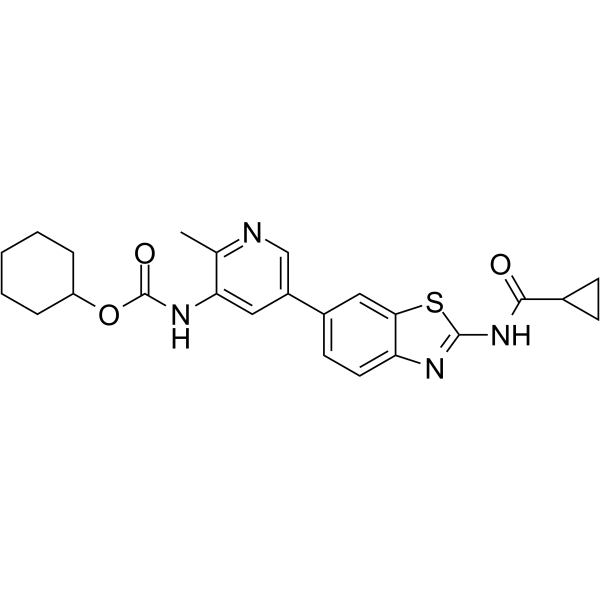
    TP-030-2, a chemical probe, is a RIPK1 inhibitor (human Ki=0.43 nM; mouse IC50=100 nM) .
    TP-030-2
  • HY-156367

    RIP kinase Inflammation/Immunology
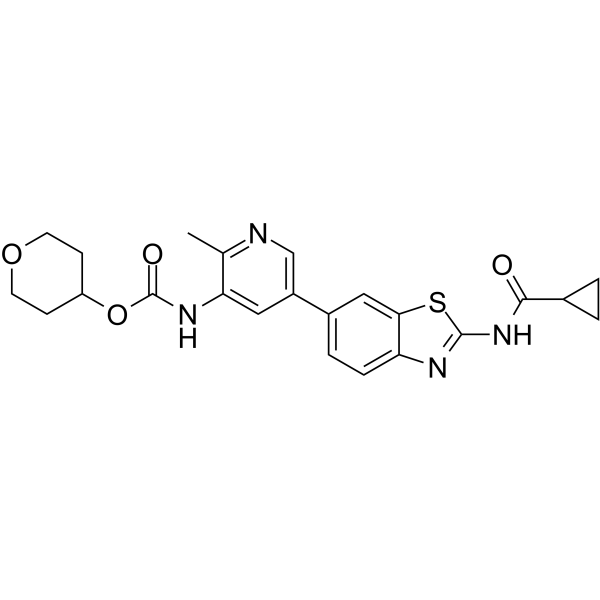
    RIPK1-IN-16 is an orally active and potent inhibitor of RIPK1. RIPK1-IN-16 inhibits excessive inflammation by blocking RIPK1-mediated necroptosis in vivo. RIPK1-IN-16 protects mouse from TNF-induced systemic inflammatory response syndrome and sepsis .
    RIPK1-IN-16
  • HY-144277

    RIP kinase Necroptosis Inflammation/Immunology
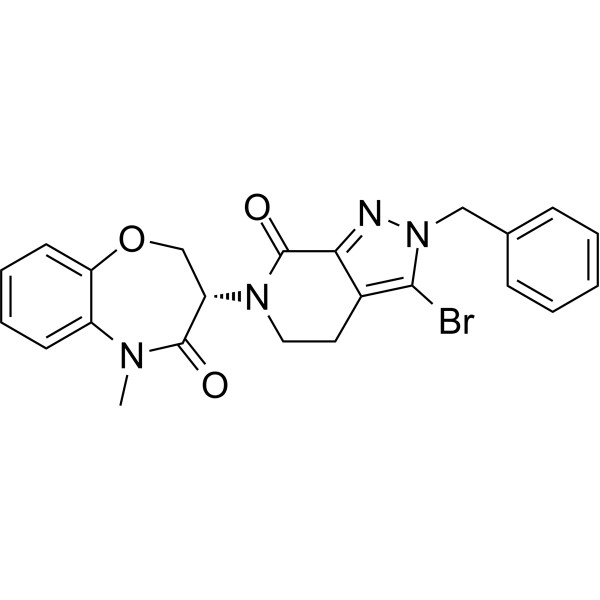
    RIPK1-IN-12 is a potent RIPK1 inhibitor. RIPK1-IN-12 inhibits necroptosis in both human and mouse cells, with EC50 values of 1.6 and 2.9 nM, respectively .
    RIPK1-IN-12
  • HY-144276

    RIP kinase Inflammation/Immunology
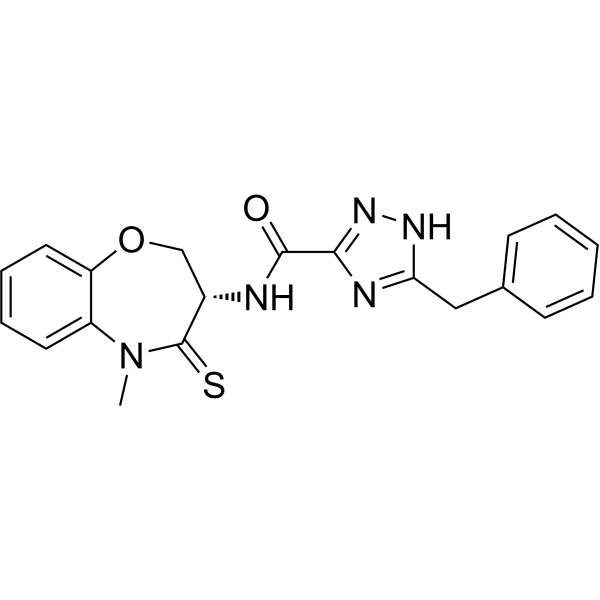
    RIPK1-IN-11 is a potent and orally active RIPK1 inhibitor (Kd=9.2 nM; IC50=67 nM). RIPK1-IN-11 inhibits necroptosis in both human and mouse cells (EC50=17-30 nM). Anti-inflammatory activity .
    RIPK1-IN-11
  • HY-156920

    Necroptosis RIP kinase Inflammation/Immunology Cancer
    VDX-111 is an analog of vitamin D. VDX-111 exhibits cytotoxicity in ovarian cancer cells through upregulation of RIPK1/RIPK3 pathway and induction of necroptosis. VDX-111 promotes expressions of cytokines and exhibits antitumor activity in mouse model .
    VDX-111
  • HY-168770

    RIP kinase TNF Receptor Apoptosis Cardiovascular Disease
    Cl-Necrostatin-1 is a RIPK1 inhibitor. Cl-Necrostatin-1 can also inhibit TNF-α-induced necroptosis in Jurkat cells deficient in Fas-associated death domain protein (FADD; EC50 = 180 nM), a modification that prevents caspase activation in response to death-domain receptor signaling. Cl-Necrostatin-1 can also reduce infarct size in a mouse model of middle cerebral artery occlusion (MCAO). Cl-Necrostatin-1 is used for research in cardiovascular and cerebrovascular diseases .
    Cl-Necrostatin-1
  • HY-P10977

    Sodium Channel RIP kinase Neurological Disease
    Tat-ASIC1a (1-20) (mouse, rat) is a competitive ASIC1a membrane-penetrating peptide. Tat-ASIC1a (1-20) (mouse, rat) has significantly neuroprotection effects, and reduces neuronal damage against acidotoxicity by targeting the ASIC1a-RIPK1 pathway and auto-inhibitory mechanism. Tat-ASIC1a (1-20) (mouse, rat) effectively protects brains from ischemic injury in ischemic stroke mice model. Tat-ASIC1a (1-20) (mouse, rat) can be used for neurodegenerative diseases research, such as Huntington disease and Parkinson’s disease .
    Tat-ASIC1a (1-20) (mouse, rat)
  • HY-183781

    RIP kinase Necroptosis Inflammation/Immunology
    RIPK1-IN-41 is an orally active RIPK1 inhibitor with an IC50 of 92 nM and a KD of 106.8 nM. RIPK1-IN-41 reduces the phosphorylation level of RIPK1, inhibits necrosome formation, blocks the activation of RIPK3 and MLKL, maintains mitochondrial and lysosomal functions, preserves cell membrane integrity, and suppresses necroptosis. RIPK1-IN-41 alleviates hypothermia and multi-organ damage in a mouse model of systemic inflammatory response syndrome induced by mTNF-α. RIPK1-IN-41 is applicable to research related to systemic inflammatory response syndrome .
    RIPK1-IN-41
  • HY-181596

    RIP kinase Mixed Lineage Kinase Apoptosis Inflammation/Immunology
    WJH-C19 is an orally active RIPK1 inhibitor with an IC50 of 5.7 nM. WJH-C19 inhibits the RIPK1/RIPK3/MLKL signaling axis, blocks RIPK1 phosphorylation, suppresses the phosphorylation of downstream RIPK3 and MLKL, disrupts necrosome formation, and exhibits protective effects against necroptosis (Apoptosis) in multiple cell lines. WJH-C19 ameliorates symptoms of inflammatory bowel disease in a mouse colitis model by regulating the necroptosis pathway. WJH-C19 alleviates inflammation and bone destruction in a mouse model of rheumatoid arthritis. WJH-C19 is applicable to research related to inflammatory bowel disease and rheumatoid arthritis .
    WJH-C19

Inquiry Online

Your information is safe with us. * Required Fields.

Salutation


Country or Region *

Applicant Name *


Organization Name *

Department *


Email Address *


Product Name *

Cat. No.


Requested quantity *

Phone Number *


Remarks

Inquiry Online

Inquiry Information

Product Name:
Cat. No.:
Quantity:
MCE Japan Authorized Agent:

