



Ponicidin
Based on 4 publication(s) in Google Scholar
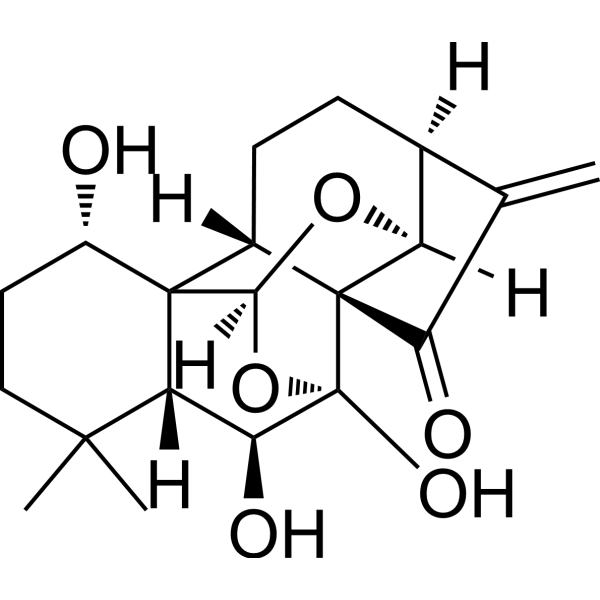
Ponicidin (Rubescensine B) is an orally active RIPK1 inhibitor with a Kd value of 135 nM. Ponicidin inhibits the JAK2/STAT3 pathway to induce apoptosis, activates the PI3K/Akt pathway, upregulates SIRT1 expression, alleviates oxidative stress, suppresses inflammatory responses and necroptosis, and blocks cell cycle progression. Ponicidin induces ROS production to exert antiproliferative and antiviral effects, while also improving cognitive function and reducing Aβ plaque deposition. Ponicidin can be used in studies related to hepatocellular carcinoma, Alzheimer's disease, and gastric cancer.
Nos produits utilisent uniquement pour la recherche. Nous ne vendons pas aux patients.
- Pureté : 99.93%
- CAS No.: 52617-37-5
- Formule: C20H26O6
- Masse moléculaire:362.42
-
Stockage:
4°C, protect from light
* In solvent : -80°C, 6 months; -20°C, 1 month (protect from light)

To place orders, for customer services and technical support, please contact: MedChemExpress USA
Tel: 609-228-6898 E-mail: [email protected] [email protected]


-
 Activité biologique
-
Chemical Information
-
Solvant et solubilité
- Protocole
- Pureté et documentation
- Références
-
 Help & FAQs


Publications Citing Use of MedChemExpress (MCE) Ponicidin
More Customer Validation & Images

-
Cell Proliferation/Viability Assay
-
IF
-
WB
-
Cell Proliferation/Viability Assay


Activité biologique
Description
IC50 & Target
Apoptosis[1]
In Vitro
Ponicidin (5-40 μM; 24-72 h) inhibits the viability of QGY-7701 and HepG-2 human hepatocellular carcinoma cells in a dose- and time-dependent manner, with treatment at 40 μM for 72 h reducing cell viability to 9.3% (QGY-7701) and 12.7% (HepG-2), respectively[1].
Ponicidin (40 μM; 48-72 h) downregulates the mRNA and protein expression of Survivin and Bcl-2, while upregulating the mRNA and protein expression of Bax, in QGY-7701 and HepG-2 human hepatocellular carcinoma cells[1].
Ponicidin (1-50 μM; 24 h) shows no significant cytotoxicity against HT-22 mouse hippocampal neuronal cells, while Ponicidin (10 μM; 2 h pre-incubation) significantly restores the cell viability reduced by Aβ1-42 exposure[2].
Ponicidin (10 μM; pre-incubated for 2 h) significantly alleviates Aβ1-42-induced neuroinflammation in HT-22 mouse hippocampal neuron cells by downregulating pro-inflammatory cytokines (TNF-α, IL-1β) and upregulating the anti-inflammatory factor IL-10[2].
Ponicidin (10 μM; preincubated for 2 h) significantly reduces Aβ1-42-induced intracellular ROS production and oxidative stress in HT-22 mouse hippocampal neuronal cells by decreasing lipid peroxidation levels and restoring antioxidant enzyme activity[2].
Ponicidin (10 μM; 2 h pre-incubation) significantly upregulates the expression of SIRT1 in Aβ1-42-treated HT-22 mouse hippocampal neurons and modulates the activation of the PI3K/Akt pathway, while SIRT1 inhibitors reverse these effects[2].
Ponicidin (10 μM; 2 h pre-incubation) significantly enhances the expression of BDNF and NGF in Aβ1-42-treated HT-22 mouse hippocampal neuron cells via a SIRT1-mediated mechanism[2].
Ponicidin (10-50 μM; 48 h) induces dose-dependent apoptosis in human gastric cancer MKN28 cells, with the proportion of early apoptotic cells reaching 59.03% at the concentration of 50 μM[3].
Ponicidin (10-50 μM; 48 h) induces dose-dependent G0-G1 cell cycle arrest in human gastric cancer MKN28 cells, increasing the proportion of G0-G1 phase cells to 60.68% at a concentration of 50 μM. It also reduces the proportions of cells in S phase and G2-M phase[3].
Ponicidin (10-50 μM; 1-48 h) induces time- and dose-dependent activation of caspase-3 in human gastric cancer MKN28 cells, with its activity reaching 28.76% at 50 μM for 48 h[3].
Ponicidin (1.56-100 μM; 8 h) exhibits a CC50 of 59.360 μM in BV2 microglial cells, and shows low cytotoxicity at a concentration of 5 μM[4].
Ponicidin (5 μM; 8.5 h) inhibits Z-VAD (LZ) (HY-164388)-induced secretion of TNF-α (IC50 = 3.56 μM) and IL-6 (IC50 = 2.635 μM) in BV2 microglia, with significant inhibitory effects observed at a concentration of 5 μM[4].
Ponicidin (5 μM; 8.5 h) inhibits TZ-induced LDH release and protects HT22 neuronal cells from necroptosis-associated membrane damage[4].
Ponicidin (5 μM; 8.5 h) inhibits neuronal necroptosis by blocking the RIPK1-RIPK3-MLKL signaling cascade, and reduces the phosphorylation levels of RIPK1, RIPK3 and MLKL in TZ-stimulated HT22 neuronal cells[4].
MedChemExpress (MCE) has not independently confirmed the accuracy of these methods. They are for reference only.
-
Cell Line:QGY-7701, HepG-2 human hepatocellular carcinoma cell lines
-
Concentration:5, 10, 20, 30 and 40 μM
-
Incubation Time:24, 48, 72 h
-
Result:Increased the percentage of sub-G1 apoptotic cells in both cell lines in a dose- and time-dependent manner.
Induced an apoptotic rate of 51.5% in HepG-2 cells after 40 μM treatment for 72 h.
Induced an apoptotic rate of 63.3% in QGY-7701 cells after 40 μM treatment for 72 h.
-
Cell Line:human gastric carcinoma MKN28 cells
-
Concentration:10, 25 and 50 μM
-
Incubation Time:6 h (JAK2/STAT3 phosphorylation assay); 48 h (apoptosis/signaling protein assay)
-
Result:Dose-dependently decreased phosphorylation of JAK2 and STAT3 without altering total JAK2 or STAT3 protein levels after 6 h treatment.
Dose-dependently decreased protein levels of VEGF, VEGFR2, and Bcl-2, while increasing protein levels of Bax and the active form of caspase-3 after 48 h treatment.
-
Cell Line:LZ-stimulated BV2 mouse microglial cells
-
Concentration:5 μM
-
Incubation Time:30 min (pre-incubation); 4 h (LZ stimulation)
-
Result:Effectively reduced LZ-induced phosphorylation of RIPK1, JAK1, and STAT1, and simultaneously downregulated protein levels of TNF-α and IL-6, with no significant effect on total RIPK1, JAK1, or STAT1 protein levels.
-
Cell Line:TZ-stimulated HT22 mouse hippocampal neuronal cells
-
Concentration:5 μM
-
Incubation Time:30 min (pre-incubation); 4 h (TZ stimulation)
-
Result:Effectively reduced TZ-induced phosphorylation of RIPK1, RIPK3, and MLKL, with no significant effect on total RIPK1, RIPK3, or MLKL protein levels.
-
Cell Line:HT22 mouse hippocampal neuronal cells treated with LZ-stimulated BV2 microglial cell-conditioned medium
-
Concentration:5 μM
-
Incubation Time:8 h (treated concurrently with BV2-LZ-su)
-
Result:Significantly reduced LDH release induced by BV2-LZ-su, decreasing relative LDH release from ~100% to ~70% and preserving cell membrane integrity.
In Vivo
MedChemExpress (MCE) has not independently confirmed the accuracy of these methods. They are for reference only.
-
Animal Model:5×FAD transgenic mice (male, 12 weeks old)[4]
-
Dosage:5 mg/kg/day; 10 mg/kg/day
-
Administration:oral; daily; 30 days
-
Result:Increased novel arm entries and reduced novel arm latency (5 mg/kg, T-maze).
Increased novel arm travel distance, increased novel arm entries, and reduced novel arm latency (10 mg/kg, T-maze).
Increased novel arm travel distance and increased novel arm entries (5 mg/kg, Y-maze).
Increased novel arm travel distance, increased novel arm entries, and reduced novel arm latency (10 mg/kg, Y-maze).
Reduced target zone latency, reduced target zone errors, and reduced target zone deviation (10 mg/kg, Barnes maze).
Increased P-point duration in the probe trial (10 mg/kg, Morris water maze).
Reduced brain APP expression, reduced phosphorylation of RIPK1, RIPK3, MLKL, JAK1, and STAT1, and reduced brain TNF-α and IL-6 protein levels (5 mg/kg and 10 mg/kg, Western blot).
Reduced amyloid-beta (Aβ) plaque deposition in the cortex and hippocampus (10 mg/kg, immunohistochemistry).
- RNA extraction experimental
- Research Protocol for Infectious Diseases
- Annexin V plus membrane-impermeant dye apoptosis staining
- ROS/oxidative-stress fluorescent staining
- BrdU Incorporation Assay
- Protocol for Water Maze
- Protocol for Cell Cycle
- Liver Cancer Modeling
- Cell Viability Determination by MTT Colorimetric Assay
- Alzheimer’s Disease Modeling
- Detection of Apoptosis
- TUNEL staining for apoptotic DNA fragmentation
- Flow cytometric DNA-content cell-cycle staining
- Apoptosis Solutions


Chemical Information
-
CAS No. 52617-37-5
-
Appearance Solid
-
Masse moléculaire 362.42
-
Formule C20H26O6
-
Color White to off-white
-
SMILES
O[C@]12[C@]3(C4=O)[C@]5([H])C6([C@](O[C@@]3([H])[C@](CC5)([H])C4=C)([H])O2)[C@](C(C)(CC[C@@H]6O)C)([H])[C@@H]1O
-
Synonyms
Rubescensine B
-
Structure Classification
-
Livraison
Room temperature in continental US; may vary elsewhere.
-
Stockage
4°C, protect from light
* In solvent : -80°C, 6 months; -20°C, 1 month (protect from light)


Publications (4)
-
Journal Impact Factor
-
Most Recent
-
Phytomedicine
Ponicidin promotes ferroptosis to enhance treatment sensitivity in Lenvatinib-resistant hepatocellular carcinoma cells through regulation of KEAP1/NRF2. [Abstract]2025 Jul 25:143:156824. PMID: 40382941 -
Phytomedicine
Ponicidin inhibited gallbladder cancer proliferation and metastasis by decreasing MAGEB2 expression through FOXO4. [Abstract]2023 Jun:114:154785. PMID: 37002972
Ponicidin purchased from MedChemExpress. Usage Cited in: Phytomedicine. 2023 Jun:114:154785. [Abstract]
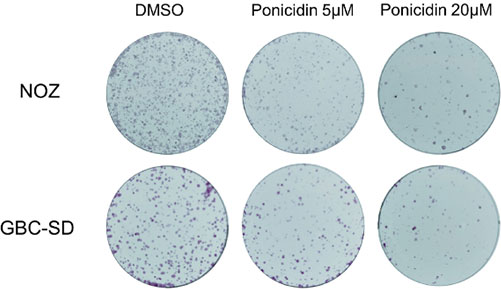
Ponicidin (5, 20 µM; 48 h) suppresses proliferation of NOZ and GBC-SD cells effectively.
Ponicidin purchased from MedChemExpress. Usage Cited in: Phytomedicine. 2023 Jun:114:154785. [Abstract]
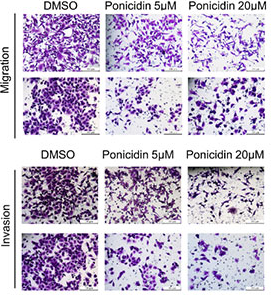
Ponicidin (5, 20 µM; 24 h) decreases the migration and invasion capabilities of NOZ and GBC-SD cells.
Ponicidin purchased from MedChemExpress. Usage Cited in: Phytomedicine. 2023 Jun:114:154785. [Abstract]
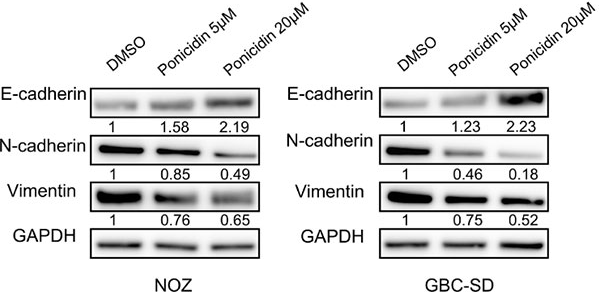
Ponicidin (5, 20 µM) significantly reduces the expression of mesenchymal phenotypes biomarkers, vimentin and N-cadherin, while upregulating the expression of E-cadherin (a distinguishing factor of epithelial cells), in NOZ and GBC-SD cells.
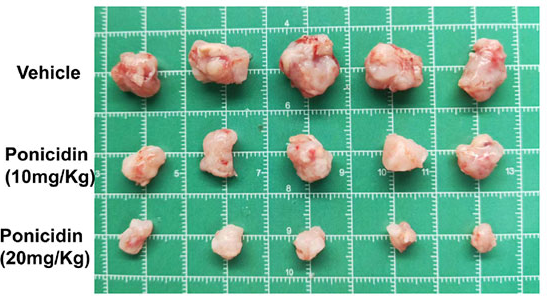
Ponicidin purchased from MedChemExpress. Usage Cited in: Phytomedicine. 2023 Jun:114:154785. [Abstract]
Ponicidin (10, 20 mg/kg; p.o.; every 2 days for 4 weeks) significantly inhibits subcutaneous tumor growth in mice in a dose-dependent manner.
-
Mol Biol Rep
Ponicidin attenuates Aβ1-42-induced hippocampal cell injury through SIRT1 and PI3K/Akt pathways. [Abstract]2025 Jul 24;52(1):752. PMID: 40705095 -
Biol Pharm Bull
Ponicidin Induces Apoptosis of Murine Melanoma by Inhibiting the NF-κB Signaling Pathway. [Abstract]2023;46(6):803-810. PMID: 37258145


Solvant et solubilité
In Vitro:
DMSO : 125 mg/mL (344.90 mM; Need ultrasonic; Hygroscopic DMSO has a significant impact on the solubility of product, please use newly opened DMSO)
Please refer to the solubility information to select the appropriate solvent. Once prepared, please aliquot and store the solution to prevent product inactivation from repeated freeze-thaw cycles.
Storage method and period of stock solution: -80°C, 6 months; -20°C, 1 month (protect from light). When stored at -80°C, please use it within 6 months. When stored at -20°C, please use it within 1 month.
Please refer to the solubility information to select the appropriate solvent. Once prepared, please aliquot and store the solution to prevent product inactivation from repeated freeze-thaw cycles.
Storage method and period of stock solution: -80°C, 6 months; -20°C, 1 month (protect from light). When stored at -80°C, please use it within 6 months. When stored at -20°C, please use it within 1 month.
Concentration (start) × Volume (start) = Concentration (final) × Volume (final)
In Vivo:
Select the appropriate dissolution method based on your experimental animal and administration route.
- For the following dissolution methods, please ensure to first prepare a clear stock solution using an In Vitro approach and then sequentially add co-solvents:
- To ensure reliable experimental results, the clarified stock solution can be appropriately stored based on storage conditions. As for the working solution for In Vivo experiments, it is recommended to prepare freshly and use it on the same day.
- The percentages shown for the solvents indicate their volumetric ratio in the final prepared solution. If precipitation or phase separation occurs during preparation, heat and/or sonication can be used to aid dissolution.
Add each solvent one by one: 10% DMSO 40% PEG300 5% Tween-80 45% Saline
Solubility: ≥ 2.08 mg/mL (5.74 mM); Clear solution
This protocol yields a clear solution of ≥ 2.08 mg/mL (saturation unknown).
Taking 1 mL working solution as an example, add 100 μL DMSO stock solution (20.8 mg/mL) to 400 μL PEG300, and mix evenly; then add 50 μL Tween-80 and mix evenly; then add 450 μL Saline to adjust the volume to 1 mL.
Preparation of Saline: Dissolve 0.9 g sodium chloride in ddH₂O and dilute to 100 mL to obtain a clear Saline solution.
Add each solvent one by one: 10% DMSO 90% (20% SBE-β-CD in Saline)
Solubility: ≥ 2.08 mg/mL (5.74 mM); Clear solution
This protocol yields a clear solution of ≥ 2.08 mg/mL (saturation unknown).
Taking 1 mL working solution as an example, add 100 μL DMSO stock solution (20.8 mg/mL) to 900 μL 20% SBE-β-CD in Saline, and mix evenly.
Preparation of 20% SBE-β-CD in Saline (4°C, storage for one week): 2 g SBE-β-CD powder is dissolved in 10 mL Saline, completely dissolve until clear.
In Vivo Dissolution Calculator
Please enter the basic information of animal experiments:
-
-
-
-
Recommended: Prepare an additional quantity of animals to account for potential losses during experiments.
Please enter your animal formula composition:
-
%DMSO +
Recommended: Keep the proportion of DMSO in working solution below 2% if your animal is weak.
-
%+
-
+%Tween-80 + +
-
%Saline +
The co-solvents required include: DMSO, . All of co-solvents are available by MedChemExpress (MCE). , Tween 80. All of co-solvents are available by MedChemExpress (MCE).
Working solution concentration: 0.22 mg/mL
Method for preparing stock solution: mg drug dissolved in μL DMSO. Stock solution concentration: mg/mL. * In solvent : -80°C, 6 months; -20°C, 1 month (protect from light)
1. Take μL DMSO stock solution;
2. Add μL .
μL , mix evenly;
3. Then add μL Tween 80, mix evenly;
4. Then add μL
Please ensure that the stock solution in the first step is dissolved to a clear state, and add co-solvents in sequence. You can use ultrasonic heating (ultrasonic cleaner, recommended frequency 20-40 kHz), vortexing, etc. to assist dissolution.


Pureté et documentation
-
Fiche technique (300 KB)
-
SDS (392 KB)
- English - EN (392 KB)
- Français - FR (392 KB)
- Deutsch - DE (392 KB)
- Norwegian - NO (392 KB)
- Español - ES (392 KB)
- Swedish - SV (392 KB)
- Italian - IT (392 KB)
- Korean - KR (392 KB)
- Portuguese - PT (392 KB)
-
Instruction de manipulation (2659 KB)
Références
[1]. Zhang JF, et al. Ponicidin inhibits cell growth on hepatocellular carcinoma cells by induction of apoptosis. Dig Liver Dis. 2007 Feb;39(2):160-6. [Content Brief]
[2]. Wang C, et al. Ponicidin attenuates Aβ1-42-induced hippocampal cell injury through SIRT1 and PI3K/Akt pathways. Mol Biol Rep. 2025;52(1):752. Published 2025 Jul 24. [Content Brief]
[3]. Liu YF, et al. Ponicidin induces apoptosis via JAK2 and STAT3 signaling pathways in gastric carcinoma. Int J Mol Sci. 2015;16(1):1576-1589. Published 2015 Jan 12. [Content Brief]
[4]. Hu H, et al. Ponicidin ameliorates Alzheimer's disease through dual inhibition of RIPK1-mediated neuroinflammation and necroptosis. Int Immunopharmacol. 2026;171:116095. [Content Brief]


Complete Stock Solution Preparation Table
Please refer to the solubility information to select the appropriate solvent. Once prepared, please aliquot and store the solution to prevent product inactivation from repeated freeze-thaw cycles.
Storage method and period of stock solution: -80°C, 6 months; -20°C, 1 month (protect from light). When stored at -80°C, please use it within 6 months. When stored at -20°C, please use it within 1 month.
| Optional Solvent | Concentration Solvent Mass | 1 mg | 5 mg | 10 mg | 25 mg |
|---|---|---|---|---|---|
| DMSO | 1 mM | 2.7592 mL | 13.7961 mL | 27.5923 mL | 68.9807 mL |
| 5 mM | 0.5518 mL | 2.7592 mL | 5.5185 mL | 13.7961 mL | |
| 10 mM | 0.2759 mL | 1.3796 mL | 2.7592 mL | 6.8981 mL | |
| 15 mM | 0.1839 mL | 0.9197 mL | 1.8395 mL | 4.5987 mL | |
| 20 mM | 0.1380 mL | 0.6898 mL | 1.3796 mL | 3.4490 mL | |
| 25 mM | 0.1104 mL | 0.5518 mL | 1.1037 mL | 2.7592 mL | |
| 30 mM | 0.0920 mL | 0.4599 mL | 0.9197 mL | 2.2994 mL | |
| 40 mM | 0.0690 mL | 0.3449 mL | 0.6898 mL | 1.7245 mL | |
| 50 mM | 0.0552 mL | 0.2759 mL | 0.5518 mL | 1.3796 mL | |
| 60 mM | 0.0460 mL | 0.2299 mL | 0.4599 mL | 1.1497 mL | |
| 80 mM | 0.0345 mL | 0.1725 mL | 0.3449 mL | 0.8623 mL | |
| 100 mM | 0.0276 mL | 0.1380 mL | 0.2759 mL | 0.6898 mL |


Ponicidin Related Classifications
HY-N1535 Related Classifications
 Powered by Bioz
Keywords
- Ponicidin
- 52617-37-5
- Rubescensine B
- RIP kinase
- Apoptosis
- Reactive Oxygen Species (ROS)
- JAK
- STAT
- PI3K
- Akt
- Sirtuin
- Necroptosis
- Amyloid-β
- PI3K/Akt pathway
- mouse RIPK1
- JAK2/STAT3 pathway
- Alzheimer's disease
- SIRT1
- HepG-2
- HT-22 mouse hippocampal neuronal cells
- QGY-7701
- gastric carcinoma
- hepatocellular carcinoma
- Inhibitor
- inhibitor
- inhibit