
1. Search Result
Search Result
Pathways Recommended: Vitamin D Related/Nuclear Receptor
Results for "

nuclear fragmentation

" in MedChemExpress (MCE) Product Catalog:

9

Inhibitors & Agonists

2

Natural
Products

Cat. No. Product Name Target Research Areas Chemical Structure
  • HY-N12503

    Apoptosis Caspase Cancer
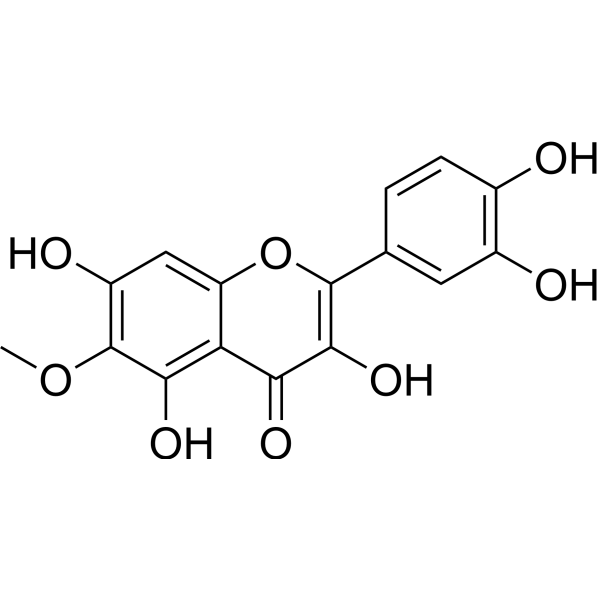
    Patuletin is a flavonol, that can be isolated from the flowers of Tagetes patula. Patuletin shows anti-proliferative activity against cancer cells. Patuletin causes significant nuclear fragmentation and has a great capacity to induce caspase-3 activation .
    Patuletin
  • HY-N6674

    ECO-4601; TLN-4601; BU 4664L

    Apoptosis Bacterial Cathepsin Parasite Endogenous Metabolite Infection Inflammation/Immunology Cancer
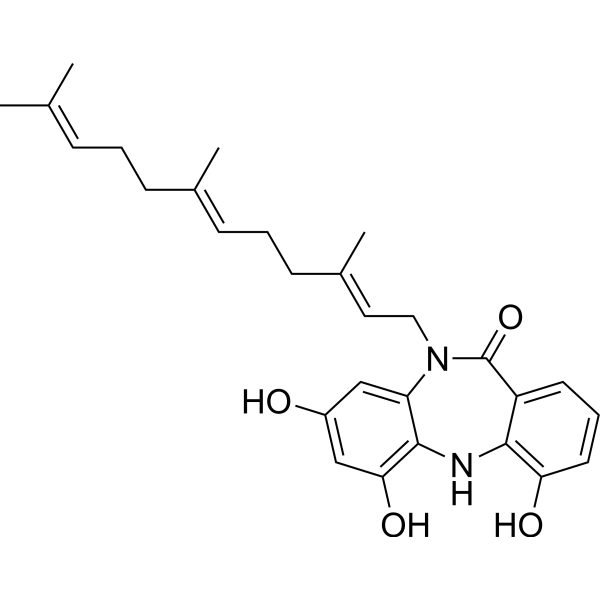
    Diazepinomicin (ECO-4601) is an anticancer and antibacterial agent. Diazepinomicin can be produced by a Micromonospora strain. Diazepinomicin induces Apoptosis. Diazepinomicin inhibits the proteases Rhodesain and Cathepsin L at an IC50 of 70-90 μM. Diazepinomicin possesses anti-inflammatory and anti-tumor activity. Diazepinomicin has demonstrated activity against hepatocellular carcinoma. Diazepinomicin shows antiparasitic activity against trypomastigote forms of Trypanosoma brucei with an IC50 of 13.5 μM. Diazepinomicin exhibits moderate antibacterial activity against specific Gram-positive bacteria, with an MIC of approximately 32 μg/mL .
    Diazepinomicin
  • HY-168720

    Apoptosis Cancer
    Apoptosis inducer 32 (Compound 7g) is an apoptosis inducer with a KD of 42 μM, showing anti-tumor activity. Apoptosis inducer 32 caused significant cellular morphological changes in MDA-MB-231 cells, including membrane bubbling, nuclear fragmentation, and apoptotic body formation. The IC50 of Apoptosis inducer 32 in MCF-7, MDA-MB-231, and HEK cells is 4.77, 6.56 and 337.8 μM respectively .
    Apoptosis inducer 32
  • HY-117249

    AK-2123

    Apoptosis Caspase Cancer
    Sanazole (AK-2123) is a hypoxic cell radiosensitizer. Sanazole enhances radiation-induced DNA strand breaks. In mouse fibroblast tumors, Sanazole increases nuclear condensation and fragmentation, as well as elevates caspase-3 activity, thereby enhancing radiation-induced apoptosis .
    Sanazole
  • HY-169253

    Reactive Oxygen Species (ROS) Apoptosis Cancer
    ROS inducer 5 (compound 6e) can induce intracellular ROS accumulation and subsequent nuclear fragmentation. ROS inducer 5 can induce apoptosis in MCF-7 cells, with an IC50 value of 3.85 μM. ROS inducer 5 can be used in anticancer research .
    ROS inducer 5
  • HY-149523

    Apoptosis NO Synthase Caspase Inflammation/Immunology Cancer
    Anticancer agent 157 (compound 15) is a NO inhibitor (IC50=0.62 μg/mL) with anti-inflammatory and anticancer activities. Anticancer agent 157 can bind to iNOS (inducible NO synthase) and caspase 8, causing nuclear fragmentation and chromatin condensation, inducing apoptosis. Anticancer agent 157 inhibits HT29 colon cancer cells (IC50=2.45 μg/mL), Hep-G2 liver cancer cells (IC50=3.25 μg/mL), and B16-F10 murine melanoma cells (IC50=3.84 μg/mL) .
    Anticancer agent 157
  • HY-W714212

    Herbicide Microtubule/Tubulin DNA/RNA Synthesis Apoptosis Others
    Fluchloralin is a dinitroaniline herbicide that effectively controls annual gramineous and broadleaf weeds primarily by inhibiting tubulin synthesis and cell division . Fluchloralin exhibits cytotoxicity and genotoxicity, and promotes cell apoptosis by activating apoptotic signaling proteins, forming DNA ladder bands, inducing cell shrinkage and nuclear fragmentation .
    Fluchloralin
  • HY-N13034

    Caspase Apoptosis Parasite Infection Cancer
    Diuvaretin is an antimalarial agent and a C-phenylated dihydrochalcone. Diuvaretin can be isolated from the roots of U. acuminata. Diuvaretin increases the activity of Caspase-3 and triggers Apoptosis. Diuvaretin exhibits antiparasitic activity against Plasmodium falciparum. Diuvaretin can be used in the research of promyelocytic leukemia and malaria .
    Diuvaretin
  • HY-121901

    MDM-2/p53 Cancer
    Safrole oxide is a p53 modulator that upregulates the expression of the p53 tumor suppressor protein, linking cell cycle arrest to the apoptotic process. Safrole oxide induces apoptosis in lung cancer cells without triggering necrosis. Safrole oxide can be used in lung cancer-related research .
    Safrole oxide

Inquiry Online

Your information is safe with us. * Required Fields.

Salutation


Country or Region *

Applicant Name *


Organization Name *

Department *


Email Address *


Product Name *

Cat. No.


Requested quantity *

Phone Number *


Remarks

Inquiry Online

Inquiry Information

Product Name:
Cat. No.:
Quantity:
MCE Japan Authorized Agent:

