8 Results for "

pyrrole group

" in MedChemExpress (MCE) Product Catalog:
Products (8)

8 Results for "pyrrole group" in MCE Product Catalog:

1
1 Cited Publications
Cat. No.: HY-B0840
CAS No.: 122453-73-0
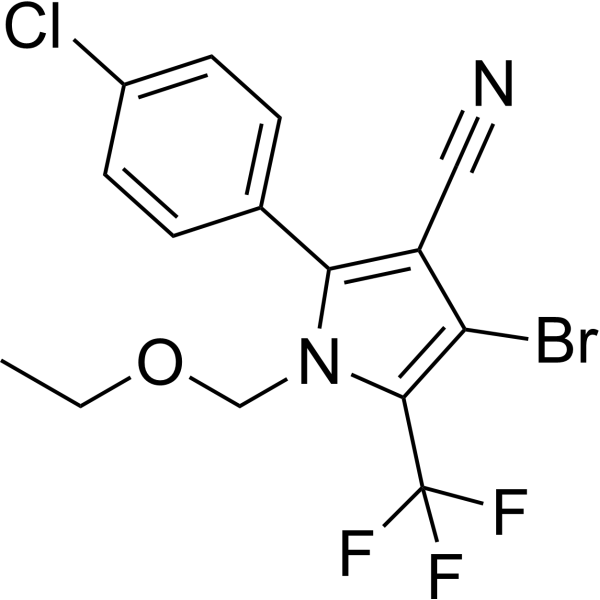
Chlorfenapyr is a pyrrole insecticide. Chlorfenapyr has a mode of action: the mixed function oxidase oxidizes and removes the Nethoxymethyl group to form the active metabolite, CL 303268. Chlorfenapyr is used for termite control and crop protection against a variety of insect and mite pests .
loading...
    loading...
Cat. No.: HY-32959
CAS No.: 135884-31-0
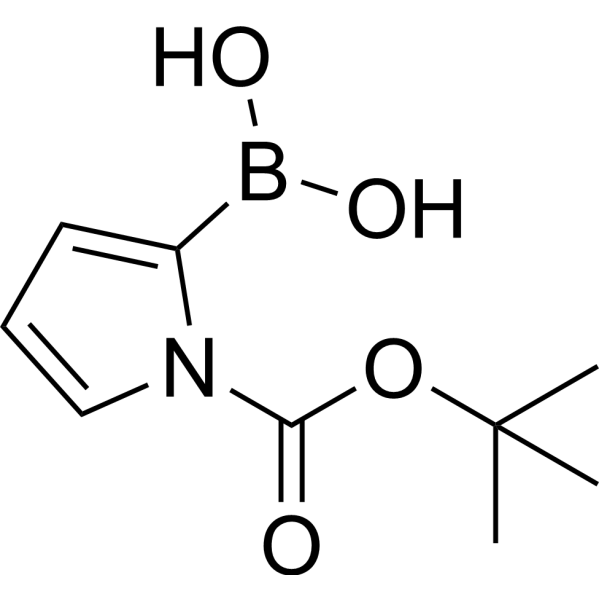
N-Boc-2-pyrroleboronic acid is an organic synthesis intermediate used primarily in the synthesis of chiral pharmaceutical molecules and biologically active molecules. The boronic acid on the pyrrole ring can participate in Suzuki coupling reactions. The boronic acid can be oxidized to a hydroxyl group under the action of nitrogen oxides, and after tautomerization, it can be further transformed into 2-oxo-2,5-dihydro-1-pyrrolecarboxylic acid tert-butyl ester .
loading...
    loading...
Cat. No.: HY-W007392
CAS No.: 934-05-4
Synonyms: Methyl 4-bromopyrrole-2-carboxylate
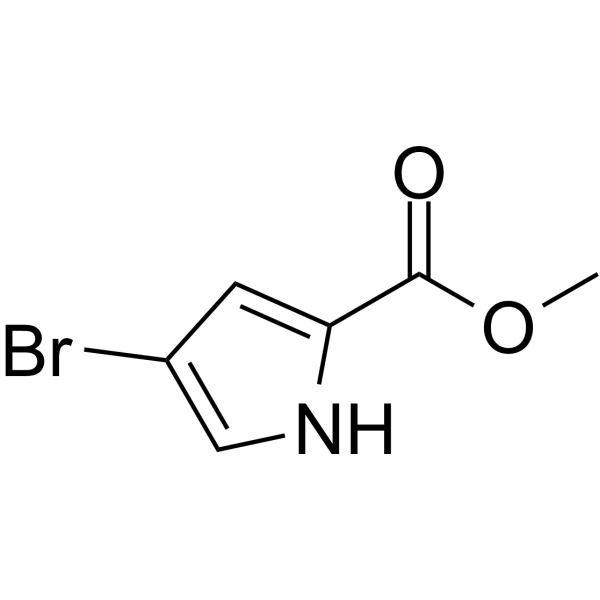
Methyl 4-bromo-1H-pyrrole-2-carboxylate (Methyl 4-bromopyrrole-2-carboxylate) is a biologically active pyrrole derivative. Methyl 4-bromo-1H-pyrrole-2-carboxylate can be used in studies on the development of pyrrole-related biosensors .
loading...
    loading...
Cat. No.: HY-B0840R
CAS No.: 122453-73-0
Chlorfenapyr (Standard) is the analytical standard of Chlorfenapyr. This product is intended for research and analytical applications. Chlorfenapyr is a pyrrole insecticide. Chlorfenapyr has a mode of action: the mixed function oxidase oxidizes and removes the Nethoxymethyl group to form the active metabolite, CL 303268. Chlorfenapyr is used for termite control and crop protection against a variety of insect and mite pests .
loading...
    loading...
Cat. No.: HY-W394551
CAS No.: 1442447-48-4
Research Areas:  

Others

Methyl 3,4-dibromo-2,5-dioxo-2,5-dihydro-1H-pyrrole-1-carboxylate is a small pyrrolidone molecule which features two bromine atoms and a methyl ester. The unsaturated dibromo motif is a covalent ligand for thiol groups, and may be used to label cysteine residues in proteins. The presence of two leaving groups on this molecule allows this linker to bind two thiols at a time. The methyl ester can be saponified to link this molecule to amines to form larger structures.
loading...
    loading...
Cat. No.: HY-183022
CAS No.: 896465-45-5
Research Areas:  

Others

1-(3-Azidopropyl)-1H-pyrrole-2,5-dione is a maleimide derivative with a 3-azidopropyl substituent, used to introduce an azide functional group to bovine serum albumin (BSA). 1-(3-Azidopropyl)-1H-pyrrole-2,5-dione reacts with the free, solvent-accessible thiol group of BSA to produce azide-functionalized BSA, which is used in click chemistry to form a TLL-BSA hetero-dimer .
loading...
    loading...
Cat. No.: HY-W714239
CAS No.: 1172134-11-0
Target:  

Drug Metabolite

Research Areas:  

Others

Spirotetramat-keto-hydroxy is a metabolite of Spirotetramat (HY-120253). Spirotetramat is an insecticide .
loading...
    loading...
Cat. No.: HY-L167
164 compounds

Boric acid is a stable and usually non-toxic group widely used in modern synthesis to form C-C and C-heteroatom bonds. Boric acid exhibits exquisite reversible coordination characteristics and can be explored as a molecular construction tool, with specific mechanisms for controlling the structure and biological characteristics of bioconjugates. Boric acid has various activities, such as anticancer, antibacterial, and antiviral activities. In drugs, boric acid mainly exists in the form of arylboronic acid. In addition to this form, heterocycles containing boric acid, such as pyridine, pyrrole, and indole derivatives, are also very useful in pharmaceutical chemistry. Molecular modification by introducing boric acid groups into bioactive molecules has been shown to alter selectivity, physicochemical, and pharmacokinetic characteristics, and improve existing activity.

MCE designs a unique collection of 164 boronic acid compounds. It is a good tool to be used for research on cancer and other diseases.

