
16 Results for "

retinal angiogenesis

" in MedChemExpress (MCE) Product Catalog:
Products (16)

16 Results for "retinal angiogenesis" in MCE Product Catalog:

  • Targets Recommended:
1
1 Cited Publications
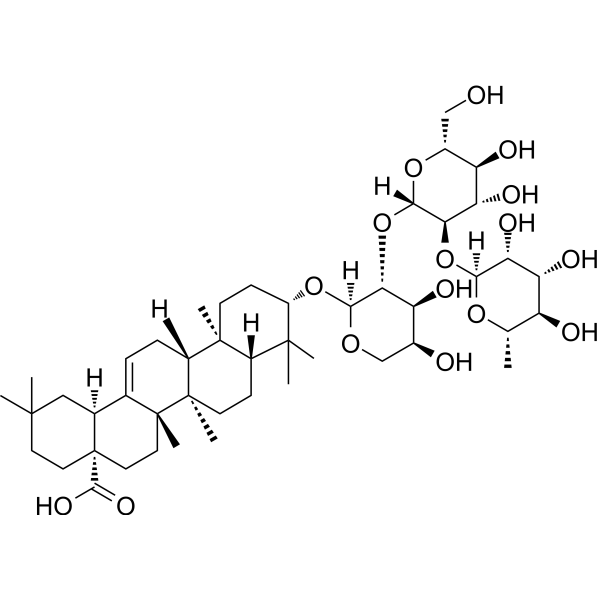
Cat. No.: HY-N0819
CAS No.: 89412-79-3
Raddeanin A is an oleanane-type triterpenoid saponin with oral activity. Raddeanin A inhibits SRC, mTOR, JNK, VEGFR2, NLRP3 inflammasome, Wnt/β-catenin, Wee1, PI3K/AKT signaling pathway, MAPK/ERK signaling pathway, AR-FL, AR-Vs, and downregulates the expression of p-PI3K and p-AKT. Raddeanin A inhibits osteoclast formation, bone resorption, osteolysis, cancer cell invasion, migration, proliferation, angiogenesis and epithelial-mesenchymal transition, while induces apoptosis, cell cycle arrest, ROS production, immunogenic cell death and dendritic cell maturation. Raddeanin A improves blood-retinal barrier function, alleviates inflammation, regulates the tumor microenvironment, and enhances the activity of anti-PD-1 antibody. Raddeanin A is applicable to the research of breast cancer-associated osteolysis, human osteosarcoma, colorectal cancer, glioblastoma, Alzheimer's disease, cholangiocarcinoma, melanoma, non-small cell lung cancer, castration-resistant prostate cancer and multiple myeloma .
loading...
    loading...
1
1 Cited Publications
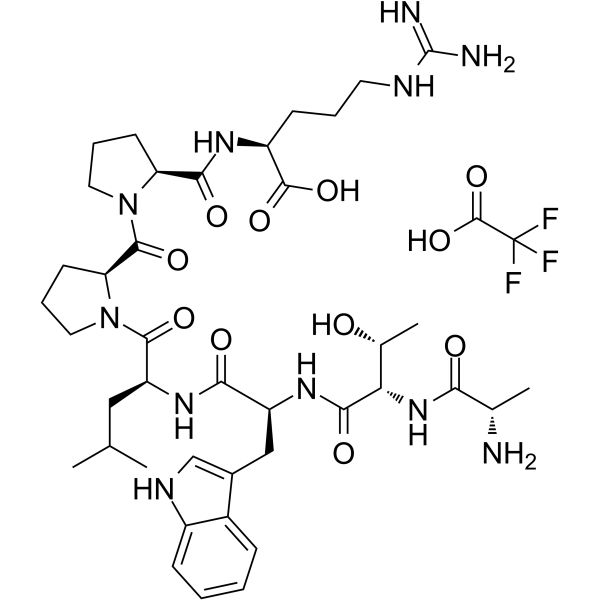
Cat. No.: HY-P1663A
ATWLPPR Peptide TFA, a heptapeptide, acts as a selective neuropilin-1 inhibitor, inhibits VEGF165 binding to NRP-1, used in the research of angiogenesis . ATWLPPR Peptide TFA has potential in reducing the early retinal damage caused by diabetes .
loading...
    loading...
Cat. No.: HY-145633
CAS No.: 2568358-31-4
Purity:  98.52%
Synonyms: OPT 302; VGX-300

Target:  

VEGFR

Research Areas:  

Cardiovascular Disease

Sozinibercept (OPT 302; VGX-300) is a soluble form of VEGFR-3, potently inhibits the activity of VEGF-C/D, which are the proangiogenic factors, inhibiting angiogenesis and vascular leakage. Sozinibercept also inhibits diabetic retinal edema in rats .
loading...
    loading...
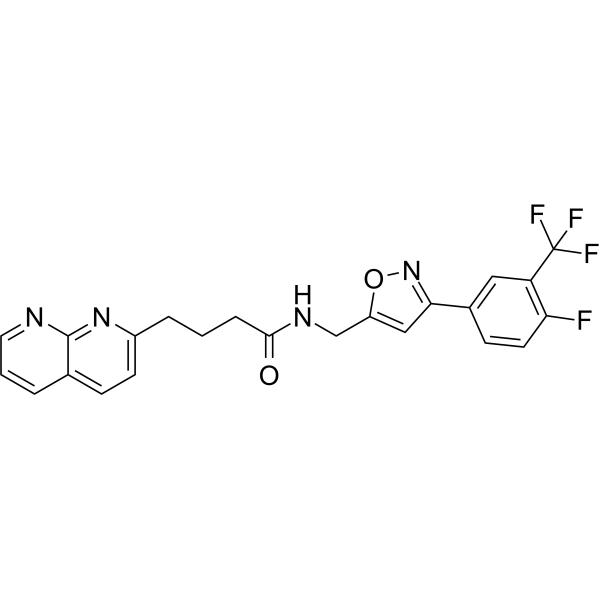
Cat. No.: HY-145919
CAS No.: 1314796-31-0
Purity:  98.82%
hGPR91 antagonist 3 (Compound 5g) is a potent and orally active GPR91 antagonist with IC50s of 35 nM and 135 nM, for human GPR91 and rat GPR91, respectively .
loading...
    loading...
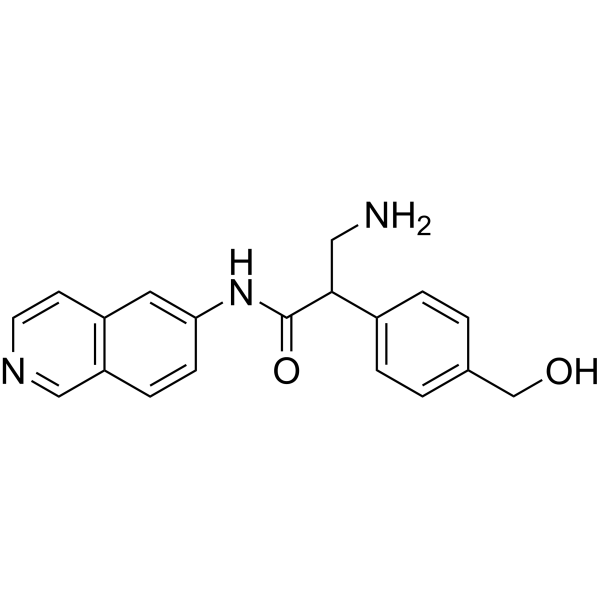
Cat. No.: HY-125639
CAS No.: 1254032-16-0
Purity:  99.08%
Synonyms: (rac)-AR-13324 M1 metabolite
Target:  

PKC ROCK

Research Areas:  

Cardiovascular Disease

(rac)-AR-13503 ((rac)-AR-13324 M1 metabolite) is the isoform of AR-13503 (HY-12798C). AR-13503 a ROCK/PKC inhibitor, inhibiting angiogenesis and enhancing retinal pigment epithelium (RPE) permeability. AR-13503 also inhibits the formation of aberrant neovascularization (NV) in oxygen-induced retinopathy (OIR) model in mice .
loading...
    loading...
Cat. No.: HY-113127
CAS No.: 20696-57-5
Target:  

Apoptosis

Research Areas:  

Others

L-Tryptophanamide is a compound discovered in wet age-related macular degeneration research, which has activities related to affecting retinal cell proliferation, apoptosis, necrosis and angiogenesis. In in vitro experiments, L-Tryptophanamide affects the proliferation, apoptosis and necrosis of human retinal pigment epithelial cells, and promotes tube formation and migration of human retinal endothelial cells.
loading...
    loading...
Cat. No.: HY-116098
CAS No.: 10184-70-0
Purity:  98.36%
Synonyms: AL-4940
Research Areas:  

Cancer

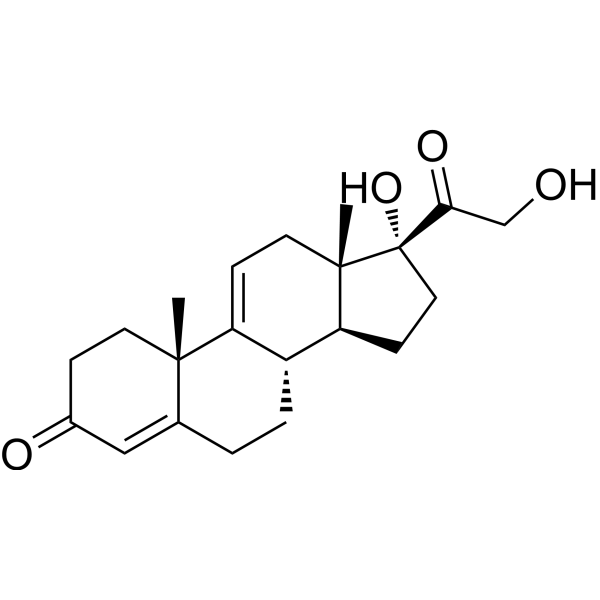
Anecortave desacetate (AL-4940) is an angiogenesis inhibitor. Anecortave is indicated for the study of exudative (wet) age-related macular degeneration as well as retinal tumors .
loading...
    loading...
Cat. No.: HY-158821A
Target:  

TGF-beta/Smad

Research Areas:  

Neurological Disease

ISTH0036 sodium is a phosphorothioate LNA-modified antisense oligonucleotide gapmer that selectively targets and downregulates TGF-β2 mRNA. ISTH0036 sodium suppresses TGF-β2 expression, reduces choroidal neovascularization and vascular leakage, inhibits fibrosis, blocks epithelial-to-mesenchymal transition, and inhibits angiogenesis while promoting bleb survival. ISTH0036 sodium exhibits long-lasting, dose-dependent ocular tissue distribution and target engagement in rabbit and non-human primate eyes. ISTH0036 sodium can be used for the study of various ocular disorders, such as glaucoma and neovascular retinal diseases .
loading...
    loading...
Cat. No.: HY-158821
CAS No.: 2179222-27-4
Target:  

TGF-beta/Smad

Research Areas:  

Neurological Disease

ISTH0036 is a phosphorothioate LNA-modified antisense oligonucleotide gapmer that selectively targets and downregulates TGF-β2 mRNA. ISTH0036 suppresses TGF-β2 expression, reduces choroidal neovascularization and vascular leakage, inhibits fibrosis, blocks epithelial-to-mesenchymal transition, and inhibits angiogenesis while promoting bleb survival. ISTH0036 exhibits long-lasting, dose-dependent ocular tissue distribution and target engagement in rabbit and non-human primate eyes. ISTH0036 can be used for the study of various ocular disorders, such as glaucoma and neovascular retinal diseases .
loading...
    loading...
Cat. No.: HY-N0819R
CAS No.: 89412-79-3
Raddeanin A (Standard) is the analytical standard of Raddeanin A (HY-N0819). This product is intended for research and analytical applications. Raddeanin A is an oleanane-type triterpenoid saponin with oral activity. Raddeanin A inhibits SRC, mTOR, JNK, VEGFR2, NLRP3 inflammasome, Wnt/β-catenin, Wee1, PI3K/AKT signaling pathway, MAPK/ERK signaling pathway, AR-FL, AR-Vs, and downregulates the expression of p-PI3K and p-AKT. Raddeanin A inhibits osteoclast formation, bone resorption, osteolysis, cancer cell invasion, migration, proliferation, angiogenesis and epithelial-mesenchymal transition, while induces apoptosis, cell cycle arrest, ROS production, immunogenic cell death and dendritic cell maturation. Raddeanin A improves blood-retinal barrier function, alleviates inflammation, regulates the tumor microenvironment, and enhances the activity of anti-PD-1 antibody. Raddeanin A is applicable to the research of breast cancer-associated osteolysis, human osteosarcoma, colorectal cancer, glioblastoma, Alzheimer's disease, cholangiocarcinoma, melanoma, non-small cell lung cancer, castration-resistant prostate cancer and multiple myeloma.
loading...
    loading...
Cat. No.: HY-184141
CAS No.: 3037217-70-9
Target:  

VEGFR

Research Areas:  

Neurological Disease

EYE1090 is an orally active VEGFR2 inhibitor with an IC50 of 3 nM. EYE1090 inhibits angiogenesis, endothelial migration, VEGFR2-induced retinal leakage, and reduces choroidal neovascularization lesion size in mice. EYE1090 can be used for the research of age-related macular degeneration, diabetic retinopathy, choroidal neovascularization .
loading...
    loading...
Cat. No.: HY-182372
CAS No.: 1638153-78-2
Target:  

Epoxide Hydrolase

Research Areas:  

Neurological Disease

SH-11037 is a potent inhibitor of soluble epoxide hydrolase (sEH) and docks to the substrate binding cleft in the sEH hydrolase domain. SH-11037 dose-dependently suppresses angiogenesis in the choroidal sprouting assay ex vivo and inhibited ocular developmental angiogenesis in zebrafish larvae. SH-11037 reduces choroidal neovascularisation lesion volume in the laser-induced CNV mouse model. SH-11037 synergises with anti-VEGF treatments in vitro and in vivo. SH-11037 induces G2/M phase blockade and retains retinal endothelial cell viability at active concentrations without overt toxicity. SH-11037 can be used for the research of retinal neovascularization and ocular neovascularization .
loading...
    loading...
Cat. No.: HY-184142
CAS No.: 3037217-73-2
Target:  

VEGFR

EYE1118 is an orally active, photoactivatable VEGFR2 inhibitor without acute hepatotoxicity. EYE1118 mediates light-enhanced inhibition via azide-functionalized receptor binding, and can utilize light-guided targeting to regulate its biodistribution in vivo. EYE1118 effectively inhibits angiogenesis, endothelial cell migration, VEGF-induced retinal leakage, and the size of choroidal neovascular lesions. EYE1118 has been applied in studies related to age-related macular degeneration, diabetic retinopathy, and choroidal neovascularization .
loading...
    loading...
Cat. No.: HY-158821B
Target:  

TGF-beta/Smad

Research Areas:  

Neurological Disease

ISTH0036 sodium scrambled negative control is the sequence scrambled negative control of ISTH0036 sodium (HY-158821A). ISTH0036 sodium is a phosphorothioate LNA-modified antisense oligonucleotide gapmer that selectively targets and downregulates TGF-β2 mRNA. ISTH0036 sodium suppresses TGF-β2 expression, reduces choroidal neovascularization and vascular leakage, inhibits fibrosis, blocks epithelial-to-mesenchymal transition, and inhibits angiogenesis while promoting bleb survival. ISTH0036 sodium exhibits long-lasting, dose-dependent ocular tissue distribution and target engagement in rabbit and non-human primate eyes. ISTH0036 sodium can be used for the study of various ocular disorders, such as glaucoma and neovascular retinal diseases.
loading...
    loading...
Cat. No.: HY-158821C
Research Areas:  

Neurological Disease

FAM labled ISTH0036 sodiumis a FAM labled ISTH0036 sodium (HY-158821A). ISTH0036 sodium is a phosphorothioate LNA-modified antisense oligonucleotide gapmer that selectively targets and downregulates TGF-β2 mRNA. ISTH0036 sodium suppresses TGF-β2 expression, reduces choroidal neovascularization and vascular leakage, inhibits fibrosis, blocks epithelial-to-mesenchymal transition, and inhibits angiogenesis while promoting bleb survival. ISTH0036 sodium exhibits long-lasting, dose-dependent ocular tissue distribution and target engagement in rabbit and non-human primate eyes. ISTH0036 sodium can be used for the study of various ocular disorders, such as glaucoma and neovascular retinal diseases.
loading...
    loading...
Cat. No.: HY-158821D
Research Areas:  

Neurological Disease

Cy3 labled ISTH0036 sodium is a Cy3 labled ISTH0036 sodium (HY-158821A). ISTH0036 sodium is a phosphorothioate LNA-modified antisense oligonucleotide gapmer that selectively targets and downregulates TGF-β2 mRNA. ISTH0036 sodium suppresses TGF-β2 expression, reduces choroidal neovascularization and vascular leakage, inhibits fibrosis, blocks epithelial-to-mesenchymal transition, and inhibits angiogenesis while promoting bleb survival. ISTH0036 sodium exhibits long-lasting, dose-dependent ocular tissue distribution and target engagement in rabbit and non-human primate eyes. ISTH0036 sodium can be used for the study of various ocular disorders, such as glaucoma and neovascular retinal diseases.
loading...
    loading...
  • 1

