18 Results for "

structure-activity relationship studies

" in MedChemExpress (MCE) Product Catalog:
Products (18)

18 Results for "structure-activity relationship studies" in MCE Product Catalog:

Cat. No.: HY-112319
CAS No.: 1312518-84-5
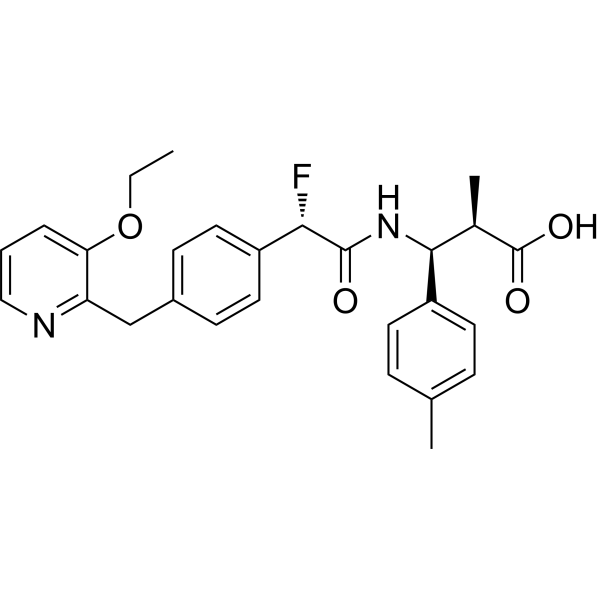
(R,S)-MK-8457 is a stereoisomer of MK-8457. MK-8457 is a dual inhibitor of Syk and ZAP70 .
loading...
    loading...
Cat. No.: HY-W011231
CAS No.: 74936-72-4
Target:  

Calcium Channel

Research Areas:  

Cardiovascular Disease

DHP-050 is a Felodipine (HY-B0309) analog. DHP-050 can be used to study the structure-activity relationship of 1,4-dihydropyridine (DHP) compounds .
loading...
    loading...
Cat. No.: HY-W008003
CAS No.: 615-16-7
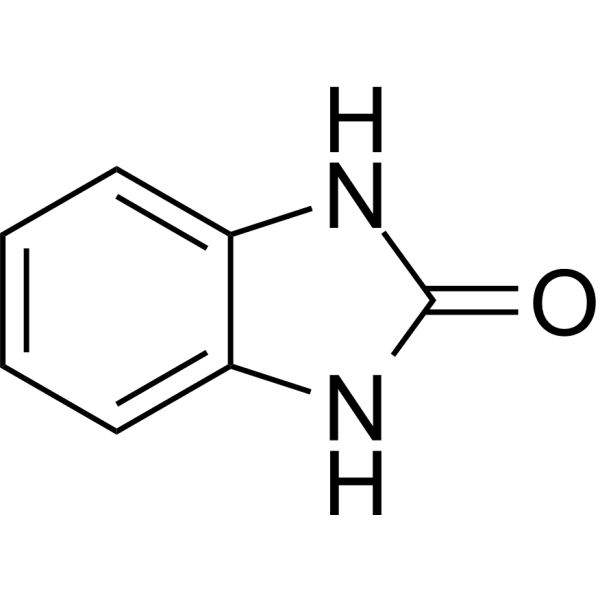
2-Hydroxybenzimidazole is an inactive compound targeting CYP1A1 and is mainly used as a control compound in the structure-activity relationship study of benzimidazole derivatives. 2-Hydroxybenzimidazole does not have the ability to induce CYP1A1 expression like its thiol or amino substituted derivatives .
loading...
    loading...
Cat. No.: HY-176545
CAS No.: 642463-22-7
Target:  

HDAC Sirtuin

Research Areas:  

Others

Z-MAL is a highly efficient and broad-spectrum HDAC substrate. Z-MAL exhibits high conversion activity for class I, II histone deacetylases, and class III SIRT1. Z-MAL can be used in studies on the structure-activity relationship, subtype selectivity, and inhibitor screening of HDAC .
loading...
    loading...
Cat. No.: HY-P1704
CAS No.: 63798-73-2
Synonyms: 11-Demethylcyclosporin A
Cyclosporin E (11-Demethylcyclosporin A) is a cyclic oligopeptide that can be isolated from fungi such as TTrichoderma polysporum and other imperfect fungi. Cyclosporin E belongs to the Cyclosporins family. Cyclosporin E can be used for studying the structure-activity relationships and molecular dynamic properties of cyclosporin compounds. As a structural control compound, Cyclosporin E holds significant research value in the fields of medicinal chemistry and biophysics .
loading...
    loading...
Cat. No.: HY-126230
CAS No.: 1781233-84-8
Target:  

Endogenous Metabolite

Research Areas:  

Others

PAT-494 is an ATX inhibitor with significant activity in biochemical and plasma assays. PAT-494 can reduce LPA levels in rat plasma through oral administration. The structure-activity relationship study of PAT-494 shows that its binding mode with ATX is novel and it can effectively occupy the hydrophobic pockets and channels of ATX .
loading...
    loading...
Cat. No.: HY-P2138
CAS No.: 124020-62-8
Target:  

HIV Protease

Research Areas:  

Others

U-85548E is an HIV protease inhibitor with nanomolar affinity for HIV-1 aspartic protease. By studying its structure-activity relationship, a potent nanomolar inhibitor with inhibitory effects on both HIV-1 and HIV-2 proteases was designed, and its binding mode was studied by X-ray crystallography and molecular modeling.
loading...
    loading...
Cat. No.: HY-103513
CAS No.: 1236105-75-1
Target:  

GABA Receptor

Research Areas:  

Others

GABAA receptor agent 2 (compound 13) is a compound used to study the structure and orthosteric ligand binding of GABA(A) receptors. The relevant model of GABAA receptor agent 2 can be used to understand the details of orthosteric ligand binding, and a detailed binding mode hypothesis was created through structure-activity relationships with two homologous series of orthosteric GABA(A)R antagonists.
loading...
    loading...
Cat. No.: HY-157928
Target:  

Keap1-Nrf2

Research Areas:  

Inflammation/Immunology

Keap1-Nrf2-IN-18 (Compound 22) is an orally active Keap1-Nrf2 protein-protein interaction (PPI) inhibitor with good pharmacokinetics (PK) profiles and more potent in vivo activities in rats. Keap1-Nrf2-IN-18 has the strongest inhibitory activity in structure−activity relationship (SAR) study (KD = 0.0029 μM) .
loading...
    loading...
Cat. No.: HY-116264
CAS No.: 1417737-67-7
Target:  

Ser/Thr Protease

Research Areas:  

Cancer

CatB-IN-1 is an enzyme inhibitor with significant inhibitory activity against tumor invasion. CatB-IN-1 may reduce the invasiveness of tumor cells by regulating intracellular protein metabolism. CatB-IN-1 demonstrates effective anti-invasive ability in cell models and can significantly reduce the invasive ability of MCF-10A neoT cells. The structure-activity relationship study of CatB-IN-1 shows that its design can target multiple functions of cat hepsin B .
loading...
    loading...
Cat. No.: HY-W141610
CAS No.: 20662-53-7
KBIP is used to study the structure-activity relationships with several potent and selective analogues .
loading...
    loading...
Cat. No.: HY-124221
CAS No.: 1166398-85-1
Target:  

Endogenous Metabolite

Research Areas:  

Cancer

Radamide is an inhibitor of Grp94 with anti-migratory activity. Radamide is used to inhibit Grp94-related diseases such as glaucoma, cancer metastasis, and multiple myeloma. Radamide exhibits selective inhibitory activity by acting on the specific structure of Grp94. Radamide derivatives show better potency and selectivity in improved structure-activity relationship studies .
loading...
    loading...
Cat. No.: HY-183524
CAS No.: 58893-33-7
Target:  

Topoisomerase

Research Areas:  

Cardiovascular Disease

ICRF 192 is a weak DNA topoisomerase II (DNA topoisomerase II) inhibitor with an IC50 of 91 μM. ICRF 192 forms an iron-chelating derivative via ring-opening hydrolysis, which can displace Fe 3+ from the Fe 3+-doxorubicin complex. ICRF 192 is used for studies on the structure-activity relationship of bisdioxopiperazines and the cardiotoxicity of anthracycline drugs .
loading...
    loading...
Cat. No.: HY-W051199
CAS No.: 4210-66-6
Synonyms: o-Phosphohomoserine
O-Phosphono-L-homoserine (o-Phosphohomoserine) is an intermediate in threonine synthesis in bacteria and plants, and can also be hijacked by MetM in some Streptomyces species to enter a novel methionine synthesis pathway. O-Phosphono-L-homoserine acts as a weak antagonist of the NMDA receptor. O-Phosphono-L-homoserine can be used as a substrate for studies on amino acid metabolism of the aspartate family, a control for mechanism studies of PLP enzymes, and a reference for structure-activity relationship studies of NMDA receptor ligands .
loading...
    loading...
Cat. No.: HY-187394
CAS No.: 1425050-80-1
Target:  

Fc Receptor (FcR)

Research Areas:  

Inflammation/Immunology

hIgG-hFc receptor-IN-3 is a protein-protein interaction inhibitor of human immunoglobulin G-human neonatal Fc receptor (hIgG-hFcRn). Identified via virtual ligand screening and optimized through structure-activity relationship studies, hIgG-hFc receptor-IN-3 competitively inhibits the binding of IgG to FcRn, thereby accelerating the clearance of endogenous IgG. hIgG-hFc receptor-IN-3 can be used for the research of autoimmune diseases .
loading...
    loading...
Cat. No.: HY-184843
CAS No.: 38063-51-3
Target:  

Cytochrome P450

Research Areas:  

Others

4-Methoxywarfarin (compound 15) is a racemic inhibitor of cytochrome P450 2C9 (CYP2C9). 4-Methoxywarfarin inhibits CYP2C9-catalyzed S-warfarin 7-hydroxylation with a Ki of 11 μM. 4-Methoxywarfarin is applicable to studies related to CYP2C9 inhibition, warfarin metabolism, and the structure-activity relationship of CYP2C9 inhibitors .
loading...
    loading...
Cat. No.: HY-184840
CAS No.: 43064-23-9
Target:  

Phosphatase

Research Areas:  

Others

(2-Sulfanylethyl)phosphonic acid (compound 2) is a thiol-containing alkylphosphonic acid inhibitor of purple acid phosphatase (PAP), which inhibits PAP derived from red kidney beans with an IC50 of 3000 μM. The phosphonic acid group of (2-Sulfanylethyl)phosphonic acid acts as a non-hydrolyzable phosphate substrate mimic, and the terminal thiol is designed to enhance interactions with the dinuclear metal active center of PAP. (2-Sulfanylethyl)phosphonic acid can be used in studies related to PAP inhibitors and the structure-activity relationships of dinuclear metal phosphatase inhibition .
loading...
    loading...
Cat. No.: HY-L245
2,265 compounds

At the forefront of innovative drug discovery, every medicinal chemist faces the challenge of rapidly identifying high-quality hit compounds from vast repositories of chemical resources.

The MCE Natural Product Diversity Scaffold Library is the result of a streamlined optimization process built upon our existing natural product collection. Adhering to the rigorous selection principle of "retaining only one representative compound per BMS scaffold", we have concentrated the diversity of thousands of compounds into a high-value, low-redundancy core set containing 2,265 compounds. All compounds are derived from natural sources, inheriting their inherent advantages of structural complexity and drug-likeness. By eliminating redundancy, the library size is significantly reduced without any compromise to chemical diversity. This approach effectively lowers the cost and time required for primary screening while simplifying downstream data analysis and structure-activity relationship (SAR) studies.

  • 1

