10 Results for "

tau fibrils

" in MedChemExpress (MCE) Product Catalog:
Products (10)

10 Results for "tau fibrils" in MCE Product Catalog:

Cat. No.: HY-156585
CAS No.: 445218-34-8
Purity:  98.88%
Research Areas:  

Neurological Disease

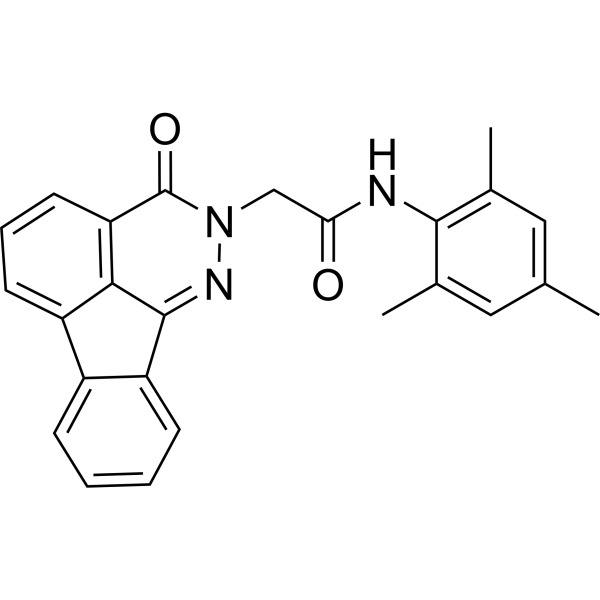
CNS-11 is a brain-penetrant tau fibril-degrading compound. CNS-11 reduces α-synuclein. CNS-11 can be used in Alzheimer's and Parkinson's disease research .
loading...
    loading...
Cat. No.: HY-19738
CAS No.: 185351-19-3
Target:  

Tau Protein

Research Areas:  

Neurological Disease

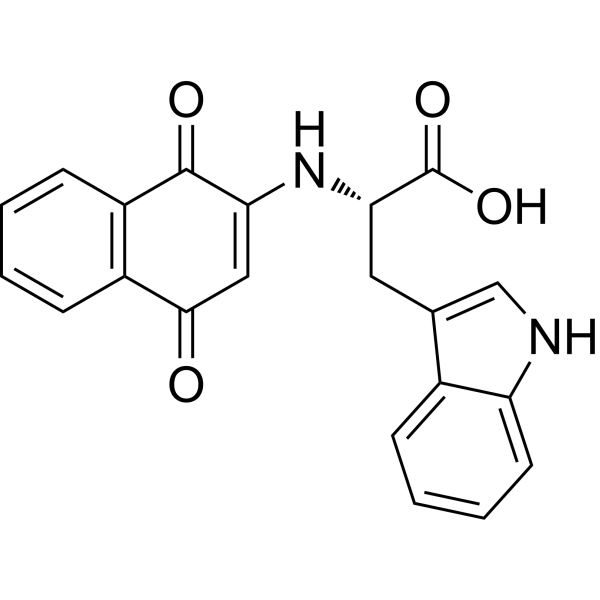
NQTrp, an aromatic naphthoquinone-tryptophan hybrid molecule, an inhibitor of the aggregation of the tau protein with generic anti-amyloidogenic effects. NQTrp inhibits the in vitro aggregation of hexapeptide ( 41GCWMLY 46 within the N-terminus of γD-crystallin) as well as full-length γD-crystallin .
loading...
    loading...
Cat. No.: HY-W338446
CAS No.: 22191-97-5
Target:  

Tau Protein

Research Areas:  

Neurological Disease

BF-170 is a selective tau fibril binding agent with an EC50 of 221 nM. It exhibits good blood-brain barrier permeability, and after intravenous injection in mice, the concentration in brain tissue reaches 9.1% ID/g within 2 minutes (with a brain clearance rate of 0.25% ID/g after 30 minutes). BF-170 can be used as a probe for tau protein pathology imaging in Alzheimer's disease (AD). It plays an important role in early-stage AD research and holds potential for imaging studies of tau-related neurodegenerative diseases .
loading...
    loading...
Cat. No.: HY-101182
CAS No.: 1374107-54-6
Purity:  98.52%
Target:  

Microtubule/Tubulin

Research Areas:  

Neurological Disease

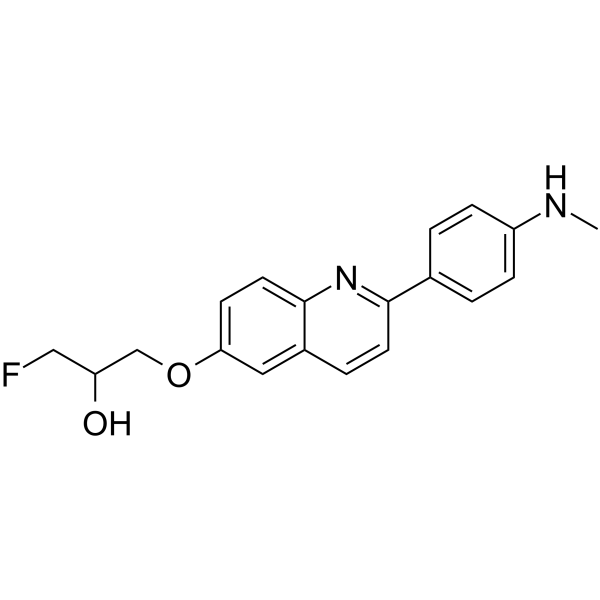
THK-5117, an arylquinoline derivative, displays high binding affinity to tau fibrils with a Ki of 10.5 nM. THK-5117 has high binding affinity to tau protein aggregates and tau-rich Alzheimer disease (AD)  brain homogenates. 18F-THK-5117 has the potential to act as a tau imaging PET probe .
loading...
    loading...
Cat. No.: HY-101181
CAS No.: 1374107-46-6
Target:  

Microtubule/Tubulin

Research Areas:  

Neurological Disease

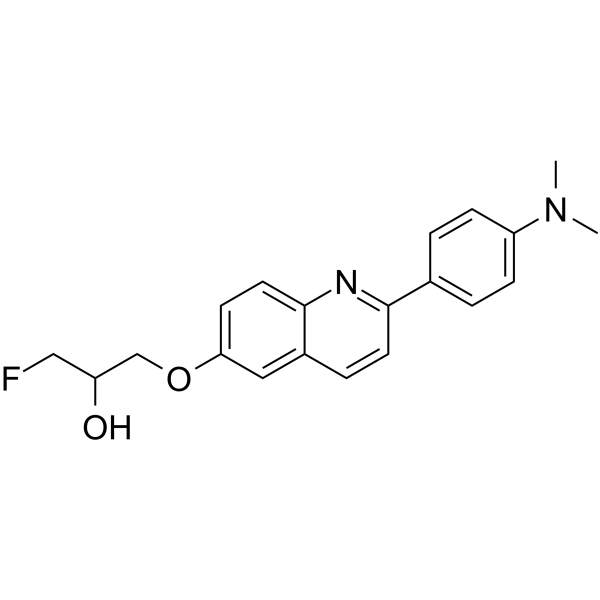
THK-5105, an arylquinoline derivative, displays high binding affinity to tau fibrils. THK-5105 has high binding affinity to tau protein aggregates and tau-rich Alzheimer disease (AD)  brain homogenates. 18F-THK-5105 has the potential to act as a tau imaging PET probe .
loading...
    loading...
Cat. No.: HY-P11593
CAS No.: 3105302-84-6
Target:  

Tau Protein

Research Areas:  

Neurological Disease

D-TLKIVWC is a tau fibril disaggregator. D-TLKIVWC has low immunogenicity and anti-degradation properties. D-TLKIVWC disrupts intermolecular hydrogen bonds of tau via a stress-release mechanism. D-TLKIVWC can be used in the research of amyloid diseases such as Alzheimer's disease .
loading...
    loading...
Cat. No.: HY-184511
CAS No.: 2648041-73-8
Research Areas:  

Neurological Disease

MODAG-005 is a blood-brain barrier-permeable PET probe precursor for α-synuclein (α‑Syn) aggregates, with a Ki value of 0.4 nM and a Kd value of 0.2 nM. MODAG-005 specifically binds to high-affinity sites within the tubular cavity of α-synuclein fibrils, and exhibits selectivity over tau protein fibrils and β-amyloid (A1-42) fibrils. MODAG-005 is applicable to the research of multiple system atrophy and Parkinson's disease .
loading...
    loading...
Cat. No.: HY-162812
H3R antagonist 4 (compound 11L) was a dual inhibitor of cholinesterase and histamine receptor (H3R), with corresponding IC50 of 7.04 μM (eeAChE), 9.73 μM (hAChE)(reversible) and 1.09 nM (H3R) , respectively. H3R antagonist 4 inhibited the aggregation of Aβ1-42 induced by itself and Cu 2+ (95.48% and 88.63%) , and degraded the Aβ1-42 fibrils induced by itself and Cu 2+ (80.16% and 89.30%) . H3R antagonist 4 chelate biometals such as Cu 2+, Zn 2+, Al 3+, and Fe 2+. H3R antagonist 4 significantly reduced tau protein hyperphosphorylation induced by Aβ1-42 and inhibited RSL-3-induced apoptosis and ferroptosis in PC12 cells. H3R antagonist 4 had the best blood-brain barrier permeability and intestinal absorption in hCMEC/D3 and hPepT1-MDCK cells.H3R antagonist 4 ameliorates learning and memory impairment in a mouse model of Alzheimer's disease induced by scopolamine (HY-N0296) .
loading...
    loading...
Cat. No.: HY-P704324
Purity:  ≥ 90%, as determined by reducing SDS-PAGE.
Synonyms: MAPT; tau-Derived Paired Helical Filament Hexapeptide; Prev. MAPTL; Microtubule-Associated Protein tau; Prev. DDPAC; Neurofibrillary Tangle Protein; MTBT1; Paired Helical Filament-tau; PPP1R103; MGC138549; tau-PHF6; FLJ31424; FTDP-17; PHF-tau; tau-40; Mic
Species:  
Source:  
loading...
    loading...
Cat. No.: HY-181861
CAS No.: 2341935-88-2
AChE/MAO-B-IN-9 (Compound E12) is an orally active, selective, reversible, non-competitive AChE and MAO-B inhibitor, with an IC50 of 0.156 μM against electric eel AChE. AChE/MAO-B-IN-9 inhibits Aβ40/42 fibril formation, promotes Aβ fibril depolymerization, and inhibits Tau protein fibril formation. AChE/MAO-B-IN-9 exerts antioxidant and neuroprotective effects, and improves scopolamine (HY-N0296)-induced memory impairment in mice. AChE/MAO-B-IN-9 can be used for the research of Alzheimer's disease .
loading...
    loading...

