9 Results for "

thermal degradation

" in MedChemExpress (MCE) Product Catalog:
Products (9)

9 Results for "thermal degradation" in MCE Product Catalog:

2
2 Cited Publications
Cat. No.: HY-B1186
CAS No.: 502-55-6
Research Areas:  

Others

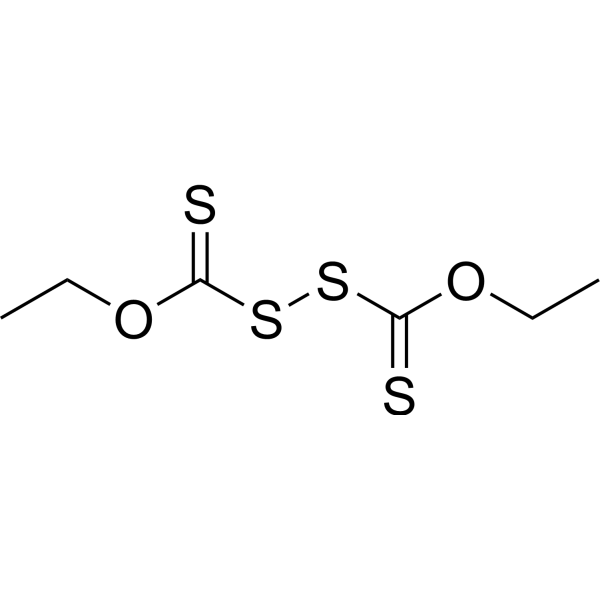
Dixanthogen is a dimer of xanthate, which forms via the oxidation of xanthate. Dixanthogen can decompose peroxides, which are key radical initiators for the oxidative degradation of polypropylene. Dixanthogen serves as a stabilizer for polypropylene, a pediculicide, and is also used in studies related to metal recovery .
loading...
    loading...
Cat. No.: HY-167629
CAS No.: 546-09-8
Research Areas:  

Others

Gibberellenic acid is an intermediate gibberellin compound with a tetracyclic diterpenoid skeleton, and can be generated by thermal decomposition of Gibberellic acid (GA3, HY-N1964) in aqueous solution. Gibberellenic acid is thermally unstable in water and can further convert into allogibberic acid (approximately 80%) and 9-epiallogibberic acid (approximately 10%). It plays an important role in the degradation pathway and structural elucidation of Gibberellins .
loading...
    loading...
Cat. No.: HY-W763591A
CAS No.: 24991-55-7
Polyethylene glycol dimethyl ether (MW=250) is a polyethylene glycol derivative that can be used to prepare rigid gel electrolytes and serve as a plasticizer .
loading...
    loading...
Cat. No.: HY-128454R
CAS No.: 3658-80-8
Dimethyl trisulfide (Standard) is the analytical standard of Dimethyl trisulfide. This product is intended for research and analytical applications. Dimethyl trisulfide is an organic chemical compound and the simplest organic trisulfide found in garlic, onion, broccoli, and similar plants. Dimethyl trisulfide is a cyanide antidote. Dimethyl trisulfide formation requires the thermal degradation of Met .
loading...
    loading...
Cat. No.: HY-B1186R
CAS No.: 502-55-6
Dixanthogen (Standard) is the analytical standard of Dixanthogen (HY-B1186). This product is intended for research and analytical applications. Dixanthogen is a dimer of xanthate, which forms via the oxidation of xanthate. Dixanthogen can decompose peroxides, which are key radical initiators for the oxidative degradation of polypropylene. Dixanthogen serves as a stabilizer for polypropylene, a pediculicide, and is also used in studies related to metal recovery .
loading...
    loading...
Cat. No.: HY-P2778A
Target:  

DNA/RNA Synthesis

Research Areas:  

Others

Thermally stable RNase H degrades the RNA strand of a DNA-RNA hybrid without affecting the DNA or unhybridized RNA strands, significantly improving sensitivity and selectivity. Thermally stable RNase H has optimal activity at 65°C and remains active at 95°C.
loading...
    loading...
Cat. No.: HY-184718
Target:  

Sodium Channel iGluR

Research Areas:  

Neurological Disease

Dual Nav/NMDAR-IN-1 (compound 11a) is a dual-target modulator of Nav and NMDAR. Dual Nav/NMDAR-IN-1 increases the thermal stability of Nav and NMDAR and slows their proteolytic degradation, indicating that it binds to both Nav and NMDAR simultaneously. Dual Nav/NMDAR-IN-1 exhibits anticonvulsant activity in a pentylenetetrazole-induced mouse model of seizures and can be used in epilepsy-related research .
loading...
    loading...
Cat. No.: HY-180654
CAS No.: 3110272-60-8
Research Areas:  

Cancer

JWZ-8-103 is an orally active analog of PRLX-93936 (HY-119264) and a molecular glue targeting TRIM21. JWZ-8-103 increases the thermal stability of TRIM21. JWZ-8-103 promotes rapid and efficient interaction between TRIM21 and NUP98 (the apparent EC50 for ternary complex formation with the PRYSPRY domain of TRIM21 and the APD domain of NUP98 is approximately 20 μM), induces extensive ubiquitination and proteasomal degradation of numerous adjacent nucleoporins (NUPs, and thereby triggers cellular apoptosis. JWZ-8-103 can be used for the research of pancreatic cancer .
loading...
    loading...
Cat. No.: HY-180654A
Research Areas:  

Cancer

JWZ-8-103 hydrochloride is an orally active analog of PRLX-93936 (HY-119264) and a molecular glue targeting TRIM21. JWZ-8-103 hydrochloride increases the thermal stability of TRIM21. JWZ-8-103 hydrochloride promotes rapid and efficient interaction between TRIM21 and NUP98 (the apparent EC50 for ternary complex formation with the PRYSPRY domain of TRIM21 and the APD domain of NUP98 is approximately 20 μM), induces extensive ubiquitination and proteasomal degradation of numerous adjacent nucleoporins (NUPs, and thereby triggers cellular apoptosis. JWZ-8-103 hydrochloride can be used for the research of pancreatic cancer .
loading...
    loading...

