



W-7
Based on 10 publication(s) in Google Scholar
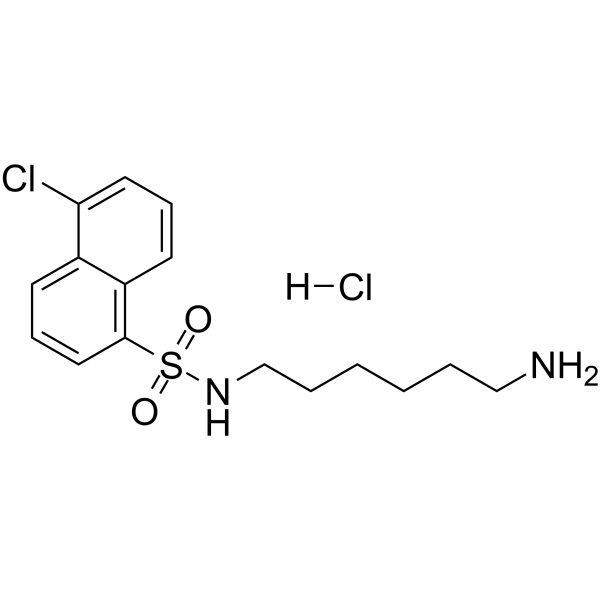
W-7 is a selective calmodulin antagonist. W-7 inhibits the Ca2+-calmodulin-dependent phosphodiesterase and myosin light chain kinase with IC50 values of 28 μM and 51 μM, respectively. W-7 induces apoptosis and has antitumor and vascular relaxing activity. W-7 is a blocker of Kv4.3 and can be used for research of arrhythmias.
연구목적의 판매만을 진행합니다. 환자를 대상으로 한 판매는 하지 않습니다.
- Purity : 99.35%
- CAS No.: 65595-90-6
- 화학식: C16H21ClN2O2S
- 분자량:340.87
-
보관:Powder -20°C, 3 years ; In solvent -80°C, 6 months , -20°C, 1 month


To place orders, for customer services and technical support, please contact: MedChemExpress USA
Tel: 609-228-6898 E-mail: [email protected] [email protected]


-
 Biological Activity
-
Chemical Information
-
용액&용해도
- Protocol
- 순도&문서
- References
-
 Help & FAQs


Publications Citing Use of MedChemExpress (MCE) W-7
More- Mol Cell. 2025 Oct 29:S1097-2765(25)00822-6. [Abstract]
- Adv Healthc Mater. 2023 Dec;12(31):e2301137. [Abstract]
- Int J Biol Macromol. 2024 Oct;277(Pt 3):134478. [Abstract]
- Cell Rep. 2026 Jul 28;45(7):117703.
- Commun Biol. 2026 Jun 1. [Abstract]
- FASEB J. 2025 Dec 31;39(24):e71322. [Abstract]
- J Biol Chem. 2024 Jun;300(6):107348. [Abstract]
- Sensors (Basel). 2024 Oct 26;24(21):6869. [Abstract]
- J Cancer Res Clin Oncol. 2024 Sep 19;150(9):424. [Abstract]
- J Immunol Res. 2026;2026(1):e5542735. [Abstract]
 Customer Validation & Images

-
WB
-
IF
-
Cell Proliferation/Viability Assay
-
Cell Migration/Invasion Assay
-
RT-PCR


Biological Activity
제품 설명
Cellular Effect
|
Cell Line

|
Type | Value | Description | References |
|---|---|---|---|---|
| Sf9 | IC50 |
50 μM
Compound: W-7
|
Inhibition of full-length recombinant human CamKII expressed in insect Sf9 cells incubated for 30 mins in presence of 5 uM CaM/[gamma32P]ATP by scintillation counting analysis
Inhibition of full-length recombinant human CamKII expressed in insect Sf9 cells incubated for 30 mins in presence of 5 uM CaM/[gamma32P]ATP by scintillation counting analysis
|
[PMID: 27043269] |
| Vero C1008 | IC50 |
>2.0 × 10⁵M
Compound: COVC-3362313685
|
Antiviral activity determined as inhibition of SARS-CoV-2 induced cytotoxicity of VERO-6 cells at 10 uM after 48 hours exposure to 0.01 MOI SARS CoV-2 virus by high content imaging
Antiviral activity determined as inhibition of SARS-CoV-2 induced cytotoxicity of VERO-6 cells at 10 uM after 48 hours exposure to 0.01 MOI SARS CoV-2 virus by high content imaging
|
10.6019/CHEMBL4651402 |
In Vitro
W-7 is distributed mainly in the cytoplasm, and inhibits proliferation of Chinese hamster ovary K1 (CHO-K1) cells. W-7 selectively blocks the phase of the cell cycle (G1/S boundary phase) in a manner. 25 μM W-7 arrests the growth of the cells at the G1/S boundary phase of the cell cycle[1].
W-7 (100 μM) exhibits a similar extent of antagonism between the contractile responses to carbachol and KCl. The increase in myosin light chain (P-LC) phosphate content in response to 1-min stimulation with 10 μM carbachol is inhibited by W-7. W-7 antagonizes the smooth muscle contraction through the inhibition of the initial increase in the P-LC phosphorylation[2].
Treatment with W-7 results in the dose-dependent inhibition of cell proliferation in various human multiple myeloma cell lines. W-7 induces G1 phase cell cycle arrest by downregulating cyclins and upregulating p21cip1. W-7 induces apoptosis via caspase activation; this occurred partly through the elevation of intracellular calcium levels and mitochondrial membrane potential depolarization and through inhibition of the STAT3 phosphorylation and subsequent downregulation of Mcl-1 protein[3].
W-7 competitively inhibits Ca2+/calmodulin-dependent phosphodiesterase with a Ki value of 300 μM[4].
MedChemExpress (MCE) has not independently confirmed the accuracy of these methods. They are for reference only.
In Vivo
MedChemExpress (MCE) has not independently confirmed the accuracy of these methods. They are for reference only.
-
Animal Model:Female BALB/c nu mice (6-week-old) injected with RPMI 8226 cells[3]
-
Dosage:3 mg/kg
-
Administration:Intraperitoneal injection; on 5 consecutive days per week
-
Result:Significantly reduced tumor growth in a murine MM model.


Chemical Information
-
CAS No. 65595-90-6
-
Appearance Solid
-
분자량 340.87
-
화학식 C16H21ClN2O2S
-
Color White to light yellow
-
SMILES
O=S(C1=C2C=CC=C(Cl)C2=CC=C1)(NCCCCCCN)=O
-
선적
Room temperature in continental US; may vary elsewhere.
-
보관
Powder -20°C 3 years In solvent -80°C 6 months -20°C 1 month


Publications (10)
-
Journal Impact Factor
-
Most Recent
-
Mol Cell
The E3 ligase RNF32 controls the IκB kinase complex and NF-κB signaling in intestinal stem cells. [Abstract]2025 Oct 29:S1097-2765(25)00822-6. PMID: 41167191
W-7 purchased from MedChemExpress. Usage Cited in: Mol Cell. 2025 Oct 29:S1097-2765(25)00822-6. [Abstract]
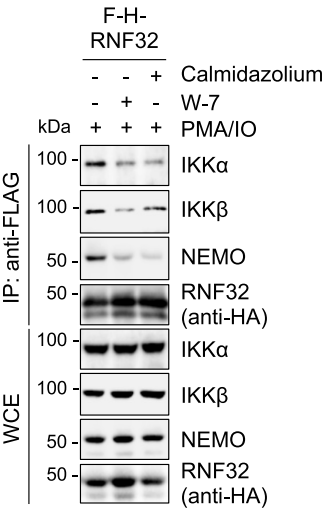
HEK293T cells expressing FLAG‑tagged RNF32 were treated with PMA and IO for 90 min, then immunoprecipitated (IP) with an anti‑RNF32 antibody in the presence or absence of the indicated CaM inhibitors W-7 hydrochloride (25-100 μM) or Calmidazolium. Whole cell extracts (WCEs) were immunoprecipitated with anti-FLAG resin. Immunocomplexes and WCEs were analyzed by immunoblotting. The results showed that the CaM inhibitors W-7 hydrochloride and Calmidazolium reduced the binding of RNF32 to the IKK complex in cells treated with PMA and IO.
W-7 purchased from MedChemExpress. Usage Cited in: Mol Cell. 2025 Oct 29:S1097-2765(25)00822-6. [Abstract]
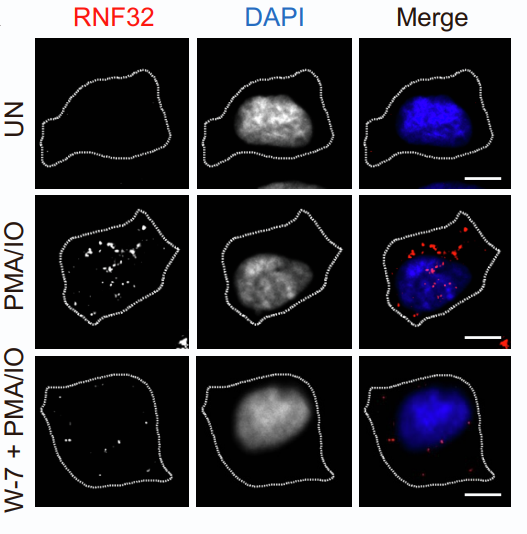
Immunofluorescence staining of endogenous RNF32 in U2OS cells stimulated with 10 ng/ml phorbol-12-myristate-13-acetate (PMA) and 950 nM ionomycin (IO) for 90 minutes with or without the CaM inhibitor W‑7 hydrochloride (25-100 μM). The results showed that the CaM inhibitors W‑7 hydrochloride greatly reduced the formation of RNF32 condensates. Scale bars indicate 10 µm.
-
Adv Healthc Mater
2023 Dec;12(31):e2301137. PMID: 37671812 -
Int J Biol Macromol
Nanoparticle-mediated calmodulin dsRNA and cyantraniliprole co-delivery system: High-efficient control of two key pear pests while ensuring safety for natural enemy insects. [Abstract]2024 Oct;277(Pt 3):134478. PMID: 39102908
W-7 purchased from MedChemExpress. Usage Cited in: Int J Biol Macromol. 2024 Oct;277(Pt 3):134478. [Abstract]
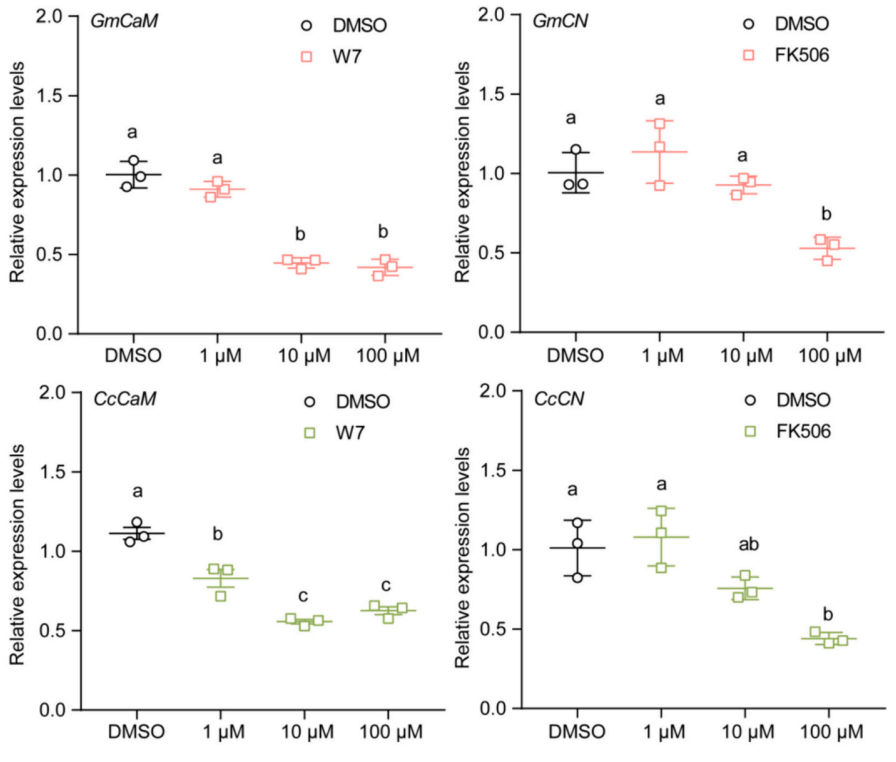
The relative expression levels of CaM and CN genes following inhibitor treatment at 48 h. The results showed that 10 μM W-7 hydrochloride (48 h) significantly downregulated CaM genes in both insects, while FK506 exhibited superior efficacy at 100 μM.
W-7 purchased from MedChemExpress. Usage Cited in: Int J Biol Macromol. 2024 Oct;277(Pt 3):134478. [Abstract]
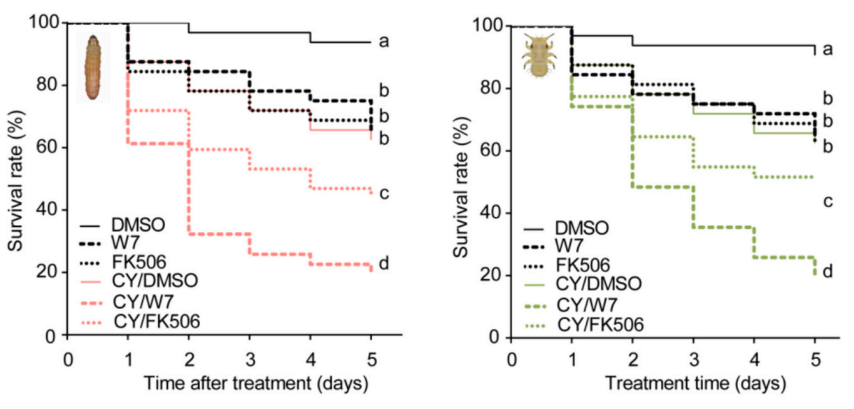
The survival rate of G. molesta and C. chinensis after treatment with inhibitors and cyantraniliprole (CY). The results showed that injection or oral administration of W-7 hydrochloride (10 μM) or FK506 (100 μM) increased the sensitivity of both G. molesta and C. chinensis to cyantraniliprole (LC20), resulting in a notable rise in mortality rates, with the cyantraniliprole/W7 group showing the highest mortality.
-
-
Commun Biol
Diurnal testosterone oscillations gate drug delivery via phase separation of ZO-1 at the blood-testis barrier in mice. [Abstract]2026 Jun 1. PMID: 42219451 -
FASEB J
ORAI3 Modulates Oral Squamous Cell Carcinoma Metastasis Through the Ca2+/Calmodulin/Calcineurin/ETV4 Signaling Pathway. [Abstract]2025 Dec 31;39(24):e71322. PMID: 41417281
W-7 purchased from MedChemExpress. Usage Cited in: FASEB J. 2025 Dec 31;39(24):e71322. [Abstract]
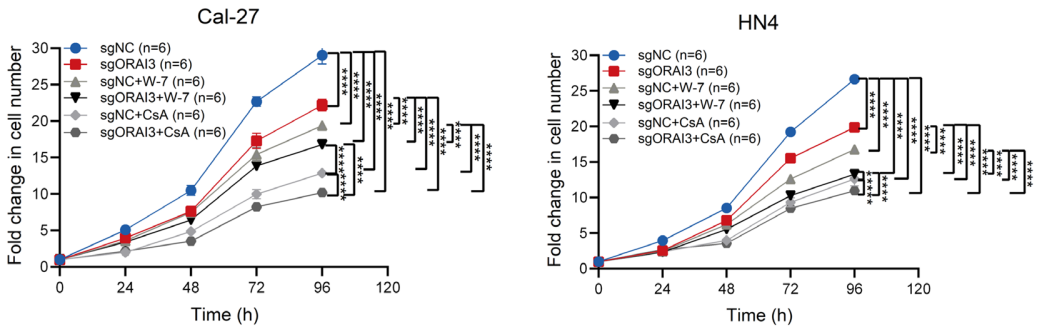
Results of CCK-8 assays assessing the proliferation of OSCC cells (Cal-27, HN4) in the sgNC and sgORAI3 groups, as well as following treatment with inhibitors W-7 hydrochloride (10 μM) for calmodulin and CsA for calcineurin. Fold changes are relative to the optical density at a wavelength of 450 nm at time 0 h.
W-7 purchased from MedChemExpress. Usage Cited in: FASEB J. 2025 Dec 31;39(24):e71322. [Abstract]
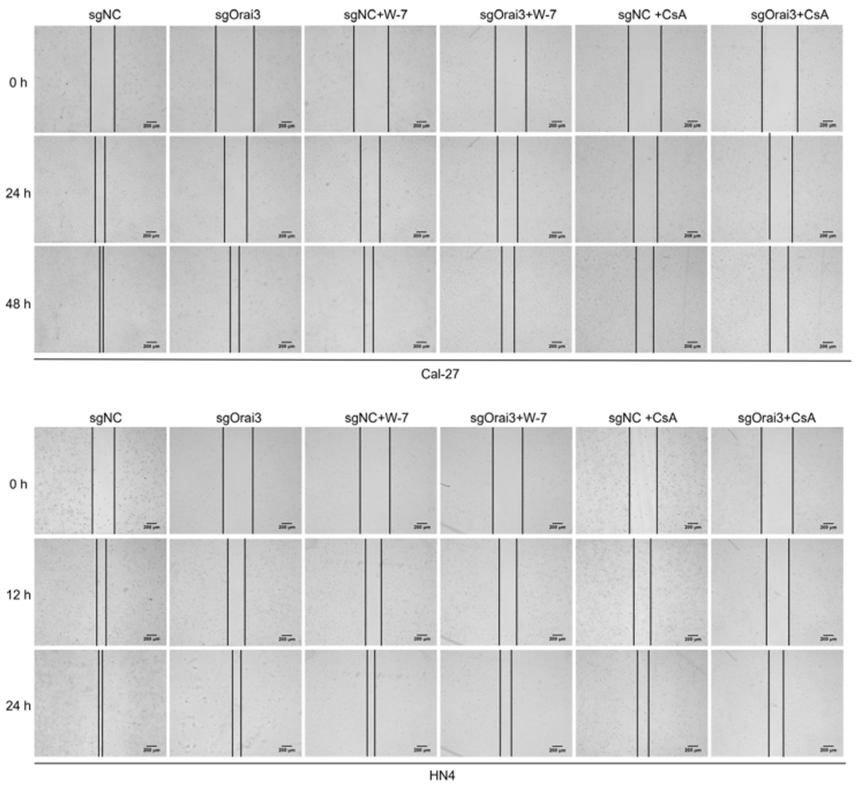
Representative images of scratch assays showing the migration of OSCC cells in the sgNC and sgORAI3 groups, as well as following treatment with W-7 hydrochloride (10 μM; 24-48 h) and CsA. Scale bar, 200 μm.
-
J Biol Chem
Calcium and IL-6 regulate the anterograde trafficking and plasma membrane residence of the iron exporter ferroportin to modulate iron efflux. [Abstract]2024 Jun;300(6):107348. PMID: 38718866 -
Sensors (Basel)
A Novel Single-Color FRET Sensor for Rho-Kinase Reveals Calcium-Dependent Activation of RhoA and ROCK. [Abstract]2024 Oct 26;24(21):6869. PMID: 39517770 -
J Cancer Res Clin Oncol
MYO3B promotes cancer progression in endometrial cancer by mediating the calcium ion-RhoA/ROCK1 signaling pathway. [Abstract]2024 Sep 19;150(9):424. PMID: 39297944 -
J Immunol Res
Aspergillus fumigatus Gliotoxin Inhibits LC3-Associated Phagocytosis in Macrophages in a Calcium-Dependent Manner. [Abstract]2026;2026(1):e5542735. PMID: 42057339


용액&용해도
In Vitro:
DMSO : ≥ 100 mg/mL (293.37 mM; Hygroscopic DMSO has a significant impact on the solubility of product, please use newly opened DMSO)
* "≥" means soluble, but saturation unknown.
Please refer to the solubility information to select the appropriate solvent. Once prepared, please aliquot and store the solution to prevent product inactivation from repeated freeze-thaw cycles.
Storage method and period of stock solution: -80°C, 6 months; -20°C, 1 month. When stored at -80°C, please use it within 6 months. When stored at -20°C, please use it within 1 month.
Please refer to the solubility information to select the appropriate solvent. Once prepared, please aliquot and store the solution to prevent product inactivation from repeated freeze-thaw cycles.
Storage method and period of stock solution: -80°C, 6 months; -20°C, 1 month. When stored at -80°C, please use it within 6 months. When stored at -20°C, please use it within 1 month.
Concentration (start) × Volume (start) = Concentration (final) × Volume (final)
In Vivo:
Select the appropriate dissolution method based on your experimental animal and administration route.
- For the following dissolution methods, please ensure to first prepare a clear stock solution using an In Vitro approach and then sequentially add co-solvents:
- To ensure reliable experimental results, the clarified stock solution can be appropriately stored based on storage conditions. As for the working solution for In Vivo experiments, it is recommended to prepare freshly and use it on the same day.
- The percentages shown for the solvents indicate their volumetric ratio in the final prepared solution. If precipitation or phase separation occurs during preparation, heat and/or sonication can be used to aid dissolution.
Add each solvent one by one: 10% DMSO 40% PEG300 5% Tween-80 45% Saline
Solubility: ≥ 2.5 mg/mL (7.33 mM); Clear solution
This protocol yields a clear solution of ≥ 2.5 mg/mL (saturation unknown).
Taking 1 mL working solution as an example, add 100 μL DMSO stock solution (25.0 mg/mL) to 400 μL PEG300, and mix evenly; then add 50 μL Tween-80 and mix evenly; then add 450 μL Saline to adjust the volume to 1 mL.
Preparation of Saline: Dissolve 0.9 g sodium chloride in ddH₂O and dilute to 100 mL to obtain a clear Saline solution.
Add each solvent one by one: 10% DMSO 90% (20% SBE-β-CD in Saline)
Solubility: ≥ 2.5 mg/mL (7.33 mM); Clear solution
This protocol yields a clear solution of ≥ 2.5 mg/mL (saturation unknown).
Taking 1 mL working solution as an example, add 100 μL DMSO stock solution (25.0 mg/mL) to 900 μL 20% SBE-β-CD in Saline, and mix evenly.
Preparation of 20% SBE-β-CD in Saline (4°C, storage for one week): 2 g SBE-β-CD powder is dissolved in 10 mL Saline, completely dissolve until clear.
In Vivo Dissolution Calculator
Please enter the basic information of animal experiments:
-
-
-
-
Recommended: Prepare an additional quantity of animals to account for potential losses during experiments.
Please enter your animal formula composition:
-
%DMSO +
Recommended: Keep the proportion of DMSO in working solution below 2% if your animal is weak.
-
%+
-
+%Tween-80 + +
-
%Saline +
The co-solvents required include: DMSO, . All of co-solvents are available by MedChemExpress (MCE). , Tween 80. All of co-solvents are available by MedChemExpress (MCE).
Working solution concentration: 0.22 mg/mL
Method for preparing stock solution: mg drug dissolved in μL DMSO. Stock solution concentration: mg/mL.
1. Take μL DMSO stock solution;
2. Add μL .
μL , mix evenly;
3. Then add μL Tween 80, mix evenly;
4. Then add μL
Please ensure that the stock solution in the first step is dissolved to a clear state, and add co-solvents in sequence. You can use ultrasonic heating (ultrasonic cleaner, recommended frequency 20-40 kHz), vortexing, etc. to assist dissolution.


순도&문서
-
Data Sheet (277 KB)
-
SDS (251 KB)
- English - EN (251 KB)
- Français - FR (251 KB)
- Deutsch - DE (251 KB)
- Norwegian - NO (251 KB)
- Español - ES (251 KB)
- Swedish - SV (251 KB)
- Italian - IT (251 KB)
- Korean - KR (251 KB)
- Portuguese - PT (251 KB)
-
Handling Instructions (2659 KB)
References
[1]. H Hidaka, et al. N-(6-aminohexyl)-5-chloro-1-naphthalenesulfonamide, a Calmodulin Antagonist, Inhibits Cell Proliferation. Proc Natl Acad Sci U S A. 1981 Jul;78(7):4354-7. [Content Brief]
[2]. M Asano. Divergent Pharmacological Effects of Three Calmodulin Antagonists, N-(6-aminohexyl)-5-chloro-1-naphthalenesulfonamide (W-7), Chlorpromazine and Calmidazolium, on Isometric Tension Development and Myosin Light Chain Phosphorylation in Intact Bovine Tracheal Smooth Muscle. J Pharmacol Exp Ther. 1989 Nov;251(2):764-73. [Content Brief]
[3]. H Itoh, et al. Direct Interaction of Calmodulin Antagonists With Ca2+/calmodulin-dependent Cyclic Nucleotide Phosphodiesterase. J Biochem. 1984 Dec;96(6):1721-6.H Itoh, et al. Direct Interaction of Calmodulin Antagonists With Ca2+/calmodulin-dependent Cyclic Nucleotide Phosphodiesterase. J Biochem. 1984 Dec;96(6):1721-6. [Content Brief]
[4]. Shigeyuki Yokokura, et al. Calmodulin Antagonists Induce Cell Cycle Arrest and Apoptosis in Vitro and Inhibit Tumor Growth in Vivo in Human Multiple Myeloma. BMC Cancer. 2014 Nov 26;14:882. [Content Brief]
[5]. Qu YJ, et al. W-7 modulates Kv4.3: pore block and Ca2+-calmodulin inhibition. Am J Physiol Heart Circ Physiol. 2007 May;292(5):H2364-77. [Content Brief]
[6]. Gbadebo TD, et al. Calmodulin inhibitor W-7 unmasks a novel electrocardiographic parameter that predicts initiation of torsade de pointes. Circulation. 2002 Feb 12;105(6):770-4. [Content Brief]


Complete Stock Solution Preparation Table
Please refer to the solubility information to select the appropriate solvent. Once prepared, please aliquot and store the solution to prevent product inactivation from repeated freeze-thaw cycles.
Storage method and period of stock solution: -80°C, 6 months; -20°C, 1 month. When stored at -80°C, please use it within 6 months. When stored at -20°C, please use it within 1 month.
| Optional Solvent | Concentration Solvent Mass | 1 mg | 5 mg | 10 mg | 25 mg |
|---|---|---|---|---|---|
| DMSO | 1 mM | 2.9337 mL | 14.6683 mL | 29.3367 mL | 73.3417 mL |
| 5 mM | 0.5867 mL | 2.9337 mL | 5.8673 mL | 14.6683 mL | |
| 10 mM | 0.2934 mL | 1.4668 mL | 2.9337 mL | 7.3342 mL | |
| 15 mM | 0.1956 mL | 0.9779 mL | 1.9558 mL | 4.8894 mL | |
| 20 mM | 0.1467 mL | 0.7334 mL | 1.4668 mL | 3.6671 mL | |
| 25 mM | 0.1173 mL | 0.5867 mL | 1.1735 mL | 2.9337 mL | |
| 30 mM | 0.0978 mL | 0.4889 mL | 0.9779 mL | 2.4447 mL | |
| 40 mM | 0.0733 mL | 0.3667 mL | 0.7334 mL | 1.8335 mL | |
| 50 mM | 0.0587 mL | 0.2934 mL | 0.5867 mL | 1.4668 mL | |
| 60 mM | 0.0489 mL | 0.2445 mL | 0.4889 mL | 1.2224 mL | |
| 80 mM | 0.0367 mL | 0.1834 mL | 0.3667 mL | 0.9168 mL | |
| 100 mM | 0.0293 mL | 0.1467 mL | 0.2934 mL | 0.7334 mL |


W-7 Related Classifications
HY-130368 Related Classifications
 Powered by Bioz