



Zinc acetate

Based on 1 Customer Validation
Zinc acetate acts as an immune response modulator. Zinc acetate enhances the expression of HSP-70 mRNA. Zinc acetate restores the proliferation and cytokine production capacities of splenocytes. Zinc acetate reduces the Apoptosis level of splenocytes in endotoxemic mice. Zinc acetate increases plasma zinc levels and improves survival rates in mice with LPS-induced lethal endotoxemia. Zinc acetate induces rapid death of prostate cancer cell lines in vitro. Zinc acetate inhibits the growth of prostate cancer xenografts in SCID mice. Zinc acetate can be used in endotoxemia research.
For research use only. We do not sell to patients.
- Assay : 99.05%
- CAS No.: 557-34-6
- Formula: (CH3CO2)2Zn
- Molecular Weight:183.47
-
Storage:
Store at room temperature 3 years.
In solvent -80°C, 2 years , -20°C, 1 year


To place orders, for customer services and technical support, please contact: MedChemExpress USA
Tel: 609-228-6898 E-mail: [email protected] [email protected]


-
 Biological Activity
-
Chemical Information
-
Solvent & Solubility
- Protocols
- Purity & Documentation
- References
-
 Help & FAQs


-

HY-B1817A
Zinc acetate, 99.99% trace metals basisHO-1 Activator -

HY-B0658A
Zinc acetate dihydrate, ACS, 98%Biochemical Assay Reagents -
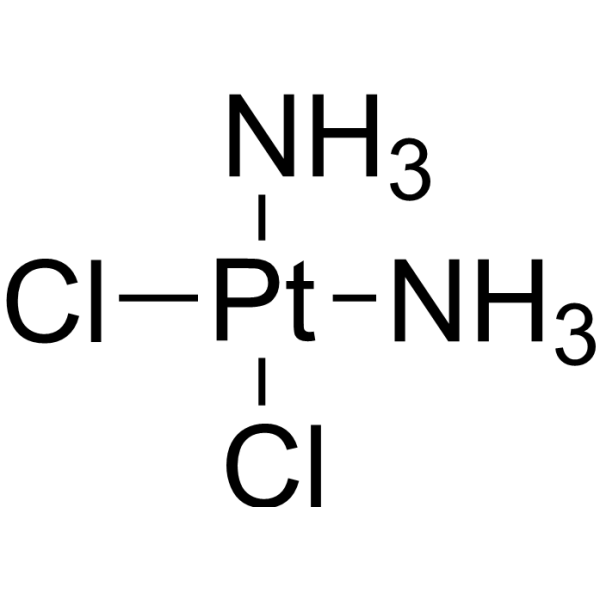
HY-17394
CisplatinDNA Alkylator -

HY-108536D
Calcium chloride dihydrate, for cell culture, 99%Biochemical Reagent -
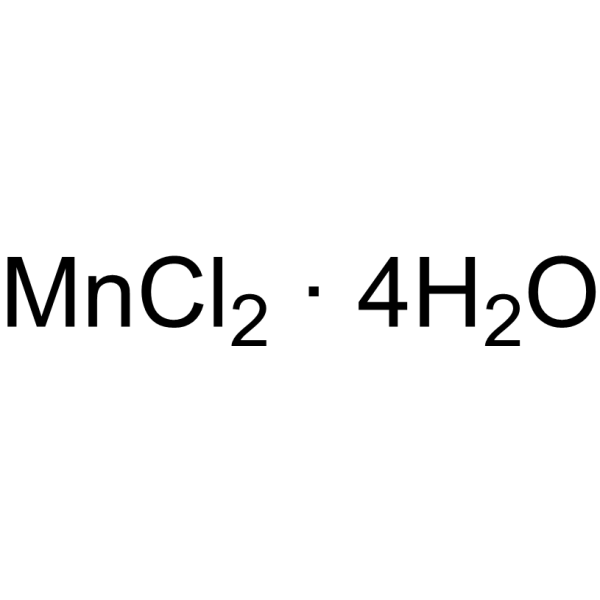
HY-109521A
Manganese chloride tetrahydrate, molecular biology grade,≥99.0% (KT)Biochemical Assay Reagent -

HY-W116336B
Zinc oxide, 99.99% metals basisBiochemical Assay Reagents


Biological Activity
Description
IC50 & Target
[1]|
HSP70 |
In Vitro
Zinc acetate (100-800 μM; 0-24 h) induces rapid, dose-dependent cytotoxicity in PC3, DU145 and LNCaP prostate cancer cell lines (with approximately 80% cell death observed at concentrations of 300-400 μM within 18 h)[2].
MedChemExpress (MCE) has not independently confirmed the accuracy of these methods. They are for reference only.
-
Cell Line:PC3, DU145, LNCaP
-
Concentration:100-600 μM (18 h incubation); 400-800 μM (4 h, 8 h, 12 h, 24 h incubation); 100 μM (prolonged incubation)
-
Incubation Time:18 h (100-600 μM); 4 h, 8 h, 12 h, 24 h (400-800 μM); prolonged (100 μM)
-
Result:Induced dose-dependent cytotoxicity across all three prostate cancer cell lines, independent of androgen sensitivity.
Killed ~80% of the cell population at 300-400 μM after 18 h incubation, with viability dropping to ≤10% at doses of 400 μM or higher.
Caused 50% cell death within 6 h, and greater than 95% cell death by 24 h across all cell lines at 400 μM.
Reduced the time to 50% cell death by approximately 90 minutes when dose was doubled to 800 μM.
Halted cellular proliferation (cytostatic effect) with no further cell death after 24 h under prolonged exposure to 100 μM.
In Vivo
Zinc acetate (3 mM; intratumoral injection; once every 48 hours; for 14 consecutive days) inhibits the growth of PC3 prostate cancer xenografts, improves the 8-week survival rate of mice, and causes no systemic tissue toxicity[2].
MedChemExpress (MCE) has not independently confirmed the accuracy of these methods. They are for reference only.
-
Animal Model:C57BL/6 (6-week-old female, 18-21 g, specific pathogen-free)[1]
-
Dosage:0.3 mg/kg; 3 mg/kg; 30 mg/kg
-
Administration:i.p.; daily; 2 days
-
Result:Achieved 75% survival rate at 6 days post-LPS challenge for 3 mg/kg and 30 mg/kg pretreatment.
Reduced splenocyte apoptotic rate to 17.9% (vs.
41.6% in LPS-only mice) for 3 mg/kg and 30 mg/kg pretreatment.
Increased splenocyte HSP-70 mRNA signal relative intensity to 2.56 (vs.
1.17 in LPS-only mice) for 3 mg/kg and 30 mg/kg pretreatment.
Prolonged survival time without significant survival rate improvement for 0.3 mg/kg pretreatment.
Increased serum IL-6, IL-1β, and TNF-α concentrations relative to vehicle controls for 3 mg/kg treatment alone.
Enhanced Con A-stimulated splenocyte proliferation relative to vehicle controls for 3 mg/kg treatment alone.
Elevated Con A-stimulated IL-2 production relative to vehicle controls for 3 mg/kg treatment alone.
Increased splenocyte HSP-70 mRNA signal relative intensity to 1.38 (vs.
0.54 in vehicle controls) for 3 mg/kg treatment alone.
Increased splenocyte apoptotic rate to 14.5% (vs.
12.2% in vehicle controls) for 3 mg/kg treatment alone.
Significantly increased plasma zinc levels, reaching a plateau after the second dose for 3 mg/kg treatment alone.
- RNA extraction experimental
- Detection of Apoptosis
- TUNEL staining for apoptotic DNA fragmentation
- LPS-Induced Endotoxemia/Systemic Inflammation
- Annexin V plus membrane-impermeant dye apoptosis staining
- Apoptosis Solutions
- Research Protocol for Inflammation-related Diseases
- Cell Viability Determination by MTT Colorimetric Assay
Clinical Trial
| NCT Number | Sponsor | Condition | Start Date |
Phase

|
|---|---|---|---|---|
| NCT01329991 | Plexxikon| | 2011-05 | PHASE1 |


Chemical Information
-
CAS No. 557-34-6
-
Appearance Solid
-
Molecular Weight 183.47
-
Formula (CH3CO2)2Zn
-
Color White to off-white
-
SMILES
C[Zn]C.O=C=O.O=C=O
-
Shipping
Room temperature in continental US; may vary elsewhere.
-
Storage
Store at room temperature 3 years
In solvent -80°C 2 years -20°C 1 year


Solvent & Solubility
In Vitro:
DMSO : 50 mg/mL (272.52 mM; Need ultrasonic; Hygroscopic DMSO has a significant impact on the solubility of product, please use newly opened DMSO)
Please refer to the solubility information to select the appropriate solvent. Once prepared, please aliquot and store the solution to prevent product inactivation from repeated freeze-thaw cycles.
Storage method and period of stock solution: -80°C, 2 years; -20°C, 1 year. When stored at -80°C, please use it within 2 years. When stored at -20°C, please use it within 1 year.
Please refer to the solubility information to select the appropriate solvent. Once prepared, please aliquot and store the solution to prevent product inactivation from repeated freeze-thaw cycles.
Storage method and period of stock solution: -80°C, 2 years; -20°C, 1 year. When stored at -80°C, please use it within 2 years. When stored at -20°C, please use it within 1 year.
Concentration (start) × Volume (start) = Concentration (final) × Volume (final)
In Vivo:
Select the appropriate dissolution method based on your experimental animal and administration route.
- For the following dissolution methods, please ensure to first prepare a clear stock solution using an In Vitro approach and then sequentially add co-solvents:
- To ensure reliable experimental results, the clarified stock solution can be appropriately stored based on storage conditions. As for the working solution for In Vivo experiments, it is recommended to prepare freshly and use it on the same day.
- The percentages shown for the solvents indicate their volumetric ratio in the final prepared solution. If precipitation or phase separation occurs during preparation, heat and/or sonication can be used to aid dissolution.
Add each solvent one by one: 10% DMSO 40% PEG300 5% Tween-80 45% Saline
Solubility: ≥ 5 mg/mL (27.25 mM); Clear solution
This protocol yields a clear solution of ≥ 5 mg/mL (saturation unknown).
Taking 1 mL working solution as an example, add 100 μL DMSO stock solution (50.0 mg/mL) to 400 μL PEG300, and mix evenly; then add 50 μL Tween-80 and mix evenly; then add 450 μL Saline to adjust the volume to 1 mL.
Preparation of Saline: Dissolve 0.9 g sodium chloride in ddH₂O and dilute to 100 mL to obtain a clear Saline solution.
Add each solvent one by one: 10% DMSO 90% (20% SBE-β-CD in Saline)
Solubility: ≥ 5 mg/mL (27.25 mM); Clear solution
This protocol yields a clear solution of ≥ 5 mg/mL (saturation unknown).
Taking 1 mL working solution as an example, add 100 μL DMSO stock solution (50.0 mg/mL) to 900 μL 20% SBE-β-CD in Saline, and mix evenly.
Preparation of 20% SBE-β-CD in Saline (4°C, storage for one week): 2 g SBE-β-CD powder is dissolved in 10 mL Saline, completely dissolve until clear.
In Vivo Dissolution Calculator
Please enter the basic information of animal experiments:
-
-
-
-
Recommended: Prepare an additional quantity of animals to account for potential losses during experiments.
Please enter your animal formula composition:
-
%DMSO +
Recommended: Keep the proportion of DMSO in working solution below 2% if your animal is weak.
-
%+
-
+%Tween-80 + +
-
%Saline +
The co-solvents required include: DMSO, . All of co-solvents are available by MedChemExpress (MCE). , Tween 80. All of co-solvents are available by MedChemExpress (MCE).
Working solution concentration: 0.22 mg/mL
Method for preparing stock solution: mg drug dissolved in μL DMSO. Stock solution concentration: mg/mL.
1. Take μL DMSO stock solution;
2. Add μL .
μL , mix evenly;
3. Then add μL Tween 80, mix evenly;
4. Then add μL
Please ensure that the stock solution in the first step is dissolved to a clear state, and add co-solvents in sequence. You can use ultrasonic heating (ultrasonic cleaner, recommended frequency 20-40 kHz), vortexing, etc. to assist dissolution.


Purity & Documentation
-
Data Sheet (277 KB)
-
SDS (640 KB)
- English - EN (640 KB)
- Français - FR (640 KB)
- Deutsch - DE (640 KB)
- Norwegian - NO (640 KB)
- Español - ES (640 KB)
- Swedish - SV (640 KB)
- Italian - IT (640 KB)
- Korean - KR (640 KB)
- Portuguese - PT (640 KB)
-
Handling Instructions (2659 KB)
References
[1]. Unoshima M, et al. Effects of zinc acetate on splenocytes of endotoxemic mice: enhanced immune response, reduced apoptosis, and increased expression of heat shock protein 70. J Lab Clin Med. 2001;137(1):28-37. [Content Brief]
[2]. Shah MR, et al. Direct intra-tumoral injection of zinc-acetate halts tumor growth in a xenograft model of prostate cancer. J Exp Clin Cancer Res. 2009;28(1):84. Published 2009 Jun 17. [Content Brief]


Complete Stock Solution Preparation Table
Please refer to the solubility information to select the appropriate solvent. Once prepared, please aliquot and store the solution to prevent product inactivation from repeated freeze-thaw cycles.
Storage method and period of stock solution: -80°C, 2 years; -20°C, 1 year. When stored at -80°C, please use it within 2 years. When stored at -20°C, please use it within 1 year.
| Optional Solvent | Concentration Solvent Mass | 1 mg | 5 mg | 10 mg | 25 mg |
|---|---|---|---|---|---|
| DMSO | 1 mM | 5.4505 mL | 27.2524 mL | 54.5048 mL | 136.2621 mL |
| 5 mM | 1.0901 mL | 5.4505 mL | 10.9010 mL | 27.2524 mL | |
| 10 mM | 0.5450 mL | 2.7252 mL | 5.4505 mL | 13.6262 mL | |
| 15 mM | 0.3634 mL | 1.8168 mL | 3.6337 mL | 9.0841 mL | |
| 20 mM | 0.2725 mL | 1.3626 mL | 2.7252 mL | 6.8131 mL | |
| 25 mM | 0.2180 mL | 1.0901 mL | 2.1802 mL | 5.4505 mL | |
| 30 mM | 0.1817 mL | 0.9084 mL | 1.8168 mL | 4.5421 mL | |
| 40 mM | 0.1363 mL | 0.6813 mL | 1.3626 mL | 3.4066 mL | |
| 50 mM | 0.1090 mL | 0.5450 mL | 1.0901 mL | 2.7252 mL | |
| 60 mM | 0.0908 mL | 0.4542 mL | 0.9084 mL | 2.2710 mL | |
| 80 mM | 0.0681 mL | 0.3407 mL | 0.6813 mL | 1.7033 mL | |
| 100 mM | 0.0545 mL | 0.2725 mL | 0.5450 mL | 1.3626 mL |


Zinc acetate Related Classifications
HY-B1817 Related Classifications
 Powered by Bioz