



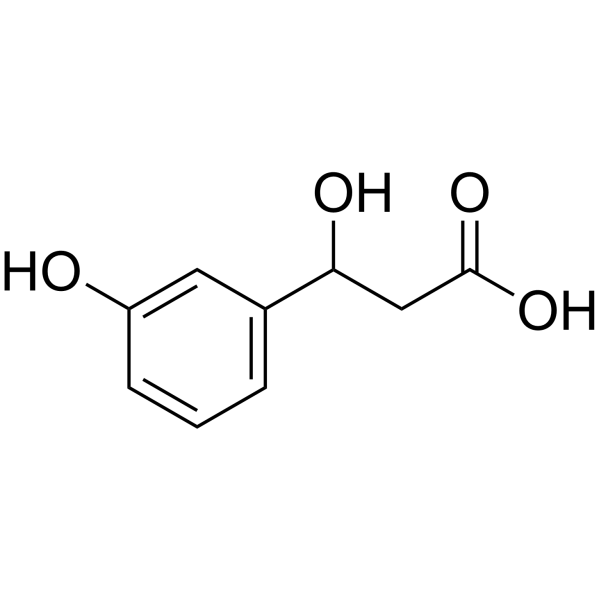
3-(3-Hydroxyphenyl)-3-hydroxypropanoic acid

Based on 1 Customer Validation
3-(3-Hydroxyphenyl)-3-hydroxypropanoic acid is an endogenous metabolite present in Urine that can be used for the research of Autism.
For research use only. We do not sell to patients.
- Purity: 99.02%
- CAS No.: 3247-75-4
- Formula: C9H10O4
- Molecular Weight:182.17
-
Storage:
4°C, stored under nitrogen
* In solvent : -80°C, 6 months; -20°C, 1 month (stored under nitrogen)

To place orders, for customer services and technical support, please contact: MedChemExpress USA
Tel: 609-228-6898 E-mail: [email protected] [email protected]


-
 Biological Activity
-
Chemical Information
- Purity & Documentation
- References
-
 Help & FAQs


All Endogenous Metabolite Isoforms
More

Biological Activity
|
Microbial Metabolite |
Human Endogenous Metabolite |
Endogenous metabolites is defined as those that are annotated by Kyoto Encyclopedia of Genes and Genomes as substrates or products of the ~1900 metabolic enzymes encoded in our genome. It is clear in the body of literature that there are documented toxic properties for many of these metabolites[1].
MedChemExpress (MCE) has not independently confirmed the accuracy of these methods. They are for reference only.


Chemical Information
-
CAS No. 3247-75-4
-
Appearance Solid
-
Molecular Weight 182.17
-
Formula C9H10O4
-
Color Off-white to gray
-
SMILES
O=C(O)CC(O)C1=CC=CC(O)=C1
-
Shipping
Room temperature in continental US; may vary elsewhere.
-
Storage
4°C, stored under nitrogen
* In solvent : -80°C, 6 months; -20°C, 1 month (stored under nitrogen)


Purity & Documentation
-
Data Sheet (266 KB)
-
SDS (252 KB)
- English - EN (252 KB)
- Français - FR (252 KB)
- Deutsch - DE (252 KB)
- Norwegian - NO (252 KB)
- Español - ES (252 KB)
- Swedish - SV (252 KB)
- Italian - IT (252 KB)
- Korean - KR (252 KB)
- Portuguese - PT (252 KB)
-
Handling Instructions (2659 KB)
References
[1]. Lee N, et al. Endogenous toxic metabolites and implications in cancer therapy. Oncogene. 2020 Aug;39(35):5709-5720. [Content Brief]
[2]. Shaw W. Increased urinary excretion of a 3-(3-hydroxyphenyl)-3-hydroxypropionic acid (HPHPA), an abnormal phenylalanine metabolite of Clostridia spp. in the gastrointestinal tract, in urine samples from patients with autism and schizophrenia. Nutr Neurosci. 2010 Jun;13(3):135-43. [Content Brief]

Calculators
Concentration (start) × Volume (start) = Concentration (final) × Volume (final)


3-(3-Hydroxyphenyl)-3-hydroxypropanoic acid Related Classifications
HY-113231 Related Classifications
 Powered by Bioz